

Day One:
Speaker 1: Well, it ain’t gossip if it’s true.
Speaker 2: Anger has been a problem for me. I am too easily triggered.
Speaker 1: I don’t appreciate the term shopaholic, but I do feel better when I buy stuff.
John: Well, what do you think? When does a routine behavior or habit become harmful? And when does it turn into something worse like sin? Today on Focus on the Family with Jim Daly, we’ll examine the hows and whys of temptation and bad habits and what God will do to help you overcome them. I’m John Fuller, and thanks for joining us today.
Jim: John, this is a crazy analogy, but have you been present where somebody is so unaware, self-unaware? Uh, it, to me, it’s like at an airport. People get off the plane and then they stand right where everybody walks-
John: R- right there. Yes, they stop.
Jim: … to look at where they’re going.
John: Yes.
Jim: And it makes everybody else kind of move around them. I’m thinking, “Could you just please stand to the side? Why are you standing right in traffic flow?” But that’s an issue of self-awareness.
John: Mm-hmm.
Jim: You know, my physical presence.
John: Yeah.
Jim: And, you know, I think we do that spiritually too. Like, you know, what are those bad habits that we’re not addressing?
John: Yeah.
Jim: Maybe even sin that we’re comfortable with. It may not even be on our radar.
John: Yeah.
Jim: We don’t know we’re standing there (laughs) in the stream of goodness.
John: We’re distracted and just-
Jim: With our sinfulness.
John: Yeah.
Jim: Right?
John: Mm-hmm.
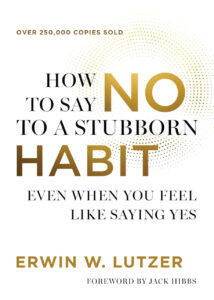
Jim: And so we’re gonna have a great discussion today and next time with Dr. Erwin Lutzer, who’s written this great book, How to Say No to a Stubborn Habit: Even When You Feel Like Saying Yes.
John: Mm-hmm.
Jim: If that describes you, stick with us.
John: Yeah.
Jim: (laughs)
John: Yeah. Dr. Erwin Lutzer is, uh, back in the studio. He’s a perennial favorite here. He’s an author, a speaker, a theologian, former, uh, pastor at Moody Church in 36 years, now Pastor Emeritus. Uh, he’s written more than 70 books. And as you said, Jim, we’re talking about How to Say No to a Stubborn Habit. And of course, we have that book here at the ministry. Just give us a call, 800, the letter A, and the word family, or stop by FocusontheFamily.com/broadcast.
Jim: Dr. Lutzer, welcome back to Focus on the Family. So good to have you here.
Dr. Lutzer: So great to be here. Thanks again, Jim.
Jim: Yeah, and we’re covering … This is a really interesting one to me, and I think some of this is around definitions. So in your context, how do you define a bad habit? I mean, I guess there’s things that seem like biting your nails. It’s a bad habit. I don’t think it’s a sinful habit per se. So how do we distinguish between what’s just a bad habit and then what’s a bad sinful habit?
Dr. Lutzer: Hmm. One of the things I think we’re going to discover is this, that when a person has a bad habit, and we could even talk about addictions, when that happens, what we need to do is to look deeper. The habit might be a symptom of something else going on in the person’s life or some issue they have not dealt with. So we’re going to look at this, and of course, there are many people listening who might find that this program helps them to define where they are at, hopefully gives them some guidance as to where they should go. Some of them might seek professional counseling, but what we want to do is to take an honest look into the human heart and, uh, you know, it can be painful.
Jim: Well, that-
John: Mm-hmm.
Jim: You know, an obvious one and, uh, you know, just to get your perspective on this, uh, you know, the Bible says don’t drink unto drunkenness. So I mean, there’s a wide variety of that expression. Some people within the body of Christ, they’re fine. The tradition even of the church might be a glass of wine is okay. I don’t think there’s anything prohibitive that way, but of course the Baptist would say, “No, never.” For different reasons. And I mean, even in that, I mean, it’s an obvious one where if you enjoy a glass of wine with your meal, is that a bad habit, or is that sin or is that okay? And when does it cross the line?
Dr. Lutzer: Well, when it crosses the line is when it begins to control you.
Jim: Hmm.
Dr. Lutzer: You know, there is such a thing as a glass of wine every once in a while. I was brought up in a family where there was no drinking of any kind. And you know, the good thing about that, Jim, is-
Jim: Yeah, it’s clean.
Dr. Lutzer: … if I never touch alcohol, I will not become an alcoholic.
John: Mm-hmm.
Jim: Yeah, and you’ll be a good role model for your children.
Dr. Lutzer: Yes. And-
John: (laughs)
Dr. Lutzer: … the thing is this, that we can have those kinds of discussions. Certainly, Jesus turned water into wine. We all know that story. So, but what we’re gonna talk about is some of those deeper issues, even like alcoholism or other kinds of addictions, and, uh, hopefully it will give people some guidance on their journey.
Jim: Let me ask you this. So often when you talk to professionals, of course, we have Christian counselors here at Focus on the Family, state licensed, they go through the process. I mean, many of them have practices outside of Focus and they’re spending part of their time here and we’re so grateful for that team.
John: Mm-hmm.
Jim: And if you need a counselor, or to talk to a counselor, you can call us and we’re here for you and they’ll have an initial, uh, consultation with you and then we even have a robust referral network around the country-
John: Mm-hmm.
Jim: … of about 1,500 Christian counselors. And so it’s a good benefit, but let me ask this question. So often in talking with a trained Christian counselor, they’re gonna say, typically, those addictions are symptomatic, not the core problem. There’s something else the person is doing and those are features of medicating the problem. What do you think about that?
Dr. Lutzer: There’s no doubt you always have to go deeper. And the deeper you go into human nature and human understanding, the better we understand why a person becomes an alcoholic or has a sexual addiction of some kind, because oftentimes, once you have crossed certain barriers, once you choose the direction of your life, it’s difficult to get off the train, if I might put it that way.
Jim: Yeah, yeah.
Dr. Lutzer: So what we have to do is to warn those who are not into those addictions, but also we have to provide help for those who are. And even as we look at this, one of the things I’ve noticed is that sin comes in clusters.
Jim: Huh.
Dr. Lutzer: By that, I mean, it’s not only that you’re committing this sin, but you’ve got other issues in your life that you aren’t dealing with. So it is so critical, first of all, in this discussion that we all agree that God is good, because that was the first sin in the garden. Satan comes to Adam and Eve and says, “God isn’t good. If he were good, he wouldn’t be restricting you. He’d let you eat all the fruit of the trees and the different trees.”
Jim: And you could be like God.
Dr. Lutzer: And you’d be like God.
John: (laughs)
Dr. Lutzer: Now, he called into question the goodness of God. And if there are people listening who haven’t come to grips with the fact that God is good, what that means is pleasing Him is very, very important, then they’re gonna say, “I’m satisfied with my addiction and I’m just going to manage it.” And how do you manage it? You manage it, first of all, by comparing yourself to others and saying, “Well, I’m not as bad as so-and-so,” because no matter what you’re into, there’s always somebody who’s worse.
Jim: Right.
Dr. Lutzer: Secondly, the human mind has the ability to justify anything that the human heart really wants to do.
Jim: Boy, that is a good statement.
Dr. Lutzer: And what happens is, therefore, how do you justify it? You constantly are blaming others. One of the most important things is this, we have to be dead honest before God, and we have to, in the words of an expression, we have to own our own stuff.
Jim: Yeah.
Dr. Lutzer: And that’s very difficult to do.
Jim: Yeah.
Dr. Lutzer: Because we’re always finding somebody to blame.
Jim: Yeah.
Dr. Lutzer: In fact, that’s exactly what Adam and Eve did. You remember God comes to them in the garden and says, “Adam, where are you? Has thou eaten of the tree where have I commanded thee that thou should us not eat?” What does Adam say? Yes.
Jim: You gave me the woman.
Dr. Lutzer: Yeah.
Jim: (laughs)
Dr. Lutzer: He says, “It’s this weak-willed woman-”
Jim: Right.
Dr. Lutzer: “… whom You gave me; she took of the tree.” And then what’s a guy supposed to do?
Jim: (laughs) Right.
Dr. Lutzer: He goes along with her.
John: (laughs)
Jim: That’s a, that’s such an amazing, timeless excuse. Isn’t it
Dr. Lutzer: Yes.
Jim: Isn’t it? We do it today.
Dr. Lutzer: We’ll condemn the whole world-
Jim: Yeah.
Dr. Lutzer: … but exempt ourselves.
Jim: Yeah. I mean, it is frightening. Let me ask you this for the person thinking it. Um, okay, so if all of this is bad, why did God put temptation into this world knowing that we were gonna struggle against it?
Dr. Lutzer: Not only that, but God allows Satan to do his work.
Jim: Right.
Dr. Lutzer: Why not confine him to a far planet?
Jim: Right.
Dr. Lutzer: We get rid of him and then we’d be more inclined to do what is right.
Jim: Which I think is Heaven to come, but-
Dr. Lutzer: Yeah, that’s right.
Jim: Right?
Dr. Lutzer: Jim, temptation comes because it is a character test. The Bible says that God did tempt Abraham, at least that’s the King James version, but really this was a test. God says, “I want you to take your son, Isaac, and I want you to sacrifice him, and this will prove that you love me more than you love your son.” And Abraham passed that test, and we need to look at temptation in the same way, namely that it is a test of our character. It is always a test of our love.
So ultimately, right from the beginning of this discussion, we have to make sure that we let people know that you are in a battle. There’s no one answer to spiritual victory. I mean, once we experience spiritual habits, that helps us, but the battle is intense and it’s going to be that way even for the rest of our lives.
Jim: Yeah.
Dr. Lutzer: So once we get out of this idea that somehow spirituality happens by osmosis-
Jim: (laughs)
Dr. Lutzer: … and that it is a battle, we begin to look at things differently. In fact, there are people listening to us right now, and they are going to discover that they are in a battle. But the good news is, it’s a winnable battle.
Jim: Some people may not feel that way though, Erwin.
Dr. Lutzer: Right.
Jim: And so we gotta … Yeah.
Dr. Lutzer: And that always goes back to the goodness of God-
Jim: Yeah.
Dr. Lutzer: … and the victory of Christ. Because there’s nothing that God asks us to do that Christ has already not done for us.
Jim: Mm-hmm.
Dr. Lutzer: He provided the foundation for which there can be spiritual victory. That doesn’t mean that we’re gonna be perfect. It doesn’t mean that the battle is going to end. What it does mean is we can begin to live differently.
Jim: Right.
Dr. Lutzer: We can have a brand-new beginning.
Jim: You know, sometimes we overcomplicate these things so much, but in scripture where it says, “Flee your youthful lusts,” uh, that’s one of wisdom. Don’t put yourself in a position where you’re being tempted sexually, run. I mean, that’s what it’s saying.
John: Mm-hmm.
Jim: And in that regard, let me ask this question. What do we need to do to lower the risk of falling into not just those temptations, but then the next thing, which are the actions on those temptations? What do we need?
Dr. Lutzer: Jim, my answer is going to be very blunt. There are people listening to us today who have to do some drastic things.
Jim: Mm-hmm.
Dr. Lutzer: Drastic. I remember reading the story of a man who was in Paris in a hotel, a Christian man, and all of the activity on the street was sexuality of various kinds. He was so tempted. What he decided to do eventually is to throw the keys to the hotel out the window, because he knew tomorrow, no matter what trouble he was in, no matter how difficult it was going to be, if he ever found the keys, it wouldn’t be as great as ruining his marriage.
Jim: Hmm.
Dr. Lutzer: Jesus said this, “If your eye offends you, pluck it out and cast it from you because it is better for you to enter life with one eye than to be in hell with two.” Let’s pause here and not hurry over this.
Jim: Mm-hmm.
Dr. Lutzer: If you were to cut out your eye or cut off your hand, like Jesus said, number one, it would be painful. Number two, it would be permanent. You wouldn’t be asking yourself, “Should I have done this or not?” (laughs) You’d have already crossed that bridge.
Jim: Right.
Dr. Lutzer: But Jesus said, obviously he’s speaking figuratively, but Jesus said, “Do whatever you need to do to cut you off from those temptations.” And he, and in context, he was talking about sexual sin. So I know men, for example, who no longer have an iPhone, they have a flip phone.
Jim: Yeah.
Dr. Lutzer: And you can receive messages, you can give messages, you can take phone calls, but you can’t access the internet. So you have to cut yourself off from these kinds of things. And my burden is for families. You see young people, for example, and they all have screens.
Jim: And adults too.
Dr. Lutzer: And adults too.
Jim: (laughs)
Dr. Lutzer: And they’re following their parents.
Jim: Mm-hmm.
Dr. Lutzer: And this has huge implications that we can’t even get into today, except to say this, that early on they develop an appetite toward what is sexual, toward what gives them the greatest boost. They sometimes discover that Christianity is boring in comparison to the next YouTube video that I can watch. And so they are being led astray. And we as parents and those who are in charge have to understand these dangers are very, very real.
John: Hmm.
Jim: You know what’s so difficult right now is it seems like, and it sounds so old-fashioned to understand that these things are all rooted in rebellion toward God. I mean, we just don’t even have that comprehension. “Why am I doing this?” It’s, it … This is a simplistic analogy, but speak to it. It’s like some guy who might like cheeseburgers. I don’t know who that guy might be, and the doctor says, “You really gotta stop eating those because you’re gonna block your arteries in your heart and you’re gonna have a heart attack.” And the guy says, “Yeah.” He goes a month without it and then boom, he’s back into his every other day cheeseburger. It, it, it may be a humorous way of looking at that, but the result is the same. Physical death in one case, but spiritual death in the other. I mean, so why, even when we have the knowledge, smoking is bad for you. Why do people still smoke?
Dr. Lutzer: Well, of course, young people smoke because they want to be accepted. Back in the day when this was your pathway to adulthood, you smoked. Fewer do it today. But Jim, you’ve raised a very important point. Now, I have studied a little bit about alcoholism, and I discovered to my surprise that one of the greatest problems with alcoholics is that they sometimes can break their habit because they say, “Okay, I’m done with it.” And they go two weeks or three weeks without a drink, and then they say, “Well, I’m not addicted.” You know, it’s like Mark Twain who said that, “I can quit smoking. In fact, I’ve done it a thousand times.”
Jim: (laughs)
Dr. Lutzer: So they keep quitting and then telling themselves that they can endure it and then they go on and on and on. So what we need to stress again is the need for dead honesty before God and often before others if we are going to change our lifestyle. And that’s not easy, but it is worth it.
John: Mm-hmm. This is Focus on the Family with Jim Daly, and our guest today is Dr. Erwin Lutzer. We’re talking about his book, How to Say No to a Stubborn Habit, and we’ve got copies of that book here and additional resources to help you in your spiritual walk at FocusontheFamily.com/broadcast.
And, uh, Dr. Lutzer, you referred earlier to owning our stuff. Um, boy, there are so many victims today in our culture. I mean, it’s not my fault, it’s my genetics or my parents or, you know, it’s just too much around the culture. So how do we, how do we actually step up and say, “Well, this habit, it’s actually my habit and I’ve got to take care of this. I’ve got to deal with God about this?”
Dr. Lutzer: You know, in our culture today, there’s a whole study on victimology because, as you mentioned, we always find someone else to blame. But what we have to understand, and there are some real victims out there. We’re not denying that, but what we need to understand is we do not have to be ultimately controlled by these kinds of influences. We have to step back and say, “Okay, I was wronged, I am a victim, but at the same time, God is for me and not against me.” And then what we have to do is to say, “Lord, let me be totally, completely honest and deal with the deeper issues.”
John, while I’m talking to you, a story comes to mind, which is true about a woman by the name of Doris. Now, she’s been in Heaven for many years, so I can tell her story because she told it in churches-
John: Hmm.
Dr. Lutzer: … as a testimony. Her husband died when he was relatively young. She would go to church in her car, wondering why in the world there are other women whose husbands live a lot longer. And on the way to church, she would cry and say, “God, your grace is not sufficient. God, your grace is not sufficient.”
John: Hmm.
Dr. Lutzer: Then she’d park her car, I think it was a Buick.
John: (laughs)
Dr. Lutzer: And then she went into church, wiped her tears, came back, and went home saying the same thing.
John: Mm-hmm.
Dr. Lutzer: Then she attended a meeting where people were really meeting God. It was like a revival meeting, and they, knowing her struggle, urged her to come into the prayer room. They didn’t talk to her because they knew that they weren’t qualified to be able to answer this question. They said, “You seek God.” She said later, for about a half an hour, “I poured out all my anger to God.” She said, “I unloaded cartloads.”
John: Mm-hmm.
Dr. Lutzer: “I unloaded cartloads of self-pity.” When she was willing to accept her circumstances and take responsibility for her feelings, that’s why she was able to give testimony years later and because of something that I was writing, I contacted her. In fact, I met her once.
John: Hmm.
Dr. Lutzer: And lo and behold, she was still giving praise to God. Now, there’s an example where someone could say, “I was a victim,” but when they got dead honest at the root of it, there was sin and there was a sinful attitude of anger toward God.
John: Mm-hmm.
Dr. Lutzer: And once she confessed that and forsook it, that’s where the freedom came.
Jim: You know, Dr. Lutzer, that is, uh, a great description of one end of, of that continuum. I think the other end of that can be that sticky habit or sin that you are struggling to control or get on top of. People can fill in the, the blank of what that might be. It might be a porn addiction or something like that, but it’s like one step forward, two steps backward. And the reason I mentioned the continuum is then you do self-loathing. You’re going, “I’m, I’m not worthy. I can’t get ahead of this.” And the enemy in your own flesh begins to work you over about your unworthiness. You’re not good enough to be called Christian. You’re not a Christian. Look at what you do in the secret spaces of your life. How do we not fall victim to that kind of self-defeating attitude and trust God and try our best and continue to improve hopefully?
Dr. Lutzer: I think, first of all, is to understand fully the matchless grace of God.
Jim: Huh.
Dr. Lutzer: You’re not beyond help. If you read the Bible, you discover that there are stories there that if they were in a paperback, you wouldn’t want to buy them, because the Bible is such a realistic book that it says to us, no matter where you are at, as a matter of fact, talking to you right now, Jim, Psalm 40 comes to mind. “He brought me up out of a horrible pit, out of the pit of destruction, and set my feet upon a rock.”
So the Bible is a message of hope, and you must understand that God is not surprised by the depth of your sin, but there’s something else that is so critical. Once you develop a certain euphoria for your addiction, you’ll always want to have that euphoria multiplied until, in the words of one person who was obviously addicted, said to me, “It’s as if you are in a trance. You don’t care who you’re hurting, you don’t care what your sinful habit is doing, you just need this fulfillment.”
And so what we have to do is to help people to understand that once you are serious about overcoming your addiction, you need help, and there are churches today that have various programs for men and women and so forth. But you must understand that ultimately the direction that you are going is going to destroy you and it can’t keep its promises.
And people have to understand that you may have the freedom to sin, but you don’t have freedom to control the consequences of your sin. That is out of your hands. So once we begin to see the seriousness of our sin, we say no matter how euphoric, no matter how wonderful this appears to be, for my benefit, for the glory of God and for my family, and for the impact I am having, I have to stop this behavior. And the first thing that must happen is the kind of dead honesty before God-
Jim: Mm-hmm.
Dr. Lutzer: … that this person needs to have and to recognize the fact that I’ve sinned does not make me unimportant. I am unworthy of God’s grace, but so is everybody. So we all come cap in hand saying, “I’m depending upon You to give me a new beginning.”
Jim: Yeah. Listen, we, there’s so much more to cover. I’ll end with this question and then let’s come back and keep rolling and, and, uh, talk about much more out of your book. But e- e- explain why you encourage Christians to thank God for temptations. Seriously?
Dr. Lutzer: Yes.
Jim: Okay.
Dr. Lutzer: And the reason for this is when we give thanks to God, we begin to see things from God’s perspective and we begin to say to ourselves, “God has a purpose here. And so what I want to do is to give thanks to Him, but also I want to give thanks to God that I do not have to go in that direction.” So it’s thanksgiving not for the sin, but for the victory that you believe God provided in Christ so that it can be yours.
The Bible says, “In everything, give thanks.” We never give thanks for sin, but we give thanks for our struggles, we give thanks for all that we have, because we recognize that this is the path of godliness. You know, it says in the book of Hebrews regarding Jesus that He was perfected through suffering. Now, we know that He was perfect in his person, but as far as his vocation is concerned, there was a lot of suffering and in the end, of course, we all benefited.
John: Mm-hmm.
Jim: That is so good. Well, I think folks can get an idea of how this book can help them, help you, uh, overcome some of those nasty habits or even those sinful things that you’re comfortable with that you shouldn’t be comfortable with.
John: Mm-hmm.
Jim: So, you know, again, don’t take this as a slap down. This is encouragement, uh, for you to do better, to go deeper, to live a even more spiritually healthy life, which is the goal. And I’m sure you would want to get a copy of Dr. Lutzer’s book, How to Say No to a Stubborn Habit: Even When You Feel Like Saying Yes. Make a monthly pledge of any amount, and we’ll send that to you as our way of saying thank you for your ongoing support of the ministry.
And here’s what your giving is paying for. A woman named Terry described how she and her husband were both alcoholics. Trying to raise three children and their life was a disaster. But when a friend introduced Terry to Focus on the Family, it completely changed her life for the better. When you give faithfully to Focus on the Family, lives are transformed, and this is your opportunity to do ministry through us. So make a monthly pledge or send a one-time gift, and thank you in advance for your generosity and for touching lives like Terry’s.
John: Mm-hmm. Donate today and get a copy of Dr. Lutzer’s book when you call 800, the letter A, and the word FAMILY. That’s 800-232-6459, or, uh, stop by FocusontheFamily.com/broadcast. And when you get in touch, be sure to ask to speak with one of our counselors if that would be of help to you. They’ll pray with you, offer you some good, godly counsel, and refer you to ongoing help in your local area. Again, our number 800, the letter A, and the word FAMILY, or check the website for the details.
Jim: Dr. Lutzer, let’s hang on and come back next time. Thanks for being with us.
Dr. Lutzer: Thank you. Be glad to be with you.
John: Mm-hmm. And thank you for joining us for this episode of Focus on the Family with Jim Daly. I’m John Fuller inviting you back as we continue the conversation with Dr. Erwin Lutzer, and once again, help you and your family thrive in Christ.
Day Two:
Dr. Lutzer: For my benefit, for the glory of God, and for my family, and for the impact I am having, I have to stop this behavior. And the first thing that must happen is the kind of dead honesty before God that this person needs to have and to recognize the fact that I’ve sinned does not make me unimportant. I am unworthy of God’s grace, but so is everybody. So we all come cap in hand saying, “I’m depending upon You to give me a new beginning.”
John: That’s Dr. Erwin Lutzer describing how it’s possible to overcome bad habits and temptations and growing your faith in the process. He’s back with us today on Focus on the Family with Jim Daly. I’m John Fuller, and we’re glad you’ve joined us.
Jim: You know, I- I’m thinking about last time, John, and Dr. Lutzer said so many things that we all have to, even sitting here at the table with him, which I wish you all could be, just right here at the table. Hopefully you’re the next best thing listening in or watching on YouTube. But y- you gotta apply this to yourself first, right? It’s not the other guy like what Adam did with Eve in the Garden.
John: Mm-hmm.
Jim: You gave me the woman. It’s, okay, Lord, what am I doing that I need to be mindful of in my behavior that is kind of short-circuiting my relationship with you? And what a great place to start. It’s convicting. And, you know, I think in today’s culture, we don’t have much of a mature appetite even as Christians to do this. But what great benefit comes in your relationship with the Lord if you can do that.
John: Hmm.
Jim: That’s called being mature, right? And so today we’re gonna continue with the discussion. If you missed it, get the app for the smartphone. You can go to the website and listen in. Uh, this is pearl material that we talked about last time, and we’re gonna talk about again today.
John: Mm-hmm. And with decades of experience, uh, as a pastor, writer, speaker, theologian, uh, Dr. Lutzer has studied these issues of habits and, uh, sin, and he’s got a lot to say, uh, as you indicated, Jim. The book is called How to Say No to a Stubborn Habit: Even When You Feel Like Saying Yes. And you can learn more about Dr. Lutzer and, uh, this specific book, which is so helpful, at FocusontheFamily.com/broadcast.
Jim: Dr. Lutzer, welcome back.
Dr. Lutzer: So great to be with you, Jim.
Jim: This is good. I love just talking with you. You must have been quite an amazing pastor. And I… You know, don’t let that go to your head.
Dr. Lutzer: (Laughs)
Jim: But that must have been fun for you. I think you just know how to feed the flock with provocative thoughts about where you’re at in your journey with the Lord. Not every pastor has that courage to say, “Wake up!” (Laughs)
Dr. Lutzer: You know, Jim, I know that this isn’t a program for pastors necessarily, but when it comes to preaching, and I used to teach preaching, I always tell pastors, always ask yourself this question, why should this message change people’s future forever?
Jim: Yeah.
Dr. Lutzer: In other words, how do we take the gap between what we know and how we live and somehow bridge them?
Jim: Boy.
Dr. Lutzer: And that is so critical, even in our Bible study.
Jim: But you think about that, that’s the work of the pastor every Sunday-
Dr. Lutzer: Yeah.
Jim: … when he gets up to preach a sermon. How do I get you from that gap Into a deeper-
Dr. Lutzer: In fact, I like to sh- Yeah. I like to shock pastors by saying, “The Bible wasn’t written to be studied.”
Jim: (Laughs)
Dr. Lutzer: Oh, really? No, the Bible was written to change your life, and we study it that we might be able to understand that transformation better.
Jim: Yeah. That’s so good. So, so good. Let’s pick up where we left off last time, and it- it’s an area that I know the book, you’ve covered it, but this acknowledgement of the spiritual warfare that is a part of our struggle with temptation and sin. You point to an interesting fact about a lion’s roar. I always love… You know, the, the longer I live, the more I realize God has set in nature so many lessons for us to understand him better. The lion’s roar, how does that teach us something?
Dr. Lutzer: Well, you know, Peter says, “Satan goes about like a roaring lion seeking whom he may devour.” Now, Jim, if you watch the Animal Channel- which we know. . .
Jim: Which we do.
Dr. Lutzer: … you know, you know that lions never roar when they are about to jump onto prey because they are stealth. They are quiet. What does it mean when a lion roars? Two things. First of all, he’s marking his territory and he’s saying, “This territory belongs to me.” And secondly, what he is doing is he’s instilling fear in anyone who would take this territory from him.
Jim: Ah.
Dr. Lutzer: And when you think of Satan, what he is really doing is he’s saying, “This territory is mine.” And, you know, this may be extreme, but what I see on the internet, obviously we use the internet, all of us do, it gets the gospel of Jesus Christ around the world, but there are sections of the internet where I believe the devil says, “This is my territory.”
Jim: Oh yeah.
Dr. Lutzer: “Come over here and I will give you all the pleasures that you want in exchange for your soul, in exchange for your future,” and that’s the deal that he is trying to make.
Jim: You know, and of course, we wanna protect ourselves from satanic influences i- if we’re believers for sure, but even some agnostics I know who wants that kind of pitfall, and you remind particularly believers to check your armor. So that’s out of Ephesians 6.
Dr. Lutzer: Yeah.
Jim: W- What does that mean? Let’s be clear, what does the armor of God provide?
Dr. Lutzer: First of all, it indicates that we are in a spiritual battle. I can’t overemphasize that enough. And most Christians don’t know that we’re in a battle because they have really submitted to the enemy. But what we must do is to put on the armor of God, and we could list all of the pieces. The one I want to emphasize is the shield of faith by which you shall be able to quench all of the darts of the wicked one. Now, Jim, in context, what he is talking about is Romans going into warfare and their shields were beveled. That is to say, they were all hooked together.
Jim: Huh.
Dr. Lutzer: So that when the soldiers marched, it was as if there was a wall going up-
Jim: Hmm.
Dr. Lutzer: … to the enemy. And that reminds us of two things. First of all, faith is absolutely critical. If there’s anything that Satan wants to do, it is to attack our faith, to bring in doubts that we can’t deal with. And the second thing is we can’t fight the battle against Satan alone. We should see ourselves in our churches as linked together with other believers marching against the enemy.
Jim: Wow, that’s a great word picture. Really is.
Dr. Lutzer: And, and what we must do is to see that believers, we may have disagreements, but at the same time, I hope that we have the same heart, namely to stand for Jesus Christ despite the arrows that are against us and to be faithful all the way to the finish line.
Jim: Hmm. You know, Romans 12 is a… I think an applicable scripture here where we’re told to transform our thinking by renewing our mind. Now, again, we can be so asleep at the switch in this modern world, Dr. Lutzer. Let’s grab this. How does a person… They have the normal job, whatever that might be. They’ve got the kids. They ge… They’re takin’ care of. Life is going by them at warp speed, and we’re saying on Focus on the Family today, “Remember to work toward renewing your mind.” What does it mean?
Dr. Lutzer: To put this in context, Romans 12:1, “Do not be conformed to this world, but be transformed by the renewing of your mind.” All right, how do we renew our mind? Well, obviously, we renew our mind through our devotion to Christ through the memorization of scripture. Now, I’m going to give everyone a test who is listening. I want you to think for a moment about the number seven.
I just chose that number arbitrarily. And now I want you to stop thinking about the number seven. Stop it. Well, you can’t, but I can tell you quickly how you can stop thinking about the number seven. I want you to think about your mother. Some of us had a very good mother, some of us had a very perhaps evil mother to some extent. Some may not really have known their mother.
Jim: Mm-hmm.
Dr. Lutzer: But think about your mother for a few moments. And you know what? You’re gonna stop thinking about the number seven.
Jim: Mm.
Dr. Lutzer: It’s the principle of replacement. So what we have to do is to replace our thoughts and our worldly thoughts with biblical thoughts. Now, I’m going to give a, a personal illustration, which I seldom share, but it’s especially interesting to me. I was taking an exam in philosophy for a degree in philosophy, and I had to learn French. I’m not good at languages. The way the professor did it, he took a French journal off the shelf, handed it to me and said, “Translate into English.”
I was terrified. I remember eating breakfast and I was just so overcome by anxiety I couldn’t eat. I got in the car, it was about a 20-minute trip to the university, but I thought Satan has something to do about all this fear. So I began to quote every verse I know, “Peace I leave with you, my peace I give unto you. Not as the world gives give I unto you. Let not your heart be troubled, neither let it be afraid.”
Or Philippians, you know, “Cast all your anxieties upon the Lord.” I quoted them over and over again, five or six different verses. I got to the university. And as I parked the car, Jim, I was overwhelmed by a sense of peace-
Jim: Ah.
Dr. Lutzer: … and the power of God. It was just almost euphoric. I walked in, the prof said, “Here’s the journal, translate it,” and I flunked it cold. And then I went to the church where I was the pastor and my secretary said, “What in the world got into you? Why are you in such a good mood?”
Jim: (Laughs).
Dr. Lutzer: I said, “I just flunked French twice in a row.” That was number two. I said, “I just flunked French twice in a row.” So I tell students, “If you’ve got to flunk, do it victoriously.”
Jim: (Laughs).
Dr. Lutzer: But do you see how instead of all of these anxieties-
Jim: Yeah, the worry and all that.
Dr. Lutzer: … my mind was now filled and renewed with the promises of God.
Jim: No, that’s so, so good. E- Explain how spiritual warfare impacts the process. Uh, what are some of the ways we can anticipate and respond to those negative thoughts that into our heads, you know? Uh, maybe, uh, the modern things, whatever they might be, just taking it captive. Um.
Dr. Lutzer: Yeah.
Jim: Some… We heard the story, but perhaps you can elaborate a little bit more-
Dr. Lutzer: Well.
Jim: … in a practical way, like, how, how do I do that? Okay, I think of a woman I shouldn’t think about. What do I do? I think of, you know, drinking and I shouldn’t. What do I do? Just give us some practical insights of replacement like-
Dr. Lutzer: Yeah.
Jim: … you just described.
Dr. Lutzer: What you have to do is especially find verses of scripture that relate to your specific addiction or your specific proclivity. What is it that is the weakest part-
Jim: Hmm.
Dr. Lutzer: … of your life? Now-
Jim: Satan knows that.
Dr. Lutzer: And Satan knows that. Now visualize that you are in a town that has a wall around it. Obviously, what you want to do is to strengthen the weakest part of the wall. I’ve known people who have allowed the devil to go into that particular town through the same weak part of the wall over and over again and never think to themselves, “I have to strengthen that part of the wall because that’s my weakness. That’s where I go off and do my own thing and ending up in all kinds of sinful and hurtful behavior.”
So what you do is it takes discipline, it takes the grace of God, it takes both. You know, when I was in Bible college, we’d have people come and teach us and, uh, one of them would say, “You know, I just learned that I have to be disciplined and be sure to be up early in the morning and so forth. Discipline was very important.” Then the next week we’d have a teacher who would say, “You know, I just learned to rest in the Lord.” And we as students used to say, “Which one is right?” And then I read in the Book of Hebrews, “Labor to enter into His rest.”
Jim: Hmm.
Dr. Lutzer: In other words, God has done His part, but we also have to do our part under His grace and under His strength because if we don’t, things are just gonna float down the river. And at the end of the day, we’ll discover that our lives have not been very fruitful.
Jim: Hmm.
John: Uh, that’s Dr. Erwin Lutzer. He’s our guest today again on Focus on the Family with Jim Daly and, uh, we’re covering such practical, uh, aspects of the Christian life, including how to battle Satan and, uh, temptations. Get a copy of the book that Dr. Lutzer has written. It’s so helpful. It’s called How to Say No to a Stubborn Habit: Even When You Feel Like Saying Yes. And we’ve got copies of the book here at the ministry. Just stop by FocusontheFamily.com/broadcast.
You know, uh, Dr. Lutzer, that makes me think about the importance of, um, transparency and honesty and community, um, in our journeys because you can hide that kind of thing only so long before it really becomes so destructive. And, um, uh, you’ve got a story, uh, about a woman who is contemplating suicide, uh, very actively contemplating it, uh, but she got, uh, sidetracked from that thought, that destructive pattern in her life of, of negative thoughts by a prayer group of some sort. Uh, share that story with us because I think it really displays the power of community when it comes to habits and sin.
Dr. Lutzer: You know, John, I think that one of the reasons why we can’t live the Christian life alone is because of what you pointed out, namely the need for humility, the need for brokenness. For example, at Moody Church, we had a special group for men who were dealing with pornography.
John: Hmm.
Dr. Lutzer: And they needed community. They needed accountability. Why? God uses that to humble us and show us that we do indeed need others. Now, to your point, this woman, yes, the sleeping pills were in her purse, and she wanted to commit suicide because of all the depression and all the things that happened in her life, but she thought that she would stop by the church to say goodbye to God.
John: Hmm.
Dr. Lutzer: On my way, but I’ll say goodbye to God. She goes in to church and the women are singing songs of praise to God. I don’t know, John, if you know the song O say, but I’m glad, I’m glad. That was a chorus we used to sing. She felt like singing, “O God, I’m mad, I’m mad.”
John: Hmm.
Dr. Lutzer: But the women urged her to come into a prayer room, and there she spilled out all of her anger because she had a great deal of anger toward God and toward others because she felt that she had been victimized and been shortchanged in life. She spilled all of that out and laid it at the foot of the cross. The women began to pray for her and with her. And, you know, she said she was never depressed again.
John: Mm-hmm.
Dr. Lutzer: Now, whether or not that’s true of everyone who’s listening, but that would be a wonderful suggestion. Get with other people, be honest before God, let it all hang out. And so honesty before God is absolutely critical because the part of us that we hide, or we think we’re hiding before God-
John: Yeah.
Dr. Lutzer: … is the thing that is going to give us most grief.
John: Mm-hmm.
Dr. Lutzer: So this is what I tell people. What you have to do is to open every door of your life. There are some people who allow God into one part of their life, but not another. So you open every cabinet, every door, and say, “God, here it is.” And God responds to that kind of honesty.
Jim: Uh, i- in the book, you explain why you believe the moment we begin to experience some victories in this space, you know, we start to overcome, we start to conquer, we start to, you know, live a less negative habit, sinful life is perhaps the most dangerous part of the journey, which that, that word picture comes to my mind like a perilous cliff on the road. We’re experiencing getting there, but now we’re in a dangerous place. Why do you think that is?
Dr. Lutzer: Maybe I’m not answering your question directly, but I was in Europe recently and I met a man who said that he was an atheist. I said to him, “You know, it’s fine for you to be an atheist. Are you healthy?” “Yes.” “Do you have a good job?” “Yes.” But I said, “The day is going to come when somebody’s gonna tell you, a doctor’s gonna tell you that you have two months to live. And then you’re gonna begin to say, ‘I wonder whether or not I really do need God.'”
And to your point, when we are in that zone where things are going well, when we seem to be victorious and we’ve overcome this and we’ve overcome that, it’s a very dangerous place. Because at that moment, we begin to think we have it made.
Jim: Yeah.
Dr. Lutzer: And we never have it made. And to many people, the doctrine of the Holy Spirit is misunderstood. They think to themselves, the power of the Holy Spirit of God is given to people who have it all together.
Jim: (Laughs).
Dr. Lutzer: No, the Spirit has been given to help us to get it together.
John: Yeah.
Dr. Lutzer: Jesus said in John 7 that, “When I go to the Father, I’m going to pour forth the gift of the Holy Spirit.” All right. How did you get saved? You got saved by looking at the cross. How do we get the fullness of the Spirit? We get the fullness of the Spirit by looking at the Ascension and the fact that Jesus has been totally victorious and he has poured forth the gift of the Holy Spirit in every one of us.
That’s why to all the weak saints out there, and we all join you in that, the Holy Spirit is available. He is resident, if you’re a believer, but what he wants to do is to be president. In Egypt, they, under the pyramids, discovered grain that had been there for, what, four or 5,000 years, and they took it and put it in moist soil and with sunlight, it grew.
Jim: That’s amazing.
Dr. Lutzer: Imagine this. There are people today with a blessed Holy Spirit of God, but it is not transforming their lives until, until they are willing to have those conditions of spiritual growth so that they might experience the fullness of the Holy Spirit and walk in the Spirit, and that is available to every Christian.
Jim: And you, you might be answering that last question I wanted to ask you, and that is for the person listening, let’s just create a- an avatar of that, the person who is a Christian, but they’ve got these nagging sin habits, whatever they might be. They could be extreme or they could be light. But they, they, in the end, create separation between them and God. They’re not moving in a positive direction.
They’re content in that. And now they’re feeling a bit of shame that I’m not motivated to do better. What do you say to them right at the end here? The first two, three things that they can do to give them that appetite to say, “I want a richer, deeper relationship with God. I don’t want to be in this chaos in my family, at my job,” whatev… Or all of it. What should they do to start turning the tide of living mediocre for Christ?
Dr. Lutzer: First of all, I would bring to mind a very familiar verse that all Christians should know, 1 John 1:9. If we confess our sins, that’s the beginning point. He is faithful and just to forgive us our sins and to cleanse us from all unrighteousness, and that cleansing gives us a new appetite to move on for God. Very quickly, I was talking to a woman who said, “Every time I go in a mall and I see a little three-year-old girl, I just absolutely am overcome by guilt because I had an abortion, and that’s-
Jim: Hmm.
Dr. Lutzer: … how old she would be if I had not had the abortion. What do I do?” The Bible says that He not only forgives us, but cleanses us. There are many people who have been forgiven because they’ve confessed their sins, but they have never experienced the cleansing of their conscience. So this person that you described, they need to understand that even their failures, and I’m glad they’re admitting them, even those failures they can be cleansed from so that they can have a new beginning.
The cleansing of the conscience is so important to free up our relationship with God to say that, “The past doesn’t have to define me. I’m gonna get on with the business of having a relationship with God daily,” that’s a good word, by the way-
Jim: (Laughs).
Dr. Lutzer: … “daily, consistently because that’s where I’m going to live.
Jim: Yeah. We… Do you tie in where Jesus said, you know, be aware, that’s not the word used there, but be aware of the plank in your own eye before you’re worried about the speck in your brother’s eye? We take that as kind of a, you know, a bit of a spiritual slap, but maybe the Lord’s just being very direct, you know.
Dr. Lutzer: Oh yeah, yeah.
Jim: Before you’re going after other people, look at your own heart, know what is true about you, and that puts you in a better position when you can be honest with yourself to, with humility, be able to say to someone,” Hey, I’ve noticed this.”
Dr. Lutzer: You know, Jim, we’re ending where we began.
Jim: Hmm.
Dr. Lutzer: The key is honesty.
Jim: Yeah.
Dr. Lutzer: Whatever you are holding back is what you are going to pass on to somebody else if it is something that is sinful or harmful. So for many people listening, we have two different kinds of people listening. First of all, those who have never savingly believed on Christ, we urge you to do that. And to those of you who are believers, but you’re not where you should be, stop today, stop, analyze, repent, and have a new beginning.
Jim: Mm. That is so good. Dr. Lutzer, this has all been so good. Thank you for being with us last time, today. Great stuff. It’s, uh, it’s like a tuneup spiritually. It’s just been good to sit here with you, talk with you, and, you know, really apply those things to my own life. And I’m sure, uh, literally hundreds of thousands, millions of people that are listening are doing the same. So thank you for that boldness, that willingness to say, “Hey, here’s what I’m learning, uh, apply it to yourself because we’ll be better in Christ for it.” So thank you.
Dr. Lutzer: And all that really matters is what matters forever.
Jim: Well, that is for sure, and it is so good. And let me invite our listeners. If today’s program has inspired you or challenged you, please let us know. We welcome your feedback. It is important for us to hear from you. And, uh, that way, we also are hearing the stories of how together, uh, with the donor community and those of us working here at Focus, we are impacting families.
For example, a man named Richard wrote to tell us this, “Focus on the Family has been such a guiding light in my life. There have been seasons when I felt overwhelmed, alone, or unsure of the path ahead. And it was through this ministry that I began to see God’s love and guidance in real, practical ways.”
John: That’s a wonderful testimony of God’s faithfulness right there.
Jim: It, it really is. And that’s what we’re all aiming for with sincerity. We’re just trying to put the, the hands and feet to it. And of course, the donor community that supports us is providing the fuel to allow it all to go. And we want to be that guiding light of God’s love and truth to families in North America and literally around the world. A monthly pledge or a one-time gift is so important to help us to do that.
It takes money to be able to make this happen, produce radio programs and podcasts and content and counseling department, all those things that we do together, uh, results in a changed life. And that is a good thing because it’s all in the name of Christ that we do this.
John: Mm-hmm. So make a monthly pledge or a one-time gift and we’ll say thank you by sending a copy of Dr. Lutzer’s book, How to Say No to a Stubborn Habit: Even When You Feel Like Saying Yes. Just call 800, the letter A, and the word FAMILY, that’s 800-232-6459, or donate and get the book at our website, FocusontheFamily.com/broadcast.
And by the way, if the conversation has raised any concerns that you have about bad habits or addictions that you’re struggling with, give us a phone call. Uh, ask to speak to one of our caring Christian counselors. Again, our number, 800-A-FAMILY. And thanks for listening to Focus on the Family with Jim Daly. I’m John Fuller inviting you back next time as we once again help you and your family thrive in Christ.