

Dad (reading): And finally, from Numbers 3, verses 17 through 20. These were the names of the sons of Levi, Gershon, Kohath, and Merari. These were the names of the Gershonite clans, Libni and Shimei. The Kohathite clans, Amram, Hebron, and Uzziel. Now, kids, isn’t that an exciting Bible lesson for today?
Jim: (laughs)
Dad: Kids? Kids?
Jim Daly: That’s about it. (laughs)
John Fuller: And it doesn’t get much boring, uh, much more boring than that.
Jim: Maybe Leviticus can take you there too.
John: I don’t know.
Jim: (laughs)
John: Sometimes the challenges of trying to be spiritual with your kids and have an effective devotional time, it gets hard. Maybe you didn’t even want to start at some point because that was what you thought devotions could be. But we have some help for you and your kids today on Focus on the Family with Jim Daly. Thanks for joining us. I’m John Fuller.
Jim: John, I just need to, to defend a little bit. Ray Vander Laan, who’s done That the World May Know with us, he will always say when you’re reading the word and you come across something that kinda sticks out, like numbers and genealogies to stop and read that-
John: Mm-hmm.
Jim: … uh, because there’s importance to it. So we don’t wanna diminish, but eight year olds might struggle with that.
John: Right.
Jim: That’s the point of that clip-
John: Mm-hmm.
Jim: … that that’s hard for an eight-year-old, a 10, nine-year-old, 10-year-old to wrap their heads around that. So it’s important to have, uh, you know, that kind of reverence for the Word of God. But at some point, some of those scriptures can be a little dry for kids.
John: You gotta work that-
Jim: (laughs)
John: … and summarize and c- and get creative.
Jim: You know, today we wanna talk about a great way to make those scriptures come alive with our guest who is an expert in translating those things from kind of the church language into kids’ language-
John: Mm-hmm.
Jim: … so they can get it.
John: Yeah.
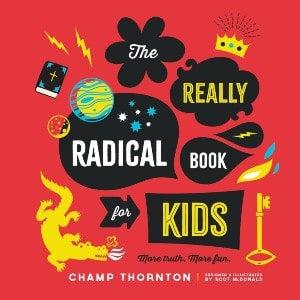
Jim: And he’s written a great book, The Really Radical Book for Kids, which at first you’re going, “What? What? Radical?” Radical in Jesus. And I’m gonna have fun today. I’m looking forward to it.
John: Yeah. And the research, of course, shows that moms and dads are the number one influence when it comes to spiritual matters. So, uh, we’re thrilled to have Champ Thornton in the studio with us. He works at Crossway Publishing and, uh, he helps, uh, children and families to grow spiritually and understand theology. And Champ and his wife, Robin, are, uh, the parents of three teens, and he’s written a devotional book that will be the basis, as you said, Jim, for our conversation. The Really Radical Book for Kids: More Truth, More Fun.
Jim: (laughs)
John: And we’ve got copies of that at FocusontheFamily.com/broadcast.
Jim: Champ, welcome to Focus on the Family.
Dr. Champ Thornton: Thanks, Jim. It’s great to be here.
Jim: What a great name. How’d you come up with Champ?
Champ: I had nothing to do with it.
Jim: (laughs)
John: (laughs)
Champ: I know you were thinking it’s like my athletic ability.
Jim: Yeah, exactly.
Champ: But no, uh, my mom and dad had a little girl who was born about a year before I was.
Jim: Oh.
Champ: She was premature and she lived about a day and-
Jim: Hmm.
Champ: … uh, passed away. And then about a year later, they’re expecting again, and I come along and I’m premature as well.
Jim: Hmm.
Champ: And they didn’t know if I was gonna make it, the medical technology being what it was in the ’70s. And so my mom just fasted and prayed and sought the Lord that He would spare my life.
Jim: Wow.
Champ: And the doctor said, “Oh, he’s a champ. He’ll make it.” And, uh, the Lord spared my life and the name stuck. So my real name is George.
Jim: Wow.
Champ: But no one calls me that, so-
Jim: What a story though.
Champ: Yeah. That’s just-
Jim: That’s amazing.
John: That’s wonderful.
Jim: And that wasn’t in the book.
Champ: God’s kindness.
Jim: (laughs)
John: Yeah, yeah.
Jim: God’s kindness is amazing. Well, let me ask you from the get go. We were kind of laughing there at that beginning in that, that intro we did.
Champ: Yeah.
Jim: ‘Cause that is kind of a typical evening devotional, especially when your kids are younger. So I just wanna get right to it. When did you fail in your devotion with your kids (laughs) and what was the subject matter and is that why you’ve written the book now?
Champ: Yeah. So I feel like I fail regularly because it’ll be something I wanna talk to my family about. And so I’m opening up God’s Word and there’s my wife and our three kids on the couch and we’re talking and it’s something I’m passionate about and I wanna communicate it and I kinda get carried away and it goes a little long. And then I kinda wrap it up. I land the plane. I think, “I did a great job.”
Jim: (laughs)
Champ: And then I say to my wife, “Uh, what, anything you’d like to add or I say to the kids? What else, what does that make you think?” And the response one time for my wife was, “I think that about covers it, Champ.”
Jim: (laughs)
Champ: And that meant-
John: Ooh.
Champ: … like, I think we’re done.
Jim: We’re done, right?
Champ: And so that phrase, now my kids say that at the end, whenever we finish our Bible time together, I’m like, “What do you guys think?” And one of the kids will smirk and say, “I think that about covers it, Champ.”
Jim: (laughs)
John: Oh my.
Jim: You know, you know, structurally, a- and this is true, and I’ve talked about this before, you know, sometimes as we marry, typically opposites, not always-
John: Yeah.
Jim: … but extrovert, introvert, all those things.
Champ: Right.
Jim: Um, for my wife, she was, you know, a biochemistry major, and so she’s very black and white. She wanted a very proper devotional time, you know, five minutes of a little music and song and, you know, 10 minutes of study and then let’s wrap up with Q&A-
Champ: Yeah.
Jim: … and that kind of thing.
Champ: Right.
Jim: T- For the parents that struggle with that, you know, and I’m, I was trying to convince her, hey, I’m, like, on the move when I take him to school, we’re talking about the Lord or what have you.
Champ: Yeah.
Jim: But speak to that structural question of how is, uh, how is it to create an effective way to do devotionals with your kids, age appropriate, et cetera? And is there any perfect way or any better way or is it, yeah, do some of all of it?
Champ: Yeah, I feel like the best way forward is to just try something, better to do something and realize how you can make it better than not to, to lean in. Uh, one thing that we tried years ago that was, worked really great for our family, and it may not work for every family because you, you gotta know your kids and their-
Jim: Yeah.
Champ: … attention span and where, what they’re thinking about in terms of their life issues at that point is, uh, we had advice from someone I read about online where he said, “Take a Psalm, like a shorter Psalm, like Psalm 1,” that’s where we started, “Psalm 1 or then Psalm 23 or Psalm 100 and gather everybody around and say, ‘We’re gonna learn this Psalm together,’ and then read the whole thing, go back, read the first verse, have maybe your oldest kid try to say it, everybody try to say it together, and then, ‘Let’s pray.'” So we did this when our kids were, I don’t know, one to two years old.
Jim: Wow.
Champ: And so, they’re just kind of nodding along and, you know-
Jim: Yeah.
Champ: … maybe mouthing a few things and then we prayed. And then we did it again the next day and we read verse one again. And then we read it again and we tried to find ways of vary it up or have my wife read or my wife and my son read together or try to say it by memory. And then I was so surprised within a few weeks, our whole family knew Psalm 1 word for word.
Jim: Huh.
Champ: I was shocked. Who knew? And so now, like you said about driving in the car, now it was portable. So now we’re driving on the way to the grocery store, I got the kids in the back and I’m like, “Hey guys, le- let’s say Psalm 1 together.” “Micah,” our oldest, “why don’t you start it off for us?” So he starts off verse one and then, “Okay, Jack,” that’s our youngest, “why don’t you take the next one?” “And Kenzie,” that’s our middle child, “why don’t you say the next?” And they would stumble and it would be okay, but just a wonderful time of like-
Jim: Hmm.
Champ: And then you can ask questions, right?
Jim: Yeah.
Champ: Like, “What do you think it means in Psalm 1 when it says, ‘He’s like a tree planted by rivers of water’? What, what is it talking about?” So it provides wonderful conversation and, uh, it’s something that it’s so easy to do as a family.
Jim: It’s so true. Le- let me ask you in terms of, uh, culture, ’cause culture, modern culture particularly feels really disconnected from words of antiquity, but you make the case, uh, maybe not so much that human beings are pretty much the same when it gets down to our behaviors, our sins, our virtues, et cetera. So how do we, and how did you help close that gap with your own children and w- what are you hoping for with the book to help other parents make ancient culture more relatable to modern culture?
Champ: Yeah. So I feel like the Bible just sets the tone for this because when you think about the, the phenomenon that we have scripture and that it is profitable, Paul says to Timothy for showing you what is right and how to, what is wrong in life and how you can make things right and how you can keep things right. These truths, God says, are coming out of an ancient book. So if God can write something 3,000 years ago and it still be relevant, then that means that there’s so much more that unites us as a human race than divides us, that I have a lot of cultural differences from people who lived in Abraham’s Day or David’s, King David’s Day, tons of cultural differences, but I have so much in common. Why? Because it was God’s Word then and it’s God’s Word now and He knows what’s gonna resonate with people of any culture and any timeframe. So God’s Word also gives us the clue when we go to Deuteronomy 6. When you go to Deuteronomy 6, you know, we have that very famous, and you kind of alluded to it, right? You’re in the car, uh, and you’re talking to your kids about the Lord. Deuteronomy 6:6 says, you know, “While you’re, uh, walking down the way or getting up in the morning or driving in the minivan, you’re talking about the Lord,” but how does it start? That’s not where it starts. It starts a few verses before, right? The Shema, it says, “Hero Israel, the Lord our God, the Lord is one. He’s unique. He, there’s only one like Him. He’s the only true God. And you should have a unique love for Him, that you should love the Lord your God with all your heart and with all your soul and with all your might.” And then this is what you teach your children. So before we get to Deuteronomy 6:6 and we’re riding around in the car talking to our children, how are we loving the Lord with all our hearts?
Jim: Yeah, that’s really good.
Champ: And that really is where it starts because we can’t pass along to our children something that we don’t have ourselves. And we’re gonna have it imperfectly, but that ought to be our aspiration and our goal that I want to love the Lord, that is the main thing in my parenting, and then I wanna pass it along to my kids.
Jim: And Champ, one of the things that’s so important is we tend to, uh, think that they’ll get enough of that at church. You know, we can go about just being family and having dinner and talking about news, weather and sports.
Champ: Sure.
Jim: But really, as John said in the opening, uh, parents have that unique role. They are the number one influencer of their kids, even through the teen years, which kinda shocks most of us parents today, but that survey information is still holding true that t- even teens will say their parents are the number one influence in their lives for the most part. So in that context, uh, I, I wanna, I want you to give that rah, rah for the parent who may be underselling their influence with their children and to take it more seriously, don’t leave it to the church to do it. You’re the primary faith giver and, and faith teacher to your children. The church will augment that, but if we designate it or relegate it just to Sunday and Sunday-
Champ: Mm-hmm.
Jim: … school with our kids and the pastor, the youth pastor will take care of that, I think we’re missing our God given responsibility to do that.
Champ: Yeah. God has put that responsibility on us as parents and there’s also a responsibility the church has for, you know, our walk with Jesus and that doesn’t exclude our children. Um, but as we think about our relationship with our kids and the responsibility we have, I remember as a young parent having, like, parenting books on my shelf and thinking, “How’s this even work?”
Jim: (laughs) That’s right.
Champ: You know, this is a 230-page book and I’m supposed to remember at 3:00 in the morning, something on page 116. Like that’s, my mind doesn’t work like that.
Jim: Yeah.
Champ: And so I really had to work and think, “Okay, w- what is our goal? How do we parent? What’s going on?” And the phrase that I came up with that my wife and I use is that we want our kids, here’s our goal, that when they leave the house at age 18, 19, whenever it is, we want them synced up with reality.
Jim: Hmm.
Champ: We want them living in the reality of this world. So that means that God is Creator, He made everything, He made everything good. That also means this is a broken world-
Jim: Hmm.
Champ: … and that we’re sinners. It also means that He’s not just Creator, but He’s Savior. God sent His Son Jesus to be our rescuer because we’re sinners. He rescues us from ourselves and He invites us into that relationship with the Father. And I want them to live in that reality. But all of the rest of life is spinning this narrative that’s untrue, right? So we kind of think as parents, we wanna be the, the naughty filter, right? So this show, we’re not going to watch that. It has these elements in it or we’re not going to talk about that because of the other thing, but the reality is we, we just go to the mall and every store is spinning fiction-
Jim: Hmm.
Champ: … right? That if you have this set of clothes, you’ll feel this way, or if you have this toy, this is what it will do for you. They’re not necessarily sinful, but they’re not necessarily true. And so as parents, we’re there to help interpret for our kids what reality is and, uh, to help our kids live in sync with that reality.
Jim: I like that.
John: Hmm. Yeah. Well, this is Focus on the Family with Jim Daly and our guest today is Champ Thornton, and we’re so glad to have him here talking about how to really make theology and scripture come alive for your children. Get a copy of his book, The Really Radical Book for Kids. Uh, we’ve got that here at the ministry and additional, uh, resources as well to help you as a parent. Uh, we’re a phone call away, 800, the letter A and the word FAMILY, or stop by FocusontheFamily.com/broadcast.
Jim: Champ, one of the chapters you mentioned Galileo’s telescope, which, uh, we were just in Europe last summer and saw a number of Galileo’s original telescopes.
Champ: Amazing.
Jim: Amazing. And I always loved astronomy, and, uh, so I connected with that section of the book. But you referred to it and compared it to the, a Bible telescope. So what, what point were you trying to make with, uh, Galileo’s telescopes being like a Bible telescope?
Champ: Yeah, and just connecting it back with the fact that we want our kids to live synced up with reality of God as Creator and God as Savior is that, you know, we go to church on Sunday and we hear about Jesus and He’s our rescuer, amen, right? But He’s also the one who made pizza so great.
Jim: (laughs)
John: (laughs)
Champ: And soccer.
Jim: Are you sure about that?
Champ: Absolutely.
Jim: (laughs)
Champ: Like, everything that we love about this world that He made, it comes out of His creative mind.
Jim: Hmm.
Champ: And so when we look to life in this world, we see so many lessons we can learn, whether it’s about a telescope and how that relates to the Bible, this book, we want it in this book to relate things that are fun but also true. And so when we think about this telescope, we’ve got those three lenses that you put in a telescope and we look at the Bible the same way. So those lenses are that we look like through the Bible as if it’s a window. Okay. So when we think about, like, the stories of Jesus, like in Mark 4 and 5, we see Him stealing the storm. Really happened, true story. We look through the Bible to a true event that happened. But then what’s interesting is we also look at the lens like it’s stained-glass. In other words, the gospel writers and other writers of history in the Bible don’t just tell stories that actually happened. They relate and arrange those stories in way that tell more of a mosaic, like a stained-glass window.
Jim: Hmm.
Champ: So notice the story about Jesus and stilling the storm. He also heals the demoniac, which no one else could heal. And then He heals the woman who had the, the bleeding issue that no one could heal for 12 years. And then He heals a daughter who’s not just sick, but now she’s dead. No one can fix that. Jesus does the impossible. So Mark is writing these stories together to show that something else is true about Jesus, that He can do the impossible.
Jim: Mm-hmm.
Champ: But then any, the third lens is that when we look at the Bible, we look at it not just, like, through a window to actual events or stained-glass, telling a larger story, but also like a mirror because-
Jim: Hmm.
Champ: … we learn that God has things to say to us and He wants us to change and become more like Jesus. And so when we read the Bible, it’s not just about something out there and then, it’s about right here and now.
Jim: Yeah, which is a great application for it. You also, in teaching your son how to play video games, you said it, it really lined up with the book of Proverbs. (laughs) So I’m dying to hear this answer. So how does, uh, video game playing line up with the book of Proverbs?
Champ: So the very short answer is I’m terrible at video games.
John: (laughs)
Jim: Me too.
Champ: And, and when my son was first starting out, I was still better than him and that lasted like about two weeks.
Jim: Yeah.
Champ: Uh, and so I went online and there are these things called like walkthroughs and cheats and it’s, the internet is amazing. And, you know, what’s really amazing is, like, could you imagine if the designer of the video game, not just someone who had lots of time on their hand to figure it out, but what if the creator of the video game created the walkthroughs? That’d be brilliant. Well, the book of Proverbs, God is giving us a walkthrough on life. When we think about, like, living in wisdom, it’s not just that the book of Proverbs gives a bunch of nuggets of wisdom. Proverbs is coming from the perspective that first God is wise and that He made the world wisely and He made it to operate in wise ways. And so Proverbs is helping us understand how God made the world to work.
John: Hmm.
Champ: And we are living, uh, in harmony with that. Someone said if you go against the grain of the universe, you get splinters, right? So Proverbs is showing us, this is how God made the universe to work. Now live that way.
John: Wow.
Jim: That’s a good way to look at it.
John: Yeah.
Jim: That’s good.
John: That’s really, uh, really an interesting approach. Now, one of the things you talked about in the book, Champ, is, uh, using the game two truths and a lie-
Champ: Yeah.
John: … to help your kids.
Champ: Yeah.
John: So some people might think, “Oh, don’t lie,” but it’s a game and it’s a fun game. A lot of folks have probably done it, but, uh, what was your lesson out of that?
Champ: Yeah, so we found this game was a lot of fun at the dinner table, especially when the kids were younger, because you know how it is, you ask your kid, “How was your day?” And what’s the answer? “Fine.”
Jim: “Fine.”
John: “Fine.”
Jim: Okay.
Champ: “What did you do?” “Stuff.” It’s like, “Okay, this is not good.”
John: (laughs)
Jim: Right. One, one word answers.
Champ: Oh, it’s awful. So we came up with this game, and of course when the kids were little, I thought, “Do we call it two truths and a lie?” So I said, “how about, we call it three things.”
Jim: Right.
Champ: That’s what we called it, just so I didn’t tell ’em to tell a lie. Um, but we said, “Okay, tell us two things that actually happened and one thing that didn’t.” And so then they would… And I got to tell you, I’m the world’s worst at this game because I have no poker face.
John: (laughs) Yeah. Right.
Champ: So I have to, like, cover my face with my hands when I play ’cause they all know exactly which one’s like the f- the-
Jim: Yeah.
Champ: … the false one.
Jim: (laughs)
Champ: But the reality is, is it occurred to me one day, have you ever noticed that, like, all the slogans out there in the world like, uh, “Be true to yourself and follow your heart and your body, your choice,” um, or, “You only live once,” all those things, you could put ’em on a bumper sticker. They’re so meme worthy, right? Uh, and I thought, why does the world have all the good slogans?
Jim: (laughs)
Champ: And it occurred to me, oh, it’s because they’re only telling half the truth, right. It’s a truth and it’s leaving something out. And the Bible gives a more full-orbed response, but those don’t fit on bumper stickers nearly so easily.
Jim: Yeah.
Champ: Right? So you could say, “Follow your heart.” Well, sure, God wants us to live authentically, right? But my heart is not always reliable.
Jim: Right.
Champ: Right? Our heart is deceitful often. And so there’s more to the story and that doesn’t, that doesn’t make a very catchy slogan. Right.
Jim: You know what’s interesting with that is so often how we wanna detach those pithy good sayings from accountability. So follow your heart under God’s guidance-
Champ: Yes.
Jim: … would be the fuller bumper sticker.
John: Yeah.
Champ: Right.
Jim: You know, but-
Champ: For sure.
Jim: … we, we wanna cut that off all the time. I just wanna follow my own heart.
Champ: That’s right.
Jim: It is.
Champ: Totally independent of God.
Jim: (laughs) Totally independent. And that is the problem.
John: Hmm.
Champ: 100%.
Jim: Of culture and everybody, every household, because we are sinners, like you said. Let, let me ask you, uh, part of your passion, uh, to disciple children comes from a health crisis that you encountered in your 20s. Describe what happened and how did that motivate you to help children better understand spiritual truth?
Champ: Yeah. I was 29 years old and I developed a, uh, blood clot in my leg, which turned into a pulmonary embolism and, uh, you know, I didn’t know what it was, but, you know, people die for those, I found out.
Jim: Yes.
Champ: And then I found out that I had the clot because I have a blood condition, a genetic disorder that inclines me to clot. And so I’m 29 years old, and you know, you’re not thinking about dying, you’re thinking about, like, let’s go. Life is in front of us and all the things that, uh, I wanna do and that hopefully God has planned for us. And then it all of a sudden makes you think about things you weren’t thinking about thinking about. And so I would say maybe for the next decade of my life, probably not a day went by that I didn’t think about dying. And maybe sometimes in a morbid way, but also I think in a healthy way that I’m mortal and that I’m not gonna be here forever. And so when kids came along, I wanted to be able to leave something with them to say, “This is what’s important to dad.” And so that really is a lot of the genesis of this book and its predecessor, the, the radical book for kids, is I wanted to leave something for my kids, like, almost like a starter kit for the Christian life to help guide them in their faith.
Jim: Yeah. Champ, your children are now, you have twins that are 15-
Champ: Yeah.
Jim: … and then you have a slightly older, uh, young adult, I believe.
Champ: Yes, indeed.
Jim: So i- i- for parents that are in that similar position where maybe now they have the teens and maybe a 20-something like you, but they feel like my, my eye wasn’t on the ball.
Champ: Mm-hmm.
Jim: And they’re hearing this with a heavy heart.
Champ: Right.
Jim: Like, “I didn’t concentrate on this. I did think the church would pick up the slack. I wasn’t as good as I could have been in doing this transfer of my faith.” What do you say to them now that they have a 15, a 16, 17 year old? What can you do to make up some ground and not be too obvious in that, uh, desire to help your children better understand kind of the core principles of faith as they launch into adulthood?
Champ: It’s a great question. I feel like with parenting, a lot of it is, uh, a wisdom issue, right? So you know your family, you know your children, you know what’s best in a certain situation. I think you need to lean into that. And, you know, if you have a spouse who’s also a Christian, then conferring on, okay, “What are best steps here with our kids?” I feel like that’s important. But I feel what’s always applicable and always the right thing and the wise thing to do when we realize that something in our past is not what it could have been and should have been, the right response is always repentance, right?
Jim: Yeah.
Champ: Is we say, “I was wrong, I was…” or, “I was foolish, God forgive me.” And then where appropriate, we share that with the people that we’ve sinned against. So, you know, in this case, if your children are teenagers and you realize you could have been a better parent in particular ways when they were younger, gather them up and say, “I, can I just share with you? God has shown me I could have been a much better dad or mom when you were younger. Can I tell you in what ways and would you forgive me? And I’d like to try to do better.” And I feel like just, like you said earlier, like, being that example for them and being honest about-
Jim: Yeah.
Champ: … not just, “Here are the expectations in life,” but like, “Here’s where I’ve not lived up to those expectations.”
Jim: You know, the irony, too, Champ, I wanna play the other side of that coin because some parents that have been very diligent, uh, you know, the, the difficulty with humanity and the Lord knows this better than anyone, is that we have free will and He has given that to us. And you might have done an excellent job, an A+ in your parenting and-
Champ: Right.
Jim: … did all the right things. You did devotionals and-
Champ: Right.
Jim: … that child has become a prodigal. And the weight and the guilt of some of that that parents have for, “What could I have done better?”-
Champ: Mm-hmm.
Jim: … it, it almost, uh, takes it out of the hands of their free will and the Lord’s design for their journey.
Champ: Mm-hmm.
Jim: You know, some kids are gonna have to hit a valley and we wear that very hard-
Champ: Yeah.
Jim: … as a parent.
Champ: That’s right.
Jim: Like, we beat ourselves up saying, “Where did I miss it, Lord? What, where did I let you down, Lord-”
Champ: Right.
Jim: “… that this child you gave me responsibility for is not acting in a way that honors you?” What do you say to that parent?
Champ: Well, I feel like probably the first thing is not even something you say, but if I’m having a conversation with someone like that, maybe the first thing is listening. I wanna hear, tell me more about your story, tell me more about your situation, how’s it affecting you? I wanna hear the, some of the pain that they’re carrying, um, and not just that I hear it, but the Lord hears it.
Jim: Yeah.
Champ: He knows. He knows the pain. Um, I, I do think when we talk about parenting, we’re talking about a wisdom issue and we go to Proverbs, for example, we see Proverbs is like, uh, a city map with streets, and you know if you go down two blocks and turn left, you’ll be at your destination. And it’s very mapped out with causes and destinations. And we feel like, yeah, that’s how parenting works. You do A, you do B, you do C and it leads to D, right?
Jim: Yeah. Right.
Champ: But what if it doesn’t?
Jim: Right.
Champ: Well, God is honest about that and He’s given us Ecclesiastes and the book of Job to show that A and B and C sometimes don’t lead to D, it leads to Z.
Jim: Mm-hmm.
Champ: And if nothing else the Lord is telling us, I know that sometimes that happens in a broken world, but He’s done more than that. He’s done two things is, and you go to the book of Psalms, you see lots of Psalms of praise. So when A and B and C leads to D, praise the Lord. And then when it leads to Z, there’s Psalms of lament, Psalms of complaint. “Lord, hear us. Lord, you’ve done stuff in the past for our fathers. Would you do it for us now?”
Jim: Mm.
Champ: “Lord, where are you?” And these songs of complaint come from God. He wants those in our mouths to Him.
Jim: Yeah.
Champ: And so I would say to a parent who’s struggling with this, learn and inhabit those Psalms of lament because God gave them for that purpose.
Jim: Yeah.
Champ: And then the last thing I would say is God doesn’t just speak to us from afar, from heaven about these things. He came down on the person of His Son and He walked this road of pain and disappointment, and He knew what it was like to have people close to Him, who rejected Him-
Jim: Mm-hmm.
Champ: … who turned on Him, and He’s not God far away for you. He’s a God who understands exactly what you’re going through.
Jim: Yeah, and that’s so good. And listen, if you’re that parent, uh, get in touch with us. Focus has spent almost 50 years now compiling help for you. It’s one of the things that we do, even, like, finding this great book by Champ Thornton, The Really Radical Book for Kids: More Truth, More Fun. This is what we’re doing to help you, uh, to identify those wonderful resources that can get into your hands and you can apply them.
John: Mm-hmm.
Jim: I mean, that’s part of what we’re doing here. So help us. Help us to continue to do that. If you can make a gift of any amount, a one-time gift, a monthly gift to be part of the ministry, uh, send that along and just ask for a copy of the book and we’ll send it as our way of saying thank you for being part of this wonderful outreach that the Lord has provided.
John: Yeah, get in touch and donate today at FocusontheFamily.com/broadcast or call 800, the letter A and the word FAMILY. And of course, when you get in touch, uh, Jim alluded to our counseling team and help that we can give you if you’re in a spot where you’re hurting about, uh, some of the things going on in your parenting journey. Uh, call that number and ask for one of our counselors to give you a call back. It’d be a privilege for us to, uh, as Champ said, to listen to your story and to help as we can.
Jim: Champ, thanks again for being with us. It’s been great.
Champ: Thanks, Jim. I’ve enjoyed it. Thanks, John.
John: And thank you for joining us as well. And by the way, if you happen to be traveling this summer to or near Colorado, we’d love to have you drop by and see us. We’ve got a wonderful bookstore here and a terrific playplace for kids featuring exhibits from Adventures in Odyssey, and our very own Whit’s End ice cream soda shoppe. Uh, it’s fun for the whole family and we’ll have a link on the website for you to check it out. Thanks for listening to Focus on the Family with Jim Daly. I’m John Fuller inviting you back here as we once again help you and your family thrive in Christ.