




Greg Koukl: If Christians want to make a bigger impact, they need to get a little bit more education about the issues themselves and about some method, I offer one, some method that’s effective to move forward. And when they do that, they are going to see things change. I promise you, they will see things change and they won’t feel so defeated, especially when they realize that their viewpoint, their view of reality is actually true.
John Fuller: That’s Greg Koukl and he’s our guest today on Focus on the Family with Jim Daly. Thanks for joining us. I’m John Fuller.
Jim Daly: John, as believers, we’re called to share the message of Christ. That’s the, uh, great commission to go and tell people about Jesus. And, uh, some people struggle with that because maybe their temperament isn’t built in such a way that they’re easily engaging people.
John: Mm-hmm.
Jim: You might say extrovert, introvert. I don’t know that that always applies, but it’s just some of the wiring that we have, uh, we’re either comfortable or we’re not comfortable in talking to people who don’t know the Lord. We call it being a witness. Uh, there’s gonna be, you know, non-Christians listening, so that just really means to profess our faith in Christ to people who don’t know about Christ. And it’s that simple. Uh, the key is being prepared. And I’m excited to talk to our guest today because I think this will really help equip, especially those that may be floundering a little bit when it comes to sharing their faith. They don’t feel equipped enough or confident enough, uh, to do it. And the best thing, uh, about our guest, Greg Koukl, is doing it with a good heart.
John: Mm-hmm.
Jim: And I love that emphasis that he has.
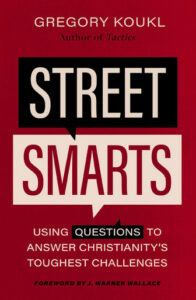
John: Yeah, he’s really, um, uh, eager to share faith, but not in a way that is overwhelming. And, um, you’ll hear more from Greg here in just a moment. He’s an apologist. Uh, he’s the founder of, uh, the ministry called Stand to Reason. He hosts a radio show and podcast. He’s written a number of books and, uh, he has a new one out called Street Smarts: Using Questions to Answer Christianity’s Toughest Challenges.
Jim: Greg, welcome back.
Greg: Hey, it’s good to be with you, gentlemen.
Jim: (laughs).
Greg: It’s always a treat for me. Thanks.
Jim: Well, it’s good to see you.
Greg: Thank you.
Jim: Let’s start with that opening idea. You know, there is that, uh, hesitation or the lack of comfortableness-
Greg: Yeah.
Jim: …in doing this.
Greg: Absolutely.
Jim: Talking to someone else about the faith.
Greg: Yeah.
Jim: Uh, why is it important for us to do this?
Greg: Right. Well, uh, we have the message that saves the world.
Jim: (laughs) That’s pretty good.
Greg: The only message. I mean, that’s a pretty good start, right?
Jim: (Laughs).
Greg: But I am very sympathetic to people who are, uh, reluctant to engage. And you s- … you mentioned a moment ago that some are foundering a little bit. I think most Christians find engaging on controversial issues a bit discomforting. And, uh, I’m the same way, you know?
Jim: It’s normal.
Greg: It’s very normal.
Jim: Yeah.
Greg: And I, in the, in Street Smarts, I start out with this concept, you know, that even someone like myself finds it difficult to engage. And so this is why finding ways to do so effectively is so important, even for a guy like me, because the message that we have is so important and I have never seen a time when the culture was so aggressively against virtually everything Christian, every piece of the story of reality, the Christian worldview-
Jim: Yeah.
Greg: …is being opposed in every sector right now, which means Christians are pretty hard-pressed and they need a way to engage productively and graciously. Get off the bench and get into pleasant conversations that matter.
Jim: You know, oftentimes when I’m in conversations with folks, they’ll mention, um, that engagement piece.
Greg: Mm-hmm.
Jim: The idea that, you know, it’s, it can be uncomfortable because people are so aggressive.
Greg: Yeah.
Jim: You know, they really hate what we have to share. Coach that person, uh, I think sometimes we go into those engagements thinking this is some kind of a, uh, a battle that we have to win.
Greg: Mm-hmm.
Jim: And you really have to mentally prepare yourself-
Greg: Yeah.
Jim: …and emotionally prepare yourself to say, “This isn’t a battle we need to win, we just need to put the evidence out there.”
Greg: Yeah, that’s a great distinction. Um, the winning of the battle is on God’s side of the equation. It’s not on ours, but think about Matthew 10 when Jesus sent the apostles out, uh, in their short-term mission kind of enterprise. There are three times within about seven sentences where Jesus says, “Fear not. Fear not. Fear not.” Now why did He say that? Because He-
Jim: ‘Cause we were fearful. (laughs).
Greg: Well, they, not only were they were fearful, but there was something to fear.
Jim: Right.
Greg: He goes on to tell them, you know, “You’re gonna… It’s gonna be rough out there, you know, and you’re gonna, you’re gonna get persecuted for the truth, okay?” But He told them that to prepare them, okay? And then He said, “You got an ally in the Holy Spirit.”
Jim: Yeah.
Greg: “Okay? He’s going to help you.” But notice He didn’t say that at the beginning of his training. Well, you got the Holy Spirit, that’s all you need. At the beginning of this training, He said, “I will make you fishers of men.”
Jim: Right.
Greg: And then after a year or so of working with them and training them so they had what they needed to face the challenges, then He began sending them out saying, “Trust in the Holy Spirit.”
Jim: Yeah.
Greg: So it’s the Holy Spirit doing the Holy Spirit’s work with the things that we have been able to learn as followers of Christ about the culture, about the issues. Um, and that combination is what’s going to make the difference. And this is why I wrote Street Smarts, to give that information to do the training, so to speak-
Jim: Yeah.
Greg: …so people can take the message out.
Jim: Yeah. And Greg, that’s what I’m excited about, because the rest of this program and next time we’re gonna cover that, and you are gonna help to begin that equipping-
Greg: Mm-hmm.
Jim: …and then hopefully folks will get a copy of the book and dig deeper into the content. Let’s get into it. Uh, I was struck by the fact that you say it’s a good thing that Christianity can be questioned and even considered to be unreliable. At first I was going, “What? What are you saying, Greg?”
Greg: (Laughs) Right.
Jim: But I get it.
Greg: Yeah.
Jim: Explain it.
Greg: Yeah. Well, I tell audiences that the fact is there’s a lot of ways to show that Christianity is false. Now, they don’t expect me to say that, obviously.
Jim: Right.
Greg: But when you think about it, our story starts in the beginning, God. If there’s no God, there’s no story. We’re Christians, we’re followers of Jesus. If Jesus didn’t exist and there’s a big movement to try and to say that nowadays, well, then we, we don’t get off the ground either. Or if He’s not the person that the texts, the gospel say He is, then we’re in trouble. Um, if there is no soul, there’s nothing to, uh, survive the death of the body, no heaven or hell. You know, Paul said that if, uh, Jesus didn’t rise from the dead, uh, people should pity us.
Jim: Right.
Greg: So the point is, in principle, there are lots of ways that Christianity is actually falsifiable. Now, this isn’t a bad thing, it’s a good thing, because if a view is falsifiable, it’s verifiable.
Jim: Hmm.
Greg: In other words, it can be shown to be true if it can be shown to be false. And of course, this is what people like, like, like I do, apologists, and you’ve had a number of them on recently, we give the reasons why God exists, Jesus existed, and He was the person recorded in the gospels. Uh, we talk about existence of the soul, we talk about the resurrection. We give all of those rationales to give evidence that God and the world is the way the scriptures describe.
Jim: Yeah. You know, uh, Greg, one thing that I’ve encountered is, um, this idea that God built this on faith. He wants faith to be the demonstration that you believe.
Greg: Right.
Jim: So I, I think it’s very purposeful that you’re not gonna find this concreteness. It’s not gonna be like gravity-
Greg: Mm-hmm.
Jim: …because He, Himself, wants to see that you have faith-
Greg: Oh, let me-
Jim: …In Him.
Greg: Oh, yeah, let me speak to this because it’s really important. Um, sometimes we can get the faith thing separated from the content or the evidence. I want you to, and, and the two actually scripturally go together. So if you think about the end of the Gospel of John, John tells us why he wrote the gospel. He said, many other signs and wonders God has performed, or Jesus, was… Jesus performed that are not written in this book, seven miracles there in the Gospel of John. He said, “But these have been included in order that you would know that Jesus is the Messiah, the Son of God, and have faith in Him, and get eternal life through that.” So in other words, he’s connecting faith in Christ and eternal life with the evidence that’s being given. So there is not a leap of faith, the way a lot of the atheists claim right now, there is a step of trust based on good reason, okay?
Jim: Yeah.
Greg: Now, it can all be gainsay. People can find all kinds of problems with it and say, “No, that didn’t happen and here’s the reasons why.” So there’s room for doubt, but there’s plenty and plenty of evidence, you know, many convincing proofs is the way Luke put it in the beginning of Acts.
Jim: Well, and in a court of law, the preponderance of evidence in some of the cases are what is required-
Greg: That’s right.
Jim: …to meet the test.
Greg: That’s right.
Jim: And I would say that’s what Christianity provides.
Greg: Way over the top with Christianity. I agree entirely.
Jim: There’s a preponderance of evidence that-
Greg: Right.
Jim: …Jesus is who He said He was.
Greg: That’s right.
Jim: And they captured only a few of the miracles that He did-
Greg: That’s right.
Jim: …in order to give us that insight.
Greg: J- John said the whole books of the world couldn’t hold all that Jesus did, right?
Jim: Right. Let me move to another kind of, “What?” kind of question, which is in 30 years, you’ve never actually been the one to lead someone to Christ.
Greg: Yeah, that’s another one that shocks the audiences, but I, I haven’t prayed with someone to receive Christ in at least 30 years. And I know-
Jim: So you’re the tiller and the waterer.
Greg: Pa- … Well, yeah, this is-
Jim: Not the reaper.
Greg: This, this is-
Jim: The Harvester.
Greg: That’s right. And so this is to shock people into considering another concept because I also tell them that I’ve never been more effective for the cause of Christ than I have in the last 30 years. And that’s because of a concept that I laid hold of that is thoroughly biblical and that is that there’s a difference between harvesting and, and what I call gardening, you know?
Jim: Yeah.
Greg: Jesus talks about those who sow and those who reap, it’s in John 4. Okay? And He tells the disciples, “You’re about to reap where you did not sow.” This is after his conversation with the woman at the well, right? In other words, somebody else did the heavy lifting and they get the easy pickings. But Jesus identifies there one field, Sychar, but He also identifies two seasons, sowing and reaping, gardening and harvesting, the way I put it, and two kinds of workers, gardeners and harvesters, sowers and reapers. And the problem, what I discovered is, as I looked at my life, I’m actually not a reaper. I, I’m not a, a harvester. I’m a gardener. And the things that I do in the writing of the books and when I’m on campus, spoken at more than 80 university campuses around the country, and what am I doing? I’m gardening, gardening, gardening. And then I’m trusting God to bring the harvest in when it’s ready.
Jim: Yeah.
Greg: Here’s my conviction. Not only do I think I’m a gardener, but I also think most Christians are gardeners, uh, because that’s where the work is done for a harvest to take place. But the methods that we have for evangelism are always harvesting methods. There it is, the last page, you know, “Do you want to pray to receive Christ? Sign on the dotted line,” that kind of thing. And when people, Christians, consider that motif in a hostile environment, they stay on the bench.
Jim: Right.
Greg: They’re not gonna get engaged, okay? So what I’m trying to do is provide a means, a toolkit, so to speak, of gardening effectively and let God worry about the harvest-
Jim: Yeah.
Greg: …when the harvest comes in.
Jim: It’s good to know you’re bent. Uh, in that regard, um, I think I saw a statistic, uh, based on research where it’s 12 harvesting touches before a person accepts Christ. Now, I don’t know how they did the research, but that proves your point.
Greg: But it makes perfect sense.
Jim: It makes like a 12 to one ratio.
Greg: Absolutely. And maybe even more than that in the culture now.
Jim: And that certainly was true of me. My Christian football coaches in high school-
Greg: Right.
Jim: …that made an impression on me, they, you know, I wasn’t there in the immediate moment.
Greg: Right.
Jim: It took time for me to, to be harvested-
Greg: Right, right, right.
Jim: …if I could say it that way. So I totally get that and I’m sure that’s true of everybody’s experience in coming to Christ. Um, your method of debating someone with opposing views is to ask questions. Now, again-
Greg: Right.
Jim: …people are saying, “Well, yeah, I’ve read the scripture. That’s what Jesus did too.”
Greg: Yeah.
Jim: Explain that methodology.
Greg: Well, I, I took my cue from an old TV guy named Columbo and a lot of folks remember him.
Jim: (laughs).
Greg: Lieutenant Columbo because he come in-
Jim: The detective.
Greg: The detective, right. He, he would come in kind of under the radar, scratching his head, kind of feeling like you, you’d think he doesn’t know what he’s doing, right? But he’s stupid like a fox because he’s got a plan.
Jim: Mm-hmm.
Greg: And his plan is to ask these questions, and the questions that he asks are inconsequential at first, he’s just kind of generally gathering information. But what he’s doing is he’s building a case, little by little by little, this information, okay? And, and I found that this to be the absolutely hands down, most effective way to move forward in a conversation, be effective for the cause of Christ, and still stay safe yourself. I, I, my comment is, and there’s a chapter in the book called Questions Keep You Safe.
Jim: Hmm.
Greg: You’re in the, for a number of reasons, but you’re in the shallow end of the pool. What am I trying to do? I’m trying to get Christians off the bench and into the garden so they can do some gardening with a very simple but powerful technique, which is all explained in the book, of course. But that’s the key there, questions.
Jim: Yeah.
Greg: Questions keep you safe and they are powerful, uh, for use by God to make an impact in people’s lives.
Jim: How, if you’re a closer, if I could use that example…
Greg: (Laughs).
Jim: …If you’re the closer mentality-
Greg: Yeah.
Jim: …you, you actually could do some damage if-
Greg: Uh, I-
Jim: …if the fruit’s not ripe.
Greg: That’s right.
Jim: You’re picking the fruit too early. So how, how do you, if that is who you are, and again, know who you are, how do you back up a bit and say, “Okay, it’s not futile to ask questions?” Because I think that personality type is like, “Why would I waste time asking questions?”
Greg: Yeah.
Jim: The only question that counts-
Greg: Yeah.
Jim: …is, “Do you know Jesus?”
Greg: Do you wanna receive Him?
Jim: Yeah.
Greg: Or something like that. But that isn’t the way Jesus approached it, okay? And so when I look at the gospels, I see Jesus doing something entirely different than a lot of us doing our culture right now. Uh, we jump in with the good news and we explain the good news, and we say something about sin occasionally, and then we invite people to receive Christ. But Jesus didn’t get to the good news very often at all. A lot of times He spent time with the bad news. Look at the sermon on the mount, you know? I mean, there’s a lot of bad news in that first chapter-
Jim: There is. The woman at the well, I’m smiling because He was like-
Greg: Yeah.
Jim: …”Woman, I’m in front of you.”
Greg: Yeah.
Jim: “It’s me.” (laughs)
Greg: Yes, but at… Notice that He s- … bef-… He said that after He had-
Jim: Yes.
Greg: …talked to her about the moral life.
Jim: And asked the questions. Right.
Greg: You’ve had five husbands and the one you’re living with now.
Jim: Right.
Greg: Now, this doesn’t mean we gotta jump right in on top of people and talk about sin. The point is, what Jesus was doing, and we saw with Paul, is you almost never see them cl- …trying to close the deal. Inviting people to receive Christ, having an altar call. Those aren’t in the New Testament. What do you see them doing? Responding to the need of the moment and the individual circumstance with the person. Paul said in Colossians 4, “Conduct yourselves with wisdom towards outsiders, making the most of the opportunity, let your words be with grace, seasoned as it were with salt.” I mean, that’s pretty cool, right? And then he says, “So that you know how to respond to each person.” And this is the key.
Jim: Mm.
Greg: With a tactical approach, using questions, it allows you to focus right on the individual. You’re not just bringing a generalized cookie cutter thing and jump-, dumping it on them, you’re listening to them talk, you’re getting to know that individual.
Jim: Mm-hmm.
Greg: And that’s powerful in people’s lives.
Jim: Yeah.
John: Greg Koukl is sharing from his heart and, uh, his new book, Street Smarts. Uh, we’ve got copies of that here. Stop by our website, FocusontheFamily.com/broadcast or call 800, the letter A and the word FAMILY.
Jim: Greg, we’ve, uh, talked about the theoretical here.
Greg: Mm-hmm.
Jim: Now let’s get down to some practical examples that you have.
Greg: Sure.
Jim: One is with a waitress in Seattle.
Greg: Oh yeah, that’s right. (laughs)
Jim: I love that. You know, oftentimes I’ve been with people and I’ve done this couple times, you know-
Greg: Yeah.
Jim: …we’re about to pray over our meal, can we pray for something for you?
Greg: Yeah.
Jim: That’s a nice way to get that out there.
Greg: Yeah.
Jim: But what happened with this waitress in Seattle?
Greg: Okay. Well, see, one of the advantages of asking questions is it gets you going in a simple way. And, uh, what a lot of people don’t realize is just asking simple questions is going to also make an impact even though you’re not preaching the gospel. So here I, I am in Seattle. I did Apologetics event on Friday night and all day Saturday. I wasn’t the only speaker, but I worked really hard. That Sunday morning I had to preach in a church and, uh, so I’m dragging my roller bag out of the hotel, into the cafe. On my way out, I’m just gonna get some coffee to wake up. And the, the subtext here is, I’m not a morning person.
Jim: (Laughs).
Greg: All right? I quit, before my first cup of coffee, I’m an atheist, right?
Jim: (laughs).
John: (laughs).
Greg: So I do… Honest to goodness, I do not want to talk to anybody about Jesus.
Jim: I kind of know that feeling from time to time.
Greg: Yeah. (laughs) I don’t want to talk about God. I, I don’t want to talk. Okay? And this waitress comes up to the table and she is way too energetic for that time of the day for me. “Hi. Good morning,” and doing all, “What are you doing here in Seattle?”
Jim: (laughs).
Greg: Like, oh my good- So I figured I’d get rid of her. Um, “I’m gonna preach in a church in two hours.” “Oh…” I thought she’d be scurrying then. “Oh, that’s great.” And I think, “Why is that great?” I said, “Are you a Christian?” And she said, “No, I used to be a Christian, but I’m not.” By the way, notice that I’m asking a question.
Jim: Yeah, right.
Greg: I’m confused by her response.
Jim: Mm-hmm.
Greg: So I just ask a question, all right? And that’s the Columbo tactic. And the first question is, “What do you mean by that?” That’s the general question. And, and here I am asking, “Why is that great,” which is Columbo. I’m not trying to witness, I’m just trying to figure out what she’s talking about. And she said, “No, I’m no longer a Christian. Now the universe takes care of me.”
Jim: (laughs).
Greg: And I’m thinking, “Huh?” You know, “What does that mean?” So I asked her, “How could the universe take care? Is the universe a person?” She goes, “Oh, no. Not, not, it’s not a person.” “Well, then how can I take care of you?” And so that made her think.
Jim: (laughs).
Greg: And then she says, “Well, um, God takes care of me.” Oh, okay, that makes sense. And then she says, “God is the universe.” And I’m thinking, “Huh?” You know, kind of, but I didn’t say that. I’m being polite to her and I’m trying to figure out what she means. Now notice, I am not trying to witness.
Jim: Right.
Greg: I don’t want to witness.
Jim: You’re trying to figure it out.
Greg: It’s my inner Columbo that’s just coming out…
Jim: (laughs).
Greg: You know, with simple questions of clarification and trying to figure out what she’s talking about. So I asked her some more questions. I didn’t have the slightest impact, or so it seemed, on her frame of mind. She was completely comfortable with her new age thing. And then she trots off and brings my order. And then when she brings my check, and this is the key, she says to me, “No one has ever asked me questions about my view before.”
Jim: Hmm.
Greg: “And it got me thinking.” Which is exactly what the Columbo tactic is meant to do.
Jim: Yeah.
Greg: And I said, “Well, if I had more time, you know, I could ask you more questions and you could do more thinking.”
Jim: (laughs).
Greg: You know, I was kidding with her. It turned out I did have a copy of The Story of Reality in my bag, which we’ve talked about here in the past. And so I, I gave her the copy, so I left something behind for her. But here’s the takeaway. I didn’t want to witness. I didn’t want to get involved in a conversation. I didn’t want to talk at all. But I couldn’t help myself, in this conversation, just asking a couple of clarification questions, and it turned out God used that in her life to get her thinking about her own view. And of course, that’s all I want to do. That’s my goal. It isn’t to close the deal. I’m not swinging for the fences. I just want to put a stone in their shoe. I just want to get them thinking. And that’s all the time I had for her.
Jim: No, that’s really good.
Greg: And now she’s in God’s hands.
Jim: Let me ask you this Columbo approach, I love it, and, uh, we’ve mentioned that before you and I because I, I fell into it talking to people in DC. I kind of use that same approach. I’m not an attorney. I could meet with Supreme Court justices and others and go, “You know, I don’t know much about this, but where do these rights derive from?”
Greg: Right.
Jim: And then they are very professorial or fatherly even with me to say, “Well, Jim, this is how it happens.”
Greg: (laughs).
Jim: Which is great.
Greg: Yeah.
Jim: Giving me a little, uh, tutorial. But you also in the book mention how lies and deception play into all this. And I’m not talking about DC directly-
Greg: No, this is-
Jim: Not to link those two.
John: (Laughs).
Greg: Yes.
Jim: But, but generally, how do lies and deception play into these conversations?
Greg: Well, um, this is a more backstory for us as followers of Christ, okay? And I talk about the, uh, the spiritual battle in the street. Um, as Paul says in Ephesians 6, “Our battle is not against flesh and blood.” I mean, those are the points of contact and confrontation, but the real battle is in the spiritual arena of forces of wickedness in heavenly places. And the, when you look at the scriptures and it talks about the devil (laughs), it says over and over again, the whole world lies in the power of the evil one. He’s blinded the eyes of the unbelieving. You know, they can’t see Christ because of the blinding that he’s done. And so what the devil does is he blinds people from the truth by telling them lies.
Jim: Mm-hmm.
Greg: Okay? And, uh, Jesus said, “The devil is the father of lies. He lies from his nature.” So we take this insight then and we go to the culture and it helps inform us that there are schemes going on and lies we see everywhere, and we see them and they’re obvious. A person says there is no truth. I mean, my quick response is, “Really? Is that true?”
Jim: (laughs).
Greg: I mean, it’s, it’s, it almost seems glib to say it, but I, I try to weave it in with some other things, but the point I’m making is this is obviously false, but people think this all over the place.
Jim: Well, you gotta slow down a minute there-
Greg: Okay.
Jim: …Because people need to hear what you said.
Greg: Okay.
Jim: When somebody said there is no truth-
Greg: No truth, okay.
Jim: …and that’s the truth.
Greg: Yes.
Jim: They’re claiming a truth claim. (laughs)
Greg: So last week, last weekend, I was giving a talk in a church in Denver and a woman came up to me and she said her daughter went to university and the professor told the class that there is no truth, okay? Now I said she should ask for, for her money back, you know, kind of thing. But think of this. When somebody says that to you, I ask them, “What am I supposed to take away from this? I think you want me to believe you. I think you want me to affirm it. I think you want me to think you’re right in what you say, but the minute I try to do that, I’m being told by you that I can’t do that.”
Jim: Yeah, there is no truth.
Greg: “I can’t believe what you said is true because there is none of that stuff.” Now, the point I’m making here is this is a, a way that a lot of people talk. People should know better. And it’s obviously false, but they don’t see it.
Jim: Right.
Greg: Why don’t they see it? Because they have been blinded by the Devil, all right? You talk about the gender issue right now. The gender issue, it, it’s hard to believe what’s happening in our country on the gender issue. Yet, why, why can’t people see reality in this regard, okay? And the reason is, is because there is a scheme that blinds the world to what is obviously so. Christians can see it, okay? The world doesn’t. So our job then is to go in graciously understanding the enemy is up there or out there, he’s the devil, the schemes, we see the schemes, and then we maneuver graciously with questions. This is what I found to be the most effective. And in the book, I have lots of examples of specific questions for specific issues. Um, in order to help them to see, trusting that God will take the truth that we’re communicating to them and open their eyes.
Jim: Yeah. And that is so good. And I think that’s one of the difficulties we’re in right now in our country particularly is that the, the truth divide is getting bigger. You cannot say this is a hand. Well, you may say it’s a hand, but I think it’s a foot.
Greg: That’s right.
Jim: Right? And that’s gonna create great difficulty or bigger challenges for us to talk to non-believers.
Greg: That’s right.
Jim: Because it’s gonna be harder to agree on certain things.
Greg: And you can’t parody this stuff. You just gave a little parody down the line six weeks from now, somebody’s gonna be doing that and they’re gonna have a website all about it.
Jim: Right.
Greg: That’s what’s so crazy.
Jim: And followers.
Greg: Oh, and followers.
Jim: So in that context, uh, right at the end here, one of the obvious questions is, as a Christian, trying to equip him or herself to be able to do these things, what if they’re consistently feeling defeated? Even when you say, “Remember, it’s not your battle, it’s God’s battle-”
Greg: Yeah.
Jim: …but it feels like you’re on-
Greg: Right.
Jim: …the arena floor spiritually. And so you walk away from a confrontation feeling like the score was 21-14…
Greg: Sure.
Jim: …and I lost the game.
Greg: Sure.
Jim: How do we get away from that scoreboard mentality and just trust that God will use what you’ve done-
Greg: Right.
Jim: …your little mustard seed is sufficient.
Greg: Well, th- there’s a couple thoughts that come quickly to mind. One of them is you read through scripture and you find these small things that people did ended up being used for a great effect in, in other people’s lives. Okay? And I’ve seen that myself. But part of the difficulty is, is look, everybody starts at the beginning. Everybody starts at the beginning. You wanna start an engaging culture, okay, we have the truth, how do we communicate that in a way that makes sense to the people that we’re talking to, where there’s a learning process here?
Jim: Yeah.
Greg: This is why, in Street Smarts, I start out with a few chapters that kind of gets people going, and then we talk about specific topics to give insight in the problems, and then once you have insight in the problems, having some dialogic kind of cues, asking questions to move forward.
Jim: Yeah.
Greg: And then you start to do that, okay? Now what I tell people though, and I did this last weekend at the end of a talk, I said, “Look, this is a great way to engage, and it’s really, really productive, but if you don’t do it, it don’t work.”
Jim: Mm.
Greg: Okay? And what I’ve tried to do is provide a way of allowing Christians to stay in the shallow end of the pool and still make a difference. But the key is the way we use questions. So if Christians want to make a bigger impact, they need to get a little bit more education about the issues themselves and all… About some method, I offer one, some method that’s effective to move forward. And when they do that, they are going to see things change, I promise you they will see things change and they won’t feel so defeated, especially when they realize that their viewpoint, their view of reality is actually true. And this is one of the greatest things-
Jim: Yeah.
Greg: …about Christians Apologetics, it helps Christians to face the toughest critic they’ll ever face, and that’s themselves.
John: Mm.
Jim: That, that’s good. Greg, this has been so good, and there’s more to cover. Next time, I want to come back and get real specific on the topic of abortion and some of the big cultural topics.
Greg: Okay.
Jim: Maybe do a little banter with you-
Greg: Okay.
Jim: …Playing the opposition, and we can go through that discussion just to equip people again on how to answer these questions and be engaged. But, uh, boy, for the listener, for the viewer, this is a must read. I mean, these, I don’t know, maybe it’s just me. I think I’m an evangelist at heart.
Greg: Mm-hmm.
Jim: So I get excited about this kind of equipping. It doesn’t intimidate me. I’m hungry for it. And if you’re in that spot, or maybe you’re thinking, “Maybe I could be in that spot,” give us a call, go to the website, get a copy of Greg’s book. If you can join us in ministry and help us monthly, we’ll send you a copy of the book as our way of saying thank you for being in and helping other families. If you can only make a one-time gift, we’ll send you the book to say thank you. The bottom line is, get a copy of this book and begin that great challenge. And I like to think of it that way, of being equipped to ask the questions, and answering some questions, that people that don’t know the Lord are gonna deeply benefit with.
John: Mm-hmm. Yeah. Uh, donate today. Join the support team. Get a copy of the book by Greg, Street Smarts, and, uh, start living kind of, uh, expectantly about how God could use you in the lives of others. Our number is 800, the letter A, and the word FAMILY, or stop by FocusontheFamily.com/broadcast. Well, plan to be with us next time, uh, for now on behalf of Jim Daly and the entire team, I’m John Fuller thanking you for being here and inviting you back as we once again help you and your family thrive in Christ.