




Asheritah Ciuciu: I think the problem is we become complacent in thinking all there is to the Christian life is holding on and suffering until He brings us home, but God wants to restore His joy in us. He wants us to be filled with the presence of God’s spirit, with His joy and delight. He wants more for us, I think, than sometimes we want for ourselves.
John Fuller: Well, that’s Asheritah Ciuciu, and she’s with us today on Focus on the Family with Jim Daly, and I’m John Fuller.
Jim Daly: You know, John, there is no way around it, this life has pain, and I’m sure some of you listening or watching are experiencing it right now. Uh, but there is good news, and you’re sitting in that pain going, how could there be good news? You don’t know what’s going on in my life, but Jesus hasn’t left you, and He is with you if you will reach out to Him. And I think it’s one of those things where He adjusts our attitude toward life. Um, our circumstances may or may not change. And often we pray for just that, Lord change our circumstances. And sometimes it happens, in other times He gives us the ability to go through those circumstances regardless of what they are.
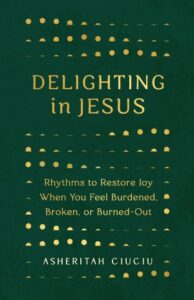
John: Yeah. There’s so much to be learned in the valley and, uh, we’re glad to have Asheritah Ciuciu back with us today. Uh, she’s a former missionary kid, and a mom, and a wife, and founder of an online ministry called One Thing Alone Ministries, which helps overwhelmed women find joy in Jesus. And Asheritah is also an author, and she’s written a wonderful book called Delighting in Jesus: Rhythms to Restore Joy When You Feel Burdened, Broken, or Burned Out. And we’ve got details about Asheritah, that ministry, and this great book online at FocusontheFamily.com/broadcast.
Jim: Asheritah, welcome to Focus. Welcome back, really.
Asheritah: Yeah, thank you so much for having me back.
Jim: Yeah.
Asheritah: It’s good to be here.
Jim: Good to have you. Let’s start with that idea of One Thing Alone. Uh, what is it? What does that, uh, online experience do for somebody?
Asheritah: Yeah, yeah. Well, the concept comes from, uh, Martha and her interaction with Jesus-
Jim: Mm.
Asheritah: … where she’s doing all the things, super busy, and trying to get everything just right.
Jim: Mm-hmm.
Asheritah: And she misses the gift of the presence of Jesus right there with her. And Jesus looks and says, “You are overwhelmed, and busy, and bothered about so many things, but only one thing is needed.” And that was my heart, um, when I started this years ago, is that for me, Jesus would always be that one thing. He would be the, the grounding center of my life. He would be the source of my joy and delight, amid everything else that’s happening. And that’s my heart, is to encourage women in the church to keep their delight in Jesus.
Jim: Yeah.
Asheritah: To make Him their one thing alone.
Jim: Well, let’s talk about the early twenties-
Asheritah: Right.
Jim: … and what was happening in your family, and that may have been an early dose of this is real life. What was going on then?
Asheritah: Yeah, so I grew up in a missionary family. You mentioned that. And loved Jesus from an early age. My parents modeled for me what it looks like to serve the Lord. Um, and yet what wasn’t visible was what was happening behind the scenes, behind closed doors. Um, and it wasn’t until my early twenties when my father walked out on us.
Jim: Mm-hmm.
Asheritah: Um, not just on his marriage, but on his children, disowning me on the way out the door. And this is the man who, (laughs), um, led me to Jesus, the man who baptized me, who taught me how to read my Bible, who taught me how to use a Greek lexicon and-
Jim: Wow.
Asheritah: … do word searches. And, um, really brought me alongside him in ministry and mentored me in ministry.
Jim: Mm.
Asheritah: And so for him to walk out and just cut off any ties, um, was an earth-shattering moment.
Jim: It had to be. I mean, that’s devastating. The, the internalization of that is feeling, I would think, feeling like worthless. Like he’s not even taking me into account or your mom into account. What was that feeling like?
Asheritah: Hmm. I think it was disbelief at first.
Jim: Yeah.
Asheritah: Um, my mom and I spent months praying for his return, praying for repentance, for restoration. And, um, after that initial period of disbelief was anger that God would allow … You know, as, as we began to unpack what had happened, and I started going to counseling and recognizing some of the dysfunctional systems that were part of our family, um, and learning this is actually not the heart of God, our father toward us. This is not what God wants for His children, is to be hurt this way. Started feeling anger toward my father, but also toward God. Like how can you let-
Jim: Mm-hmm.
Asheritah: … someone who can abuse power and hurt people to also preach the gospel? So in my early twenties, it was also what we would call now deconstruction.
Jim: Yeah.
Asheritah: Because I was trying to figure out what part of all of this that I grew up with is real? If the person who’s supposed to most represent God, the heart of the Father and his love for me can turn his back-
Jim: Mm-hmm.
Asheritah: … and disown me-
Jim: Yeah.
Asheritah: … will my Heavenly Father do that as well?
Jim: Let me ask you. ’cause that’s, I mean, that is humanity. That’s our experience. And this idea that if this part is not true, then are the other parts not true about faith? H- how did you as a twenty-something daughter wrestle through that and come to a healthy conclusion versus the deconstruction saying, okay, it’s all a farce?
Asheritah: Yeah. I got some good advice from our chaplain. I went to a Christian college, and the chaplain was addressing the whole student body knowing that this is part of, I think the growing up process for anyone who grows up in a Christian family, is making your faith your own. And he was saying, if you find the ground beneath your feet crumbling, then back up and keep backing up until you’re standing on solid ground.
Jim: Yeah.
Asheritah: And then from there, allow God to rebuild and to lead you in His truth.
Jim: Yeah.
Asheritah: And so I had to back all the way up to what, what is fundamentally true that I can hold onto. And it was that even if my father walked away, God will never turn His back on me.
Jim: Yeah.
Asheritah: That God is the perfect father, that His love endures forever. That He’s not an angry father, but rather a God of compassion, and mercy, and tenderness. And God in His kindness surrounded me with community that, um, encouraged me to keep seeking His heart and scripture, who were able to help me disentangle my childhood and those experiences and saying, no, that is not the heart of God for you. That I’m so sorry that happened, um, so much in my twenties of just kind of backing up until I found that solid ground in God’s Word.
Jim: Yeah.
Asheritah: But especially the heart of a father who delights in His children.
Jim: You know, what’s amazing about that, that is humanity. You look at the Old Testament and certainly in the New Testament too, such twisted stories.
Asheritah: Mm-hmm.
Jim: I mean, these are really dysfunctional people-
Asheritah: Mm-hmm.
Jim: … because they’re us.
Asheritah: Yeah.
Jim: They’re not extraordinary. These are normal men and women of the Bible that had difficulty, King David, you know, uh, an adulterer, a murderer. I mean, those things just are in us as humans. It’s called sin, right? But the remarkable thing that I see in your story is your ability to separate those two. And I think this is the greatest difficulty for each one of us, is how to understand the bad things, the hypocrisy at times, but how to hold on to God’s truth.
Asheritah: Mm-hmm.
Jim: And so many people jettison all of it, and they don’t make that distinction that human beings are gonna let us down, but God is solid, rock solid, and His Word is true, but we don’t see it always demonstrated through His people, and therefore we check out. So speak to that person that’s in that moment right now. They’re going, yeah, you know what? I lent that guy a thousand bucks and he never paid it back.
Asheritah: Yeah.
Jim: And he called himself a Christian.
Asheritah: Yeah. Well, I’d say, uh, whatever anger we experience toward the hurt, um, that happened either to us in the church or to our loved ones in the church, um, God’s heart breaks so much more in those situations. Um, and it was just so healing for me as I continued studying scripture to recognize that, um, again and again, God’s anger is shown toward those who are in positions of power and abuse their power to hurt those who were entrusted in their care. When you look at the prophets and how they speak against the kings and the leaders of Israel, it’s almost always like you have turned your back on what God has commanded you to love Him, to love others. Looking at the heart of Jesus in the gospels, how He is always reaching out to the outcasts, the marginalized, those who were not enough, those who were hurt. Um, that, I think that was what was so healing and restorative to my heart to say, if I was hurt by this, how was the heart of the good shepherd in that moment?
Jim: Mm.
Asheritah: If Jesus never leaves His children, He was with me in that moment, and in that moment, and in that moment. Um, and Psalm 23, I know has been such a comfort to so many people. Um, and growing up in church, I memorized it at, I don’t know, five or six, such an early age, right? But it wasn’t until I experienced that, my father leaving, and then the years that followed, um, that I learned that what it means, that even though I walk through the valley of the shadow of death, I will fear no evil. Not because it’s not bad and not because, oh, God’s gonna work it all for good like those … sure, but I will fear no evil because You are with me.
Jim: Mm-hmm.
Asheritah: And so recognizing that Emmanuel, God with us, that God’s spirit within us, that He is with us in the hurt, that the man of sorrows suffered on the cross on our behalf. I think He always lives to intercede for us, Hebrews says, He sees our weakness, He hears our cries, and even when we have no words, His own spirit will groan on our behalf. It was that companionship of Jesus with me that He held onto me.
Jim: Yeah. No, that’s so good. And the other kind of component of all of that, when you look at modern Christian leadership, churches, whatever, you know, the very character of God is humility. I mean, and it’s one of the things that seems so elusive to the Christian community today. Maybe it’s the Western overlay that we have high achiever, but the very character of God being humility, and His desire for us to know Him that way, uh, that’s, that’s what you learned, if I could be that bold.
Asheritah: Right. Right. And that was, I think why I was saying the, the hardest moment for me was actually a few years ago because it felt almost like whiplash, um, seeing what was happening in the evangelical church in America, all the scandals that started hitting-
Jim: Yeah.
Asheritah: … the headlines, kind of, I, I guess to use the word term, like triggered.
Jim: Uh-huh.
Asheritah: It kind of brought up those old wounds again that, oh, it wasn’t just my family. This is happening-
Jim: Yeah.
Asheritah: … in churches around the country and, and missionary families, and pastors families, and, and churches. And then in, in 2020, 2021, it happened in our own church, uh, where the place where I felt safe, and I felt held, and that I belonged, um, went through a crisis, and our senior pastor was investigated for abuse of power for numerous things that just patterned the same way as I’d seen in my father.
Jim: Mm-hmm.
Asheritah: And I think that was why it just kind of bottomed out because it’s this beautiful community that held space for healing, even that is not safe anymore. (laughs)
Jim: Yeah.
Asheritah: Where do I go? And how is this happening in the church? And God, don’t you care? Don’t you see what’s happening? How are you just sitting by and doing nothing? And that was that moment of, um, the dark night of the soul.
Jim: Yeah. You refer to it like an emotional breakdown. Was it on that par, or how, how did it affect you so deeply?
Asheritah: Yeah. Um, I mean, there were so many factors leading into this. Uh, physically I had been running at a pace that was not sustainable in ministry, and publishing, and trying to pour into everything else while this was happening. And then COVID.
Jim: Yeah.
Asheritah: It was just so many layers.
Jim: Right.
Asheritah: Um, so emotionally it affected me. Like I would read a headline of an- another pastor, um, who had sinned and, and disgraced, and it was like four days afterwards, I would just enter this slump. Um, but yeah, physically, mentally, emotionally, even spiritually at that point, was just this rock bottom moment, and there were days when I didn’t wanna get outta bed.
Jim: Yeah.
Asheritah: There were days when I would maybe make it through the morning and then collapse on the couch, and my husband was concerned, my mom was concerned.
Jim: Mm-hmm.
Asheritah: They were both like you, we, this is not like we need to do something here. (laughs).
Jim: Yeah.
Asheritah: We need an intervention.
Jim: Well, even noticing being stuck is so critical with a loved one, somebody in your immediate family. I mean, it’s hard to recognize those things, like what is really going on here? So I applaud your husband being able to say, “Are you okay?”
Asheritah: And I think so many of us, um, whether you’re in a position of serving in the local church or leadership, or women in general, I think feel the compulsion to keep pushing on and keep pressing on. Like, I can’t slow down. I can’t-
Jim: This is back to Martha.
Asheritah: Yeah.
Jim: Totally.
Asheritah: If I slow down, everything’s gonna fall apart. Which I think at the root of it reveals a distrust in God.
John: This is Focus on the Family with Jim Daly, and our guest today is Asheritah Ciuciu. And, um, she’s sharing very candidly about some of her challenges in life, and how she found Christ, uh, to be sufficient in, uh, meeting those. She’s written a book called Delighting in Jesus: Rhythms to Restore Joy When You Feel Burdened, Broken, or Burned Out. And, uh, we’ve got, uh, this book and other resources to help you in your struggles at our website, and that’s FocusontheFamily.com/broadcast.
Jim: Asheritah, let me ask you this, again, I’m delving into, uh, areas that I maybe should not tread, not just for you, but just human experience. The disciple that you’re describing, like you know whether it’s control or discipline. Um, I’ve observed where people will move into that discipline, mistaking it for moving closer to the Lord.
Asheritah: Mm-hmm. Mm-hmm.
Jim: And it’s really just ringing true in my head as I’m listening to you back to Martha. We move toward the things we can control, and we confuse discipline for closeness to God. In other words, if I read the Word, and pray, and do these spiritual disciplines, then the outcome will be whatever.
Asheritah: Mm-hmm.
Jim: Rather than the rest. That doesn’t bring you rest. The rest in the Lord to say, okay, I’m my father’s daughter, meaning my Heavenly Father’s daughter. There’s a distinction there. I don’t know that I can describe it. Can you lift that up for me though?
Asheritah: Yeah. I’m so glad you brought that up, Jim, because that’s a lot of what I wrestled with. Um, because when I was going through these experiences that advice from Christians who loved me and wanted to help was, “Well, you just need to read your Bible more.”
Jim: The discipline.
Asheritah: “You just need to pray more.”
Jim: Mm.
Asheritah: “Are you going to church? Are you involved? Are you being discipled? Are you discipling others?” It’s all the things. And the truth is, I, I was. Now, there were seasons of my life where I felt like the Bible was boring, to be honest. I feel like we shouldn’t say that, but anyone who’s tried to read through the Bible in the year has gotten to parts of Leviticus, or Deuteronomy, or numbers, where it’s like, “How is this supposed to help? I don’t know.” And I found myself doing the things and still feeling this is not bringing refreshment, this is not bringing rest. Jesus says in Matthew 11, “My burden is easy and my yolk is light. If you come to me, I will give you rest.” And I’m like, but I’m doing all the things people are saying, where is the rest? Where is the refreshment? Um, and one day, I, I was reading this place where Jesus is looking at the Pharisees, the teachers of the law, and He’s saying, “You read your scriptures, you know them well, you study them, and you do well. And yet, those very scriptures speak of me, yet you refuse to come to me.” And I sat with that, and I thought, how many times have I read the scriptures and missed Jesus? How many times have I checked off like my reading plan? I did it, I read my three chapters, let’s move on with a day. And yet, I didn’t have a personal encounter with a living God in His Word, because I was just too busy going through the motions and doing the things.
Jim: Yeah.
Asheritah: And my prayer became, God, would you, would you teach me to delight in you? Would you open my eyes to see the wonder in your Word? Would you help me encounter you, the living Word, in your Word?
Jim: Yeah.
Asheritah: And He answers that prayer.
Jim: That linkage, and again, I’m gonna say something that might hurt, that linkage to me is pride.
Asheritah: Mm.
Jim: When we are doing the disciplines, and it may be so subconscious, we’re earning, and the Lord’s saying, nope, that’s not the way it works.
Asheritah: Mm-hmm.
Jim: I want you to rest in me, not work in me. Does that make sense?
Asheritah: Right. So what does that look like though?
Jim: Yeah.
Asheritah: Because I’m not saying don’t read your Bible.
Jim: Right.
Asheritah: (laughs), you know?
Jim: Read it with the right attitude.
Asheritah: Uh, I, I think part of it, what switched for me was to say, if Jesus says I no longer call you servants, I call you friends. What does it look like to nurture a friendship with Jesus? That was a totally different mindset to say, what does it mean to come to scripture? To say, I want to delight in the revelation of God that He has for me in scripture. To come to prayer and say, I want to delight in, in friendship and communication with God. That I would tell Him yes, but I would also hold space to listen to the good Shepherd’s voice, to listen to that still small voice. What does it look like to, um, engage in these spiritual disciplines in such a way that we are looking for Jesus in the practice of them, that we are encountering Him in a real and life-changing way?
Jim: Mm-hmm.
Asheritah: That is where He began to bring healing. Um, it’s in those things but different.
Jim: Yeah.
Asheritah: Focused on Him.
Jim: No, I love this. I mean, we could sit and keep talking.
Asheritah: (laughs)
Jim: You mentioned five rhythms in the book, five rhythms of joy. I think we need that hope. Now we’ve, (laughs), I think we’ve undressed our, our human nakedness here-
Asheritah: Mm-hmm.
Jim: … spiritually speaking. What are those five rhythms of joy that we find resting in Christ?
Asheritah: Yeah. Um, well, they’re all W words, because I’m a word nerd. (laughs).
Jim: Yeah. No, I love it. I love it.
Asheritah: Um, and the first one is worship. It is, um, delighting just in who God is.
Jim: If you’re carrying a heavy yoke, I have experienced, just begin to worship the Lord. Lord, thank you. Thank you for loving me. Just go.
Asheritah: Mm-hmm.
Jim: And you’ll be amazed at how that burden will lighten on your shoulders, on your heart.
Asheritah: Yeah.
Jim: It is true. I have done it, and I applaud it.
Asheritah: Yeah. It’s also, I think, um, recognizing that all of life is worship. It’s not just Sunday morning. It’s not just when we play a praise song in our car. All of … When I wash dishes and, uh, when I prepare a meal, when I fold laundry, if I’m presenting something before a board, or I’m sending an email, all of it can be done as unto the Lord. It, in friendship and relationship with God, C.S. Lewis talks about how every part of life can become a channel of adoration. That we can look at the sun and say, what must God the Creator be like if this ball of fire He made somehow reveals His glory, what does that say about Him?
Jim: Mm-hmm.
Asheritah: Uh, what about this baby that I get to hold that twinkle in their eyes. If I delight in them that much, how does the Father delight in me? Right. All of life then becomes worship.
Jim: Yeah.
Asheritah: My friend Hannah says that, uh, her favorite thing is eating a Reuben sandwich for the glory of God. (laughs).
Jim: (laughs) I can relate to that. I like that idea. So you have worship, and then word, and whisper, and wonder, and walk. Obviously, these are things in the book that we’re gonna encourage people to pick up. Uh, knock off one or two others. The, the-
Asheritah: Yeah. I mean, word and whisper. Whisper is prayer. Uh, we already mentioned. So I’m gonna go to wonder. And that is, uh, delighting in the gifts of God. And part of what, um, fascinated me as I was doing, not just studying scripture, but also in brain science, is how God wired our brains for joy. And when we deliberately look for the good, when we recognize the gifts of God in our lives, and we take time to thank Him for those gifts, and to recognize this isn’t just, uh, a pretty sunrise. This is the God of the universe who paints the sky with color, and then pausing to receive it as a gift, awakens wonder and awe, which brain scientists have, uh, demonstrated heals the brain, creates synaptic connections here in the prefrontal orbital cortex. That’s our joy center.
Jim: Yeah.
Asheritah: And moves us from the amygdala, from the place of fear and scarcity and, um-
Jim: Fight or flight.
Asheritah: … fight or flight-
Jim: Yeah.
Asheritah: … back to a place of peace, and stability, and serenity, and joy. Uh, and so I geek out on that in the book, but-
Jim: (laughs).
Asheritah: … recognizing even just every day I try to take time to say, what are the little sparks of joy? What are the small things that brought a smile to my face that James says, “Every good and perfect gift comes from the Father above.” And so can we receive that even in the midst of the hard, the burdens, the sorrow, we can begin to see God’s good gifts in our lives. And thank Him for that.
Jim: That is so good. You know, right at the end here, one of the challenges, and I feel this at times, you know, you walk with the Lord for decades and, uh, you know, you’re in the Word. I think the most critical thing is being in the Word and praying. Those are the intimate things, ’cause God’s gonna show you so many different levels within the Word. You can read a passage one year, and you come back and read it a year later, even months later, and it means something new. It’s not gonna, you know, change its entire meaning, but you’re gonna see it in a different way, different application. So the importance of doing those things. But I think over the decades, for those of us that are older, to keep that crisp, to be engaged with the Lord so that we’re not going, you know, 10 years ago when I read the Word regularly, I had a different sense of God than today when kind of the thorns of life have taken over. Would you agree with that?
Asheritah: Absolutely. And I, I think God delights in His children when we recognize that and then turn to Him and say, “God, would you stir up a hunger for your Word in me? God, Psalm 13, restore the sparkle to my eyes. I feel like I’m dying. Would you refresh my soul? God, would you renew my spirit with the joy of your salvation? Would you do this work?” And His answer is always, yes. I think the problem is we become complacent in thinking all there is to the Christian life is holding on and suffering until He brings us home. But God wants to restore His joy in us. He wants us to be filled with a presence of God’s spirit, with His joy and delight. He wants more for us, I think, than sometimes we want for ourselves.
Jim: Right.
Asheritah: As just humbly asking God, “Give it more of you, more of your spirit, more of your presence, more of your Word. More answered prayer. I want more.”
Jim: Yeah.
Asheritah: He says yes.
Jim: And that’s John 10:10, you know, where the thief comes, meaning Satan, comes to steal, kill, and destroy. But the Lord says, I have come that you would have life and life more abundantly. And that’s what you’re talking about. Man, we could, uh, just keep going on this theme, couldn’t we? This is such a great topic. Asheritah, thank you for being with us.
And let me turn to our listener. I hope you know Focus on the Family is here for you. Um, man, I’m genuine about this, sincere. And as I said at the top of the program, your relationship with God is so important, and we want to help you grow in your relationship with the Lord. If you don’t know where to start, we have a fantastic article called Coming Home that we will link to, and it will walk you through some of those first steps of becoming a believer in Christ, and help you better understand how to find your place in God’s family. Uh, we have helpful resources available to you, like Asheritah’s outstanding book, Delighting in Jesus: Rhythms to Restore Joy When You Feel Burdened, Broken, or Burned Out. It’s a wonderful guide full of biblical wisdom and heart to help you rediscover the joy you should have in Christ. And let me add this, um, last year alone, over 970,000 people said Focus on the Family helped them grow stronger in their faith.
John: Mm.
Jim: That’s, that’s almost a million people.
John: Yeah.
Jim: But we can’t do that kind of ministry without you. And you know, the engine here at Focus is powered by people like you, faithful listeners, John and Dena, Jean and I, to put the fuel in the tank here at Focus on the Family to further the Kingdom of God. So let me just ask you, won’t you partner with us today? Uh, give a gift of any amount and we can send you a copy of Asheritah’s book as our way of saying thank you for being in it with us to help minister to others.
John: Mm-hmm. Yeah. Partner with us today. Uh, when you call 800, the letter A, and the word FAMILY. 800-232-6459. Uh, when you have us on the phone, of course, uh, ask about, uh, that coming home article. We’ll give the link to you, and it’ll also be in the show notes. Um, and of course, Asheritah’s terrific book, Delighting in Jesus. Uh, again, our number 800, the letter A, and the word FAMILY. Or online, we’re at FocusontheFamily.com/broadcast. And coming up next time, we’ll share a very special episode of Adventures in Odyssey.
Buddy: That’s it. That’s why Dion is being so nice.
Zoe: Why?
Buddy: It’s his new heart.
Zoe: What are you talking about?
Buddy: Dion must have gotten the heart of a nice person.
Zoe: Whoa.
Buddy: You think I’m right?