




Preview:
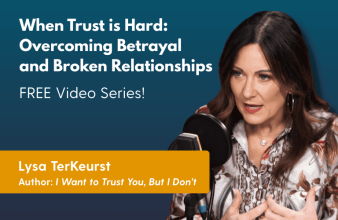
Lysa TerKeurst: Because it’s really hard to enjoy your life when you’re trying to control everything and everyone in your life.
Jim Daly: It won’t be joyful.
Lysa: It will not be joyful. And so the choice is, it’s not that we’re gonna get it right all the time, but the choice is to get it right right now while there is still time to instead of dreading your life, start enjoying your life.
Jim: Yeah.
Lysa: And start surrendering to God that which is outside of your control.
End of Preview
John Fuller: Well, that’s Lysa TerKeurst, and she joins us today on Focus on the Family with Jim Daly. And I’m John Fuller.
Jim: You know, John, most of us probably wouldn’t describe ourselves as controlling. So often controlling people don’t know they’re controlling. (laughs)
John: (laughs) That’s true.
Jim: And there’s so many different environments when we talk about controlling. There’s work. I mean, I’ve said, you know, when you’re in this position, I’m responsible to the donors and the board. There’s a certain amount of control I need to exert to make sure the ministry’s moving in the right place and not feel bad about that. You know, “This is a direction or a change of course that we need to make, so let’s make it.” And people say, “Well, that’s very controlling.” But you need that. So there are healthy examples of control.
Then we get into marriage, and again, uh, that can be unhealthy. You know, if one of the spouses is overly controlling, out of fear perhaps. The good news is we’re gonna talk about this topic today with our guest in, in such a powerful and positive way for us to recognize those temptations for control, what drives it, the fear in us and other things. And then what do we do to move to a more biblical, godly perspective?
John: Yeah. Yeah, because so much of life can’t be controlled. (laughs).
Jim: (laughs)
John: Right?
Jim: Let’s hope not.
John: Well, Lysa TerKeurst is always popular when we have her here in the studio and you’re about to hear why. Uh, as the president and chief visionary officer of Proverbs 31 Ministries, she’s encouraged literally millions of women to strengthen their faith and their relationships. She’s written a number of books and, uh, one that we’re talking about today is called Making Peace with What I Can’t Control: Find Relief from the Exhaustion of Overthinking, Trying to Fix Others, and Wanting to Figure It All Out. And you can learn more about Lysa in this book at our website.
Jim: That is so good. What a great title.
Lysa: Thank you.
Jim: Lysa, welcome in.
Lysa: Thank you so much. I’m so honored once again to be with you guys.
Jim: At Proverbs 31 Ministries, you’re talking to so many women. What in this category of control are you hearing from them where they’re struggling?
Lysa: I think people, first of all, there’s a big section of people that wouldn’t necessarily, like you said before, Jim, they’re, they’re not necessarily saying, “I’m a control freak,” or, “I have control issues.” Um, and yet they’re walking around so exhausted from trying to manage everything that they are responsible to manage, but then also stepping over that line, managing other people, situations that they feel they want a certain outcome. All of it’s so very understandable. And I would say the vast majority of people, the root of their control is not power, it’s fear.
Jim: Mm-hmm.
Lysa: And I think when we start to really peel back the layers, we have to understand and take a look at there’s a paper-thin line between being a responsible person, which is really good, to being a controlling person. And so we have to examine where is that line and how can we address the fear-
Jim: Yeah.
Lysa: … that often drives these controlling tendencies that whether we know it or not, must be dealt with.
Jim: And we are gonna get into that, thankfully, because I think you’re right over ground zero when you talk about fear manifesting itself in control ’cause we wanna control the environment we’re in. But before we get there, this idea of control can be masked as something good, you know, that you care about others.
Lysa: That’s right.
Jim: You wanna help them get to a better place. And those are all noble things to be about.
Lysa: Exactly.
Jim: Talk about that, that you saw in yourself this justification for control that I’m just trying to help them be better.
Lysa: Yeah.
Jim: (laughs)
Lysa: Well, and not just I saw in myself, I still see it in myself.
Jim: (laughs)
Lysa: And so-
Jim: All of us have some of this.
Lysa: Yeah. Yeah.
Jim: Especially as Christians. Y-
Lysa: Yeah. You know, when I, I went through in my first marriage, just complete betrayal and devastation, I didn’t realize that I was working overtime to try to manage another person. I truly felt like I was trying to save my marriage. I was trying to save my family. I was trying to save this man that I had been with so long. I didn’t understand, I just didn’t have the language or the context that what I was actually doing was hindering him from hitting rock bottom and realizing that he had a Savior, but it wasn’t me. And sometimes I think in a desperate attempt to save another person, what we don’t realize is we’re actually stepping in front of the very consequences that could-
Jim: Mm.
Lysa: … actually help them. It’s only understandable that we do everything that we can to try to talk them into making different choices, to try to prevent, you know, certain outcomes. And, you know, it’s also very understandable. So if you’re in that place, you know, before we even start talking about what needs to be done, I just wanna say I get it. And here’s another big category, parents of adult children, you know?
Jim: Teens too.
Lysa: It… Yeah.
Jim: (laughs)
Lysa: Teens too. It’s like, you know, we, we see things so clearly because for me, I’m bringing 57-year-old wisdom into a scenario where there’s 20 and 30-year-olds making decisions. My kids are great kids, but also there are certain things that I’m like, “Oh, no, no, no, no, no. Don’t do that. Don’t do this.” And it’s not because I wanna control them. It’s because I wanna help them. But help taken too far can really get us in trouble.
Jim: And I think the challenge is knowing where that line is, like you said. Uh, it’s so hard, um, to give advice. You know, I, I’m thinking of the scripture where the Lord, they’re out on the, the sea and the storm is going and He’s sleeping. And the disciples are like, “Man, come on, this is dangerous. This is life-threatening.” And then He calms the storm and… But it, it’s mentioned in scripture that they kind of woke Him up. It’s that kind of thing. Uh, some people, let’s say spouses, may look at that and say, “You’re disconnected from reality, man. You should be a controlling in this situation.” Like the Lord should have known to wake up and calm this storm in that setting. But with a teen child who’s having struggles or an adult child, there’s a certain amount of wisdom and control you wanna apply, but in the end, you gotta let them be the Lord’s, right?
Lysa: Mm-hmm.
Jim: That sounds hard and calloused.
Lysa: It is very, very challenging. But here’s that paper thin line, I think let’s just go there, between responsibility and being controlling. When I am being responsible, I manage all that is within my ability to manage, to control. But regarding other people, I don’t step over that line and also try to manage them. So being responsible is I am gonna manage what is within my ability to manage, but regarding the outcome, I must trust God.
Jim: Yeah.
Lysa: And I’ve made peace with the fact that ultimately, I have to trust God. If I’m being controlling then, controlling is I’m gonna manage everything that is within my ability to manage and I’m also gonna manage everything that is really outside of my ability to manage because regarding the outcome, I’m only willing to accept the outcome that I think is best.
Jim: Yeah.
John: Mm.
Jim: There’s so many behaviors that the Lord warns us about, fear being one of them. Fear not. Uh, you know, don’t live in that state of fear. One of the things for unhealthy control, in my opinion, as I’ve observed it, is when it starts from fear-
Lysa: Mm-hmm.
Jim: … rather than from a healthy place. Fear almost, when it rises, the only tool in a mom’s tool chest, a dad’s tool chest, a husband, a wife, whatever the application is you reach for control to increase control to lower your fear.
Lysa: Exactly.
Jim: And it doesn’t really help.
Lysa: Well, and here’s the tricky thing about it. Sometimes it does in a temporary sense. Sometimes our controlling efforts really do start to steer things in a direction that we want them to go, but it’s all temporary because ultimately, we cannot control how another person thinks, the narrative that another person believes, or what a person does or what they even say. So ultimately, we can’t control that. So even if it seems like it works for a little bit, our controlling efforts, it will eventually fall apart and leave us more anxious than we were before. Control is really fear disguised as a strength.
John: Mm.
Lysa: So think about that for a second.
Jim: Yeah.
Lysa: Control is really fear described as a strength. And I think sometimes we think there’s nothing we can do about fear. It just hits us. And we know the, we know the verses, you know, the go-to verse, of course.
Jim: Yeah.
Lysa: You know, “God did not give us a spirit of fear.” But I think it’s important that we understand fear can actually be broken into four distinct components that will give us a little bit more understanding of what we can do, practically speaking, about fear. The first component of fear you can’t do anything about. That’s the alert or the alarm. So that’s when you become aware of something and you become alert or alarmed. This is something that’s stirring up fear inside of me. That’s gonna hit you and you really cannot control that at all.
Then the second two components of fear, that’s where we can do some work. So one of them is memory. Instantaneously, when we feel that alert or alarm, our brain is gonna go back very quickly, it happens just like this, go back to another time, a memory that we felt the same feeling. And then it’s gonna interpret what we are experiencing based on the memories that we have.
Jim: Mm.
Lysa: Then the next component is perception. Based on what’s happened before, you know, and, and certainly if we’ve had previous trauma. Trauma is not just what happens to us. It’s the story we tell ourselves because of what happened. That’s perception. So memory and perception, that’s where work can happen. That’s where we can really make progress with our fear.
And the fourth component is either our reaction or our response. We wanna get to response, not always just feeling paralyzed because we feel a fear and then we react, right? Now, obviously, in the moment that I feel this feeling of fear, I’m not gonna go, “Okay, let me break it down now. What’s a previous memory?”
Jim: (laughs) Right.
Lysa: “What’s a perception?” That’s not the time to do it. The time to do it is when we don’t feel threatened.
Jim: Yeah.
Lysa: And we can really examine. So this situation is constantly stirring up this fear inside of me. So now let me go back. Where do I have other memories where maybe a worst-case scenario did happen? And what is the story, the perception that I’m telling myself because of what happened? We can do work there in a time where we’re not threatened. And if we do some work, then our chances increase to have a better response on the end. So in that moment, we more quickly tell ourselves a better story about what reality is.
Sometimes when you’ve been through worst case scenario after worst case scenario, you start convincing yourself and in that moment of fear saying, “Oh, this is absolutely gonna be worst case scenario,” when in reality, it probably won’t be. It won’t be best; it won’t be worse. It’ll hit somewhere in the middle. So that perception work-
Jim: Yeah.
Lysa: … the story that we’ve been telling ourselves is really important.
Jim: It, it’s so critical because, uh, that controlling attitude, especially in parenting, can really bring damage to the relationship.
Lysa: That’s right. And, you know, we talked a little bit about the role that fear is playing in all of this and the two components, memory, and perception. So this is where we can really take a step back. I, I encourage people to get a journal and start writing healthier perceptions in our journal. Like, “When I feel this, you know, it’s not always this.” And then put in some Bible verses. And like Nehemiah says, take counsel with yourself and then certainly bring it all to the Lord in prayer-
Jim: Mm.
Lysa: … and bring in scriptures too. All of that can help us in a moment where we’re preparing in times of strength for times of struggle.
John: I so appreciate that perspective. Our guest today is Lysa TerKeurst on Focus on the Family with Jim Daly and, uh, what a terrific book she’s written called Making Peace with What I Can’t Control: Find Relief from the Exhaustion of Overthinking, Trying to Fix Others, and Wanting to Figure It All Out. Uh, get a copy of the book from us here at the ministry. It’s focusonthefamily.com/broadcast.
Yeah, and Lysa, this is something generally in the culture that we’re seeing anyway of b- bubble-wrapped kids, you know, wearing bike helmets ’cause they might fall from their bike. I fell from my bike. I, I survived. So, uh, there is something in the Christian community where we think Jesus is the answer for this.
Lysa: Mm-hmm.
John: And you have a story of, of Judas in, uh, in the scripture that really highlights the d- the difference between saying, “I want Jesus to take care of this,” and then, “I really want Jesus to take care of this.”
Lysa: Exactly. Well, the story of Judas, you know, we have certain perceptions of Judas where, you know, he was the one that betrayed Jesus, sold Him out for money, and then of course we know what played out after that. And so oftentimes I would see the story of Judas and think, “Oh yeah, I know that.” So I didn’t ever dig deep or do any personal reflection of-
John: Mm.
Lysa: … what part of Judas’ mistake do I see my own self making?
Jim: Mm.
Lysa: Like, how can I learn something more specific from him? And when you boil it all down to it, you know, take away the greed. I, you know, that may have been a large part of it. But what I really want to focus on is Judas saw an outcome that he was very determined. And he decided that if Jesus wasn’t gonna cooperate with the outcome that Judas thought was best, then Judas was gonna force Jesus’ hand. Judas wanted Jesus to rise up and become an earthly king to overthrow the Romans and make the Roman oppression go away. That is good. That’s not a bad desire. Oftentimes, the outcomes that we want, they’re good. They’re not bad desires. The problem is that Judas decided to do it his way, and he was only willing to accept an outcome that he thought was best. And he didn’t pause and think that God could be doing something different and better. It, different doesn’t always mean bad. Different just means different. What Jesus’ plan was, He was gonna rise up, He was gonna become a king, but He wasn’t just after saving the people of the day. He was after eternal salvation. God’s plan was so much bigger-
Jim: Mm.
Lysa: … than what Judas could even fathom. And the most tragic part of Judas’ story is in the end, he tried to undo what he did. He took the money back and said, you know, like, “Take the money back.” And, um, he realized he couldn’t, uh, undo what he did. And then of course, it wound up taking him right to his death.
Jim: You know, there, there is such a big application-
John: Mm.
Jim: … for us there in terms of God’s plans for our lives-
Lysa: Mm.
Jim: … for those around us, our kids, et cetera. I mean, and it’s hard to say, “Lord, I truly give this all over to you.”
Lysa: Mm-hmm.
Jim: Which was Judas’s mistake. You’re absolutely right. But we do do that in so many different ways that we, we are saying, “I love you. I don’t trust you, Lord.”
John: Mm.
Jim: That’s what we’re really saying.
Lysa: Yeah.
Jim: And man, God has to say, “Okay, child, just give me some time. You’ll see why my plans are better and bigger.” You know, so many testimonies of alcoholics, addictions of all kinds that end up in a, in a godly place where the person is saved. Not everybody has that experience. But you sit there and go, “The, the valleys that I had to go through, I’m so grateful for-”
Lysa: Mm-hmm.
Jim: “… because that’s what ultimately brought me to the Lord.”
Lysa: Absolutely.
Jim: And, but that is hard. It’s hard for a parent to say, “Okay, Lord, have your way with my child.”
Lysa: Yeah.
Jim: “‘Cause I’m gonna trust that you’re gonna bring him to you.”
Lysa: But in the end, you know, we have to remember when we release a loved one, when we release a child into trusting the Lord, you know, we’re releasing them to the Lord, we’re not releasing them to a cliff to fall over. We’re, we need to mentally have this picture. We are releasing them into the arms of God, and that’s the safest place for any person to be. Now, will we always get the outcome that we want? Absolutely not. But regardless, we can’t control the outcome anyways.
Jim: Mm.
Lysa: So why not take that step and release them into the arms of the Lord and let the Lord carry what was never yours to carry?
Jim: Yeah. And also in that respect, it, it’s not saying don’t be engaged.
Lysa: Absolutely.
Jim: You know, sometimes as Christians, we live on these switches, you know?
Lysa: Yeah.
Jim: “Lord, he’s all yours, and I’m not gonna talk to him again.”
Lysa: Yeah, we don’t wanna live extremes like that, right?
Jim: Right.
Lysa: We want to be responsible.
Jim: Right.
Lysa: For example, like the riding the bike thing, it is responsible to tell our kids to put their helmet on. It is responsible to give them a safe path to bike. It is responsible to, you know, let our kids get outside and have some fresh air and, and all of that. But can we ultimately control that no accident will ever happen? No, we can’t.
Jim: Yeah.
Lysa: And so we can do all that we are responsible to do, and then once we’ve done that, we have to rest and trust in the Lord. That doesn’t mean disengage. Stay engaged. Just don’t be controlling.
Jim: Yeah. You know, this idea of helper and fixer, I think Jean and I represent this. She is a helper. I’m a fixer. And, uh, we can get into trouble with that.
John: (laughs)
Jim: Um, and you have a similar story that we helped a friend with a car loan-
Lysa: Mm-hmm.
Jim: Um, and it didn’t go well.
Lysa: Right.
Jim: But, uh, what, what was your story and your experience with that?
John: Uh-huh.
Lysa: Yeah. So, you know, I’m a very tenderhearted person. And compassion taken too far, I’ve learned in therapy, is codependency. “I need you to be okay so I can feel okay. So how can I make you okay because I wanna feel okay, okay?”
Jim: (laughs)
John: (laughs)
Jim: I think I followed that. (laughs)
John: Yeah. (laughs)
Lysa: Yeah. And so, you know, sometimes my compassion will, will run ahead. And, you know, if I have something, example, if I have the money to go help another person, I sometimes feel compelled to do it. And I know this about myself, so I have to watch it. Because what can often happen is if we try to step in and rescue that person… If I wanna give them money as a gift and it’s not irresponsible for me to do that, then give it as a gift. But I would really caution you about giving money to someone who has already proven themselves irresponsible with money. Because when you do that, what’s gonna eventually happen if you expect them to pay you back, it’s gonna go bad really quickly. If they’ve already proven themselves not responsible with money, they’re not gonna suddenly, because now you give them more money, it’s not gonna suddenly make them responsible with money.
And that’s kind of the trap I got in. And the situation started off, it felt so good in the moment. Like I’m helping this person, you know, co-sign this loan. It’s gonna be great. It felt awesome. I felt like a hero. But then when it came time to expecting them to be responsible again when they’d already proven over and over and over to not be responsible, my expectations for them to suddenly manage this well, of course, they weren’t met. And it caused me so much angst and so much anxiety. And in the end, I was definitely not a hero. In their eyes, I became a zero. I became part of their problem, that I was always chasing them down for money, which really was not the case.
Jim: Yeah.
Lysa: And so it was a heartbreaking, hard lesson to learn. Now, again, am I saying never loan money to people? That’s not what I’m saying. I’m saying don’t enable somebody who’s already proven that they’re gonna be irresponsible. Don’t go into it thinking you’re gonna be the savior. They have a Savior, but it’s not you.
Jim: Yeah.
John: Mm.
Jim: But it is so hard to pull back for their best interests.
Lysa: Yes.
Jim: ‘Cause you wanna feel good about yourself, right?
Lysa: Yes. And the thing is, can you do… Like here’s what I encourage people. Okay, you wanna help and you wanna take the risk? Totally your choice. The control police, they’re not gonna come swarming in on you and give you a big hand slap. Nope, you know. But do you have to take it to an extreme of solving the big problem? Or could you come in and solve part of the problem out of your compassion, out of your love for them? You know, do you have to give them all the money, or could you come in and offer them a gift of relief that’s a temporary, you know, solution, not to the big problem, but to something more immediate today?
Jim: Yeah.
Lysa: And so I’m not saying draw hard lines here. I’m not saying to, you know, be suddenly like anti-people. I’m saying be wise about what it is really costing you.
Jim: Be aware.
Lysa: Be aware-
Jim: Yeah, that’s good.
Lysa: … of the emotional wear and tear.
Jim: You talk about flipping the script, and I think this might be… And day one here. We’re gonna come back next time if you’re willing-
Lysa: Absolutely.
Jim: … and, uh, talk more about this topic. But you talk about flipping the script, replacing thoughts like, “I can’t believe this.” Like, “I can’t believe that couple would not manage this auto loan the way they need to,” right?
Lysa: Mm-hmm.
Jim: And you can, again, you can generate a lot of emotion about what they’re not doing to perform to your expectation, which is a form of control. But talk about flipping the script. Give us some of those examples of what we’re saying in our head that tends to float in the control person’s mind. (laughs)
Lysa: Absolutely.
Jim: Yeah.
Lysa: So often, and I’m not gonna put this on anyone else, I’ll put it on me. Often what I would say is, “I can’t believe they’re doing this.” And that shocks my system, almost sending me into fight, flight, freeze mode. Right? Or I’ll go, “I would never do this to someone.” Again, shocking my system, putting me in this place of extreme anxiety and almost disbelief that this is happening. So instead, I’ve learned to go, “Okay, this is very consistent with other behaviors that they’ve demonstrated before. I really shouldn’t be surprised.” Or, “This is hard. I can acknowledge that it’s hard, but I don’t have to let this derail me and my emotions the rest of the day. I can accept this because you know what? Again, very consistent with the behaviors they’ve been demonstrating for a long time.” It’s not that that second script fixes the problem, but what it really does is help me stay in touch with reality. This person has demonstrated this behavior before. They’re continuing to demonstrate it. And remember, mental health is a commitment to reality at all costs. We wanna stay in reality and so that we can really deal with the issue.
Jim: You know, uh, you wrote in the book, control is fear disguised as strength, which I think is great. That’s the neon sign. ‘Cause you think this is giving you strength or it’s coming from a place of strength, but in the end, it’s actually debilitating. Just clarify that right at the end of day one here, what, what you’re going after.
Lysa: Absolutely. You know, we want to rise up and do something about something that’s so bothersome. And it’s not that we shouldn’t do anything. We absolutely should be responsible. But we can’t do our part and their part and God’s part and then think we’re fully capable of doing all of this. Because the reality is anything we do will be very temporary. And if we’re not getting to the heart of what they really need, they really need to take responsibility for themselves, until we get to that place, all of our efforts are gonna be very temporary and in the end, probably very disappointing and disillusioning because ultimately the only person we have control over is ourself. God never calls us to control anyone else, but He says fruit, evidence of His Spirit in us is self-control. And really, that’s what we’re trying to get to here. We wanna be self-controlled enough that we know we can be responsible, we can be loving, we can be caring, but we don’t wanna be controlling.
Jim: Lysa, this has been incredible and we’re just kinda getting there, you know, the scratching of the surface. I wanna come back next time and continue the discussion if you’re willing.
Lysa: Sure thing.
Jim: And, uh, man, uh, let me turn to the listener. We all face circumstances we can’t control. And then what do we do with that, especially when it involves the people we love and care about the most? Typically, we tend to control those people the most, not the, the friend or the stranger at a distance. And, uh, Focus on the Family is here with great input from wonderful guests like Lysa and all the content from her and other people. Just think of us as your resource center in that regard. We will help you with that and hopefully give you biblical wisdom, practical guidance, and hope in Christ fundamentally.
If you’re struggling and need some guidance, get ahold of us. We have caring Christian counselors. You can start there. They’ll call you back and spend time with you. We have a referral network. If you need more time with a counselor, we’ll find somebody in your area that you can go and talk with.
We also have those trusted resources, articles, programs, videos, counseling support, and much, much more. The idea is don’t create an excuse that you can’t find help. Help is here for you. Just call us.
And if you can make a monthly pledge of any amount, we’ll send you Lysa’s book as our way of saying thank you for being part of the ministry and helping other people. We had one, uh, woman who wrote in, Connie. She said, “10 years ago, I learned I was carrying a stillborn child.”
Lysa: Mm.
Jim: “I turned to Focus on the Family and you helped me through one of the most difficult times of my life. Now, a friend I’ll be mentoring was diagnosed with cancer. I knew exactly where to turn for resources and support. God has used this ministry in my life again and again, and I’m so grateful you’ve always been there when I needed you.” There’s the evidence.
John: Wow.
Jim: And that’s such a powerful story. So get in touch with us. Uh, help us to help others like Connie to find their source in Christ. And if you can’t make a monthly pledge, we’ll send you a copy of Lysa’s book for a one-time gift as well. And man, I just, I hope you’ll do it today.
John: Yeah, your generosity really makes a difference in the lives of people like Connie. So donate today as you can or, uh, call to set up, uh, that initial consultation with one of our counselors. Certainly call to get a copy of the book, Making Peace with What I Can’t Control by Lysa TerKeurst. Our number is 800, the letter A and the word FAMILY, or stop by focusonthefamily.com/broadcast.
Well, thanks for joining us today for Focus on the Family with Jim Daly. I’m John Fuller, inviting you back as we continue this really important conversation with Lysa TerKeurst and once again, help you and your family thrive in Christ.