

John Fuller: Monsters under the bed, being teased at school, fear of the dark, a best friend moving away. You know, kids are no strangers to big, difficult emotions. And these can be really challenging for parents to navigate. Welcome to Focus on the Family with Jim Daly. I’m John Fuller, and today we hope to give you the tools you need to help your child manage difficult emotions and ultimately to bring them closer to God.
Jim Daly: Monsters under the bed, that one gets me.
John: (laughs)
Jim: I think I was afraid of that o-
John: I, uh-
Jim: That was a big one. Every bed had a monster under it.
John: It’s funny how you can get under the covers and feel safe.
Jim: But the good news-
John: But, yeah.
Jim: … I think I grew outta that by 18.
John: (laughs)
Michelle Neitert: (laughs)
Jim: (laughs)
John: I’m glad for that. Uh-huh.
Jim: But, you know, these things do affect children. And, um, on the one side we can laugh at it now, because we know as adults, older adults, that those things have no power, those are all imaginary things.
John: Mm-hmm.
Jim: But oftentimes for some children, I mean, they both battle the imaginary fears, but also some true fears. And, uh, we want to equip you as a parent. Uh, maybe you’re a grandparent, you could pass this along to your adult children to, uh, talk with their kids about. But this is a, an area that I think more kids need tools to be able to navigate these emotions.
John: Mm-hmm.
Jim: And they’re not too young. You know, my mom died when I was nine, and I can tell you guys, it was so important to hear more. Everybody cut me out of the information loop.
John: Mm-hmm.
Jim: But you sense it, you… Children have far more insight than adults realize, and you need to help them manage those insights.
John: Mm-hmm. Yeah, so the goal of today’s show, as you said, Jim, is to give parents the tools so they can equip their kids. And Michelle Nietert is with us, and, uh, she’s a professional counselor, an author, speaker, podcaster, wife, mom of two.
Jim: (laughs)
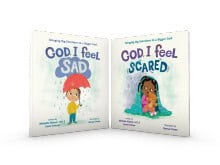
John: And, uh, her podcast is called Raising Mentally Healthy Kids. And she’s written a couple of books that we’re gonna talk about today. Uh, the titles are, God, I Feel Scared, and God, I Feel Sad. And of course, we have details about Michelle and, uh, these great books at our website. The link is at FocusontheFamily.com/broadcast. And with that, enjoy this Best of 2025 episode of Focus on the Family with Jim Daly.
Jim: Michelle, welcome to Focus on the Family.
Michelle Nietert: Thanks for having me.
Jim: Yeah, it’s good to have you. And from Texas, we have many friends in Texas.
Michelle: Yes.
Jim: Yeah, and that’s good. And uh, you’re living wh- wha- right outside where?
Michelle: Well, the counseling center is in Allen, outside of Dallas. And then we live in a little tow… Uh, well, it used to be a little town, now it’s gotten a little bigger, called Wylie, Texas. Near Plano-
Jim: Wylie, Tex… I just love it-
Michelle: Everybody knows where Plano is.
Jim: … Wylie, Texas. It just sounds right.
John: I- it’s got a sound to it, doesn’t it?
Jim: (laughs)
Michelle: (laughs)
Jim: Let me ask you, you know, as adults we aren’t always comfortable with our emotions. Some of us, I think especially men, w- that’s one of the clubs we get hit with. I definitely have been hit with that club. You know, th- i- it just takes a lotta energy and thinking for us to get our emotions out there in the table. Then at the end of the day we’re going, “Why did I do that?” But for kids particularly, we can be a little more honest as children. We do say things kinda just out there, don’t we, as children?
Michelle: We do, because children’s filters aren’t as well developed a lotta times. The world hasn’t started, um, blocking some of that in their lives. And so therefore, they are more apt, some, to express their emotions, and really, especially in the, you know, the preschool years, to show you all the different emotions and all the different intensities of them. And then they go through these different hormonal spikes and their brain changes, and then they continue to just oscillate between different levels of emotional intensity, for sure.
Jim: When do you… I mean, you’re clinically trained, you’re, uh, taking care of kids all the time in your practice.
Michelle: Mm-hmm.
Jim: When do kids begin to, kind of, express these emotions? And then when do you see, as a clinician, when it becomes an issue? What w- how do you diagnose that?
Michelle: Well, I teach our counselors two words, frequency and intensity. So, those are the things we wanna look at at any age. We love that kids are saying “I’m scared,” because they’re developing emotional vocabulary, which we want. And you’re right, previously generations didn’t want emotions to be on the bus. Even psychology tended to lean towards logic. Even Christian work did. And then we moved into this area where we are now, where emotions are almost running our bus, right? But what we really want to do is, like, empower kids to let God and them drive the bus, but have emotions on the bus.
John: Mm-hmm.
Jim: Yeah.
Michelle: And it’s really, really important that we do that. And so we wanna help kids gain perspective, for sure. You know, “On a scale of 1 to 10, how scared are you?” is a great question-
Jim: Yeah.
Michelle: … for a parent to ask.
Jim: Yeah. Those are really good. I do say a-scared on purpose. I think I d- used that as a (laughs)-
John: (laughs)
Jim: … grammatically incorrect as a child.
Michelle: (laughs)
John: You were identifying-
Jim: A-scared. I don’t know why children lean to a-scared, but-
Michelle: Mm-hmm.
Jim: … let me ask you this. Um, some common mistakes that parents make trying to help their kids process their emotions, what are they?
Michelle: Well, the f-
Jim: The mistakes that we make.
Michelle: … the first one is to ignore emotions or try to shut them down. And granted, you know, sometimes we’re in a hurry and we don’t have time for the full meltdown, and we have to help them cope (laughs).
Jim: What does that sound like? Yeah.
Michelle: A lotta times it’s, “Just, we gotta go. I don’t care if you’re sad,” if you’re in a hurry. Or it may be, “You don’t even know what sad is. Let me tell you what sad looks like.”
Jim: So, discounting?
Michelle: Yes, discounting it. And that is… If we do that young, this is the one thing I really want parents to understand, you will lose the opportunity to be the emotional compass in your child’s life. Because if they realize that you don’t care about that and you’re not approachable about that, they’re gonna find other sources to be their emotional compass.
Jim: Wow, that’s powerful.
Michelle: And you don’t want that.
Jim: Yeah. That is so powerful.
Michelle: Yeah.
Jim: Um, and in that regard, I mean, w-, uh, we discount kids so much, you know, as parents, th- what they have to say can be… You know, the kid… Were you this kid, John, that ask why all the time?
John: (laughs)
Jim: “Why does it work that way?”
John: Hmm.
Jim: “Why does it do that? Why does it ring? Why does it…” I mean, it’s just that annoying kinda thing. And if we’re not careful, especially as Christian parents, if we’re not careful, you do drive your child away because you don’t feel safe to them. And as adults, we don’t even realize that-
John: Mm-hmm.
Jim: … that we’re promoting that kind of distance in our relationship with our child.
Michelle: Yeah.
Jim: So let me ask you for the moms and dads right there, I mean, what is a better way when you’re pressed with time, you gotta get out the door, and your child’s saying, “I don’t feel good right now,” right? You know, “I feel sad right now.” What should they say?
Michelle: Well, the first thing I think we need to do, depending on the age of the child, is get on their level.
John: Mm-hmm.
Michelle: And give, uh, us do a parental pivot. ‘Cause we’re usually juggling a lot of things too, and trying to get ourselves out the door, if it’s morning time and I’m working with families. So, we want to get on their level, if they’re little, and say, first, just validate the feeling. Recognize what they’ve said, “I know you feel sad. And I understand that, but we still have to get to s- preschool, school.” You know, sometimes I think, “But you still have to go to work today,” right?
John: (laughs)
Michelle: So, and that’s happened. I mean, I lost my dad last year to cancer-
Jim: Mm-hmm.
Michelle: … and I s- I still had to do some things even when I was feeling sad. So I think it’s also important that we let… There t- there’s a time and a space to… I took a break, you know? And we wanna not let emotions shut us down, but let us take some space. But then we also have to teach our kids the resilience of learning… not to white-knuckle it all the time, but to learn how to push through emotional distress sometimes to be able to do things-
Jim: Mm-hmm.
Michelle: … and then come back to that emotional distress at a more appropriate time. Sometimes parents never come back, and that’s the issue. We can get them moving forward, but especially if there’s something going on. The other thing, real quickly, I wanna say is that we wanna name it, and then we might wanna ask them, “Where are you feeling that in your body?” And then lastly, ask them, “What would you like to do to let go of some of that?”
Jim: Hmm.
Michelle: And then we’re empowering them, too, to manage their emotions. Or sometimes, “How could God be involved in your sad and help you through it?” That’s a great parental question.
Jim: Yeah, and a good way to connect that. Because that feeling-
Michelle: Yeah.
Jim: … is gonna be there throughout their life-
Michelle: Yes, unfortunately.
Jim: … given circumstances that will pop up. Uh, you had an experience with your own family loss, uh, where your husband’s brother and sister-in-law tragically passed away of cancer. I’m sorry-
Michelle: Yeah.
Jim: … that that happened.
Michelle: Thank you.
Jim: They had to be young.
Michelle: They were. J-, um, they were… Well, she was in her forties-
Jim: Yeah.
Michelle: … and he was in his fifties. We all had our kids young, I mean old (laughs).
Jim: Yeah.
Michelle: We had h… We were old when we had our kids.
Jim: Forties and fifties are young, it’s okay (laughs).
Michelle: They are young. They’re young to me now, it’s kind of changed. But, um, yeah, Jen was actually Drew’s twin sister.
Jim: Yeah.
Michelle: And, um, within two weeks, she and Dwight were diagnosed with cancer. And they died two years apart with cancer, leaving behind three kids under 10.
John: Hmm.
Michelle: And my children spent the first four and a half years with them moving in and out of our home, as they were… Sometimes they just needed to take care for themselves. So, we actually bought a bigger car ’cause we needed more space for five kids.
Jim: Sure.
Michelle: But it was really hard on my youngest son, Nolan, who didn’t have a lot of language at that point.
Jim: Yeah.
Michelle: And I di… You know, the enemy can do really disastrous things in kids’ minds during that time, and that’s why we wanna ask good questions to them. Because Nolan thought that it was common that both parents died, so he had this… Uh, he was having these horrible nightmares, I found out after he… We went to the doctor with a stomach issue, and the pediatrician teased me.
Jim: Right.
Michelle: We’re on b… You know, small town, we’re on boards together. She’s, she usually tells me, take my counselor hat off and put my mom hat on when I walk in the door.
Jim: Yeah.
Michelle: But this time she’s like, “I wa- I na- I can’t believe I’m doing this with you, but can you put your counselor hat on? Take your mom hat off. I’m gonna read you a case.” And she’s reading him her notes, and I’m like, “He’s got separation anxiety.” And I looked at him and I said, “Are you afraid mom and dad are gonna die?” And he said, “Mom, almost every night I dream,” m- and my husband was traveling at the time, “Dad’s plane blows up, you have cancer, and I can’t find Sophia.”
John: Hmm.
Jim: Oh, wow.
Michelle: That’s devastating.
Jim: Yeah.
Michelle: And so we began to pray about that specifically, and I ex-, you know, I normalized the fact that most parents don’t die. And then we had to work on that separation anxiety. He was leaving school due to these stomach issues. And so the school counselor called me and she said… I used to be the crisis counselor for a school district. She goes, “This is kind of embarrassing because you’re the parent, but you’re the person I’d call in a situation like this.
Jim: (laughs)
Michelle: What do you want me to do?”
Jim: Yeah.
Michelle: And I said, “I want you to give him a job when I drop him off. Because when he sits in that gym, he thinks about leaving us. Instead, could he be your door holder or something where he’s interacting with kids?
Jim: Ah.
John: Mm-hmm.
Michelle: And that way he won’t start thinking about, you know, us dying or anything else. And then if he has… And my son’s pretty quick with his work, so if he gets downtime in the middle of the day and this starts, when he goes to the nurse, I need the nurse to send him to you. I need you to read him a book, do an activity with him, and then let’s see if we can get him back in class.
Jim: Yeah.
Michelle: Unless he’s running a fever, and then let’s send him home.”
Jim: No, and th- those are the good practical things you need to be mindful of. I- in fact, you encourage parents to listen intently-
Michelle: Mm-hmm.
Jim: … which can be a short stick for parents. ‘Cause we don’t always have time to listen intently to our kids, ’cause we’re not sure they’re gonna say anything that we think is important. But you wanna challenge that to say-
Michelle: Well, I think we need-
Jim: … if they’re expressing themselves, you need to hear it.
Michelle: I think we need to listen with our eyes.
Jim: Yeah.
Michelle: And that helps a lot. Because that directs our attention-
John: Mm-hmm.
Michelle: … and our affection a lotta times, too, because the eyes are the window to the soul. So that’s, a lotta times, what my, even… My children will even give that back to me now (laughing)-
Jim: (laughs)
Michelle: … sometimes as teenagers. “Mom, can you listen to me for a moment with your eyes?”
John: Uh-huh.
Michelle: You know? And that means, “Give me your full undivided attention.” And let me tell you what, if we want kids to feel significant in this world, and confident, one of the ways we do that is we see them. And that’s when we listen with our eyes, we tell them, “I see you.”
Jim: Yeah.
Michelle: Just like the Lord does with us. And we help them understand that, that the Lord always sees them too. And we’re the vessels and the source of that in their lives-
Jim: Yeah.
Michelle: … until they have that experience more maturely with Him.
Jim: You know, Michelle, uh, we sit at this table, John and I, and we talk to some smart people, some PhDs, and counselors, and psychiatrists. And so much of who we become is rooted in our family of origin.
John: Mm-hmm.
Jim: And what we’re talking about here are things that these children are gonna learn, that we actually learned too, uh, when we were kids. And that becomes embedded in us. It’s kind of our wiring, our l- if you use a computer term, right, it’s our programming.
John: Mm-hmm.
Jim: And some of life becomes how to undo those things that have been done, most of the time, I would say, without thought. Parents aren’t trying to-
Michelle: Mm-hmm.
Jim: … set up a young adult for failure. But that ignoring them, not listening to them, not counting their comments as worthy to be heard, those are devastating signals to a, a child. And that will become part of their fear structure. Most of the things the enemy will use-
John: Mm-hmm.
Jim: … spiritually against them as teenagers and young adults, right?
Michelle: Well, I actually experienced some of that in my own home growing up, uh, while my dad was a el- deacon and elder in the church. And I mean, my l- his last job was the head of pastoral development for MAF. He was a very godly man, but he had a horrible temper. And it was really outta control when he wasn’t walking with the Lord very closely when we were young. And so, I did have a huge impact with that in my own life. I was a very sensitive child, and he did not appreciate that always. And so we did have a, a lot of conflict, um, when I was young, and, and even I would say to go so far as to some verbal and physical abuse. Um, one thing, uh, that parents do that’s one of the biggest mistakes is when a kid is upset, we’re projecting future failure through that on our kids.
Jim: Oh, yeah.
Michelle: We need to be real careful with that. Who we become as we move into adults has a lot to do with our family of origin. But especially in the family of Christ, and I’m a great example of this, my parents hit the mission field in young adulthood, who we become can be greatly influenced by the family of Christ becoming new creations in our lives.
Jim: Totally.
Michelle: And I do not think ever, one of the things I say, even with my mental health, is our diagnosis doesn’t have to determine our destiny.
Jim: Yeah.
John: Mm-hmm.
Jim: I think in that context, though, the f- f- fair thing is that these things, potentially, can be the shackles that you have to, um, find the key, hopefully through-
Michelle: Yes.
Jim: … a relationship in Christ, to unshackle your emotional heart so that you can grow in the Lord.
John: Mmmm. This if Focus on the Family with Jim Daly and today on this Best of 2025 episode, you’re hearing from counselor and mom, Michelle Neitert, as she addresses mental well-being for parents so you can raise mentally well kids. And Michelle’s written a couple of great children’s books, God, I Feel Scared, and God, I Feel Sad, and we’re bundling those together and you can find out more at FocusontheFamily.com/broadcast.
Jim: Michelle, let me ask you this. I mean, thi- this is a serious topic. We’ve kind of put a cloud on some of this discussion. The lighter side of this, I think you have a Taco Bell meltdown experience.
Michelle: (laughing) Yeah.
Jim: This is so funny because this is where I lived when my boys were small-
John: Mm-hmm.
Michelle: Yeah.
Jim: … whether the store and the candy checkout or-
Michelle: Mm-hmm.
Jim: … you know, whatever. B-
Michelle: Yeah. So my, my daughter still doesn’t eat breakfast regularly, which is, I always ask her to, but you know… And this is part of what we learn as parents, there are battles to fight and there are battles not to fight.
Jim: Yeah.
Michelle: And there are things for our kids to learn on their own. And so I was, I told her, you know, we’re g- th… You know, I’m always telling the kids the plan, ’cause I’m that kind of personality. So, “We’re, I’m gonna drop you at school, we’re gonna go to Taco Bell. Your dad’s gonna take your brother from the soccer field, we’re gonna meet at home, and then we’re gonna go see your grandma,” right?
Jim: (laughs) This was Sergeant Lo-
Michelle: Yeah.
Jim: … Logistics right there.
John: (laughs)
Michelle: I’m, I am moving-
John: This is all diagrammed out (laughing).
Jim: (laughing)
John: (laughing)
Michelle: Yeah, I am moving this, this path along.
Jim: Go, go, go, go (laughs).
John: (laughs)
Michelle: And I go to pick her up, and as I’m literally in the parking lot, my husband calls and says, “Mom is headed to the hospital.” Um, we are not allowed to leave children unattended in Texas on a soccer field, so that changed what I needed to do. So, I picked Sophia up, and I was like, “Hey, you know, we can’t go to Taco Bell right now. We’ve got to go… We’re gonna end up at the hospital, but I’m gonna, we gotta go get your brother.” And she acts like I said, “Your grandma has just died.”
Jim: Hmm.
Michelle: You know, she is like, “I’m starvi…” I’m g- gonna be a little dramatic here. You know, “I’m starving. I can’t make it that long. I can’t go all the way to Wylie-
Jim: (laughing)
Michelle: … and then to the soccer field. And then you’ll talk to people, and then we’ve gotta get home.”
Jim: “I’ll starve to death.” (laughing)
Michelle: And I s- just-
John: (laughs)
Michelle: … you know, I just listened, and then I calmly said to her-
Jim: It’s only Taco Bell.
John: Yeah (laughs).
Michelle: Well, I said, “On a scale of 1 to 10-
John: Hmm.
Michelle: … how big is this, really?” And she says, “I know it’s a 2, but it feels like an 8,” you know?
John: (laughs)
Jim: (laughs)
Michelle: And so, and that’s so true. Isn’t that true in our own lives?
Jim: Yes (laughing).
Michelle: Don’t we have things that happen, and we’re like, you know, perspective-wise-
Jim: Uh-huh.
Michelle: … this is not the way my emotions feel. But our emotions can get ahead of us sometimes.
John: Mm-hmm.
Michelle: And that why, w- that’s why we can’t let ’em drive that bus. And we’ve gotta teach our kids that they’re gonna have ’em, but they just can’t run their lives. Now, I also wanna remind you, your children’s frontal lobes aren’t developed. You know, and so that’s gonna make a big difference in their ability to manage their emotions. So, what I ask of parents in family therapy is hard. It’s hard for me to do in my own home sometimes, and that is my expectation of you is you will be the calmest person in the room.
Jim: Hmm.
Michelle: And that means you must co-regulate with God.
Jim: Yeah.
Michelle: ‘Cause you need His peace, that passes all understanding, to anchor you so you can anchor them.
Jim: And that’s i- when you were saying that, when you said to your child about Taco Bell, and you said, “Well, on a scale of 1 to 10, w- how important this, is this to you?” that’s a brilliant comment.
Michelle: Oh, thanks.
Jim: And it’s just so funny that we, as parents, we don’t go there.
John: Mm-hmm.
Jim: “I told you, we’re not going to Taco Bell.”
Michelle: (laughs)
John: Match the emotions, yeah.
Jim: Let’s get down to a fight.
Michelle: Well, and guess what you just did? You mirrored the emotions.
Jim: Exactly.
Michelle: See, I instead kicked in th- the left side of her brain into the numbers so she had to think, and that shut down part of that right side of the brain that was over-aroused and over-emotional.
Jim: Right, it’s kind of irrational.
Michelle: Yeah.
Jim: Like, “You wanna go here? You wanna have a fight?
Michelle: Yeah.
Jim: Don’t you know I’m your mother? Don’t you know I’m your father?” (laughing)
John: (laughs)
Michelle: I grew up like that.
Jim: “I’m gonna win this fight. Let’s go.”
John: Yeah, mm-hmm.
Michelle: Yeah. And I grew up like that.
Jim: (laughs)
Michelle: But here’s the thing. I do love one thing, and it’s silly, Dr. Phil says this. He says, “Do you wanna be right? Or do you wanna be in relationship?”
Jim: Well, that’s a great question.
Michelle: And as a parent-
Jim: Boom.
Michelle: … I want to be in relationship. I’m usually right (laughs).
Jim: Yeah.
Michelle: But I’m gonna manage them in such a way that either I direct that well, or we take a break so our brains calm down, or I let them learn a little bit and let them, um… Because that drives them to the Lord too. The last thing we wanna be, you know, we used to have helicopter parents. Now we’ve got lawnmower parents, just plowing ahead. And I have really struggled with this with my daughter who’s about to go off to college. But I’m watching the fruit of this. You know, she… And this is another thing, we, all these things that we want for our kids’ emotional control, they’re fruits of the spirit.
John: Mm-hmm.
Michelle: Well, a two-year-old’s barely a seedling.
Jim: You’re right (laughing).
Michelle: You know? And a 14-year-old’s ba-, what, they’ve got a couple little grapes starting to bud? But sometimes we expect them to be vineyards.
Jim: Oh, yeah.
Michelle: And they’re not.
Jim: Yeah.
Michelle: W- and I’m not a vineyard yet, so it’s t-
Jim: Well-
Michelle: … it’s tough.
Jim: … and I think especially as Christian parents-
Michelle: Yeah.
Jim: … ’cause we have high expectations-
Michelle: We do.
Jim: … of our behavior, of their behavior.
Michelle: We do.
Jim: And so, we better see a vineyard, even though you’re two. I want fruit of the spirit.
John: Mm-hmm.
Michelle: That’s right. And the fruit of the spirit is something we sing about in preschool, and we learn to live out, hopefully, well as we age. It’s one of my gr-
Jim: Yeah.
Michelle: I’m grateful now, even though we went through a lot of fertility treatment, that I am an older parent, because there is hopefully more fruit.
Jim: Yeah.
Michelle: And when I start, when she and I, or he and I, ’cause I, one of each start rubbing on each other, that’s an indication to me that they need to go more to the Lord, I need to go to more the Lord, I need to be… ‘Cause here’s the thing I wanna do. I wanna plug into the spirit so I can be an extension cord of Him-
John: Mm-hmm.
Michelle: … to my kids and plug them in.
Jim: Yeah, that’s so good.
John: Mm-hmm.
Jim: Right here at the end, Michelle, let’s just cover this one thing. Um, it’s important to pray with your child, and specifically pray for those difficult emotional experiences. How do you do that, um, with your child? Not to freak them out or panic them.
Michelle: Mm-hmm.
Jim: But how do y-
Michelle: First of all, short and sweet. Let me-
Jim: Yeah. Okay, good.
Michelle: I’ll give you an example, okay? W- and the enemy can be really twisting with our words. One time my daughter looked at me, she was probably about eight, like I’d punched her in the gut.
John: Hmm.
Jim: Huh.
Michelle: And I, she was headed up the stairs, and I said, “Whoa, whoa, whoa, come back here,” you know?
Jim: (laughs)
Michelle: And I said to her, “What did you hear mommy say?” And she said, “That I’m the worst kid in the world and I never do anything right.”
Jim: Wow.
Michelle: And I said, “Oh, Honey, do you know what I said? I said these shoes have been here for five days. Do you think you could take ’em up with you ’cause I’m sick of looking at ’em.” But isn’t that funny that my tone of… ‘Cause 93% of everything we say is nonverbal.
John: Mm-hmm.
Michelle: So, what she received from that, and what the enemy twisted, I said, “First of all, those two thoughts would never enter my mind.
Jim: Yeah.
Michelle: You are God’s gift to me. And I delight in being your parent.” And then I said to her, “Let’s pray about this right now, ’cause I want to break this idea in your mind.” And so I just said, “God, I am frustrated. And I know Sophia felt the full weight of my frustration in this moment. But I pray that in Jesus’ name, she would know how loved she is even when I’m frustrated with her. At the angriest moment we will ever have together, Sophia will know that I’m proud of her and that she is loved because she is your gift for me. And Lord, help us to live that in Jesus’ name. Amen.”
Jim: Man, that’s good.
Michelle: Short, sweet-
Jim: Yeah.
Michelle: … to the point.
Jim: And it affirms-
Michelle: And still emotional today (laughs).
Jim: Yeah, it-
Michelle: A little bit.
John: Yeah, mm-hmm.
Jim: … but it affirms that child.
Michelle: Yeah.
Jim: That’s what’s so beautiful about it.
Michelle: Yeah.
Jim: And it really makes that distinction between, “I’m not attacking you as a person, I’m trying to shape your behavior,” and that’s different. And I think we, as parents, we fail to make that distinction for them so they know w- we’re not attacking them. W-
Michelle: Especially when we’re emotional.
Jim: Yeah (laughs).
Michelle: I think that… And they’re emotional.
Jim: Yeah.
Michelle: I think we miss that information, for sure.
Jim: Totally. Totally.
John: Mm-hmm.
Michelle: Yeah.
Jim: This has been great.
Michelle: Thank you.
Jim: And thank you so much. I, you know, I used to draw the scared, sad, uh, happy faces.
Michelle: Mm-hmm.
Jim: I didn’t know you could get a chart (laughs).
John: (laughs)
Michelle: (laughs)
Jim: I’m serious, I’m that dense.
John: (laughs)
Jim: But I used to draw these out with the boys and say, “How do you feel right now?” And they’d circle one, and we’d talk about it.
Michelle: Yes. We do that a lot.
Jim: But you got these great books, God, I Feel Sad, God, I Feel Scared. And I’m, you could probably just keep releasing these books into every emotion that, uh, children have.
Michelle: We’re looking at that. And we actually have one for older teens called Managing Your Emojis, which covers all for the emotions.
Jim: Yeah.
John: Hmm.
Jim: That’s a clever way to say it.
Michelle: Yeah, just t- to-
Jim: Yeah.
Michelle: … to help. And, and the thing I love about these is I have grandparents who are telling me, like, “I call my granddaughter,” and ’cause they’re latchkey kids, a lot of ’em, and so, “I call her, and we read one of these on FaceTime when she gets home together.”
John: Hmm.
Michelle: But she said to me, “I’m learning things I never was taught.”
Jim: Yeah.
Michelle: And I think that’s so beautiful. I couldn’t ask for the Lord to use this material in a better way.
Jim: Think of that.
Michelle: Yeah.
Jim: I mean, thankfully, we’re contacting hundreds of thousands of parents every year through Focus on the Family. If we just do that job together, you being here, the books, the other resources that are here, our counseling department, and we help hundreds of thousands of parents do that job better, connecting, I mean, I can sleep tonight.
John: Mm-hmm.
Michelle: Wow.
Jim: And sleep very well. But Michelle, thanks for being with us.
John: Mm-hmm.
Michelle: Thank you.
Jim: I see why this “Best of 2025” conversation with Michelle resonated with you. She packs a punch!
It’s no secret that we live in an emotionally charged world today, so it’s crucial to support parents with the tools to help their children navigate and thrive with God’s help. If you want to equip your family, your church family, or someone you know with Michelle’s great insights, we’re offering a bundle of her children’s books – God, I Feel Sad and God, I Feel Scared. We want to make these books available to you. When you give a gift of any amount to Focus on the Family, we’ll send you a bundle of Michelle’s books as our way of saying thank you. It’s our mission to support families. And we love to hear from you. In fact, Barbara is a grandmother from California who wrote us and told us this:
“It’s wonderful as a mom to be able to share excellent resources with our children. This started a couple decades ago with Adventures in Odyssey and visits to your Welcome Center in Colorado Springs. Fast forward, [my daughter] is 29 and married 2 years. They’re both strong Christians and have committed their lives to their Lord. I know your magazine articles and podcasts over the years have made me a more godly wife and mother…We want nothing more for our daughter than a thriving, God-centered marriage. I told her Focus on the Family resources are like marriage and family vitamins! I am so happy to say she has taken all this to heart. They read the devotional together and she listens to your podcasts…Thank you, thank you, thank you. My husband Ken and I are deeply grateful for your ministry…Focus is a lifeline for Christian families trying to navigate this culture. We’re monthly supporters…I write to express our appreciation of your vital ministry, to tell you how much you mean to us, and to encourage all of you who work at Focus on the Family. There are no doubt times of discouragement when it feels like such an uphill battle within our culture…you’re making a significant difference! Wow! Praise God for all He has done to strengthen families through this ministry, and for those great reports, John. We can’t do it without your financial support. Help us deliver hope and joy to families this Christmas season, giving them the tools they need to raise godly children in Christ, walk closely with the Lord, and thrive in their marriages. It is so important. And here at the year end, we have a limited opportunity for your generosity to be matched dollar for dollar! Every $5 dollars you give is $10, and every $50 is $100. That’s twice the number of families and marriages strengthened by your support.
John: Yeah, you can donate and get your bundle of Michelle’s books, God, I Feel Sad and God, I Feel Scared, when you call 800—the letter A and the word–FAMILY. 800-232-6459, or visit FocusontheFamily.com/broadcast.
And if you enjoyed this program – we have an entire audio collection featuring 20 of our “Best of 2025” shows. This free collection features encouragement for overcome trauma, refresh your marriage, improve your parenting, and grow in your faith. You’ll hear from our most popular guests like Michelle Nietert, the late Gregory Jantz, British evangelist J.John, Lee Strobel, Dr. Gary Chapman, Sheila Walsh, and more. Look for that free audio collection at FocusontheFamily.com/broadcast. Coming up tomorrow, Dave and Ann Wilson describe the importance of unity in marriage.