




Dr. Nicole Wilke: We want them to have the ability to overcome difficult things because they will experience difficult things. It’s something that we need to exercise. So what we wanna do is not protect them from every bit of stress, but instead cultivate that ability to overcome.
John Fuller: That’s Dr. Nicole Wilke sharing about resilient children and, uh, her observation that many children can overcome hardship, even trauma. She’ll offer hope today on Focus on the Family with Jim Daly, and I’m John Fuller.
Jim Daly: John, every child faces some sort of adversity. You know, if you just stop and think of junior high, that’s nothing but adversity, right?
John: Yes.
Jim: I remember being punched in the chest because I was not, you know, filled out yet by a older, uh, you know, junior. I think I was a freshman.
John: He just picked on you.
Jim: And he just hit me in the chest and said to his friend, “See, he’s not filled out like us yet.” And I’m sitting there wheezing going… I later, he, that, that guy accepted Christ after high school and I saw him a couple summers ago.
John: Oh.
Jim: He called and it was fun. We, uh, forgave. (laughs)
John: So the trauma was closed.
Jim: Yeah. But I mean, that’s it. That’s just a little m- maybe more humorous idea there. But children, you know, they hit the wall for some reason.
John: Mm.
Jim: I don’t look the right way. I don’t feel the right way. I think that person is better than me. All those things begin happening like at junior high. I often quote the scripture, you’ve heard me say this many times, Psalms 34:18, which says, “The Lord is near to the brokenhearted and saves those crushed in spirit.” That was my mantra as a boy.
John: Mm.
Jim: Uh, you know, growing up as an orphan, you had to find places to say, “Lord, do you see me? You know me?”
John: Mm.
Jim: Um, and I felt that all, all along. So he really did reinforce that. But as you said, we invited a psychologist today, and I’m looking forward to talking with her about children and resiliency.
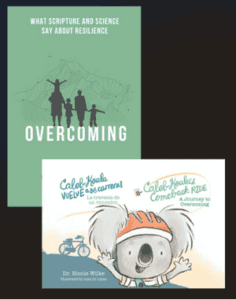
John: Yeah, and she’ll bring personal experiences and research to help parents, uh, really understand and guide children to help them thrive. And, uh, Dr. Nicole Wilke serves as director of the Center on Applied Research for Vulnerable Children and Families, which is an initiative of the Christian Alliance for Orphans. Uh, she’s written a book that captures a lot of what we’re talking about today. It’s called Overcoming: What Scripture and Science Say About Resilience. And you can learn more about our guest and this book at FocusontheFamily.com/broadcast.
Jim: Nicole, it is nice to have you here at Focus on the Family all the way from Peru. Uh, what a journey. Thanks for making that journey (laughs).
Dr. Wilke: Hey, thank you for having me. I’m so grateful to be here.
Jim: Now, for the viewers and the listeners, I gotta ask that question, what are you doing in Peru?
Dr. Wilke: Yeah. Well, we’ve been there almost eight years, and my husband leads a care reform coalition called Peru Polos Ninos, where he works with churches, NGO leaders, and leaders in government to change the system of care for vulnerable and at-risk children in Peru.
Jim: Boy, that’s amazing. Um, I think globally, I saw some of this data. I think we may have gotten it out of your book, but globally, up to 20% of children and adolescents endure some kind of debilitating mental illness.
Dr. Wilke: Mm-hmm.
Jim: Suicide is the third leading cause of death among adolescents. And I mean, when you look at the CDC here in the US, I think the last survey I saw was like 50% of young people have had, uh, depression, anxiety, suicidal ideation. I mean, that’s a big number.
Dr. Wilke: Oh, undoubtedly. And I don’t see that changing drastically anytime soon. We are in a time, in an era of increasing, um, technology, increasing separation, isolation, relationally, increasing chaos. And if we look at scripture, this isn’t a surprise for us, right?
Jim: Right.
Dr. Wilke: We know that, um, there are times of chaos, there are times of seeing the brokenness of this world, and yet we can be confident that God has ordained for our children to be born in this very time, for such a time as this. So we have kind of the tension to hold between both seeing the chaos of the world and the brokenness of the world, uh, the world in which they’re growing up in, and recognizing that He has special plans and purposes for our kids, even, uh, in spite of that.
Jim: Yeah. Let’s move into it. You were raised in a foster and adoptive family. You were a bio child.
Dr. Wilke: Yeah.
Jim: But, um, your mom and dad had, I think, over 70-
Dr. Wilke: Yes.
Jim: … kids come through the home.
Dr. Wilke: Yes.
Jim: And they adopted… How many kids did they adopt?
Dr. Wilke: Nine.
Jim: Nine. So-
Dr. Wilke: All from foster care.
Jim: I mean, that’s a robust family.
Dr. Wilke: Yes (laughs).
Jim: A lot of dynamics. W- what do you think, uh, that taught you as a child?
Dr. Wilke: I will say that it was one of the most educational and demanding experiences of my life.
Jim: Mm.
Dr. Wilke: Undoubtedly formative, beautiful. Uh, I can say very easily that, um, the Lord gave me a gift in that.
Jim: Yeah.
Dr. Wilke: An education, an understanding that I could never have had without that experience, because these are not numbers or ideas to me. These are people, these are my closest people who I love so dearly.
Jim: Mm.
Dr. Wilke: And when I saw their experiences and, and mine as being a part of this whole family system, um, I think that’s where I started to realize God’s redemption amidst these horrible things. Because of course, you ask the question, why? Why did they experience these hard things? Abuse, neglect, violence, exploitation, the things that we’re seeing kids face in this world, why is that happening? And the truth is, I don’t have a perfect answer for that, and I don’t think anyone will this side of heaven. And yet, we can still trust in a loving God, in a sovereign God who has good plans for these kids. And part of it is seen through that lens of watching them overcome these difficult things and go on to thrive-
Jim: Yeah.
Dr. Wilke: … uh, as contributors to society, as people who are building the kingdom.
Jim: What are some key factors for us when we experience trauma to try to get through that?
Dr. Wilke: Yeah. Well, especially speaking about our kids, I think the first thing that we can do is be present. I mean, so much of this is about our presence, which sounds like a very simple idea until we recognize that we all have a world of information and addiction in our pockets. And so a lot of it is about being present. We’re going to normalize and validate the experience, right?
Jim: Yeah.
Dr. Wilke: We’re going to say, “Wow, you’re right. This was hard. This was hard for you.” Even if I’m thinking, “It was an accident with 30 miles an hour, you’re fine,” I’m not saying that, right?
Jim: Correct.
Dr. Wilke: I’m saying, “I see that for you, this was tremendously difficult.” We’re going to then, after validating, we’re going to normalize and say, “Around the world, many children have experienced this. Many families have experienced this. I’m so sorry.” We’re going to lament with our children. “I’m so sorry-”
Jim: Yeah.
Dr. Wilke: ” … that this was your experience. I wouldn’t have chosen this for you. This isn’t what I want for you.” And then we’re going to offer hope. Together, there is nothing that with God’s help, we can’t overcome.
Jim: Yeah.
Dr. Wilke: I’m here with you. I’m staying here with you.
Jim: And I think what’s so hard for that person is that scripture even is hard to believe because they don’t feel it.
Dr. Wilke: Absolutely.
Jim: They don’t seem to experience that. And it keeps them locked like a, the gravity of a black hole, right? It just-
Dr. Wilke: Yeah.
Jim: And they do often need help-
Dr. Wilke: Yeah.
Jim: … to be able to get free of the grip of that fear.
Dr. Wilke: I think what you said though is so important, the element of feelings-
Jim: Yeah.
Dr. Wilke: … because feelings are important, and yet often society, media, culture would have you believe that feelings are reality. This is your reality.
Jim: It’s the world we’re living in right now.
Dr. Wilke: Okay. So we have a saying in our family that I, I learned from a, a missionary friend years ago. It’s feelings are indicators, not dictators.
Jim: Wow.
Dr. Wilke: Feelings are indicators, not dictators.
Jim: Yeah.
Dr. Wilke: And so we can acknowledge the feelings. Feelings are pieces of information, right? They give you a signal. And so we want to attend to them. Is this telling me something I need to know or is this something that is guiding me in the wrong path? At the risk of being controversial, um, follow your heart is not the best or most sound advice.
John: Mm-hmm.
Dr. Wilke: And so I think when we’re dealing with feelings, we want to attend to them, w- we wanna acknowledge that that is the real experience of the person, especially if we’re dealing with children, this is their real experience, and yet we wanna help guide them through those feelings so that they can recognize them, acknowledge them, and move past them.
Jim: Nicole, let me ask you about this. And, you know, again, you, you heard a little bit of my background. My mom and dad divorced at five, my mom remarried, then she died a year later when I was nine. I ended up in foster care. Then my bio dad, I got back with my bio dad. He then died when I was 11, and I ended up living with my, one of my siblings who was older than me, and that had its own chaos because it was just without boundaries. I mean, I, you know, it, it, it was an odd way to do this. But here’s the thing, and, you know, I so appreciate the Lord’s grace and all that. I accepted Christ at 15 through a football coach. But the dynamic of it, one thing I can remember is I never felt guilty about people’s behavior, my dad’s alcoholism, my stepdad’s distance, my foster dad’s craziness.
I was able, even as a, even as a child to be able to say, “That’s their problem, not my problem.”
Dr. Wilke: Mm.
Jim: And I always point to that, because I think that was what God’s grace did for me.
Dr. Wilke: Mm-hmm.
Jim: ‘Cause so many children end up processing that as what did I do wrong?
Dr. Wilke: Mm-hmm.
Jim: Why do I have this dad or what did I cause him to drink over, right? Or whatever. Describe that importance, because that is kind of the resilience factor, the key of saying, “Okay, I’m strong enough. That wasn’t my fault. That was their fault.” How do you develop that in your child?
Dr. Wilke: Well, it’s a great question. I think in your particular situation, it sounds like even through your coach that you mentioned, there were sources of support.
Jim: Correct.
Dr. Wilke: One of the things that we… So we actually did a study of more than a thousand adults with care experience. So adults who had been separated from their biological families and had, ended up in foster care adoption, um, orphanages, children’s homes, things like that. And we wanted to see what worked for them, what helped them to thrive, and a lot of it went back to supportive relationships. Um, I think we see our place in the world, especially as children, through the lens of the people around us.
Jim: Right.
Dr. Wilke: So I think, uh, when we’re thinking about how to support our kids, number one is building into that relationship, recognizing that to help them build resilience, we’re going to need to require certain things of them, which we can get to in a minute. But in order to be able to require things of our children, we need to have filled their bucket, right? If we’re going to be pulling out of their bucket, if we’re going to be requiring things of them, we need to be pouring into that. And we’re doing that through things like connection, presence, eye contact, through, um, you know, having times of play.
Jim: Yeah.
Dr. Wilke: Or, um, you know, listening to the, the thing that they want to talk about that we’re like, “Oh my word, I cannot handle this for like one more minute.” We’re going to handle it for one more minute because we know it’s important to them. So we’re going to not treat them as children to be, you know, controlled or modified, but really human beings who need our input. And then that gives us the relational capital to start to, um, help shape and form their thinking, their behaviors, which then leads to informing their feelings about their experience.
Jim: Yeah, that’s so good.
John: This is Focus on the Family with, uh, Jim Daly, and our guest today is Dr. Nicole Wilke. Um, she’s done the research. She’s got the experience and we’re talking about some of, uh, her experiences and understanding as captured in her book, Overcoming: What Scripture and Science Say About Resilience. Uh, get a copy of the book from us here at the ministry at FocusontheFamily.com/broadcast. And, uh, Dr. Wilke, you’ve mentioned the importance of relationship here, and it’s not just, uh, an individual, but you’ve got kind of three layers of protective relationships, if it were. Describe those.
Dr. Wilke: Absolutely. So when we think about resilience, we sort of have this formula, right? The formula is difficult or challenging experience plus protective factors. And those together will lead to resilience. When we think about those protective factors, a lot of them are in the context of those relationships. So we have the relationship that one has with oneself, okay? So those internal, uh, internal dialogue, the internal, um, elements of understanding your, your identity in Christ, understanding how He made you, understanding gifts. We have, um, the, the family as the second level, the family layer of relationships where we’re seeing things like healthy communication, we’re seeing warmth, we’re seeing, um, you know, even in your situation, having a sibling who was willing to-
Jim: Yeah.
Dr. Wilke: … care for you, you’re seeing things like, um, kind of a positive atmosphere in terms of learning and curiosity. And then you’re having your community-based factors. So things like not growing up in a war zone is a protective factor, things like having, uh, teachers that pour into you, coaches, medical staff that can help care for you when you’re sick. These all have incredible power, let’s call them advantages, right?
Jim: Yeah.
Dr. Wilke: So it’s kind of this idea of counteracting the disadvantages-
John: Yeah.
Dr. Wilke: … of adversity with the advantages that children have in life. And our hope is to counterbalance that and wait it out with having more advantages and disadvantages.
Jim: Yeah. It, this so is, it’s affirming so many things that I’ve thought of.
Dr. Wilke: Mm.
Jim: And I didn’t go for my PhD in psychology, but I’ve often thought life is kinda, we’re in this box that’s tilted toward finding God.
Dr. Wilke: Mm-hmm.
Jim: I mean, you know what I mean? So the things that we experience, the hardship along with the good things, I feel like it’s all tilted for us to find Him, you know? To realize we’re not perfect people that were sinners saved by grace, and then there’s the opportunity of salvation. I mean, that’s a great story, especially for people that are downtrodden.
Dr. Wilke: Absolutely.
Jim: And I think children’s hearts just open up. That’s why, man, all the programs for, you know, Christian kids or non-Christian kids in school, the release time and things like that, because it’s such a vital moment, uh, second, third, fourth grade, trying to figure out what life is all about.
Dr. Wilke: Yes.
Jim: And then some adult comes along and says, “I know what life’s all about.” It’s reassuring.
Dr. Wilke: Yes.
Jim: That’s why the church is so critical. In that context, you describe a sweet spot of stress. Now, most people are gonna say-
John: (laughs).
Jim: “A sweet spot of stress? You gotta be crazy.”
Dr. Wilke: Yes.
Jim: Stress is something we wanna get away from, to run from. What is the sweet spot of stress?
Dr. Wilke: Yeah. Well, I think what you just mentioned is so vital, because one of the ways that we recognize that we are not, uh, human beings who have it all together, we are not sufficient. The way we recognize our insufficiency and our dependency often is through suffering.
Jim: Yeah.
Dr. Wilke: If everything goes easily for us, why do we need God?
Jim: Yeah.
Dr. Wilke: Why do we need Christ’s work on the cross if we think that we’re in some way equal to God or make an idol of self? And so it’s a hard truth. It’s a hard pill to swallow. But when we look at scripture and Jesus says, “In this world, you will have trouble, but take heart because I have overcome the world.” That’s the context in which we wanna see stress and hardship and challenge. We will all have stress. And in fact, um, science says that we need to have stress to be successful. So there’s something called the Yerkes-Dodson model, and essentially it’s an upside down U shape, and we’re looking at how, um, stress and adversity predict success, okay? So what we see is that if somebody has the extremes, either way too little stress or way too much stress, you know, extreme adversity and trauma, they are much less likely to achieve success long term. But when we have some stress and adversity in our life combined with some times of, uh, less stress and certainly robust support systems, that is what gives us the capacity to overcome long term. And that’s actually a muscle that we want our kids to have, right? We want them to have the ability to overcome difficult things because they will experience difficult things. It’s something that we need to exercise. So what we wanna do is not protect them from every bit of stress, but instead cultivate that ability to overcome.
Jim: Yeah, that’s so good. And, you know, we’re a little, as parents, I think I was, I won’t speak for all parents here, but negligent to wanna create safety, comfort. And especially in Western civilization, that could be a great mistake.
Dr. Wilke: Absolutely. Absolutely. So let me give you an example of how we think about this in our family, okay? So, you know, by God’s, um, ordination, my children have a mother who studies resilience, so you can just imagine-
Jim: (laughs).
Dr. Wilke: … what that entails.
Jim: Bummer.
Dr. Wilke: Right? So my kids, thankfully, our children have not experienced extreme adversity, but I know that in order for them to be successful long term, they need to have hurdles that they need to overcome. So that can look like when our child has a difference of opinion with her ballet instructor and she tells me about it and I say, “Hey, um, what do you think you need to do?” And she says, “Well, I think I need to talk to her.” Okay, so do you want me to, um, pray with you? Do you want me to, um, role play with you? Do you want me to… Like, I’m giving her this menu of options-
Jim: Yeah.
Dr. Wilke: … and she wants them all, but what I’m not doing is I’m not doing it for her.
Jim: Yeah, I’m not gonna call the ballet instructor.
Dr. Wilke: I won’t have the conversation. And then we do things like we live in the mountains and we climb mountains with our girls. From a young age, actually last year they summited, um, 15,200 feet, and that’s a significant undertaking, but the incredible thing is when they do things like that, when we come back on Monday and they’re working on their math facts and that’s hard for them, I can say, “Whoa, whoa. Okay. So I know that you’re saying you struggle with this, but two days ago, you just finished a 30-mile hike at elevation. And I understand that this is challenging, but, like, let’s just consider this in context, right?” And what that does for them is it makes them say, “Of course I can do math facts. Please, what am I thinking?”
Jim: Right. Confidence.
Dr. Wilke: It give-… Exactly. It gives them that confidence because they’ve exercised that muscle of doing hard things. Now, that can be the pre, um, kind of prefabricated experiences that we’re giving them, or it can be where our kids have experienced hard things that we would never assign to them, right? We would never give them those types of experiences, but we can say, “Listen, let’s look at scripture. Let’s look at Joseph, right? Let’s look at David. Let’s look at Esther, and let’s look at how God takes what the enemy means for evil and uses it for good, and what does that mean to your story?” When I was a kid, I had my own situation. My appendix burst in my body and they didn’t find it for two years.
Jim: Whoa.
Dr. Wilke: So I was bedridden.
Jim: Yeah.
Dr. Wilke: And I remember laying in bed one night with my mom and I am just ranting about the situation and very unwell physically and mentally. And I remember her saying, “Nicole, as I listen to you, I know that God is going to do something great.” And I was 14, so I didn’t, I couldn’t acknowledge, like, I was, you know, too cool. I blew right past it externally, but it registered-
Jim: Yeah.
Dr. Wilke: … in my brain.
Jim: Right.
Dr. Wilke: And it changed everything for me to think that there was a possibility that God could take the hardest thing I’d ever experienced, that I didn’t understand, that I had no explanation for, that didn’t fit in the box that I created for Jesus in my life, and yet He could use that for His glory and for my good, it changed everything. And I think that’s a gift that we can give to kids when they’ve experienced difficult hardships.
John: Yeah.
Jim: Wow.
John: A- a- as you’re describing that, Nicole, earlier, a- as you were talking about the, some of these interactions, it felt to me like what I did with my children, which was I gave them logic and I gave them truth, but I didn’t, I really didn’t connect with them at that place of emotion. As you said earlier, we need to feel with them. So was your mom feeling with you when she said, “I think God’s got something for you here?”
Dr. Wilke: Oh, 100%. And she kept, you know, putting my focus on what was yet to come.
John: Yeah.
Dr. Wilke: And, and it’s super interesting. I didn’t know it at the time, but one of the protective factors we see in research is a future orientation. And so helping our kids to see what is yet to come, even if it’s not in detail, is a vital, practical step that can kind of pull them out of that vortex that they’re in.
Jim: Yeah. Nicole, I mean, this time has flown by, but I think parents are getting the idea of some things to be mindful of. Hopefully they’ll get your book. I wanna end with the cookie story-
Dr. Wilke: Yes.
Jim: … that you had with your daughter, because I think it’s a fun place to end, but there’s so much we couldn’t get to in the book. And that’s the idea here. We wet the appetite and people that are going, “That’s for me,” then we’ll give you the invitation to get a copy of Nicole’s book at the end here. But speak to the cookie story.
Dr. Wilke: Yes. Well, when my oldest daughter was nine months old, you know, I was a stay-at-home mom and she was my sidekick.
Jim: (laughs).
Dr. Wilke: And she did everything with me. Um, and I would bake a lot with her. She loved baking. And of course, you know how this goes with toddlers-
Jim: And she’s how old?
Dr. Wilke: She’s nine months. So I would sit her on-
Jim: (laughs).
Dr. Wilke: I’d sit her on the, the counter while I baking.
Jim: She just stayed engaged. You can tell.
Dr. Wilke: Oh, absolutely. She wanted to do everything with me.
Jim: Wow.
Dr. Wilke: And so she’s like putting her hand in the flour and like flinging it everywhere and she’s grabbing the chocolate chips and putting them in her mouth and-
Jim: Smart.
Dr. Wilke: … it was chaos. Yes.
Jim: (laughs).
Dr. Wilke: A sign of intelligence from a young age, absolutely.
John: (laughs).
Dr. Wilke: Um, and she was just making a mess of it, but she’s thinking she’s helpful, right?
Jim: Yes.
Dr. Wilke: So I thought, have I got an idea? I know how to quell the chaos. So while she’s taking a nap, I make a quadruple batch of cookies and I, I put the dough in Ziploc bags and stick them in my freezer so when she wakes up, we can bake together. So I sat her on the floor, um, and I put a cookie sheet next to her and I would like break off pieces of the frozen cookie dough and hand it to her and she’d kind of like, you know-
Jim: Throw it (laughs).
Dr. Wilke: … toss it onto the, onto the pan. And, um, we’d bake them and then when daddy got home, she would, she would give him one proudly, “Look at what I did.” And I’m thinking to myself, I have really arrived, I’ve hacked parenthood, look at me.
Jim: (laughs).
Dr. Wilke: And, um, in that moment one day, the Holy Spirit just said to me, “You know that’s you. That’s you with ministry, with parenting, with everything that you’re doing in life. I could do all of this without you. And frankly, I could do it better.”
Jim: (laughs).
Dr. Wilke: “But because I love you, I have invited you in to the high and holy calling of joining me in building the kingdom here. Not because of what you bring-”
Jim: Wow.
Dr. Wilke: ” … because you don’t bring anything that I didn’t give you, but because I love you and I wanna spend time with you.” And at the same time, it was both very, very humbling, of course, and incredibly freeing, because there’s, there’s no way that I can mess this up.
Jim: Yeah.
Dr. Wilke: God is God. He’s sovereign. He’s going to pursue His purposes.
Jim: Always a nice reminder (laughs).
Dr. Wilke: Absolutely. But He’s invited me along in the journey.
Jim: Isn’t that great? And that’s true for each and every one of us. Uh, that, that is God’s loving kindness toward us.
Dr. Wilke: Yes.
Jim: Join me in what I’m doing to help others.
Dr. Wilke: Yes.
Jim: And, uh, it’s such a beautiful thing. And boy, your mom and dad certainly have done that. 70 foster kids. I mean, that’s just like, wow, they’re my heroes.
Dr. Wilke: Mm. Me too.
Jim: And to be able to do that and then the great experience that you had in learning from that and your own difficulties and I’m shocked your appendix broke-
Dr. Wilke: (laughs).
Jim: … and it was in there for two years. Didn’t you get really sick?
Dr. Wilke: Absolutely.
Jim: Wow. That is a miracle that you’re here.
Dr. Wilke: Yeah.
Jim: Really. Well, you’ve heard it and I think it should have wept your appetite to, to get a copy of Nicole’s book, Overcoming: What Scripture and Science Says About Resilience. I think as a parent of two boys, I’m gonna dig into this. Even though they’re in their 20s now, there’s still things we can learn together and to help them become even stronger in that area. We also have a companion book that Nicole wrote called Caleb Koala’s Comeback Ride, and that’s a children’s book in English and Spanish about overcoming adversity, and we’re gonna bundle it with her other book. With a gift of any amount to support Focus on the Family on a monthly basis or a one-time gift, we’ll send both of those to you as our way of saying thanks for joining us in ministry. Let’s do this together, help more families. Your support is literally changing lives and we can’t do it without you. One of the ways we’re meeting people’s needs is through our great Christian counseling staff. You can schedule a free conversation by phone, so get in touch with us no matter what you need.
John: Yeah, contact us today, uh, donate as you can and request, uh, the book called Overcoming, and also Caleb Koala’s Comeback Ride. Uh, we’ve got this bundle available for you. Uh, the details are at FocusontheFamily.com/broadcast, or call 800, the letter A, and the word FAMILY. That’s 800-232-6459. And if you’re traveling this summer, we’d love to see you at our welcome center here in Colorado Springs. We’ve got a great bookstore, a fun play area for kids, and lots of treats, and, uh, what an experience at Whit’s End Soda Shoppe. It’s all here on the Focus on the Family Campus. Stop by and create memories together. And next time, we’re gonna hear from Dave and Ashley Willis offering tips on ways that you can do marriage better.
Ashley Willis: Coming to your spouse with curiosity and compassion instead of criticism is really key because it changes the words you say to them, but also the way that you come at them with your tone, because tone is really important too.