

Preview:
Lee Strobel: Now, because I had no belief in God, I, I really lacked a moral framework for my life, so I lived a very immoral, and drunken, and profane, and narcissistic, self-absorbed. Really, in a lot of ways, self-destructive kind of life. That was my life.
End of Preview
John Fuller: As we commemorate Good Friday today, Lee Strobel explains how he went from being an unhappy atheist to becoming an ardent believer in Jesus Christ when he examined the evidence of the resurrection, historical evidence that might surprise you. Uh, welcome to Focus on the Family with Jim Daly. I’m John Fuller.
Jim Daly: A- as many of you know, Lee Strobel was an award-winning investigative journalist when his wife, Leslie, became a Christian, and he applied his skills as a journalist to try to disprove her newfound Christianity. But ultimately, Lee had to admit that the evidence of Jesus Christ’s birth, death, and resurrection couldn’t be denied, and he’ll detail some of those facts today. Lee’s the author of over 40 books, including the bestselling Case for Christ Series. Let me just say, uh, Lee is a good friend of mine, he is a good guy. I, I can just see in it when we’re together at a restaurant or anything that, uh, I’ve seen him in, he is just the genuine deal.
John: Mm-hmm.
Jim: And believe me, you can trust the words that Lee Strobel expresses.
John: Mm-hmm. Yeah. Well, here he is now speaking to our staff on Focus on the Family with Jim Daly, and we’re jumping in as he gets really to the heart of his message.
Lee: Why is the resurrection foundational? Because Jesus in a variety of different ways made transcendent and messianic and divine claims about Himself. He claimed to be the Son of God. But so what? I could claim to be the son of God. Jim Daly… Well, maybe not Jim. Um- (laughs)
Audience: (laughs).
Jim: You know me!
Lee: Yeah. (laughs) Anybody could claim to be the Son of God. But if Jesus claimed to be the Son of God, died, and then three days later rose from the dead, that’s pretty good evidence He’s telling the truth, right? That’s why, you know, the Apostle Paul says in 1 Corinthians 15:17, “If Christ has not been raised, your faith is futile. You’re still in your sins.” Right? That’s the ball game. So I thought about the fact that Easter is coming up when we remember the resurrection of Jesus, so I’m gonna give you four words that begin with the letter E. Now, I want you to remember, uh, that when I was a skeptic, when I was an atheist, um, I did not consider the New Testament to be inspired and errant, the Word of God. I do now, but I was a skeptic then. But I had to accept it for what it undeniably is, which is a set of ancient historical writings.
And so I knew just as you can investigate any ancient writing, whether it’s by Suetonius or Tacitus or, uh, it doesn’t matter, you can take those same investigative techniques and apply them to the pages of the New Testament to try to determine is it telling me the truth? So that’s what I set out to do. So what are the four words that begin with the letter E that summarize the evidence for the res- because Easter begins with E, right? So what are the four words that begin with E that summarize the evidence? The first E stands for the word execution. You have to have a death first, right, before you can have a resurrection. And what I learned is there’s virtually no dispute among scholars in the world about the fact that Jesus was truly dead after being crucified. Why? Well, first of all, we have no evidence anywhere in history of anyone ever surviving a full Roman crucifixion.
In fact, no less of a source than the journal of the American Medical Association, a secular, scientific, peer-reviewed medical journal carried an investigation into the death of Jesus, and I’ll recite to you one sentence they wrote that summarized their conclusion. They said, quote, um, “Clearly, the weight of the historical and medical evidence indicates that Jesus was dead even before the wound to His side was inflicted.” I mean, this is so well established of an historical fact that Jesus was truly dead. You would get laughed out of a major academic institution if you came in and said, “No, no, no. I think He somehow survived the crucifixion.” Because, you know, most of the facts that we accept as being true from the ancient world are based on one source, or maybe two sources, and yet for the conviction that Jesus was dead after being crucified, we not only have multiple first century sources in the documents of the New Testament, we’ve also got five ancient sources outside the Bible confirming and corroborating His death.
We have Josephus, a first century Jewish historian worked for the Romans, Tacitus, another early historian, Mara bar Serapion, Lucien, even the Jewish Talmud admits that Jesus was dead. How strong is this? Let’s go to an atheist New Testament scholar like Gerd Lüdemann of Vanderbilt University and he’ll tell you this, quote, “Jesus’ death as a consequence of crucifixion is indisputable.” In- now, I don’t know how much you said in ancient history, but there are very few facts of ancient history that a skeptical, critical atheist historian like a Gerd Lüdemann will say is indisputable. One of those facts is the death of Jesus on the cross. The first E is for execution, Jesus was dead. The second E is the most fascinating, it stands for the word early. We have early accounts or early reports that Jesus rose from the dead. In other words, reports that come virtually immediately after His death.
Why is that important? Because I used to think like a lot of skeptics that the resurrection was a legend. And I knew it took time for legend to develop in the ancient world, so I figured 100, 150 years after the death of Jesus stories were invented, mythologies were spun, legends were invented, and that’s where the idea of the resurrection came from. But what I learned decimates the claim that the resurrection is merely a legend. Follow me on this. I think this is fascinating. We have preserved for us a creed of the earliest church. The very first Christians right there in the very first century used to rally around this creedal statement based on facts that they knew to be true. Now, this creed contains the essence of Christianity. It says Jesus died. Why? For our sins. He was buried. On the third day, He rose from the dead. And then it mentions the specific names of eyewitnesses and groups of eyewitnesses to whom He appeared, including 500 people at once.
Now, what’s important about this eyewitness-based creed of the church with named eyewitnesses, named grouped of eyewitnesses, is how immediately it developed in the ancient world, because remember we said it takes time for legend to develop? We can date this creed. How? Because the Apostle Paul preserved it for us. He wrote a letter to the church in Corinth, we call it 1 Corinthians. And in that letter, which he wrote about 22 to 25 years after the death of Jesus, he includes this creed, we find it in 1 Corinthians 15, starting at verse three. And, um, so he includes it, but he includes it in a way to suggest, “By the way, I’ve already given you this on a previous visit. I’m just reminding you of this.” Which means that sometime within, say, 20 years of the death of Jesus, this creed was already in existence and he had given it to the church in Corinth.
But we can go back even earlier. How? Well, we know that Paul used to be Saul of Tarsus, a persecutor of Christians. One to three years after the death of Jesus, he’s on the road to Damascus, boom, he has this encounter with the risen Christ, he becomes the Apostle Paul.
Immediately, he goes into Damascus, and what does he do? He meets with some apostles. There are many scholars who are convinced this is when those apostles gave him this creed that he later wrote in the letter. But others are more skeptical. They say maybe it was three years later. Three years later, Paul goes to Jerusalem, and he meets for 15 days with two eyewitnesses to the resurrection who are named in the creed, Peter and James. They’re named as eyewitnesses in the Creed. They get together, and Paul describes this meeting in Galatians, he uses a Greek word, um, historio, which suggests that this is a investigative meeting that they had. They weren’t talking about the Super Bowl. They weren’t talking about the weather. They were, they were talking about how do you know what you know, what you see, what you experience? Many scholars believe this is maybe when Paul was given the creed by the two people named in the creed.
But either way, this means one to six years after the death of Jesus, this creed is already in existence, therefore the beliefs that make up that creed go back even earlier virtually to the cross itself. There is no huge time gap between the death of Jesus and the later development of a legend that He rose from the dead. We got a newsflash that goes right back to the beginning. In fact, one of the greatest scholars in this area is James D.G. Dunn. He said this. He said, “This creed, we can be entirely confident, was formulated as a creed within months of the death of Jesus.” Within months. This is historical gold. Historians drool over this. So it, it, it… It’s formulated within months, that means the beliefs that make up the creed go back even earlier. It’s incredible. Um, so we don’t have some huge time gap.
In fact, one of the greatest historians who ever lived was A. N. Sherwin-White of Oxford. He studied the rate to which legend developed in the ancient world, and he determined that the passage of two generations of time is not even enough for legend to grow up and wipe out a solid core of historical truth. And that’s not the only early report we’ve got. We’ve got others in Matthew, Mark, Luke John, the Book of Acts, all of which date back so early they were circulating during the lifetimes of Jesus contemporaries who would have been all too happy to point out the errors if they were making this stuff up. Friends, we got an execution, Jesus was dead. We have a report of His resurrection that’s so early, so immediate, you can’t write it off as being a legend, but that’s not all we’ve got. We’ve got a third word that begins with the letter E, and that is the word empty. We have an empty tomb.
The historical record tells us that Jesus’ body was placed in a tomb belonging to Joseph of Arimathea, remember the Jewish council? It’s sealed, Matthew tells us it’s guarded, and yet it’s discovered empty that first Easter morning. Now, I used to think I was smarter than all that. I used to think, whoa, whoa, whoa, wait a minute. I’ll tell you why the tomb was empty, the body was never in it in the first place. Don’t you know that part of the horror of crucifixion is they would throw your body to the dogs? It was illegal under Roman law to bury execution victims, that’s what I thought, until I got disproven by a little thing called archeology. And guess what archeologists discovered? The bodies of a couple of crucifixion victims from the first century who were buried. In fact, one of them named Johan still had the spike driven through his heel bone and a piece of the olive wood of the cross still attached.
So we know that there was some burial of crucifixion victims. In fact, I interviewed a great scholar in this area, Dr. Craig Evans. And Dr. Evans, um, said to me, quote, “I conclude that the burial of the body of Jesus in a known tomb, according to Jewish law and custom, is highly probable.” So there went my idea that the tomb was never occupied. Uh, Roman law did allow for the burial of certain execution victims. But the tomb is discovered empty, how did it get empty? That’s the interesting question. You know, when the disciples began proclaiming that Jesus had risen, what the opponents of Jesus never said was, “Baloney, go open the tomb, you’ll find the body.” What did they say instead? Disciples, “Jesus had risen.” Enemies of Jesus. “Oh, well, um, the disciples stole the body.” Now think about that. That’s a cover story.
They’re admitting the tomb is empty. They’re trying to explain how it got empty. You see what I’m saying? It’s like if you’re a teacher and a student comes up to you and says, “The dog ate my homework.” That student’s admitting, “Look, I don’t have my homework, but I can explain what happened to it. The dog ate it.” It’s the same thing. So everybody in the first century is conceding the tomb is empty. The real question is how did it get empty? And you go through the usual list of suspects. The Romans weren’t about to steal the body, they wanted Jesus dead. The Jewish leaders of the day weren’t about to steal the body, they wanted Jesus to stay dead.
The disciples weren’t about to steal the body. Why? So they could live lives of deprivation and suffering as a result of their proclamation? We have seven ancient sources, six of them outside the Bible, that confirm that the disciples live lives of deprivation and suffering as a result of their proclamation that Jesus had risen. Why were they willing to do that? Nobody knowingly and willingly dies for a lie. Why were they willing? You know why? Because of the fourth word that begins with the letter E, which is the word eyewitnesses.
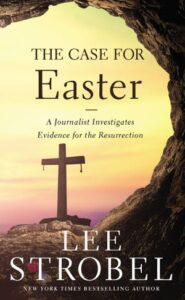
John: You’re listening to Lee Strobel on Focus on the Family with Jim Daly, and you can get all of these facts and much more in his paperback book called The Case for Easter. It’s a quick read, it’s gonna bolster your faith, and we’ll send that to you for a donation of any amount today, and we’ll include a free audio download of Lee’s entire presentation with extra content. Donate today and request those at FocusontheFamily.com/broadcast. Let’s go ahead and return now to more from Lee Strobel.
Lee: Not only was Jesus’ tomb discovered empty, but, over a period of time, Jesus appears alive in a dozen different instances to more than 515 people. The skeptics and doubters, as well as to believers. To men, to women, indoors, outdoors, daytime, nighttime. People talk with them, they touched them, they ate with them. Think of this. Remember we said earlier we’re lucky in ancient history if we have one source to confirm a fact or maybe we, if we’re lucky, we get two sources to confirm a fact. Well, get this, for the conviction of the disciples that they encountered the resurrected Jesus, we have no fewer than nine ancient sources inside and outside the New Testament confirming and corroborating the conviction of the disciples that they encountered the risen Jesus. Friends, that is no less than an avalanche of historical data. First source is the creed that I mentioned.
A creed, by the way, whose historical credentials are so strong that one of the few Jewish New Testament scholars, Pinchas Lapide said, quote, “It may be taken as a statement of eyewitnesses.” The second source is the Apostle Paul. Paul, after he became a Christian, got to know some of the disciples. He knew Peter, he knew James, and he knew John. And Paul says in 1 Corinthians 15:11, regarding the resurrection, “Whether it is I or they, this is what we preach.” In other words, we’re saying the same thing that Jesus has come back from the dead. That’s the second source. The third source is the book of Acts. Now, even skeptical atheist scholars will admit that the Book of Acts contains summaries of the preaching of the earliest church. And guess what the topic was (laughs) of the preaching of the earliest church? It was the resurrection of Jesus.
In Acts 2, Peter gets up before a group and he says, “Men of Israel, listen to these words. This Jesus, a man attested to you by miracles and wonders and signs, which He did in your midst. You know that He did.” He appealed to their common knowledge, and then he said, “This Jesus, God has raised from the dead to which we’re all witnesses. We’re all witnesses to the resurrected Jesus.” And how did they respond? Did they say, “Peter, you’re drunk. You don’t know what you’re talking about.”? No. 3,000 people said, “Peter, we know that’s the truth. What do we do?” They repented and the church was born. So first source, the creed. Second, Paul’s testimony. Third, the book of Acts and Peter saying we’re all wi- eyewitnesses. And then the next four sources are Matthew, Mark, Luke, and John, the gospels. And in the gospels we find no fewer than nine appearances by the resurrected Jesus.
The gospels are classified by scholars as being ancient biographies intended to report what actually took place. Let me read to you the conclusion of Dr. Craig Evans, who’s written like 40 books on the historical evidence for the resurrection and other topics, uh, professor at, uh, Houston Christian University. This is what he said. He told me, he said, “Lee, there’s every reason to conclude that the gospels have fairly and accurately reported the essential elements in Jesus’ teachings, life, death, and resurrection. They’re early enough. They’re rooted into the right streams that go back to Jesus and the original people. There’s continuity. There’s proximity. There’s verification of certain distinct points with archeology and other documents.” And then he said, “There’s the inner logic.” So there, we have seven total sources, but there’s two more outside the Bible. Let me ask you a question. If you were to come to work here at Focus on the Family and work here for, say, three years, do you think you’d have a pretty good idea of what Jim Daly believes?
Yeah, I think you would. Well, we have writings preserved from people who sat under the teachings of the very disciples themselves, the eyewitnesses to the resurrection. Some of them wrote letters and reported what they were told by these eyewitnesses. So two of those sources, one of them is Clement. Clement was ordained by Peter himself. And he actually wrote a letter to the church in Corinth, again, in the first century where he said the apostles had, quote, “Complete certainty caused by the resurrection of our Lord Jesus Christ.” So he’s confirming that they’re eyewitnesses to the resurrection. And then Polycarp, he was appointed by John to be the bishop at Smyrna. He wrote a letter to the Philippians. He mentions the resurrection no fewer than five times. And in this letter, he said, referring to Paul and the other apostles, he said, quote, “For they did not love this present age, but Him who died for our benefit and for our sake was raised by God.” So here are nine ancient sources inside and outside the New Testament confirming and corroborating the conviction of the disciples that they encountered the resurrected Jesus.
Now, is that just convincing to an evangelical Christian? Let’s go back to the Atheist New Testament scholar, Gerd Lüdemann of Vanderbilt University. Based on this kind of evidence, this is what he was compelled to concede, quote, “It may be taken as historically certain.” Not a possibility, not a likelihood. “It may be taken as historically certain that Peter and the disciples had experiences after Jesus’ death in which Jesus appeared to them as the risen Christ.” I couldn’t have said it better myself. So don’t you wonder why is he still an atheist? (laughs) You know why? He found the loophole. There’s a loophole that explains all this away. You know what it is? The disciples didn’t really encounter the resurrected Jesus. They merely had hallucinations. There you go. That kind of explains it all away, right? We’re d- wait a minute. I’m a journalist, I check things out.
So I sought out one of the leading psychologists in the world, an expert on the human mind, someone who had written 40 books on psychology, someone who was a professor of psychology for 20 years at a major Midwestern university, somebody who was the president of a national association of psychologists. And I sat him in a chair and I said, “Now, Dr. Collins, would you not admit to me these disciples didn’t encounter the resurrected Jesus, they merely had hallucinations?” And he looked at me and he said, “That is not possible.” I said, “What do you mean? You seem pretty sure of yourself.” He said, “I am.” I said, “Why?” He said, “Lee, you have to understand something about the nature of hallucinations. Hallucinations happen in individual minds. They’re like dreams. They don’t spread like the common cold. You can’t wake up your spouse in the middle of the night and say, “Honey, honey, wake up, wake up. I’m having a great dream about a vacation in Maui. Let’s both go back to sleep. We’ll have the same dream. We’ll save all the airfare. We’ll save all the hotel costs.”
Wouldn’t you like to be able to do that? Here’s a question. Why can’t you do that? Because dreams happen in individual minds, just like hallucinations. And then you looked at me, he said, “Lee, you said that the earliest report, the most reliable historical report you have tells you that Jesus, as risen Christ, appeared to 500 people at once.” I said, “That’s right.” He said, “Lee, 500 people having the same hallucination at the same time will be a bigger miracle than the resurrection itself.” And then he added this, he said, “By the way, if this were just hallucinations, the body would still be in the tomb, right?” Oops, the body’s gone.
Friends, these were not hallucinations. It wasn’t something more subtle like a, a vision where they missed Jesus so much that they imagine. Peter, don’t you see them there in the shadows? Y- you know, that they, they talked themselves into seeing something that wasn’t there. I don’t think so. Not when Saul of Tarsus was a persecutor of Christians. He was not psychologically primed to have a vision of the resurrected Jesus. James, a half brother of Jesus, who did not believe in Jesus during his lifetime, who was all taught his entire life there’s one resurrection at the end of time, nobody’s coming back in the interim, and yet he died as a martyr of the church. Why? Because Jesus appeared to him. Friends, these weren’t hallucinations, they weren’t visions, they weren’t mythology or legend or make believe. These were actual encounters that the disciples had with the resurrected Jesus that transformed their lives.
Friends, I spent two years of my life investigating this kind of evidence and it all came down to a Sunday afternoon. And I went alone in my room and I, I sat down with all the documents and books and evidence I’d accumulated over these two years, and I said to myself, “You know, a good juror reaches a verdict.” So I reviewed it all one more time and then I stepped back and I said, “Wait a minute.” In light of this avalanche of evidence that points so powerfully toward the truth of Christianity, I realized it would take more faith to maintain my atheism than to become a Christian, like, the scales went like that, and that’s when I reached my verdict in The Case for Christ, that based on the historical data, I was convinced that Jesus didn’t just claim that He was the Son of God, He backed it up by returning from the dead.
And then I thought, am I done? Is that it? Do I just go back to my life? Is, is that… What do you do? And then my wife pointed out a verse to me, John 1:12, it says, “But as many as received Him, to them He gave the right to become children of God, even to those who believe in His name.” And I said, “Now I get it. That verse forms an equation of what it means to become a child of God, believe plus receive equals become.” So I said, “Okay, I get it. I believe, based on the data of history, Jesus is the unique Son of God. He proved it by returning from the dead.” But that’s not enough. I had to receive. Receive what? Receive the free gift of forgiveness and eternal life that Jesus purchased for me on the cross when He died as my substitute to pay for all of my sin.
And when I would receive this free gift of His grace, then I would become a child of God. So I got on my knees and I poured out a confession of a lifetime of immorality that would absolutely curl your hair. And at that moment, I received complete and total forgiveness through Jesus Christ and I became a child of God.
Audience: (Applause)
John: And that’s where we’re gonna have to end Lee Strobel’s powerful message on today’s episode of Focus on the Family with Jim Daly.
Jim: Wow, John, I always love it when biblical accounts are backed up by non-religious sources. And Lee Strobel did a great job sharing some of those today. And if you’re wishing you could explain, uh, this content to a friend the way Lee just did, uh, don’t worry, it’s all in his little book, The Case for Easter, and we’ll send that out for you for a donation of any amount as you support the ministry of Focus on the Family. You might not know this, but in the past year, almost 800 people a day have made that commitment to Christ or rededicated their lives to Jesus through Focus on the Family. That is, that is good news, everybody. That’s the most important thing we can do here. So please donate if you can so that we can continue to reach even more families for Christ.
John: Yeah, make your contribution at FocusontheFamily.com/broadcast and request your copy of The Case for Easter. And when you get the book from us, we’ll include a free audio download of this entire presentation with extra content. Thanks for listening to Focus on the Family with Jim Daly. I’m John Fuller inviting you back as we once again help you and your family thrive in Christ.