




Day One:
John Fuller: Today on Focus on the Family with Jim Daly, we’ll explore the relationship between parents and their adult children.
Daughter: Dad, we need to talk.
Dad: Sure, honey. What’s up? Wanna use the car? Need a few bucks? I- I- can-
Daughter: No, no. (laughs). Listen, dad. I really think the time has come for me to move out of the house.
Dad: Honey, why? This is so sudden.
Daughter: Dad, I’m 35 years old.
Dad: W- what? All 35-year-old girls need to move out of their parents’ houses? I thought you liked it here. I’d miss my little girl.
Daughter: I’m not your little girl anymore, Dad. I’ve been married for seven years.
Dad: I know, I know, and we love Bob.
Daughter: Bill.
Dad: Bill. Your mother and I think the world of Bill. Don’t we think the world of Bill, honey?
Mom: Bill who?
Daughter: Listen, Dad, I’m getting older. It’s time that I led my own life to give my family an identity of its own.
Dad: Why?
John: (laughs).
Jim: (laughs).
John: Well, as our children get older, obviously some things need to change, and today we’re gonna learn how change can be a good thing. Thanks for joining us today. Uh, your host is Jim Daly, and I’m John Fuller.
Jim Daly: (laughs). Oh, I hope that’s facetious. (laughs).
John: Way over the top.
Jim: That parent needs to call Focus on the Family-
John: (laughs).
Jim: … like, right now.
John: (laughs).
Jim: But, uh, we are going to cover this issue of adult children and how we perhaps change the parenting modality at that point to be influencers rather than control freaks.
John: (laughs).
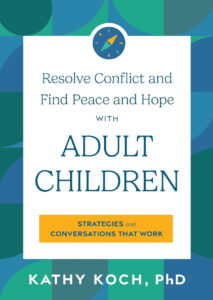
Jim: I think that the best way to intro this program, John, is to give the title, Resolve Conflict and Find Peace and Hope with Adult Children. That says it all. If you’re in this spot, you’re gonna need to order this book and listen to the broadcast today.
John: Yeah. Dr. Kathy Koch is back with us. Uh, she’s always a popular guest.
Jim: Mm-hmm.
John: And Dr. Kathy is a speaker, author, researcher, uh, the founder of Celebrate Kids, which is a ministry dedicated to equipping parents and caregivers and others to help children, uh, be more seen and heard. And, uh, today we’re gonna hear about Dr. Kathy’s book. As Jim said, I hope you’ll get a copy of it from us here at the ministry.
Jim: Kathy, welcome back.
Dr. Kathy Koch: Thank you so much. Honored to be here. Always.
Jim: It’s always. Good. You are such a… Let me say it politely, a research geek. (laughs).
Dr. Koch: (laughs).
Jim: You love the research on family, don’t you?
Dr. Koch: I love observing families. I don’t necessarily like, like, library research.
Jim: Okay.
Dr. Koch: I let somebody else do that for me. But, oh, I love the research of observation and, you know, what’s happening in culture that’s affecting our families.
Jim: Let me ask you this question because I love talking to people that like that kind of observational research-
Dr. Koch: Mm-hmm.
Jim: … if I could call it that. Because you see patterns.
Dr. Koch: Right.
Jim: Which to me indicates God.
Dr. Koch: Yes.
Jim: That life is set up in patterns that, that God is showing us. I mean, He gives us seasons, the way the solar system works. I mean, there’s these patterns that God has set up in nature.
Dr. Koch: Uh-huh.
Jim: And like Paul writes about you.
Dr. Koch: Yes.
Jim: You have no excuse because you can see God in nature, right?
Dr. Koch: Yes.
Jim: And in that regard, we can see God and how families operate.
Dr. Koch: Mm.
Jim: And what is good and what is not so good. And in that issue, when you do this observation with these families, especially now that the kids become adults, what are some of those major breakdowns from the parenting side that occur?
Dr. Koch: Oh, that’s so good to start there. (laughs). Um, I should have gotten, given you the memo, easy questions only.
Jim: (laughs).
Dr. Koch: Um, you know, the fact that parents are still trying to parent when they need to move into a consulting role, maybe being a guide, a coach, a mentor, an influencer. Um, we can’t parent adult kids. We still may want to. And we may legitimately feel like we haven’t finished our job yet because we begin to see some things that are lacking in our adult children when they begin to launch out. And then how do we deal with that? Um, do our kids want us to be involved at all? Do, do they maybe still want us to parent because they feel insecure, but we don’t want to. I think that’s part of the confusion for sure. I think relationships between adult children and the younger siblings can also be a really complex issue.
Jim: That’s true.
Dr. Koch: Younger siblings are still being parented or still living at home, but the older ones have maybe moved out and launched and, but we still want them to be connected. I think that’s a factor. I think overwhelmed parents. I think every parent of adult kids, every one of them is overwhelmed. Uh, not just by the adult kids-
Jim: Yeah.
Dr. Koch: … but just by culture, right? By confusion. By things that are going on at church-
Jim: Yeah.
Dr. Koch: … things that are going on in their workplace. And it’s messy, but we don’t give up, right? Because we have God.
Jim: Yeah.
Dr. Koch: And, and we know, I hope we know in the knowing of our knowing, I like to say, I hope we know in the knowing of our knowing that we’re still a family and that God ordains the family and He doesn’t want that to ever break up.
Jim: Yeah. There’s such power there when it’s healthy. And-
Dr. Koch: Yes.
Jim: … and unfortunately, many of us will experience, uh, kind of the destructive power of that too, you know, family of origin leftovers, right? (laughs)
Dr. Koch: Mm-hmm.
Jim: And I’ll tell you a lot of therapists, Christian therapists-
Dr. Koch: (laughs)..
Jim: … will talk about that, things that, um, give us a little limp in our adult lives-
Dr. Koch: Mm-hmm.
Jim: … because of what happened when we were children, right?
Dr. Koch: Mm-hmm.
Jim: You, you kind of do learn a lot. You don’t fall far from the tree typically. Now God can intervene and-
Dr. Koch: Amen.
Jim: … and interdict. And, you know, if your father was an alcoholic, you don’t have to become an alcoholic.
Dr. Koch: Amen.
Jim: And so I love those components. That’s part of my story, right?
Dr. Koch: Right.
Jim: So, you know, there, there’s power through that relationship in Jesus. And that, that’s key to everybody’s healthiness spiritually, right?
Dr. Koch: Mm-hmm.
Jim: Well, let’s get into it. Uh, you warn parents about making kids into idols. Uh-oh. Especially, I think, especially Christians.
Dr. Koch: Oh, shoot.
Jim: I mean-
Dr. Koch: Yes.
Jim: … don’t you think?
Dr. Koch: Yes.
Jim: You know, we love our kids. I am always pulling out my phone. Look at my boys-
Dr. Koch: (laughs).
Jim: … look at my boys, (laughs) you know?
Dr. Koch: Yeah.
Jim: But how do we need to be careful? And what does it mean, I guess, to, as a parent to make your children an idol?
Dr. Koch: To depend upon them to be your everything.
Jim: To meet your emotional needs.
Dr. Koch: To meet your emotional needs, to meet your need for, look, I’m amazing. And so we display our children on, you know, the, the pedestal, if you will, rather than the, whatever the, you know, back in Bible times when they would have used some structure somewhere. No, we’re, we’re created to worship, right? We are created to worship. We will worship someone or something.
Jim: Mm.
Dr. Koch: It should be God. Um, and do we, are we doing that? Is, is God the center of our universe? Is God who we think of and talk about? Is it God that we’re trying to impress? And again, we don’t have to impress God, but to glorify God, right?
Jim: Mm-hmm.
Dr. Koch: So I’m here today and, and I don’t, like, I don’t need to be remembered. Like my, my prayer would be that God would be pleased with what happens here between the three of us and the production team, you know, behind the window and that there would be evidence that we did good work here so that God looks good and that Jesus is known and celebrated. That has to be the mindset. But yeah, we have parents idolizing children, grandparents idolizing grandchildren, meaning that they want the children to perform for them to make them look good. And that’s not appropriate.
Jim: Uh-uh.
Dr. Koch: Children are not performers. God didn’t give us kids so that we would look good. If you’re afraid that you’re gonna look like a less than great parent because your children are doing something wrong, that might be a sign that you’re idolizing them.
Jim: You know, the, the thing I’ve observed in myself, uh, let alone other parents I know.
Dr. Koch: (laughs).
Jim: But it is, uh, you know, it’s so kind of below the radar sometimes that you’re even doing this.
Dr. Koch: Mm.
Jim: You’re not aware-
Dr. Koch: Right.
Jim: … that you’re doing, you’re making an idol-
Dr. Koch: Mm-hmm.
Jim: … out of your children. Or that you’re deriving something positive from their good behavior.
Dr. Koch: Mm-hmm.
Jim: You know? And I, I can remember that. I talked to my boys, you know, there was a couple of good friends that I had saying, “Make sure your boys realize they don’t have to perform because you’re the president of Focus.”
Dr. Koch: Totally.
Jim: So I mean, I just had that conversation with them.
Dr. Koch: Good.
Jim: I’m not expecting you to be perfect young men. I think they took it to heart.
Dr. Koch: (laughs).
Jim: (laughs). But no, they’re great.
Dr. Koch: No, that’s good.
Jim: They’re really good-
Dr. Koch: Yeah.
Jim: … young men.
Dr. Koch: Yeah.
Jim: But I, you know, that’s important for parents, Christian parents, pastors.
Dr. Koch: Oh, totally.
Jim: Oh my goodness.
Dr. Koch: Yeah.
Jim: How, how do you have that healthy conversation age appropriately, you know, with your eight-year-old versus your 15-year-old?
Dr. Koch: Yeah. No, and I think, you know, uh, so I love that you were aware of that. And I think that’s, most parents are excellent parents. I tell adult children all the time, your parents did the best they knew how to do with the wisdom they had in the moment. Stop judging them and we can get into that more, you know, later. But I think the parent needs to be alert. Am I expecting something from my children that’s making them uncomfortable to be around me? Like maybe they don’t want to tell me how they’re doing because they’re afraid that I’ll be either very disappointed and harsh or expecting them to keep up the good work-
Jim: Yeah.
Dr. Koch: … you know, because the parent thinks say, I’m not, I’m not… See, if you don’t think you’re anybody who can do anything except that you’re a parent, the pressure your children are feeling is immense.
Jim: (laughs)
Dr. Koch: And this is one reason they distance themselves from us because they don’t, they don’t want that pressure. So I want to say again what you were just implying, Jim. Nobody did this intentionally. Very few parents-
Jim: Yeah.
Dr. Koch: … do this intentionally. Um, and so what we’re here to do is to raise their awareness, right? So that they don’t live in denial so that they can realize maybe this is an issue and maybe I need to rely on God in me to be well and not expecting my children.
Jim: But in that regard, you created something called a declaration of release.
Dr. Koch: Yes, sir.
Jim: I love this.
Dr. Koch: Good.
Jim: Describe it and how do we apply it?
Dr. Koch: Right. So for us to realize that God loves our adult children more than we ever could or would-
Jim: (laughs).
Dr. Koch: … and for us to understand that we can’t control. Now that they’re adults living outside of the home or even in their, if they’re living in the home, they are adults, our parenting years are finished. Now we consult, guide, coach, mentor, et cetera. And so the Declaration of Release is designed to give the parent this opportunity to say, “My son is God’s.” Now, I hope that the son has always been God’s, right? But this is different and I’m gonna release my kids, my sons and daughters to the love of God and I’m not going to control you. I’m going to pray that God meets your needs for security, et cetera, and that you don’t look to me to meet them. I think that’s huge. And then we, we parent strong still, right? We still parent, but we parent differently.
Jim: Yeah.
Dr. Koch: We love, we love maybe a bit differently and we release them to God. So say it every day, you know, that you’re, you’re now released to the love that God has and I’m going to take my hands off of you and I’m going to ask God to, like, help you. I know the look on your face-
Jim: I know.
Dr. Koch: … people who are not watching on YouTube-
John: (laughs).
Dr. Koch: … you’re like, “This is not easy.”
Jim: Yeah. I, and that’s the point there because we, I would say over engage.
Dr. Koch: Mm.
Jim: You know, someone asked me this question, which I thought was really good. If the Lord’s plan for your child was to take them through a valley at 25, let’s say-
Dr. Koch: Yeah.
Jim: … so that He could get their attention, whatever that might be, would you be willing as the parent to allow God that maneuverability to get to their soul? Now, we’re gonna say, “Absolutely.”
Dr. Koch: (laughs).
Jim: But when it comes to doing it, it’s like absolutely not.
Dr. Koch: (laughs).
Jim: Right?
Dr. Koch: Right.
Jim: We’re gonna save, we’re gonna intervene, we’re gonna do the things that keep them from pain, and the irony is we may be keeping them from a depth of their relationship with Christ.
Dr. Koch: Absolutely. And that’s a reason that I would love and be honored if parents of teenagers would buy this book, because we can begin to see the pattern that needs to be established now so that when they launch, whether that be college, trade, military, early marriage, entrepreneurship, gap year, whatever, they’re able to do that well. Um, I think, I think the point that you’re making is really, really good. We know the scripture, we know what it says in Romans 5. We’ve, I’ve been on the show before talking with the two of you about the resiliency factor, and it comes from going through valleys well. Romans 5:3-5, James 1:2-4 are two of the places. Romans 8:29, the verse after Romans 8:28, that all things will work together, you know, for those who love God and live on purpose. All those verses say that the struggle is worth it. That’s where we get our biblical character, that’s where we get our deeper faith in the God of the Bible because we experience Him in the valley. So if parents have overprotected their children and they’ve expected their children to look good so that they feel good about the job that they’ve played as parent, the kids are possibly fragile. They have loved that parents have protected them up until this point. “Grab your lunch.” Every kid loves that they’re reminded to grab their lunch-
Jim: (laughs).
Dr. Koch: … because they don’t wanna go hungry in the middle of the day. But now that they’re 21, 23, you know, (laughs) 35, they do wanna grow up and they do want some independence and they do want to discover how the world works and they’re gonna discover that when we allow them to walk through valleys, we pray in the distance perhaps. We ask, “Hey, can I help you in any way? Let me know. How can I help you?” But we, we watch and then we praise God for the opportunity that those kids had to grow up and hopefully it wasn’t trauma and, and tragedy, but it was growth.
Jim: Yeah. Well, again, I love that idea of declaration of release.
Dr. Koch: Mm-hmm.
Jim: And if you haven’t done that, that’s one good reason to get the book-
Dr. Koch: Mm.
Jim: … just to see that concept and do it.
Dr. Koch: Mm. Thanks.
Jim: And write it out. Let me ask you this, uh, in, uh, funny, I was reading the prep last night and Trent was over for dinner.
Dr. Koch: Oh, fun.
Jim: So I actually went through some of this with them, but you caution parents to listen more and talk less, ouch. (laughs).
Dr. Koch: (laughs).
Jim: And then, you know, making I statements versus you statements.
Dr. Koch: Mm.
Jim: So describe what that looks like and sounds like.
Dr. Koch: Right.
Jim: The I statement versus the you statement.
Dr. Koch: Right. So it would be, like, the I statement is, you know, I, um, I worry when you don’t reach out to me often enough. Okay? Like, I worry or I wonder who you’re hanging out with. I just, I st- I love you and we’re not as connected because you don’t live here. So I’m just curious about who you’re hanging out with. That I statement, I’m curious, versus you never tell me who you’re hanging out with.
Jim: Yeah.
Dr. Koch: Okay. So you never tell… That’s very judgmental, right?
Jim: Correct.
Dr. Koch: That sounds invasive, I think, to adult kids. It sounds like, well, why don’t you trust me to just hang… Why do you need to know who I’m hanging out with?
Jim: What’s the outcome of that style of, of parenting at that level? What will that adult child do?
Dr. Koch: Yeah. Oh, the you statement will cause them to remain distant.
Jim: Correct.
Dr. Koch: Yeah. They’ll-
Jim: So the very thing you’re wanting is the parent, you’re not gonna get-
Dr. Koch: Right.
Jim: … because of how you’re interacting.
Dr. Koch: Right. Let me tell you guys, this book was hard to write because nobody wants to hear that because you can’t go back 10 years and change the way you parented. So let me say to our audience, like, thank you for being here. And-
Jim: (laughs).
Dr. Koch: … you did the best you knew how to do when you did it, and now we’re gonna give you some advice about changing course if, if you are willing to do that, right?
Jim: Mm-hmm.
Dr. Koch: So I worry or I wonder or I’m concerned because you told me that you had a job interview, but you haven’t told me how it turned out that’s healthier and that I think engages conversation.
Jim: Yeah. On demand parenting, I think of streaming.
Dr. Koch: Oh, yes.
Jim: Is that a sh- is that a show on Netflix?
Dr. Koch: Yes.
Jim: On demand parenting?
Dr. Koch: Yeah.
John: (laughs).
Dr. Koch: Yeah.
Jim: What is on demand parenting and why do we need to be aware of it?
Dr. Koch: Yeah. So back in the old days, you know, we just had the phone, right, and praise God for the phone on the wall.
Jim: (laughs).
Dr. Koch: Um, you know, now we’ve got, you know, we can follow our kids on apps if, if they allow us to. There’s, you know, there’s FaceTime, there’s texting, there’s calling, there’s, you know, Facebook, there’s Instagram, there’s so many places where we can go to our kids. So if we know our kid is on the phone, like if our kid just texted us, we’re tempted to call. No, if they text you, which means that they’re in, they’re on their phone, that doesn’t give you the right to call and take advantage of the fact that they’re on their phone. You know, that feels, again, invasive and, you know, you’re laughing, but it’s not funny.
Jim: I, because I’m in that moment.
Dr. Koch: Yeah.
Jim: I just… That’s where I gotta do a little better job.
Dr. Koch: Yeah. It’s you know-
Jim: Trent will tell… I’ll call Trent and then he’ll text me, “What’s up?”
Dr. Koch: Instead of calling you back?
Jim: (laughs). Instead of calling me back.
Dr. Koch: Yeah.
Jim: (laughs)
Dr. Koch: Yeah.
Jim: And I’ve gotta, I’ve gotta relent and say, “Okay, I’m gonna text him back. Nothing much, just wanted to hear your voice.” (laughs)
Dr. Koch: Did you notice one of the things I write about in the book is be satisfied with what you have even though you want more?
Jim: Oh, that’s good.
John: Mm-hmm.
Dr. Koch: I mean, seriously, you guys, like I understand you want the phone call, you want the real visit, you want the, the time with the kid and, and you have a right to want that.
Jim: Yeah.
Dr. Koch: They’re your kid. Let them launch appropriately, and again, complex issues, but be satisfied and be grateful for the text because if you manipulate, “Oh, you just texted? You can’t call?”
Jim: Right, right. You don’t wanna do that-
Dr. Koch: They’re not gonna call you.
Jim: You don’t wanna do that-
Dr. Koch: No, no, no.
Jim: … for sure.
Dr. Koch: Easy to do, but it’s not healthy.
John: Mm. This is Focus on the Family with Jim Daly and today our guest is Dr. Kathy Koch. We’re covering some of the content in her book, Resolve Conflict and Find Peace and Hope with Adult Children. And, uh, we have copies of that here. We also have a free downloadable, uh, document of that Declaration of Release for you, which is for you to work through as the parent and then to share with your child. It’s great and, uh, we’ve got a link for it at FocusontheFamily.com/broadcast.
Jim: Dr. Kathy, you have great suggestions, recommendations for parents and adult children and how to help their relationship. Uh, home visits is one of the things-
Dr. Koch: Mm.
Jim: … that you cover in the book. No, that’s really funny. ‘Cause again, I’m talking experientially. John, you’ve got six kiddos-
John: Mm-hmm.
Jim: … so, uh, but, you know, even going by the apartment-
Dr. Koch: Oh.
Jim: … to, to just say hi, you gotta… I’ve only done that one time and it was-
Dr. Koch: Mm.
Jim: … you know, Trent said, “Hey, why don’t you stop on by?” But you, you gotta respect their territory, right?
Dr. Koch: That would be ideal.
Jim: Yeah.
Dr. Koch: You know, you said you’ve got to. I think absolutely. I think if you want a healthier relationship with your adult children, if you want to have communication that’s give and take, if you want them to freely share with you their joys and their despair so that you can still be involved with them, then we respect by asking permission. We say things like, “Hey, I’m gonna be over on your side of town to be, will you be home tonight? I’d love to just stop by and say hi.”
Jim: Yeah, it’s kind of like how you would treat a friend of yours. You would call and say, “Hey, are you gonna be around Tuesday? I’m in your area.”
Dr. Koch: I love that.
Jim: Yeah.
Dr. Koch: Because you just made the comment that your son has delighted in this newer, uh, friendship relationship. By the way, one of the things that was really hard in writing the book was finding out that parents who think they did everything right so that they could be a friend with their kids later are now not friends with their kids and it’s been devastating to them. And so again, we do what we can do in hopes that it will turn out well, but it’s never too late. It’s never late, too late to, you know, not live in denial and recognize that we maybe were doing some things that weren’t great, you know, to ask for forgiveness perhaps, to apologize perhaps, and for us to say to our kids, “Hey, could I stop by for 15 minutes?” I think what’s, what’s interesting about that limit, I’d love to, you know, “I, I made your favorite cinnamon coffee cake. Could I stop by? 15 minutes, I’ll just stay.” And no joke, you guys, that gives the kid the freedom to say yes because 15 minutes isn’t a three-hour visit-
Jim: Right. (laughs).
Dr. Koch: … when you don’t know, maybe your son or daughter had work to do at home that night.
Jim: Yeah.
Dr. Koch: Or a really important FaceTime call with somebody else that you want them to be friends with or whatever the ca- they just wanted to go to bed.
Jim: I love that idea.
John: Oh, yeah.
Dr. Koch: They had a movie to watch or whatever.
Jim: Yeah.
Dr. Koch: And so you, you set the mental timer. Or I have friends who actually set the timer on their phone for 15 minutes, they walk in and it buzzes and they say, “Hey, 15 minutes,” and they leave. Now, if the kid says, “Oh, stay a little bit longer.” Like that’s fabulous right?
Jim: That’s an invitation.
Dr. Koch: Right? But I think the limit is really a blessing.
Jim: Yeah, that’s great.
Dr. Koch: Shows respect.
John: And, you know, Kathy, uh, you said something earlier about parents who don’t have a relationship with their adult kids. And I, I know several, we probably all know several-
Dr. Koch: Mm-hmm.
John: … uh, families going through that where the child is the one that says, “No, I don’t want the relationship.”
Dr. Koch: Mm-hmm.
John: Offer some encouragement to that parent because that’s a really hard place to be.
Dr. Koch: It is. I appreciate that, John, and it is happening far too often. Um, first of all, I wanna say this, most parents parented really well with the information they had at the time. So I don’t want every parent to think that they’ve done something wrong that has caused their adult child to distance themselves from them. There can be influences on the adult kids. There can be any number of things that have happened. So don’t look back and think, “Oh, if only…” In fact, I write about the if only and the what ifs. “Oh, if only I would’ve prayed more.”
John: Yeah.
Dr. Koch: You know, “What if we would’ve changed churches earlier?” “What if I wouldn’t have sent my kid to a public school?” We can, we can do that all day long and it’s not necessarily gonna help us find peace and hope in that situation. So I think that’s important. Go forward more than look back. Um, if you realize that there is something you’ve done wrong, own it. Take responsibility for your stuff. And again, I say you did the best you knew how to do in the moment. And yet if you’re recognizing, whoa, you were distant, you know, you traveled and you didn’t work to relate to the kid when you got back from the business trip or whatever, own it, uh, apologize for that if you feel like you, you should-
John: Yeah.
Dr. Koch: … if sin was involved, asked to be forgiven, I think those things are important. One of the things I’ll comment on that might be hard for people to hear is that the research is clear that the more that we helicoptered our children, the more likely it is that they’re gonna distance themselves from us now. So if you over parented, if you did demand, if you were in control, if you asked every little nitpicky question-
John: (laughs).
Dr. Koch: … if you made them study next to you because you didn’t trust them in the bedroom, all these things were done really with love in your heart, but now the kids are afraid you don’t know how to be a different mom. If the only mom they knew was the helicopter mom that hovers over the breakfast bar while they’re doing their homework, and now they do wanna be independent. Now they do wanna mature on their own. This is how life is supposed to happen. They don’t think you can parent any differently, but you can if you choose to-
Jim: Yeah.
Dr. Koch: … back off, give them the space and the place where they discover why they are the who they are and actually find out that you did a good job as a mom.
Jim: So much of what you’re talking about in the book for us as the parent of the adult child is seeing your blind spots.
Dr. Koch: Yeah.
Jim: But even the statement is incongruent. It’s hard to see your blind spots.
Dr. Koch: Yes. Yes.
John: (laughs).
Jim: That’s why they’re called-
Dr. Koch: Blind spots.
Jim: Blind spots. ‘Cause you don’t see them. In fact, you used a term in the book, uh, for the parent, which is the story you tell yourself.
Dr. Koch: Yes.
Jim: And I, I related to this one too. It, it speak to that idea of the story you tell yourself as a parent.
Dr. Koch: Right. No, I appreciate what you guys are talking about here. So let’s say that you reach out to your, your adult daughter and you want her to visit, and she has said no three times in a row. And maybe she even gave you a reason. You know, “Katie has a soccer tournament.” Or, “I’ve got an assignment due for my supervisor and I need to work at home tonight.” So there were reasons, but your, the story you tell yourself is she doesn’t love me. If she loved me, she’d come over. If she loved me, she’d allow me to visit. Or the story you tell yourself is she has time for everything else.
Jim: Yeah.
Dr. Koch: But she never makes time for me. And those protect us, but they’re lies because we’ve chosen to not believe our adult kids. Now, what’s awkward is maybe the adult kid doesn’t value you. So the story you tell yourself is, I have no value in my daughter’s eyes. She doesn’t care anymore at all. That’s the story you tell yourself every time she says, no, no, no, no, no. Sadly, that might be true. So then you ask her, like, “The story I’m telling myself is that you have no interest in my life at all. Is that right?” “Well, no, that’s not right.” “Well, then why do you say no all the time?” “Well, I told you that Katie has a soccer game-
Jim: (laughs). Right.
Dr. Koch: … and I had an assignment due for work and I told you that Jonathan wasn’t feeling well.” “Oh, so those are true statements? So what day in the upcoming week would we be available together to have coffee?” “Oh, well, I don’t have time.” “Okay, now that just told me that you don’t value me.” Is that making sense?
Jim: Oh, it does.
Dr. Koch: So you have-
Jim: I just feel even that statement feels strong coming from the parent.
John: Mm.
Dr. Koch: And, and-
Jim: But I get laying out the groundwork.
Dr. Koch: Come on.
Jim: I, no, I know, but I mean-
Dr. Koch: Yeah, we earn the right to say that, right?
Jim: Yeah. Yeah. But it is a different era. I mean, a different time in your parenting now where you gotta say it.
Dr. Koch: It is.
Jim: I would say it with a little more happiness, like, “Hey, do you wanna, do you wanna grab coffee next week?”
Dr. Koch: Right, right.
Jim: Rather than-
Dr. Koch: So I’m gonna accept that you’ve been busy the past week, so thanks for being honest with me.
Jim: Yeah.
Dr. Koch: What about the upcoming week? Can you glance at your calendar real quick?
Jim: Yeah.
Dr. Koch: I’m free Tuesday and Wednesday.
Jim: You know what this is reminding me of is, and Dr. Dobson, he talked about this on the old Focus on the Family program, Harry Chapin’s song, you know-
John: Mm-hmm.
Jim: … Cats and the Cradle.
Dr. Koch: Oh, yes, come on.
Jim: I mean, it’s right there, you know, so the essence of the song is dad, as his child is growing up-
Dr. Koch: Mm.
Jim: … he just never has time to play catch or do anything.
Dr. Koch: Mm.
Jim: And then the boy keeps saying, “When I grow up, I’m gonna be just like him.”
Dr. Koch: Yeah.
Jim: And then that happens. He goes off to college, he comes home, “I don’t have time to meet with you dad. Can I have the car keys? See you later.” (laughs).
Dr. Koch: Mm-hmm.
Jim: (laughs) “Can I have them, please?”
Dr. Koch: Right, right.
Jim: And it, it’s a whole reflection on the fact that your son grew up to be just like you, meaning no time for you. But now in a different context, you’re the old guy, dad, and, uh, your adult son has no time for you.
Dr. Koch: Yeah.
Jim: ‘Cause that’s what, what you did to him.
Dr. Koch: And that’s hard, right?
Jim: Yeah.
Dr. Koch: So we, we accept what’s happened and we move forward full of grace for ourselves and our kids. And maybe we talk that through with the spouse if we’re married with even our parents, if they’re alive and they’re healthy for us, maybe a best friend, maybe a pastor, maybe a counselor, say, “Hey, I’m having a hard time getting through this moment in time.”
Jim: Yeah.
Dr. Koch: And it’s one of the reasons, and we can talk about this later, that I do write in the book about how important it is for adult parents to have all other identities solid as well. They’re-
Jim: Yeah.
Dr. Koch: … you’re not just parenting adult kids, you’re a member of a choir and you’re, uh, a neighbor’s best friend and you’re a wife or a husband and you’re, you know, a consultant in this way and that way, and you’re still, you know, an important person at work. Know who you are so that you don’t depend only on your parenting relationship to get your confidence from, if I can put it that way.
Jim: Oh, without a doubt. And I, you know, this is day one. We want you to come back and-
Dr. Koch: Great.
Jim: … let’s continue for day two.
Dr. Koch: Great.
Jim: And we’ve touched on it, but I don’t wanna land. It feels heavy a little bit.
John: (laughs).
Dr. Koch: (laughs).
Jim: There’s hope for you, mom and dad. I mean, this is not the end of the world, hopefully, but even if, even regardless of what your adult child does responsibly, you doing the right thing-
Dr. Koch: Yeah.
Jim: … is the right thing to do.
Dr. Koch: Yes. Oh, say that again.
Jim: Yeah. I mean-
Dr. Koch: Yes.
Jim: … it, it’s just so evident. Yes. And so what we wanna encourage you to do is to get the book, understand, especially if you have conflict in that relationship-
Dr. Koch: Mm-hmm.
Jim: … with your adult children. What you’re responsible for is improving that relationship. There’s no guarantee that the adult child’s gonna change.
Dr. Koch: Mm.
Jim: But that’s not the motivation. It’s to be the light of Christ.
Dr. Koch: Yes.
Jim: To be loving and kind as Christ would be, and to do the things you’re responsible to do, to give the opportunity for your adult child to respond.
Dr. Koch: Yes.
Jim: Yes?
Dr. Koch: Beautiful.
Jim: All right. So let’s do it. Let’s come back next time. Thanks for today.
Dr. Koch: You’re welcome.
Jim: And, uh, let me just say it, the title of the book again. This should be the motivation for everybody going, “I need that book.”
Dr. Koch: (laughs).
Jim: And let me tell you, we are hearing from so many parents of adult children right now.
John: Mm-hmm.
Jim: The donor community, the constituents that engage with Focus. I know you’re living in this spot. Um, even more serious things than what we were able to get to today, but come back tomorrow, we’ll cover some more content. Order the book, Resolve Conflict and Find Peace and Hope with Your Adult Children. Who doesn’t want that?
John: Hmm. Yeah, call today. Our number is 800-232-6459. Uh, make a donation as you can, and, uh, we’ll send that book, Resolve Conflict and Find Peace and Hope with Adult Children. Uh, right away, you can go to our website and download Dr. Kathy’s, uh, Declaration of Release. She’s given us, uh, that to offer you for free, so stop by FocusontheFamily.com/broadcast. And of course, if, uh, today’s conversation brought up any concerns, if this is a space, as, as Jim said, that you’re living and there’s tension, ask to speak with one of our caring Christian counselors. Again, our number 800, the letter A, and the word FAMILY.
Jim: Kathy, again, thanks for being with us. Let’s come back and hit it again.
Dr. Koch: I’d love to.
John: And we hope you’ll join us next time as well. And thanks for listening to Focus on the Family with Jim Daly. I’m John Fuller inviting you back as we once again help you and your family thrive in Christ.
Day Two:
Dr. Kathy Koch: If the only mom they knew was the helicopter mom that hovers over the breakfast bar while they’re doing their homework, and now they do wanna be independent. Now they do wanna mature on their own. This is how life is supposed to happen. They don’t think you can parent any differently. But you can, if you choose to back off, give them the space and the place where they discover why they are the, who they are. And actually find out that you did a good job as a mom.
John Fuller: Well, that’s Dr. Kathy Koch describing how it’s possible to have a respectful, healthy, loving relationship with your adult child.
Jim: (Laughs).
John: Dr. Kathy is back with us today on Focus on the Family with Jim Daly. I’m John Fuller, and we’re so glad you’ve joined us as well.
Jim Daly: It, you know, we’re talking to so many of you. When I travel, I’m meeting so many parents of adult children now, the 25-year-old, 30-year-old. And it, it’s a whole bouquet-
Dr. Koch: (Laughs).
Jim: … of what’s happening out there.
John: Mm-hmm.
Jim: And a lot of frustration and a lot of good things are happening too. Not to paint it all in a bad picture. It’s just, you know, the whole array I’m able to hear about. But we do wanna help you as a parent particularly do the best job you can do in being a parent and an influencer of that adult child. And, uh, they’re g- guess what? Here’s the, here’s the neon sign. They’re gonna do things that you disagree with.
John: Mm-hmm (laughs).
Jim: And the question is, what are you gonna do with that? Uh, are you gonna treat them as a 15-year-old or as a 25-year-old? And believe me, there’s a difference.
John: Mm-hmm. And if you missed any of the conversation last time with Dr. Kathy, uh, get our Focus on the Family app so you can listen on the go anytime. And I checked the website for audio and video as well. And we’re talking about Dr. Kathy’s book, Resolve Conflict and Find Peace and Hope with Adult Children: Strategies and Conversations That Work. And we’re so glad to have her back.
Jim: Kathy, it’s great to have you back. Thanks for being with us.
Dr. Koch: I’m glad to be here. Thank you.
Jim: All right. So we pummeled the parents last time.
Dr. Koch: (Laughs).
John: (laughs).
Jim: Let me, let me just say, we had lots of examples-
John: Gently.
Jim: … of where we’re blowing it, you know, the overcontrol, the things that we do that alienate our adult children. And it’s easy to do because we have the best intention. You are very kind-
Dr. Koch: Yes.
Jim: … to defend a parent’s, uh, lack of, uh, maturity-
John: Mm-hmm.
Jim: … in parenting their adult children. But it’s time to get on the horse and go, right?
Dr. Koch: Yes.
Jim: We gotta have a better relationship. If you’re in a bad relationship or a, not as adequate a relationship with your adult children, this is what we wanna do is equip you. So what, what’s on the adult child side of the responsibility ledger? ‘Cause you’re gonna, and I know you know this, you hear from parents. “Well, it’s not me.”
Dr. Koch: Right.
Jim: “It’s him.”
Dr. Koch: Right.
Jim: “It’s that son, or it’s that daughter.”
Dr. Koch: Right.
Jim: So-
Dr. Koch: Or the daughter-in-law or-
Jim: Or the-
Dr. Koch: … the son-in-law.
Jim: Right. So the question in all that is, yeah, what’s on their pa- side of the lodger? What are they responsible for?
Dr. Koch: Yeah, I actually love that we’re starting with that. Um, you know, love your parents, good heavens.
Jim: (Laughs).
Dr. Koch: They sacrificed for you. They’ve gone out of their way for you.
Jim: Amen, sister. (Laughs)
Dr. Koch: Yeah, he didn’t even tell me to say that. But, um, you know, we’re all imperfectly perfect, right? So the, the parents have been imperfectly perfect. I wanna say to the adult children, your parents parented the best that they knew how to do in the moment that they did it. And you’re now judging based on things that you know, things that you think are true. You’re watching culture, like, why didn’t my parents do that or say that or why are they the way they are? Well, they are the way they are. Can you love them in that anyway? And can you walk toward them? You know, and can you say yes more often than no? Like, they want 15 minutes.
Jim: That should start like at age seven.
John: (Laughs).
Dr. Koch: Come on. No, it should.
Jim: Say yes more than no.
Dr. Koch: Yes.
Jim: That’s a good piece of advice.
Dr. Koch: I mean, I appreciate that, Jim. We are a family. And, and what we know here at Focus on the Family, and at Celebrate Kids is that God ordains the family before He ordains the church. We are supposed to be a family. We’re imperfect for each other.
Jim: Isn’t that e- even interesting that the Lord, I think, saw fit to put in scripture that check, “Train up a child in the way he should go. And when he is old, he will not depart from it.”
Dr. Koch: Yeah.
Jim: I mean, isn’t it? It’s interesting that that little description got in there.
Dr. Koch: Mm-hmm.
Jim: Not, not when they’re 25.
Dr. Koch: Um-
Jim: You know, it-
Dr. Koch: Right.
Jim: … it’s saying when, when they’re mature in their head, they’ll remember these things-
Dr. Koch: Yeah.
Jim: … like desperation, whatever that might be. But I just find it interesting that, that even that little nuance, because I, again, I meet so many parents of adult children now that are freaking out, rightfully so.
Dr. Koch: Mm-hmm.
Jim: That their adult children aren’t engaged in church, etc.
Dr. Koch: Mm-hmm.
Jim: But then I meet with many of them that say, “You know, my son’s 45 now and he’s back at church.”
Dr. Koch: Yes.
Jim: And they say it with such relief.
Dr. Koch: Mm-hmm. Mm-hmm.
Jim: And you know, you’ve gotta have that hope that that is still in front of them. That they can get there and that’s critical. L- … We’ll, we’ll call today the tough question day because now-
Dr. Koch: (Laughs).
Jim: … I wanna talk about when the adult kids get married.
Dr. Koch: Oh yeah.
Jim: And, uh, I’ll put it in this context because it’s funny. I was playing golf with somebody and he missed the green on what they call an approach shot. That’s when your last shot into the green and he missed it off to one side and he said, “Oh, that’s a son-in-law shot.”
Dr. Koch: Whoa.
Jim: I said, “What do you mean?” He goes, “It was close, but not what I was hoping for.” (laughs)
Dr. Koch: Oh, ouch.
Jim: I thought, “Oh, wow. I hope he doesn’t have a son-in-law.” But, you know, the point is, it’s humorous, but I get it. I mean, it’s not what you were hoping for for your daughter, or it’s not what you were hoping for for your son.
Dr. Koch: Mm-hmm.
Jim: How do you, how do you navigate all of that? You know, this new family that you’re now part of, and how do you let yourself go a little bit to be less selfish about all that? And be encouraging to that new family member?
Dr. Koch: That was a great point. So how do we navigate that very carefully?
Jim: (Laughs).
Dr. Koch: And often silently. Um, you know, I think-
Jim: (laughs).
Dr. Koch: … you know, when our, when our, when our kids are, you know, in our home and they’re beginning to date or they’re of that age, we pray. I think we pray more for our children to be ready for marriage than we pray for the spouse. I think that’s something I say all the time. Most parents I meet pray for their children’s spouses. Have you prayed for your child to be ready for that step of life? And then yes, you pray for the spouse. And you hopefully have taught your kids how to discern. Do they know their values? Do they know family values? Do they know who they’re becoming and who they would love to be, and the kind of life they’d like to live? And if they know those things, they’re going to seek a spouse who will support those things. Now, if they do fall in love with somebody who has a different faith or a different work ethic, or a different family structure and you’re concerned, then speak up. Before they marry, before they marry, speak up. And be, be truth and be wisdom and be love in those moments. If they’ve married somebody who you think is not great, pray, pray and pray again for the spouse to mature, for the relationship to be healthy. I would pray that you would want them married and that it would be good for your daughter or your son to be married to that person. And I think, again, we support, we, we, we love, we pray and we say things like, “How can I help you?” Like if you notice that your daughter is struggling, let’s say your daughter’s become critical and she didn’t used to be a critical person. You can say to your daughter, “You know, Samantha, I’ve noticed just a critical spirit in you. You’re quick to judge and quick to be angry and I’m … You weren’t, you weren’t that way.” You don’t have to say, “You, you weren’t raised that way.” You don’t have to make it about you.
Jim: Mm-hmm.
Dr. Koch: You can say, “Man, I just, that just hasn’t been a part of your character. So I’m naturally concerned because you used to be a woman of great joy. I think you’ve lost your joy. How can I help you?”
Jim: Yeah.
Dr. Koch: Now, you know, can I help? No. But how can I help? Well, you can help by being quiet about it. You know, you can help by praying, you can help by, you know, could we go out for coffee? Or you could help by, could you answer a question like, how have you dealt with it? Like was dad ever mean spirited? Did dad, was dad critical and how did you handle his criticism? So ideally you’re available to be a, a blessing of, again, consultant role, not again, parenting in the way that you would control or force them to, to agree with you.
Jim: Yeah.
Dr. Koch: And I think the other … another thing that’s really complicated about family, you guys is that when somebody marries, they, they marry a person, but that person comes with family.
Jim: Oh yeah.
Dr. Koch: Right? So there’s in-laws and there’s siblings and there’s aunts and there’s uncles and there’s … yeah, so we … And we don’t, we don’t know them, so it’s hard to love them. But you can love without knowing them because that’s what we are, lovers, right? We love because God loves us. And I don’t … I haven’t found a Bible verse that says, “You know, because you know them well, you should love them well.” No, you love because your daughter’s married into that family.
Jim: Yeah.
Dr. Koch: And now you go to a family dinner, Mother’s Day, Father’s Day, Christmas, Thanksgiving, and you choose to sit next to somebody you haven’t gotten to know well yet, and you say, “Oh, so you’re the Aunt Kathy?” You’re my-
Jim: (laughs).
Dr. Koch: “… my son-in-law’s sister. I’d love to get to know you. Tell me about yourself.”
Jim: No, that’s really good. You know, that introduction of the holidays, you know, now these become, I hate to say it this way, but it can be true, battlegrounds.
Dr. Koch: It can happen.
Jim: You know, where-
Dr. Koch: Yeah.
Jim: … the boys aren’t gonna be there because they’re with their wive’s family. There are constructive ways. I’ve heard of really good resolution to that-
Dr. Koch: Mm-hmm.
Jim: … that they flip every other year-
Dr. Koch: Yeah.
Jim: You know, and they come to our house for Christmas and the in-law’s house for next year’s Christmas-
Dr. Koch: Yeah.
Jim: You know, and the same with Thanksgiving or whatever. How, how do you go into that environment with, uh, an open mind about the fact that you have to share?
Dr. Koch: Come on.
Jim: I mean, we’re like little kids again.
Dr. Koch: (Laughs).
Jim: I’m not sharing my son with you.
Dr. Koch: (laughs) Yes. Open mind, absolutely. Like, know that this is gonna happen. Like, let’s not be clueless about this and let’s be grateful for what we have more than angry for what we don’t have. And again, I, I say that, and I don’t say that like it’s an easy flip a switch, but it’s a choice that we have. Both the adult children need to be grateful because they’re gonna miss siblings and they’re gonna miss parents and grandparents. And the adult parents need to be grateful as well, or the parents need to be grateful as well. Friends of mine, um, got remarried after both spouses passed away, so they now have eight children among them, and I think 19 grandkids, if I remember right-
John: (laughs). Oh my-
Dr. Koch: And they don’t get together with any of their family on Thanksgiving or Christmas. They decided to not be the problem.
Jim: Yeah.
Dr. Koch: And they’ve said to their children, um, “Go with the in-laws.” And they do that. And so my friends are “alone” every Thanksgiving and every Christmas, so they serve.
Jim: Oh.
Dr. Koch: Which is beautiful.
Jim: Okay.
Dr. Koch: And the entire family gets together one day in usually November and one day usually in January. But what’s really cool about that, you guys, is that every one of the children and the stepchildren are there. So now all the cousins meet, and get to know each other and the children get to know the stepchildren better than they ever would have before if they would have split every other year.
Jim: Yeah, yeah.
Dr. Koch: And that’s a choice that my friends have made to honor their children, and the children then honor their parents and the siblings by absolutely cementing that one day in January is the family day.
Jim: And what I’m hearing you say is just get creative.
Dr. Koch: Yes.
Jim: Find ways-
Dr. Koch: … we can.
Jim: … and meet the needs-
Dr. Koch: Yes.
Jim: … without disrupting too many people, right?
Dr. Koch: Because it’s not supposed to be about us.
Jim: Yeah. Yeah.
Dr. Koch: We’re supposed to be other centered.
Jim: Which is good. You mentioned in the book about prioritize the future over the past.
Dr. Koch: Mm-hmm.
Jim: Uh, what do you mean by that?
Dr. Koch: Mm-hmm. We have a tendency to look back and we look back with regret or we look back and we assume because we did this, this will happen in the future. You know, the, the, the past is done. That was one of the reasons that the book was challenging to write, to be honest with you, because I know you can’t go back and re-parent. So we’re gonna look forward with hope. Hope in God. Not hope in our kids, not hope even in us, but hope in God. We’re gonna look forward. Now we, we keep the past alive in the right way, Jim. Like memories are important-
Jim: Yeah.
Dr. Koch: … to keep alive. Remember when we went to the zoo, like you’re, you’re with your grandkids and they’re six and seven or six and eight. Hey, do you remember when we went to the zoo and you were about seven, and you got to feed the draft for the first time?
Jim: (Laughs).
Dr. Koch: You know, I think memories are really important to look back on and keep alive. But I think, I think parents have a tendency to look back and wish for so much that can never be.
Jim: Oh, interesting. Yeah.
Dr. Koch: And then the past becomes less than it could be because we, we see it with that red pen critical spirit, which doesn’t do anybody any good.
Jim: Well, that’s good. The red pen critical spirit.
John: Mm-hmm. Well, some imminently practical biblical insights today from Dr. Kathy Koch on Focus on the Family with Jim Daly as we talk about her book, Resolve Conflict and Find Peace and Hope with Adult Children: Strategies and Conversations that Work. Uh, we’ve got the book available for you. We’ve got a connection to our caring Christian counselors. If you’re struggling in your family dynamic and need some help, uh, they are terrific to, uh, talk with. It’s a free over the phone consultation. And we also have a free download, A Declaration of Release that Dr. Kathy is making available to you. All of that at our website, the starting point is gonna be FocusontheFamily.com/broadcast. Or call 800, the letter A and the word FAMILY. And Kathy, we haven’t directly, uh, talked much about grand-parenting, but that’s a sacred calling.
Dr. Koch: Yes.
John: And, um, it comes with some challenges sometimes. Uh, so how do we come alongside and help our child and ultimately spend time with our grandkids? Um, there can be some friction points there.
Dr. Koch: Yes. So true. One of the things that I heard about over and over again as I interviewed people was the disrespect that our adult children feel in their parenting realm. Because the gr- the grandparents come in and, “Oh, you’re letting her eat sugar at her age? Like, we didn’t-
John: Mm-hmm.
Dr. Koch: “… introduce you to sugar until you were at least six or seven. Well, isn’t it bedtime? It’s eight o’clock. And so-
John: (laughs).
Dr. Koch: … the parent wants to parent-
Jim: The cringe factor here.
Dr. Koch: Yes, exactly.
Jim: Oh!
Dr. Koch: So the adult parent, you know, the grandparent wants to be involved and is judging the children in the way that they’re raising the grandchildren in the way that they, you know, raise the children. If that, if you can follow that line-
Jim: Oh yeah, yeah.
Dr. Koch: … easily. And it becomes, it becomes complex. You know, you’re the grandparent, you’re not the parent, and so you need to learn to be quiet. I would love for our, our adult children to be affirmed. I would love for the grandparent to say, “I, I love how much you love Bethany.” Or, “I love that you’ve enrolled Peter in soccer. I think he’s gonna thrive. He’s so body smart.” Or to say, “Man, your, your bedtime routine with Alice is so calming. I imagine she sleeps really well because you just usher her down the hall and there’s this, this peace about it.” Like look for the things that you can affirm and, and keep your mouth shut about lots of the things that you think are maybe concerns. Maybe you ask questions when the kids aren’t in the room. Like, “I’ve noticed that you allow for more sugar in their diet. I’m, I’m just curious about that. Like you don’t eat much. Have, have you …” You know, and then let them talk with you if they’re willing to talk with you.
John: Yeah.
Dr. Koch: But again, I want to say to our listeners that a number one thing I heard over and over again is, “My parents think that they’re the parents, but they’re the grandparents.”
John: Mm-hmm.
Dr. Koch: “And I want them to be partners in what we’re doing, but they’re not parents.” So again, do you know your grandkids? Like celebrate the grandkids. Like, do you know which ones are the, the wiggles? You know, do you know which ones would want to go to the zoo with you? Do you know which ones would love to go to a bookstore and hang out with you because they absolutely love books? Do you know who you should take to a craft store? Because if they had their way, they’d spend $100 in a moment you know, in a craft store. Do you know who they are? And then do you celebrate that and hang out with them? Do you send them snail mail? You know, do you do Marco Polo videos? Do you do FaceTime when you can? Again, do what you can, whether they’re living near or far. And, uh, and to relate to them, not as parents, because you’re not a parent.
Jim: Yeah. I’m, I’m smiling because of my humor here. Because another great colloquialism I’ve come across is grandparents and grandchildren have a common enemy.
Dr. Koch: (Laughs). Yes.
Jim: The adult children.
Dr. Koch: Yes, yes.
Jim: (laughs). And again, it’s just-
Dr. Koch: It can be hard.
Jim: It’s just funny in that way. It’s casting humor into the situation. But there is, it’s … You know, the one thing about grandparenting that seems so different, and I haven’t experienced that yet. But, um, you’re at far more peace-
Dr. Koch: Mm-hmm.
Jim: … which should be an indication for adult parents. How do we be more like mom and dad who are kind of chill when the kids are over at their house? Hopefully.
Dr. Koch: Yes, hopefully.
Jim: And you know, the little things don’t get corrected, like the spills and the, yeah, that’s okay.
Dr. Koch: Yeah.
Jim: You know, it happens.
Dr. Koch: Yeah.
Jim: But I, I kind of love that concept. There’s something different about the way … And grandchildren respond to that. They feel really deeply loved by their, by their grandparents.
Dr. Koch: Mm-hmm.
Jim: ‘Cause they’re not on a behavioral ticklist, right?
Dr. Koch: Right.
Jim: In my opinion, when it’s healthy.
Dr. Koch: Right. Right. No, that’s a really good point. I think one of the things that can be awkward is, especially if you don’t live close to the grandchildren, they might not know you all that well. You know, one of the things I’ve sometimes spoken about is this reality that we are family, but it doesn’t necessarily mean that they’re gonna love you like they love their parents. They hardly know you. Like they might not even understand that you are the mom and dad of my dad.
Jim: (Laughs).
Dr. Koch: So my niece, as an example, my niece i- has a beautiful wall of family portraits. And she has three young children and she regularly points out to the young children who all of us are. I only see my great nieces and nephew every other year, but they know I’m Aunt Kathy. And they know that I’m their grandpa’s sister. Like Peanut is the sister of JD, right? They know that family relationship.
Jim: Yeah.
Dr. Koch: And that has really helped me relate with them. And so I think the adult children can do a good job of helping their children understand who grandma and grandpa are. And why grandma and grandpa want to spend time with you. And why grandpa wants to come to your soccer game.
John: Yeah. Dr. Kathy, we have, uh, that Declaration of Release that we talked about last time. It’s, uh, a free download online. There are, um, stressors involved when you release and the child comes back.
Dr. Koch: (Laughs).
Jim: Become a boomerang. (laughs).
John: So, uh, I’ve experienced that with all of our kids-
Dr. Koch: Mm-hmm.
John: All six have bounced back at one time or another.
Dr. Koch: Mm-hmm.
John: There are things that went well and other things that were unanticipated.
Dr. Koch: Mm-hmm.
John: What are some of the stressors related to a child moving back in?
Dr. Koch: Oh, I appreciate your vulnerability so much, John. Could I answer a different question first?
John: (Laughs).
Dr. Koch: Could I just re- say to our parents that it’s not necessarily true that they’ve done anything wrong. It might actually be the highest compliment an adult child could ever pay you-
John: Mm-hmm.
Dr. Koch: … is to come back home. Our economy is terrible right now. It’s possible that your adult child has a good college degree, had, or still has a great job, but can’t afford to live in an apartment by himself because it … And then that’s true. I’m not making this up.
John: Yeah.
Dr. Koch: The-
Jim: 3,000 a month.
Dr. Koch: Yes.
John: (Laughs).
Dr. Koch: And so they need to go somewhere.
John: Mm-hmm.
Dr. Koch: Would you rather have them in a dive with four guys where they’re hardly living? Or would you rather open up the old bedroom or the guest room or the basement and say to your son, “Hey, you know, come establish some life here and get yourself out of debt and then we’ll, we’ll help you launch again.” So again, we haven’t necessarily done anything wrong that they’ve bounced back. It’s possible that they are immature. It’s possible that they weren’t discerning and they’ve, you know, had a relationship that wasn’t healthy. And again, they’re coming back home. Now I do write about the benefit of having some type of a contract in place. You know, how long will you be here? And are you expected to share chores? Are you expected to contribute to the finances? Like will you buy any groceries? I know of some families that don’t do that. They just welcome them back home and they trust that there’ll be a rhythm that’s appropriate. And to God be the glory that has happened. Other families, because they know the adult child is maybe, um, you know, takes and doesn’t give and they’re concerned about that. That they do establish some kind of policy first. But I think, again, if you have space, what a glorious thing. But still, John, this must be so challenging, right? They’ve been independent for a season, they’re coming back home. And they, they don’t want the parent. They want the guide, consultant. They might want the cash bag, you know, but they don’t necessarily want the parent. And maybe this is why you have to have that conversation.
John: Yeah.
Dr. Koch: What are your expectations if we say, “Yes, you can move back in?”
Jim: Yeah. You know, so much of this sounds like conversations to make sure you have.
Dr. Koch: Yes, sir. Mm-hmm.
Jim: Um, I think we can underestimate that, especially if you haven’t developed that pattern when they were teens.
Dr. Koch: Oh.
Jim: And so, you know, getting into that groove as you’ve talked today, I’ve thought of those conversations that are important to have-
Dr. Koch: Mm-hmm.
Jim: … even in the grandparenting space, for example-
Dr. Koch: Yeah.
Jim: … what expectation do you have of your mom and I-
Dr. Koch: Mm-hmm.
Jim: … as grandparents?
Dr. Koch: Yes.
Jim: What do we need to know so we don’t offend you? We wanna be in this together with you, so what do you wanna tell us that we need to be mindful of? Whether it’s sugar or movies-
Dr. Koch: Mm-hmm.
Jim: … or, you know, whatever they want. And then you need to abide by that.
Dr. Koch: Mm-hmm.
Jim: Um-
Dr. Koch: I love that. Yes, have the conversation, show them that you want to be really good team players, and then abide by that. Oh, that’s the challenge, right?
Jim: Yeah.
Dr. Koch: ‘Cause you sneak little candy-
Jim: (laughs).
Dr. Koch: … into your pocket. No, and this is where the, the parents need to understand, I don’t have to buy my grandkids love.
Jim: Yeah.
Dr. Koch: I don’t have to buy them a cell phone, especially if the parents have said no. And I don’t have to bring candy and I don’t, I don’t have to let them stay up late because I want to be popular with them. No. That … Those are inappropriate decisions that we make out of some desperate need to be loved. But we don’t manipulate and we don’t buy love. Ideally, that’s not what’s happening here. And if somebody’s listening saying, “Oh, Kathy, I just did that last week,” you know, it’s okay. Because again, you didn’t know it last week, but you know it now. So I would love for you to stand strong in, you know, your relationship and, uh, speak well of your, your kids and your grandkids.
Jim: Yeah. You know, Kathy, uh, one of the things that we hear from, uh, parents of adult children here at Focus can be any kind of addictions that are occurring.
Dr. Koch: Oh.
Jim: We haven’t talked about any of that, but-
Dr. Koch: Mm-hmm.
Jim: … you know, uh, adult children that are really struggling. Not just, you know, launch failure, but they’re addicted to drugs or addicted to some other thing that is ha- hampering their ability to function-
Dr. Koch: Mm-hmm.
Jim: … as a healthy adult. W- what kind of parameters do you suggest, uh, parents look at in that regard? ‘Cause we’ve talked about, you know, leaving them to God, and this-
Dr. Koch: (laughs).
Jim: … could be their valley that needs to be addressed and they need to find their way. But I think the Lord’s good with providing a rope to help them climb out of the hole.
Dr. Koch: Mm-hmm.
Jim: But what does that look like so that it’s not, um, detrimental, but helpful?
Dr. Koch: Right. No, thanks for bringing that up and I love the way you worded the question. And again, this is pretty individualized-
Jim: Yeah.
Dr. Koch: … so it’s a little bit challenging here, even in writing the book. But again, um, do you know enough to know what would be helpful? What have they tried, what haven’t they tried? How motivated are they? Are they concerned? Are they angry? Um, do they feel manipulated by the system? You know, what’s going on there? But you have a right as the parent to have a, a standard and a, and a boundary. Like you’re not allowed in our home as a user. You know, we can’t … Maybe you have younger siblings, right?
Jim: Yeah.
Dr. Koch: So if you’re parenting kids in the home and you have an adult child who’s addicted and unhealthy. Maybe not even addicted, but depressed in a dangerous way, anxious in a way that would not be healthy to be around the younger kids. You have a right to say, “You’re, you’re … you know, sorry, you can come for dinner, but we can’t have you stay the night because you’re just not a healthy example-”
Jim: Mm-hmm.
Dr. Koch: “… to our family of, of how to live a, an abundant life in Christ.” You have a right to do that. You have to decide if that’s the best thing to do.
Jim: Mm-hmm.
Dr. Koch: And then you say to your kids, you know, “How can we help? Can we help? How can we help? What do you need? Help me understand what’s going on here.” You know, why did … You can ask if you have permission to do so, “Why did you make the decisions you made? You know, what, what are you lacking?” I’ll, I’ll, I guarantee you, and Jim, you know this, as the president here of Focus, that they’re trying to meet a need in an unhealthy way.
Jim: Yeah.
Dr. Koch: They have a need for something. They have a need for belonging and they’ve chosen to belong to the community of addicted people. Because they’re, they’re welcomed there. No, you can teach them that they can be welcomed elsewhere. That you can abstain from liquor or drugs or pharmaceuticals or whatever it might be, and, and we can be your belonging, you know.
Jim: Mm-hmm.
Dr. Koch: And we’ll welcome you home. And let’s go out to dinner every Tuesday night, etc., etc. I also wanna say to the parents who are listening and it’s hard moment, your son is more than addicted. He still is creative. He still is your firstborn. He still is a brother. He still is a grandson. He still is a, um, sound engineer. You know, he still is a, a, a guy with a heart of gold. Uh, addiction robbed him and is controlling him, but he’s more than that. And when we, just like a, an, a parent is more than a parent, which is a helpful reminder that you can’t rely just on your children to have all your needs met. It’s inappropriate. And I, so I think that might be something that we would think about.
Jim: That’s really good.
Dr. Koch: And, and, and Jim, what if I would also say that we start by being sad? You know, when you’re a parent of a young child, you get to be the problem solver. Now you’re the parent of an adult kid, and you might have permission from a child to be part of the solution, but you might not. So can we love anyway? And can we be sad before we’re mad?
Jim: Yeah.
Dr. Koch: And can our compassion for the mess that our son or daughter is in, could that be our motivation to pray more and to love differently and to introduce them to mentors, etc? You have a right to your sadness. You have a right to your disappointment. And please don’t look back assuming you did something wrong.
Jim: Yeah.
Dr. Koch: This is where the what if and the if only parenting can kill you. It’s possible that you did everything right. And I know what I know, you did what you knew how to do. I write in the book, “Don’t look back with today’s wisdom.” Since you raised these children, you have read more parenting books, prayed more prayers, memorized more scripture, listened to more sermons. And listened to more broadcasts of Focus on the Family. And now that you know what you know, you look back and you think, “How could I have been so stupid?” You weren’t stupid back then. You did what you knew how to do. So we look forward with hope.
Jim: Yeah. Kathy, I, I love the conversation. And again, the book content is very good.
Dr. Koch: Thank you.
Jim: And it’s right on point for these, uh, parents of adult children that are struggling.
Dr. Koch: Mm-hmm.
Jim: We’ve covered a lot of the content, but nowhere near all of it.
Dr. Koch: Mm-hmm.
Jim: So people need to get a copy of the book and start reading it for themselves and, and dig in.
Dr. Koch: Thank you.
Jim: And be a student of life-
Dr. Koch: Mm-hmm.
Jim: … about what is true and what can be, and how you need to behave in all of it. (laughs) As the adult, the more adult adult.
Dr. Koch: Yes. (laughs).
Jim: Right? Yeah. The mature one-
Dr. Koch: Yes.
Jim: … hopefully.
Dr. Koch: That’s all-
Jim: But thank you so much-
Dr. Koch: You’re welcome.
Jim: … for being with us. And, uh, again, this is really, really good. And who doesn’t want to Resolve Conflict and Find Peace and Hope with Your Adult Children? The title of your book, which is right on.
Dr. Koch: Thank you.
Jim: Um, get a copy from us here at Focus on the Family. And if you can make a gift of any amount, we’ll send you the book as a gift and our way of saying thank you for being part of the ministry. And helping other families to do well. And, uh, we’re so thankful for friends like you who support this ministry. Our research shows that over the past 12 months, our joint efforts have helped more than 80,000 parents, uh, work through a significant crisis in their parenting. And I’m proud of that. In fact, I have a story from one such parent that said, “Focus on the Family has greatly impacted us over the years. Thank you for helping us raise our family, strengthen our marriage, and for supporting and encouraging us in everyday life. Uh, we recently became monthly supporters and are so grateful to be part of this wonderful ministry.” Well, thank you, Tracy, for sending us that note. And that’s it, doing it together is how this gets done. So thank you for supporting the ministry.
John: Yeah. Be part of the team when you call 800, the letter A and the word FAMILY, or stop by FocusontheFamily.com/broadcast. And if your family is traveling this summer, we hope you make plans to include Focus on the Family. Uh, stop by, we have a wonderful Welcome Center with, uh, a self-guided tour through the history of our ministry. Along with a great play place for kids based on our popular Adventures in Odyssey programs, and a world-class bookstore as well. Thanks for listening to Focus on the Family with Jim Daly. I’m John Fuller inviting you back as we once again help you and your family thrive in Christ.