

Preview:
Becky Harling: In one of the Proverbs, Solomon says, you know, that a person’s heart is a deep well and you’re wise if you draw that out. And most of us want to be able to express what we’re feeling and be able to figure out what we’re feeling and be able to figure out the answer to our own problems. So as you’re drawing them out and they’re processing, they will come up with the solution and then it gives you an opportunity to affirm like, “Hey, that’s a great way to solve this.”
End of Preview
John Fuller: That’s Becky Harling, and she joins us today on Focus on the Family with Jim Daly. And I’m John Fuller.
Jim Daly: John, we spend a lot of time talking, don’t we?
John: We do. Yeah.
Jim: I mean, this is a talk show. (laughs)-
Becky: (laughs)-
Jim: So we spend a lot of time talking, but sometimes we don’t spend enough time listening.
John: Hmm.
Jim: And, uh, I don’t know about you, John, I’ll just aim it at you, whether that is a struggle for you.
John: I, you know, I, I learned long ago that listening is a habit you can cultivate.
Jim: You know, you strike me as a good listener.
John: I can be.
Jim: Yeah, honestly. I think I tend to finish sentences.
Becky: (laughs)-
John: You, you weren’t in my home last night, were you?
Jim: I’m waiting for you-
John: (laughs)-
Jim: … to finish my sentence.
John: Yes.
Jim: I, no, this is one of the things I’ve really been working on with Jean because it is understandably super irritating to her. But she’ll be looking for that word, and I’ll jump in. Antagonistic?
Becky: (laughs).
Jim: Supportive?
John: (laughs).
Jim: She’s going, “No, would you like to keep trying?”
Becky: (laughs)-
Jim: She’s being very patient. But it, there’s something in my mechanism. I think it’s a compliment if I’m engaging you that way. I can help you finish your sentences.
Becky: (laughs).
Jim: She doesn’t think it’s much of a compliment.
John: I, I have a wife similar-
Jim: (laughs)-
John: … to that, Jim, which is why it’s good that we’re talking about this.
Jim: Well, and I think, you know, there’s probably some gender reality to that. I think men typically are not great listeners. It doesn’t mean we cannot be. So today’s program, we’re gonna certainly equip you. And then for, uh, the women who tend to be good listeners, uh, maybe reinforcing some of that or improving on that skillset, or better yet, just as a couple having some discussion about it, how can I communicate more effectively-
John: Yeah.
Jim: … with you is probably a good start. So we’re gonna talk about that today with Becky Harling.
John: Yeah. And the implications are for everyone because we all have conversations. It’s not just married couples. It’s everywhere you go, you can be a better listener. Becky Harling is a speaker, author, mom, and, uh, she would probably tell you that grandmother is one of her best titles and roles.
Becky: (laughs).
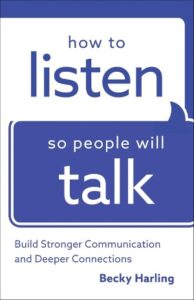
John: She’s written, she’s written a number of books, including the one that forms the foundation for today’s conversation, How to Listen So People Will Talk: Build Stronger Communication and Deeper Connections. And you can learn more about Becky and this book at FocusontheFamily.com/broadcast.
Jim: Becky, welcome to Focus.
Becky: Hey, thanks, Jim. It’s-
Jim: It’s so good to have you.
Becky: … great to be back with both you and John.
Jim: It’s so fun. You know, most of us, if we were to take a self-assessment, uh, this is one of those areas of life that we probably tend to score ourselves higher-
Becky: Yes.
Jim: … than we actually are. Like, are you a good listener? Let me ask you that question. What do you think? And you say, “Yeah, I think generally I am.” And then you ask somebody close to you, maybe a spouse or an adult child or a teen child, and they might say something like, “Yeah, I don’t think you’re a very good listener.” Um, I guess the question is, what are some honest signs that we might not be listening as well as we think we are?
Becky: Yeah. So I, I think it’s a really good question to ask those that are closest to you, you know? So how well do you think I listen? I mean, I asked our adult daughter that, she was a young adult at the time, and I really thought I was gonna get rave reviews, you know? And y-
Jim: I’m good.
Becky: You don’t-
Jim: I’ve written a book about it.
Becky: Right. Well, (laughs)-
Jim: (laughs)-
Becky: And you should never ask your kids a question unless you really want an honest answer. (laughs).
Jim: That’s for sure.
Becky: So I, you know, I stood back waiting for her accolades and instead she’s like, “Well, sometimes you’re a good listener, but you interrupt me a lot, you know, you seem distracted a lot, you finish my sentences.”
Jim: Mm-hmm.
Becky: “Um, and you try to fix things, you know?” And I remember thinking, “Aren’t I supposed to fix things? I mean, I’m a mom, right?”
Jim: (laughs).
Becky: That’s what we do. And-
Jim: Seems reasonable.
Becky: Yeah. And I just remember laying in bed later that night, you know, praying that the Lord would change me and, you know, kind of wrestling it out with the Lord, like, I thought I was good at this, you know? I’m always home after school when they’re there and … But it doesn’t mean you’re listening.
Jim: Well, that’s so true. Uh, you say listening is like a muscle that needs to be trained. That sounds so fatiguing already. (laughs).
Becky: (laughs).
Jim: Really? It’s one more thing I gotta go to the gym for now.
Becky: Yeah.
Jim: Uh, to, to-
Becky: The good news is you don’t have to go to the gym.
Jim: Well, that’s true.
Becky: (laughs).
Jim: You gotta go to the listening gym.
Becky: Yeah.
Jim: Uh, what does that mean, to train your listening skills? What does that look like? So I, you know, I go from this to that. Describe that.
Becky: Yeah, you have to be intentional. You know, you have to go into a space where you’re saying to yourself, okay, everything that’s on my mind right now, I’m going to put in like a box or a locker or a folder so that I can focus on the other person. You know, I think this is really good in marriage. You know-
Jim: Yeah (laughs)-
Becky: … you sit down.
Jim: You think?
Becky: (laughs).
John: (laughs).
Becky: You sit down at the dinner table, right? And you come and you’ve had maybe a long day, you’ve got a million things on your mind, and your spouse also has a million things on his or her mind. And so learning to just kind of quietly pray, this is the way I do it, you know, help me to put the things that are on my mind aside so that I can be intentional in hearing what Steve has to say, you know, really listening and seeking to understand him, um, because I think that’s where the work begins.
Jim: Yeah. So it is, you gotta be thoughtful about doing it.
Becky: Yeah.
Jim: That’s the thing. I think for an extrovert, maybe we could break it into that kind of design. Extroverts, we flap our mouths a lot. It’s fun for us. We wanna talk. We wanna be at the party.
Becky: Right.
Jim: “Hey, what are you doing? Hey, did you know last week this happened, blah, blah, blah?”
Becky: Yes.
Jim: You, you know the rhythm. And then you have the introverts that are thoughtful people that usually don’t finish other people’s sentences, they’re really trying to listen to you. I’ve noticed that pattern with people. Um, how do we look at it from that perspective of if you just like to talk, you’re really gonna have to work that muscle out to get it into a place where you refrain from talking?
Becky: Yeah, you really do. I think sometimes the problem with those of us that are extroverts is we like to be the center of attention, you know?
Jim: We do.
Becky: And so (laughs)-
John: (laughs)-
Becky: … we go to a party and we want people to engage with us or we wanna be the center of attention. And when you’re seeking after being the center of attention, you’re not really, um, listening to the other person. You know, there’s two types of people, it’s been said before. One comes into the room and says, “There you are.” And another comes into the room and says, “Here I am,” you know?
Jim: That’s a great-
Becky: And I think we have to look at that-
Jim: Yeah.
Becky: … and say, “What are my expectations as I’m entering this room?” Because, you know, bringing it back to Jesus, Jesus was an amazing listener, you know?
Jim: Yeah. You know, I’m thinking of that scripture that out of the heart, your tongue speaks, right? It’s kind of-
Becky: Yeah.
Jim: … generally that. So these are really spiritual principles beyond the words that are being expressed. So even coming into the room like that, that, that’s a spiritual observation about how we see the world, how we see us-
Becky: Yes.
Jim: … ourselves in the world, how I see you in the world. I mean, that, that’s a- another level to go to, isn’t it?
Becky: You know, it really-
Jim: In terms of your ag-
Becky: … is.
Jim: Kind of estimating your, uh, listening skills. It’s a spiritual issue before it’s anything else.
Becky: It is. Jesus said, you know, “Be careful how you listen.” Um, and He also instructed us that we’re to love one another. And, uh, it was David Augsburger who said, you know, “To feel heard is so close to feeling loved that for most the two are indistinguishable.”
Jim: Huh.
Becky: So that means if my kids don’t feel heard, they’re not gonna feel loved. If my spouse doesn’t feel heard, he’s not gonna feel loved.
Jim: Yeah.
Becky: I- if my friends don’t feel heard, they’re not gonna feel loved. And that kind of raises the ante on this (laughs).
Jim: Okay, here’s the, the golden question, and we’re not halfway yet into our discussion, but what’s one thing that somebody could do to begin to move in that direction to shift their listening skills, uh, to be more fully present? Just give me one thing at this point.
Becky: Put your phone away.
Jim: (laughs)-
Becky: (laughs)-
Jim: That’s a good one.
Becky: That’s, that’s a start. You know, we’re so distracted. And, you know, so put your phone away. I, I can give you, like, five steps to start, you know? Uh, put your phone away, lean into the person who’s talking, you know, uh, nod your head when it’s appropriate or smile to keep them, you know, learn to use the phrase, “Tell me more,” if you don’t understand. All of those are good practices.
Jim: One of the things you mentioned in the book is self-awareness. That seems right about just, just about any kind of situation. Self-awareness is a good thing. Some people don’t have it. It’s like the people that get off an airplane and stand right in the gangway.
John: (laughs).
Becky: (laughs)-
Jim: I cannot figure that out. It’s like they’re coming off the ramp, off the plane, and they need to know where to go, that’s fair, but they stop right in the doorway.
Becky: Yeah.
Jim: And like 140 other people are waiting for them to figure out what direction they-
John: (laughs)-
Jim: I’m going, self-awareness-
John: Yeah.
Jim: … just isn’t there.
Becky: (laughs).
Jim: But we do kind of that in listening to others too, right? We just clog up the gangway.
Becky: Yeah. We need to learn about self-awareness. And, you know, it’s a topic that I don’t feel like the Church has often taught about.
Jim: Hmm.
Becky: And because we’re so concerned about not being self-obsessed. But to be self-aware means you’re aware of how you’re coming across, you know, and so you, you’ve gotta raise that. And the only way to raise that really is to ask people close to you, you know?
Jim: Yeah.
Becky: And, and see how you’re coming across, you know?
Jim: You had a friend that had kind of missed an emotional moment, and you mentioned this story in the book. What happened as an illustration for all of us, what was going on with her where she just missed the moment and didn’t understand the gravity of the situation?
Becky: Yeah. So I was at a conference and I was having coffee with a friend who had just been diagnosed with breast cancer.
Jim: Hmm.
Becky: And I am a breast cancer survivor.
Jim: Hmm.
Becky: So I had a lot of empathy for her and was asking her how she was doing and what the treatment plan for her was gonna be. And we were having this really deep, intimate conversation. And another friend walked up to the table and just kind of word-vomited (laughs) all over us, you know? And was kind of like all spastic and going on and on about her interviews at the conference and what was happening. And she was talking 90 miles an hour. And at the end, I just said, “Well, I, you know, I hope it goes well for you.” And she walked away. And it was like, oh, wow, you know? But I think we’ve all done that from time to time.
Jim: She just missed-
Becky: You know-
Jim: … the moment.
Becky: She just missed the moment. She didn’t read the room, you know? We have to learn to read a situation when we enter. And if two people are involved in a really quiet, deep, thoughtful conversation, you don’t wanna come in, you know, like a piece of dynamite sharing your story.
Jim: How, how does somebody-
Becky: You wanna listen.
Jim: … develop that ability? I mean, somebody, you know, hearing us or watching. They might say, “Yeah, if I give myself an honest assessment, I’ve done that a few times. Where I’ve-”
Becky: Yeah.
Jim: So what do you do to get better at reading the room? Um, what, what does that mean to the person who struggles to read the room? How do you get them to a better place?
Becky: That’s a great question, Jim. I, I think first and foremost, you pray, um, and you, you become a fast confessor. When you realize you didn’t read the room well, you say, “Lord, forgive me. I didn’t observe that well, and so help me to show up differently.” And I think learning to ask yourself the question in every relationship, in every room that you walk into, how do I wanna show up in this room?
Jim: Huh.
Becky: You know? I wanna-
Jim: That’s, that’s good.
Becky: I wanna show up like Jesus. A lot of times I fall short of that, but I have to remind myself and ask myself, “How do I wanna show up? How do I wanna show up in my marriage? How do I wanna show up in my friendships-”
Jim: Hmm. Yeah, that’s good.
Becky: … “with my kids?”
Jim: Becky, you had a great story about honoring someone, uh, during a trip to Nigeria with your husband. What happened there?
Becky: Yeah, so that trip was life-changing for both of us. For starters, so my husband was raised in Nigeria. He’s a missionary kid.
Jim: Okay.
Becky: And he had grown up, um, being put in boarding school.
Jim: Hmm.
Becky: Um, and so when we got back to the boarding school, I remember him just doubling over and sobbing ’cause it was so traumatic.
Jim: Ah.
John: Hmm.
Becky: And I had rarely seen my husband cry, let alone sob. You know, he’s a very strong leader. And, um, the boarding school had set up all these appointments for him, and I just kind of said, “You know, he’s gonna need time to just go back and see what God has here.” And that, later that night, we were sitting outside the little cabin they gave us, you know, and we were drinking coffee and there were mosquitoes all around, you know? And, and Steve just started to talk about what it was like as a kid being dropped off at boarding school-
Jim: Oh.
Becky: … not seeing his parents for sometimes six weeks at a time, wondering where God was in all of that. And during that time, as we were sitting there and I was listening to him, I just felt like the Holy Spirit said to me, “Becky, this is a holy moment. Just listen to Steve and let him get it all out,” you know? And it, it still brings tears to my eyes, you know, because I had seen my husband, and he is, he’s a very strong leader, he speaks all over the place, you know, and leads organizations and all of that. But here, I got a glimpse of the little blonde-haired boy-
Jim: Hmm.
Becky: … that had felt abandoned because of ministry and wondered, where is God in all of this, you know? And, and that was a huge moment in our marriage, it, because it really took us to a deeper place of understanding each other.
Jim: Sure. Built intimacy.
Becky: You know? And it was a huge moment for him as far as the healing God wanted to do in his life. And really, all I did was ask questions and sit and listen.
Jim: That’s good.
John: Yeah. Yeah, this is Focus on the Family with Jim Daly, and our guest today is Becky Harling, and we’re covering some of the content in her book, How to Listen So People Will Talk: Build Stronger Communication and Deeper Connections. And, uh, we’ve got the book here at the ministry, just stop by FocusontheFamily.com/broadcast.
Jim: Becky, let me, let me ask you this. There’s so many circumstances where this fits, a married couple, um, a teen or adult child with his or her parent, uh, good friends. And what I’m setting up is this, uh, difficulty where … And even, we even express this in gender terms. Men tend to listen to somebody who’s got an issue, they’ve got a problem. It could be their spouse or any of the configurations I just named, and we’re sitting there, we’re listening to provide you a way out.
John: (laughs).
Becky: (laughs).
Jim: That’s our whole mission here, “Okay, so you had a problem with your girlfriend and you sat down and had coffee, and she said this, and you said that, and you know what, maybe next time you’re together, you might wanna try saying this.” And your spouse is going, “That’s not why I told you this story. I don’t need your advice on how to do that.” Ha- on the two sides of those equations, how do those that are trying to be the problem-solvers take a deep breath and say, “Okay, I’m not here to fix something.” That’s a tough one for me. Uh, do you have that experience?
John: I absolutely, (laughs) yes.
Jim: So, I mean, I need those mechanisms, if you can provide ’em to me, especially in-
John: Hmm.
Jim: … my marriage with Jean, where I need to know this is not a point of fixing, and h- how do I figure that out?
Becky: Yeah.
Jim: Help me, Becky, help me!
Becky: (laughs).
John: (laughs)
Becky: I think men and women struggle with that.
Jim: Okay, good.
Becky: You know?
Jim: That’s good to hear.
Becky: Yeah. So be assured, be validated, um, you know, that we all struggle with that. We wanna fix somebody else’s problems, but the truth is people don’t want us to fix their problems ’cause that really makes them an idiot, you know?
Jim: Oh, that’s interesting.
Becky: So, I mean, if you can-
Jim: Hmm.
Becky: … solve my problem in a minute and I haven’t figured out how to solve it, that makes me an idiot, right?
Jim: I’ve never thought about it that way.
Becky: You know?
Jim: It’s horrible, but I never have. I just think, you know, you got three people thinking about the problem, maybe one of you will come up with a good idea to solve it. (laughs).
Becky: Right.
Jim: I mean, that’s a more simplistic way of looking at it. That’s, that’s my approach.
Becky: So-
Jim: I never thought about it that it would be demeaning to you-
Becky: Yeah.
Jim: … that you haven’t found the answer. That may be part of my problem right there.
John: Hmm.
Jim: (laughs)-
Becky: Well, and I, so I think one way to change that is to put your focus on understanding the problem more deeply, not on finding the solution to the problem.
Jim: Hmm.
Becky: So, you know, let’s say Jean opens up to you and she’s had a rough day with a client or, you know, um, a rough day in the grocery store or whatever-
Jim: Yeah.
Becky: … you know? Instead of saying, “Well, next time you should,” first of all, drop the word “should”, ’cause that’s not really helping any of us (laughs)-
Jim: Yeah (laughs).
Becky: But then ask her to describe the situation more and ask questions like, “How did that make you feel? And, you know, what do you think of that? And what is God saying to you in that?” And just kinda ask questions, be curious. Learning to be curious is huge.
John: Yeah. Yeah, you mentioned Jesus earlier, and He did ask insightful questions.
Becky: Yes.
John: I have a friend who kinda went through and did a Bible study and the questions Jesus asked, and it, it feels like there are conversations where the person is not going to be receptive to my fixing.
Becky: Yeah.
John: Uh, my wife spent about two hours listening to one of our children, um, and she didn’t do the mom thing that you mentioned earlier. She said nothing. She really just asked questions-
Becky: Yes.
John: … and listened, and sometimes the situation doesn’t call for, uh, a response, just that question you asked earlier, “We- tell me more.”
Becky: Yeah.
John: So why is that so significant to the person that’s talking when we ask questions?
Becky: You know, it, it goes back to the book of Proverbs where in one of the Proverbs, Solomon says, you know, that a person’s heart is a deep well, and you’re wise if you draw that out. And most of us want to be able to express what we’re feeling and be able to figure out what we’re feeling and be able to figure out the answer to our own problems. So as you’re drawing them out and they’re processing, you know, verbally or internally, they will come up with the solution and then it gives you an opportunity to affirm like, “Hey, that’s a great way to solve this,” you know? Rather than you coming in as the knight in shining armor or the hero to solve it.
Jim: Yeah, that’s good. Yeah. Jean is an excellent listener. That’s something I’ve observed, but she’s learned how to do that well.
Becky: Yeah.
Jim: Uh, you mentioned in the book, The Five Be’s of Availability. It starts with be reliable, be intentional, be prepared, be flexible, be alert to divine appointments. So let’s talk about those. Be reliable. What does that look like?
Becky: Yeah. Being reliable is so important. Um, you know, in the context of listening, it’s really understanding that you are being given a gift with another person’s story. And so you wanna treasure that. You don’t wanna share what’s not yours to share.
Jim: Hmm.
Becky: You know, so you wanna hold confidences and you wanna be a reliable friend or a reliable spouse who’s going to hear and treasure that story.
Jim: Yeah, that’s good.
Becky: Yeah.
Jim: You also, in this area of being flexible, again, one of the Five Be’s of Availability-
Becky: Uh-huh.
Jim: … be flexible, uh, you have a neighbor, had a neighbor Clarice, that taught you-
Becky: I did.
Jim: … a lot about flexibility. What was that?
Becky: She did. You know, every morning I would go out for a walk, we were living in Denver at the time, and I would say hi to her and she never answered. Um, so I thought, well, you know, maybe she just doesn’t wanna be friends. And then one evening I went out for a walk and she said, “Oh, hi, Becky. Come for a walk with me.” So we walked and she poured out her whole story to me. And so I had a delightful time with her. The next morning when I said hi, again, she didn’t answer, but then I realized she had earphones in. She was listening to something. It wasn’t that she didn’t wanna be a friend.
Jim: (laughs). Okay.
Becky: You know? And then before we left that house, before we moved from that house, I remember her knocking on my car door window and we were just about to pull out. And she just said, “Becky, you’ve been such a good neighbor.” And I remember thinking, “I don’t think I’ve been a good neighbor.” But she thought I had-
Jim: Yeah.
Becky: … because I had taken time to listen to her.
Jim: Yeah, that is so good. That actually folds in nicely to the last of the Five Be’s-
Becky: Yeah.
Jim: … and that’s be alert to divine appointments.
Becky: Oh, so huge.
Jim: That kind of illustrates that. But get more specific and maybe another illustration from the book where-
Becky: Yeah.
Jim: … being prepared, uh, for those divine appointments, what does that look like?
Becky: You know, um, oftentimes those divine appointments happen on planes. And as people who travel, we are often in a hurry. I mean, one great tip for listening better is to let go of your hurry. But I remember that our daughter was traveling home from college. She had just finished finals. She didn’t feel like talking to anybody ’cause she just wanted to veg out with a magazine. And a, a young woman came and sat by her and really wanted to engage her in conversation. And in the course of the conversation, Carrie asked this young woman, “What do you do?” And she said, “I’m an actress.” And Carrie has taught musical theater for years, so she said, “Oh, what kind of acting do you do?” Well, it turns out the woman was in the adult industry. And Carrie said, “Well, h- how does that make you feel?” And this woman began to pour out her heart about how it didn’t make her feel good, but she had given it all away because God didn’t protect her in one situation. And, you know, Carrie said to her, “What would it look like for you to come back to God?” And she said, “I don’t think He’d want me.” And Carrie grabbed her hand and they were both crying at this point and Carrie said, “You know, God loves you so much. He wants you back and He wants to take away that shame.” And she prayed with this young woman whose name was Jessica before the plane landed. And as a family, we continued to pray for Jessica. And a couple years later, we heard from Jessica that she was out of the industry, that God had redeemed her life-
Jim: Wow.
Becky: … and that she was now traveling and speaking about, you know, why wait.
Jim: Yeah.
Becky: And, um, but she said something interesting in that conversation. She said God had positioned so many people near her in airplanes who kept directing her back to Jesus-
Jim: Huh.
Becky: … that she finally thought, “I better listen to this.”
Jim: Boy, that’s a-
Becky: You know?
Jim: That’s a reminder of being prepared and ready.
Becky: It is.
Jim: And I, I think so many people that we talk to, Becky, that have been at the microphone here with us talking about how to reach people, how to, you know, do better at being present, uh, so the Lord can use you. What a great example. And I think that pain and that hurt is all around us.
Becky: Yes.
Jim: It’s just that we’re going so fast, to your point-
Becky: Yes.
Jim: … we don’t stop to notice it or we don’t take time-
Becky: Yes.
Jim: … to say, “I can see you’re carrying a heavy burden.”
Becky: Yeah.
Jim: I mean, some of these things are simple to do, but it takes and requires your engagement-
Becky: Uh-huh.
Jim: … which we’re so … Um, I’ll just speak for myself. I don’t know how all of you react to that, but, you know, I feel like I wanna be very specific with how much of that I give away, which I think is not where the Lord’s heart is at. He’s saying like, “Be ready. Be my kingdom right now.”
Becky: Yeah.
Jim: “Bring my kingdom to those around you. Be present and give to those around you. Ask the right questions.” And let me turn to the listener, uh, here at Focus on the Family. We wanna be here for you. We have so many good things for you here. We have a counseling team that can help you, uh, you just call us and John will give those details in a minute and we’ll schedule a time for a counselor to call you back. We have, uh, just amazing resources for you in every area of your life right now, whether it’s marriage or parenting or whatever it might be. We’ve got resources here to help you, including Becky’s great book, How to Listen So People Will Talk: uh, Build Stronger Communication and Deeper Connections. Uh, make a gift of any amount to Focus on the Family, and we’ll send it as our way, send the book as our way of saying thank you for being part of the ministry, five, $10, and you get a great resource to learn how to be a better communicator, a better listener. In fact, Becky, you have a story that I was aware of about an NBA player-
Becky: (laughs).
Jim: … that had a little, um, situation go on, and he later let you know what happened.
Becky: Yeah.
Jim: Describe that story.
Becky: It, it’s a crazy story. After the book came out, um, How to Listen So People Will Talk was on the choice books racks and is it-
Jim: In the airports?
Becky: Yeah. In the-
Jim: Yeah.
Becky: … airports. And this NBA player, and for the life of me, I cannot remember his name, Jim.
Jim: (laughs).
Becky: But, um, he had gotten in trouble in that game because, uh, he was yelled at by the coach for not listening and not following through on what the coach had asked him to do. And it became this big storm on TV. You know, everybody knew the guy hadn’t listened and he was mad and he’s walking through the airport and he sees my book and he holds it up and he points to it and he’s like, “Clearly I needed this book.”
John: (laughs).
Becky: You know, and it kind of went viral on-
Jim: Couldn’t get better publicity.
Jim: … Instagram. (laughs)-
Jim: Yeah. That’s so good. But I guess it proves the point, right?
Becky: Yeah.
Jim: And at least he had the ability to say, “I’ve made a mistake.”
Becky: Yes.
Jim: “I need to listen better.”
Becky: Yes.
Jim: That’s what we’re talking about. If you feel like you’re that guy or that lady, man, get ahold of this book. You can do that directly through Focus. Make a gift of any amount, and we’ll send it as our way of saying thank you for being engaged with us in ministry, and you’re getting a great resource that even an NBA player uses.
John: (laughs).
Becky: (laughs).
John: And our number is 800, the letter A and the word FAMILY, 800-232-6459. We’ve got all the details at FocusontheFamily.com/broadcast. And by the way, uh, this reminder, as we kind of turn the corner, um, it’s hard to believe that spring break is coming up quick. Uh, if you haven’t done so yet, plan to swing by Colorado Springs-
Jim: Yeah.
John: … and see us. We have a terrific campus. We’d love to have you enjoy some time at Whit’s End Soda Shoppe, uh, visit our bookstore, take a tour to learn more about the ministry. Uh, we see about a quarter of a million people a year. We’d love to see you this spring break, or maybe if you’re doing long-term planning this summer. On behalf of the team, thanks for listening to Focus on the Family with Jim Daly. I’m John Fuller inviting you back as we once again, help you and your family thrive in Christ.