




Opening:
Excerpt:
Les Parrott: But as a couple, if you want to infuse your relationship, if you’re an empty-nest couple or you’re just beginning your relationship, you want to infuse that relationship with more joy and happiness, one dial, you can immediately turn is the dial of gratitude. Make a list of those things you’re grateful for in your spouse. You can’t help but to be more happy about your circumstances when you do that.
End of Excerpt
John Fuller: Great advice from Dr. Les Parrott, he was our guest last time on Focus on the Family, along with his wife, Dr. Leslie Parrott. And they’re back again today with some excellent starting points to cultivate more happiness in your relationship. This is Focus on the Family with your host, Focus president Jim Daly. I’m John Fuller, and we keep coming back to this topic, Jim, because so many people seem to be in need of kinda rediscovering happiness.
Jim Daly: Well, that’s important. We did talk about happiness and joy, they’re a little different, but if you missed the program last time, download it, or get the CD of this series, to learn more about how to be joyful and happy in your marriage.There were some golden nuggets in that conversation that can really help all marriages, I don’t even care what stage you’re in – newly married or married 50 years. We also talked about the empty-nester because when you get to that point, you think, okay, what’s the rest of my life gonna look like? What do we want to accomplish together? What are those dreams that we still might have, or do we have any? And we’re gonna talk more about that today.
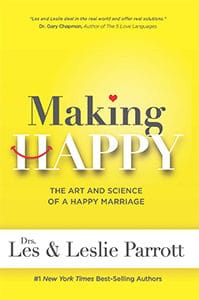
John: And Les and Leslie Parrott, have been doing marriage mentoring and helping couples for many many years. They’re the authors of a number of books including, MakingHappy:TheArtandScienceofHappyMarriage. Les is a clinical psychologist and professor, and Leslie, is a marriage and family therapist. We recorded this conversation with them, and here’s how Jim got day two underway.
Body:
Jim: You know, last time we talked about this distinction between joy and happiness and I thought you did a great job bringing all of the high-level Christian attitude about that into a right perspective. And I’m guilty of that. I often make this distinction and join the conversation about, that can’t be all about happiness, come on. And I thought you did again, a wonderful job doing that. But Les, let me start here again, that broader perspective of happiness. What is it the Lord wants? What are we really trying to hit here in this life when it comes to happiness?
Les: Yeah, you know, I – I think that God wants us to be happy in spite of our circumstances. That’s what we mean by joy, I suppose, but whatever you call it, it’s a combination of not just pleasurable experiences, but meaningful experiences.
Let me give you a quick illustration. Leslie and I teach this class at our university, at Seattle Pacific University. We’ll have 200 students in this class. It’s on relationships and so forth and – and we – we’ll ask them early on, what makes you guys happy? And video games, uh Netflix, uh you know, fishing, whatever it is. And it’s all these activities that we think make us happy.
And then we eventually kind of say, let’s do a little experiment and half the class in the next 48 hours, we want you to just indulge yourself in those things that make you happy, just if it’s playing video games, you go do that. And if it’s whatever – just – and this other half of the class, what we want you to do it give your life away in the next 48 hours. We want you to go minister to people. We want you to go do something that adds value to other people and volunteer and so forth.
They come back and we begin to debrief. What was the experience like? And what do you think happens in that classroom?
Jim: Yeah.
Les: It’s incredible, because all of a sudden, the students that were doing the video games and all the other stuff went, oh, I guess we kinda missed out. These people are really filled with a lot of happiness and joy over here. And that’s what we mean by that balance of meaning, as well as pleasure. You can’t make those – when you go after pleasure, you’re setting yourself up for disappointment. It’s guaranteed. If that’s what you’re after, how do we go have fun today? That’s cool. Go do that, but just know you’re gonna be disappointed, because not everything is gonna be fun.
Jim: Well, why then do we continue to come to the trough of pleasure as a culture? I mean, the culture is screaming at us. It’s all about your pleasure. And even as Christians, we continue to come toward that direction, trying to find meaning and purpose and fulfillment, when it’s almost like just eating too much sugar.
(LAUGHTER)
It’s not – it’s not good for you.
Leslie Parrott: A sugar high has the law of diminishing returns, doesn’t it?
Jim: Yeah, it’s a sugar high.
Leslie: It drops us lower than ever. And I think that’s a good way to look at happiness, because I think we – we go after it, because we don’t know what else to do in order to achieve that. And deep in our hearts, I think God has planted a desire. He’s – we’ve been created for joy. We’ve been created for that. And so, if we don’t have biblical wisdom on how to pursue that, I mean, one of the reasons meaning brings us so much happiness is because there’s engagement in it. You know, we’re fully engaged in service. We’re giving ourselves away and we also know that any kind of – any way that we can use our gifts that God’s hard-wired into us, you know that sense of flow and engagement sweeps us up in a deep sense of joy. And that’s where the meaning and purpose comes.
Jim: Les, you’re a clinical psychologist. Would you say with everything that you’ve studied and just the way the human mind works, did God create us to serve others? I mean, He told us to serve others, but do you think He created us in our – in our – in our very core to serve others, that our greatest sense of joy comes when we give ourselves away.
Les: Yeah, there’s no doubt in my mind that He did. We’re – we’re created for relationship. It’s our deepest longing and our greatest fulfillment is found in relationship to other people. And that’s not just peer to peer, but it’s when we reach out to other people and as iron sharpens iron, as Proverbs says, we help each other along the pathway of knowing God.
Leslie: Right.
Les: And so, it’s that idea of – of our truest sense of purpose is fulfilled when we are giving our lives away to other people. That’s what makes us the happiest. That’s where true joy abounds.
Jim: Last time we talked about these six happiness boosters, which are in your book, MakingHappy. And those first two that we covered were, “count your blessings” and “try new things”. Again, if you missed it, go download the interview. I think it’ll be really worth your time.
We also today wanted to talk about and connecting specifically to the empty-nesters. There was an article awhile back, I think in TheWallStreetJournal, about the greying of divorce – that couples are committed to raising their kids. They’re invested in it. You’ve got the helicopter parents. You know, they’re at every practice, everything, and it’s all about the kids and the kids doing well. And then the child grows up and goes off to college or starts their vocation, leaves the house. And mom and dad look at each other and go, we don’t know each other anymore.
Les: Right. What do we do?
Jim: I don’t know if I want to be with you anymore. How does this apply to that couple that is now in the wilderness? They don’t know if they want to even stay together. How do they turn that corner and make their relationship fulfilling and happy?
Les: Yeah, I’m glad you bring this up, because when you look at the big trend of fulfillment and happiness in marriage, which by the way, this book is about happiness in marriage. And I should remind our listeners, the hinge point of this whole thing is, marriage was never designed to make you happy. You make your marriage happy, and that’s what these six power boosters, these happiness boosters are about. And they’re – they’re counterintuitive. We don’t do them naturally.
But when you look at the big trend of marriage satisfaction and it starts off at a 10 out of 10. Why’d – why’d you get married? Oh, this is fantastic. We love each other. It’s fantastic. We’re on our honeymoon. And you gradually see this decline in fulfillment. And it reaches its lowest ebb about the time we have teenagers in the home, okay.
And then we see a big – it’s known as the inverted Bell curve. And then it begins to go up in the second half of marriage for those couples that stay together. But we also know the biggest spike in divorce is right there, what you’re talking about in the empty nest. And those couples are missing out, I believe, on the greatest part of marriage, because in that second half of marriage, the level of fulfillment begins to skyrocket for those couples that hang in there in spite of that kind of low ebb, right?
Leslie: Yeah, but you get the greying of divorce in that, they’re making those decisions right when not only they feel at their lowest ebb, but their marriage is at the lowest ebb, because – and it’s not always those, you know, the kids’ fault.
Jim: Right, their tank’s a bit empty.
Leslie: Their tank’s empty. They’ve been pursuing work. Work’s demanding, you know. They’ve got parents they’re taking care of in many cases. They’ve got kids. So, they haven’t had the luxury of staying focused and giving energy to their marriage, even sometimes couples who long to do that, enjoy each other, have still – life has not allowed them to invest at the level.
Les: And – and so, they you know, the – that proverbial saying, they cut down the tree in – in the wintertime, which you should never do right?
Leslie: Right.
Les: And there – it’s the lowest ebb and they’re goin’, let’s call it quits. You know, we got the kids through school. It’s time to move on. Obviously, sad for a lot of reasons, but like I said, sad primarily because they’re missing out on this great journey ahead of them, that they have so many choices that they can make to make it a different experience.
Leslie: In a way, they’ve earned the right now to enjoy the happiest season of married life and they just give that away right before they step into those years.
Jim: For the couple that’s feeling that way, it’s a degree of – of severity. I mean, some couples will be at the bottom of that description that we gave.
Leslie: It can be overwhelming.
Jim: They’re ready to call it quits. Other couples may be seeing a glimmer of hope that now that the fast pace is behind us, we can be doing some different things, investing in each other.
Leslie: Right.
Jim: How does that conversation go at the dinner table tonight? What would you suggest? Or maybe it’s not there; it’s later. What would you suggest they do tonight to rekindle the dream?
Les: Well, number one in my opinion is, you take inventory. Let’s find out where are we at? What do we have going in our favor? What are the things that we’ve been doing well? What is it that we’d like to change, right? It’s that old, you know, perspective of awareness is curative. If you become aware of what’s going on right now that needs to be different, then we can do something about it. If we don’t acknowledge it, it just continues.
Leslie: Well, and actually that’s pretty fertile soil for any couple to really step into this next booster of happiness that we want to talk about, which is dreaming dreams together, because they’re at the place where that can infuse their relationship with really fresh energy if they have the courage to do that.
Les: Yeah, to dream a dream, that’s the third kind of counterintuitive lever that we say you can pull in your relationship to bring about more happiness. And uh…
Jim: But Les, let me push on that a bit, because these are people that again, if we’re talking about the empty-nester, maybe some of their dreams have not been achieved. They’re starting to feel like now they’re in their 40s and 50s and beyond. And they’re thinking, we don’t have time nor energy, nor perhaps even the opportunity to pursue some of those dreams. How do they pull themselves up out of that kind of, you know, downer, into a place of more joy and more happiness, to say we can still dream dreams?
Les: You know, I think is beautifully illustrated in a little motion picture called Up. Do you remember the movie?
Jim: Oh, yeah. One of our favorites.
Les: We love that, and I love the opening, you know, that piece that just…
John: That opening montage.
Les: Yeah.
John: Oh, that’s beautiful.
Leslie: That shows the marriage over the lifespan.
Jim: Yeah.
Les: With no words and we sometimes show that at some of our live marriage events and so forth and people cry just watching that.
Leslie: I cry; what are you talking about?
Les: But – but you know, that movie is all about fulfilling our – our dreams as a couple together. And you know, they didn’t get to do that in that marriage, because she – she passed away.
Leslie: It – but I – what I love it – even in that story, what I think illustrates what we’re talking about, you know, they’ve had many setbacks. They – they dreamed of going to, what is it? Paradise Falls, you know, and…
John: Which was near Buenos Aires.
(LAUGHTER)
Referring back to something that happened.
Leslie: Yeah.
Jim: Right near the airport.
Leslie: I so empathize.
Les: I need more miles to make it there, yeah.
Leslie: You know and they never got there. All their – their little jar of money they were saving coins, they had to bust that jar for so many reasons along the way. They dreamed of becoming parents and of the heartbreak of infertility. I mean, so many of their dreams as a couple were unfulfilled. And yet, it was still in the pursuit of that final dream that they found so much purpose, joy, meaning and engagement and gave their lives away in the service of other people and to one another…
Les: Right.
Leslie: …that it didn’t matter whether the dream was fulfilled or not, it was the journey.
Les: Right.
Leslie: It was the hope. It was the – the shared excitement over that and making that happen for each other. So, in a way, life is real. We don’t get every dream we dream. And sometimes we get what we dreamed for and then we’re left more disillusioned than ever, because it didn’t bring the happiness we expected it to.
Les: I gotta tell you, we have a reminder of this powerful story, not far from our home…
Leslie: That’s true.
Les: …in Seattle because there is a real-life person that was – had an Up, what we call the “Up house.” And uh this little house, you’ll see it…
Leslie: A sweet little woman.
Les: …that is surrounded by this five-story building, and then this little tiny one-story house is down there. And she’s like what they modeled the – the movie after, I think, because she just stuck to her guns. She’s not gonna sell this house. This is where all of her dreams were.
Leslie: Edith.
Les: Yeah, her…
Leslie: She’s lived there for 50 years.
Les: Edith Macefield, yeah. And uh – so, when we see that house, we always go, what – what should be dreaming about when we drive by it? It’s a – it’s a monument to this idea of dreaming together for us.
Leslie: Right.
Les: And so, I would challenge every couple out there that’s listening to us right now, to begin to build a dream list. There’s nothing wrong with doing this, dreaming together in concrete ways. What’s on our bucket list?
Leslie: Yeah, a marriage bucket list is a great thing to have.
Les: Have you ever come up with a – a bucket list with your wife?
Jim: I think we have it, but we don’t have it written down.
Les: Yeah.
Jim: I think we have two or three items there that regularly rotate in as we do them. But we don’t have it written down.
Les: So, here, I – I want to give you guys an assignment.
Jim: It’s not trapeze?
(LAUGHTER)
John: Maybe that’s on Jean’s list.
(LAUGHTER)
Jim: I’ll ask her. I’ll ask her tonight if that’s on her list.
Les: But here’s my challenge: you say you have two or three that are kinda rollin’ around in your heads. I want you to come up with a written list of 50.
Jim: Fifty!
Les: Fifty things on your bucket list.
Jim: Wow! I don’t think I have a list of 50 of anything.
(LAUGHTER)
Les: That’s why I’m here. I’m here to help you.
Jim: Can we start with 10?
(LAUGHTER)
Les: But the reason I say 50, if the two of you will just brainstorm crazy things, I want to go to a rodeo. I want to go to whatever it is.
Jim: Now that’s crazy.
(LAUGHTER)
Goin’ to a rodeo. We could do that pretty easily.
John: That’s a tame one here in Colorado.
(LAUGHTER)
Les: But you make your list of things that you haven’t done together as a couple: little things, big things.
Leslie: And by