

Jim Daly: Here’s some data for you. Over a third of Americans surveyed have a garage that is so cluttered. Oh, did they look at my garage?
John: (laughs).
Jim: I think they did. But you can’t even park your car in there.
John: Mm-hmm.
Jim: Ooh, that hurts because I park outside the garage (laughs).
John Fuller: Obviously it’s a pretty common issue.
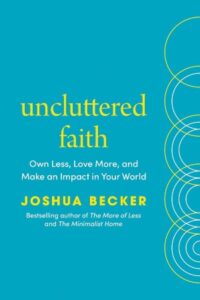
Jim: Th- obviously. The average American, uh, doesn’t wear 82%… 82% of the stuff in their closet. (laughing) That, that again would be true of me. Man, it’s like they just called me. Survey of one. And today, we wanna talk to you about how to correct that. I love the title of Josh’s book, Uncluttered Faith: Own Less, Love More, and Make an Impact in Your World. That sounds perfect.
John: And we’re gonna talk, uh, about all of this without shaming you.
Jim: (laughs).
John: So, don’t turn away because you feel guilty.
Jim: You can all shame me.
John: There’s gonna be inspiration here because there’s a, a higher purpose to getting rid of our stuff and living, uh, with less clutter. And our guest is Joshua Becker, who’s a bestselling author, speaker, and founder of the website, Becoming Minimalist. And we’ll be talking about one of his books, Uncluttered Faith: Own Less, Love More, and Make an Impact in Your World.
Jim: Joshua, welcome back to Focus.
Joshua Becker: Well, it is good to be here.
Jim: (laughs).
Joshua: Thank you so much.
Jim: Hailing all the way…
Joshua: Looking forward to our conversation.
Jim: Hailing from Phoenix.
Joshua: Hailing from Phoenix.
Jim: That’s a great spot. We love Arizona.
Joshua: And we will be winsome and invitational and not judgmental. Anyway…this is important.
Jim: Were those all golf terms? (laughs) Listen, I mean, you are this minimalist expert. Now, Kimberly, your wife’s in the audience, so I’ll be looking at her like, “Is she surviving in this minimalist environment?” Kimberly, thumbs up, thumbs down. All right, thumbs up from the spouse, so this is good.
Joshua: Here you go.
Jim: Now, uh, talk to that idea, that data I just gave. 82% of the stuff in people’s closets they don’t wear.
Joshua: Yeah.
Jim: Seriously.
Joshua: Yeah, and you mentioned the garage stat about third, 33%-
Jim: Careful-
Joshua: … park in their garage.
Jim: … this is tender.
Joshua: Well, the part I was gonna add to it, which makes it even more fascinating, is that the average American home has tripled in size in the last 50 years, and we still can’t park in our garages.
Jim: Mm-hmm.
Joshua: And over 11% of Americans rent off-site storage. And so, for further…
Jim: Okay, now we’re shaming. Now we’re shaming people.
Joshua: No, no, no, that’s just the data.
Jim: No, I know. It’s amazing, though.
Joshua: No, but really, I mean, when you think about it, how much stuff we own, like never in human history have human beings owned as much stuff as we do today, and whether it’s improving our lives or not, uh, I think is an important question we should be asking.
Jim: Okay. I guess the right question is why? I mean, that’d be a good place to start, just to say, you know, if I’ve got my garage full of stuff and I’m now renting additional storage facilities for more stuff, what does that say about my ability to declutter? (laughs).
Joshua: Well, uh, that is a good question. I think that there are different reasons. Different people struggle with, uh, difficulty decluttering. I think the most important truth that it communicates to us is that stuff can never satisfy.
Jim: Mm-hmm.
Joshua: And so, the world will tell us constantly… we see 5,000 advertisements every day, and every ad is telling us our lives will be better if we buy whatever they’re selling. And so, we believe it slowly, subtly, uh, and we keep accumulating these things, thinking that our lives will be better. And in reality, they don’t improve all that much. And so, rather than thinking, “Hey, maybe accumulating more,” which is what Jesus told us, isn’t the way to a better way of life, uh, we just keep accumulating more and more and more.
Jim: Well, uh, let’s get to that benefit. I mean, the Lord did indicate that it’s good not to be encumbered by a lot of stuff. I mean, He did that with the rich man who was saying, “How do I get into heaven? Well, sell all your possessions.”
Joshua: Yeah.
Jim: “And follow me.”
Joshua: Yeah.
Jim: Uh, I, I would see Jesus as pretty much, uh, a minimalist (laughs) when it came to stuff, but speak to the spiritual element here and what we’re trying to overcome with our appetite.
Joshua: Yeah. So, let me speak to the spiritual element and what Jesus had to say about money and possessions. I, uh, I grew up in a Christian home. I was a pastor for 15 years. I knew full well what Jesus had to say about possessions and money and being generous to the poor and, uh, life is not found in the abundance of possessions, and sell your things and give to the poor, “Come follow me, you’ll have treasures in heaven.” And for some reason, I used to read all of those instructions, and for some reason, my thought was, “Man, Jesus really wants me to live a miserable life today.” Like, I can see how that would help the poor, I can see how that would give me treasures in heaven. Like, it makes sense in that way, but man, my life is gonna be boring and miserable if I have to sacrifice everything. Until we started actually living that out and started… we got rid of 60 to 70% of our possessions. And when we did, I discovered, lo and behold, that Jesus knew exactly what He was talking about, that life is better. It’s more freer. We have more energy and focus. We can find more fulfillment and meaning. And once you know, just like everything else, Jesus knew the best way for us to live. Um, so that’s what Uncluttered Faith is about. It’s not a negative view of materialism so much as it is, “Hey, let’s look at the life that Jesus was actually inviting us to live.”
Jim: Yeah. Um, y- you had a friend, I think, or a woman that you mentioned in the book named Amy, who was at a big box retailer, and, uh, I think it was Target, if I remember correctly, but she had an epiphany in the parking lot.
Joshua: Yeah.
Jim: And I’ve had an epiphany in one of those parking lots, but I don’t think it was the same one, like-
Joshua: (laughs).
Jim: … “What am I doing here?”
Joshua: Yeah.
Jim: But what was her epiphany?
Joshua: Yeah. Uh, Amy’s a great story. She’s the first story in the book. And, uh, most of my other books, I start with my own story of discovering minimalism, and Amy’s is just a… Amy Slenker-Smith is her name.
Jim: (laughs).
Joshua: Uh, she lived just outside Washington, D.C. Uh, the short version of her story, uh, they had tried for years to have a child. Uh, they finally had a son named Zack. Uh, she continued to work full-time. He worked full-time, and she said that she went through this thought process of, “Man, we spent years trying to have this child, and I just see him in the mornings when I drop him off at daycare and bring him home for dinner and put him to bed.” And she said, “There must be, there must be a better way.”
Jim: Mm-hmm.
Joshua: Uh, and so she found minimalism. She found decluttering to try to free up her life and to free up her time at home to be with her family, uh, and to be with her son. And, uh, one day, on her way home from work, she stops in the Target parking lot to run in, as she said she did every single week, and it’s raining. She gets out of the car, she’s gonna get Zack out of the backseat and run in, and she just stopped before she opened the door, and she thought to herself, “I don’t actually need anything more in Target. Like, I have enough at home already.” And so, she got back in the car, and she drove away. And I think it’s a, a, a wonderful observation and an illustration and metaphor about so many of our lives, that we’re sacrificing time with the Lord. We’re sacrificing time with our kids. We’re sacrificing time serving and volunteering because of the things that we wanna buy, and we wanna accumulate. I just have this picture of, like, rain falling on, as like the symbolism of new life and, uh, a fresh new way to approach life.
Jim: Yeah.
Joshua: So…
Jim: Well, and what you’re connecting is that fact that when you declutter, you can lower your stress and anxiety and actually give yourself more time. Uh, fill in the blanks a bit more on that. And, because a lot of people, you, you don’t think of that equation working that way. It seems opposite of gravity.
Joshua: Yeah. Yeah, because the message from the world is the exact opposite. Like, the more you’ll have, the easier life will be, the happier life will be. But all of the studies… I mean, UCLA, Princeton, psychology, they, like, they go on and on. The more clutter we have, the more stress we feel. Like, literally the, uh, hormones spike in our, in our system when we’re surrounded by things that are calling for our attention. I mean, just think of, like, the clutter in our homes. It has to be dealt with. It tends to stir up a lot of guilt and anxiety, things that need to be dealt with at some point in the future. I always think all of our physical possessions don’t just take up physical space in our home, but they take up mental space in our mind, uh, and that’s the connection between clutter and stress. And so, the less that we own, the more calm, and refreshed, and rested that we feel, and so there’s a very direct connection there for sure.
Jim: You created a series of, uh, I think, steps to follow for people who want to practice minimalism. I think it’s the Becker Method?
Joshua: Yeah, so the Becker Method is a, a way to approach decluttering your home. And honestly, what I have discovered in my life is that the best way to realize the benefits of owning less, the invitation, the blessings that Jesus invites us to, is to actually start owning less. So…
Jim: Yeah, that’s good.
Joshua: So, yeah, the approach is, uh, number one, like, just get convinced on the benefits of owning less, that this is something that you want to happen in your home. Uh, and then the approach is, uh, a lot of people, when they think about decluttering, they think about, “Yeah, I gotta do my garage or my basement or my attic or gotta go through all the photos in the, in the basement.” And I say, “No, no, you don’t have to start by getting rid of the hardest thing in your home.” Like, declutter your bedroom, your living room, your bathroom, your closet. Like, start in those easier, lived-in spaces so you can start to feel the benefits of owning less. And then you’ll, kind of, build up that muscle and that momentum and motivation to eventually get to the garage and the attic and the storage unit.
Jim: I think it’s great.
Joshua: Yeah.
Jim: What are some of those other steps?
Joshua: Um, there’s, uh, there’s steps about, uh, noticing, uh, the benefits and articulating the benefits as we own less. Uh, I think it’s really important to reinforce even something as simple as, “Hey, my kitchen is easier to clean now that there’s less Tupperware in the cupboard. Hey, my living room is more relaxing now that there isn’t just so much stuff in there. Hey, it’s easier to pick out clothes in the morning because there’s less clothes hanging in. It’s easier to do laundry.” Like, the more we notice those benefits, uh, the more motivated we become to discover this freedom in other places.
Jim: So, a- as you’ve talked to people, especially when you were a pastor, were you kind of, uh, talking with people about this when you were pastoring?
Joshua: No.
Jim: (laughs) I can say.
Joshua: I, uh, I discovered, uh, I was a pastor for 13 years before discovering minimalism. Actually, it was my unsaved neighbor who introduced me to minimalism. And so-
Jim: God works in mysterious ways.
Joshua: Yeah, indeed. Yeah.
Jim: But go ahead. What did you say?
Joshua: So, I had about three and a half years where I was pastoring and writing about minimalism, and certainly this seeped into a number of my sermons and conversations. But, you know, once a pastor, always a pastor, I hope. And so, I just feel like I have a different ministry now.
Jim: Well, I was gonna say there, there’s probably two types. I mean, Jean and I are very different this way. I throw everything away, to where she’s gotta reach in the trash to pull out phone numbers that I throw away off stickies. So, she’s like, “Can you just run it by me before you do that?”
Joshua: Mm-hmm. Mm-hmm.
Jim: And so, I, I think I can be on the extreme throwaway side. But w- w- when you get to that point, uh, where maybe even in your marriage you have very different perspectives about that, and you could be foolish in that, and you could be wise-
Joshua: Yeah.
Jim: … so speak to both aspects of the, the one that would be less h- hurried to throw things away or give things away-
Joshua: Yeah.
Jim: … versus the person who’s chucking it out the house as fast as it comes in.
Joshua: Yeah. So, true, isn’t it? Uh, and I think that this is no different than most other aspects of marriage. Like, you can be on different wavelengths entirely, but Kim and I, like we were on board for owning less and wanting to declutter our home. And I always think if I wanted to get rid of 80% of our stuff, Kim wanted to get rid of 50% of our stuff. And so, like, the first 50% went pretty well.
Jim: Hey, 30%. Yeah, you’re negotiating.
Joshua: The first… Exactly. And it’s that way in almost everything, right? Like, we both want to be involved at church, but what does that mean? Like, how many nights a week, and where are we serving? And we wanna raise our kids the same way, but when do we spank and when we don’t? Like, when do we ground and when… Like those, finding those fine lines.
And so, minimalism, decluttering is the same way. I think there’s always gonna be one who’s a little bit more passionate than the other. Uh, I think that we learn from each other and we, um, we respect one another. It’s always easier to see everyone else’s clutter than it is to see our own. And so, always taking that humble attitude in of, “Hey, you own too much of this.” And “Yeah, but you have way too many tools, and you keep buying things in the garage.” And so, who, who cares if I have more cookware? You know, so I think finding those conversations is important.
Jim: (laughs) Sounds like you’ve had those conversations.
Joshua: Uh, indeed.
John: Yeah. And we have counseling here at Focus.
Joshua: There you go.
Jim: (laughs) It does help.
John: 800-A-FAMILY, uh, give us a call. Seriously. We do have counselors here, and they can guide you through some conversations about this and other topics. Uh, we do encourage you to get a copy of Joshua Becker’s great book, Uncluttered Faith: Own Less, Love More, and Make an Impact in Your World. Uh, just stop by FocusontheFamily.com/broadcast, or call us, and we can tell you more. 800, the letter A, and the word FAMILY. And, and Joshua, you, kind of, touched on this earlier, but there’s a mindset of greed that you say-
Jim: (laughs).
John: … is not just for the well-to-do, but it’s actually pretty common to man. I, I don’t have any problem believing that, but just not about myself.
Joshua: Mm-hmm.
John: So, what’s the problem with greed?
Joshua: Yeah. Isn’t that true? Uh, no one ever admits to be greedy.
Jim: (laughs).
Joshua: A little bit like money. No one loves money. Everyone just wants more of it. Uh…
Jim: Yeah.
Joshua: Um, yeah, exactly. Yeah, greed, I think, is a pretty important conversation. Jesus says it this way, “Be on your guard against all kinds of greed.” Uh, and then He says, because life does not consist in an abundance of possessions. And the, the story that He uses to make that point is the story of the farmer. Uh, if you know where the teaching comes, uh, the farmer who has a really bountiful harvest and he builds bigger barns, and then He says, “I’m gonna eat, drink, and be merry.” Uh, and then God says, “You fool, today your life will be, uh, taken from you.”
And then, uh, Jesus says that this is how it will be with anyone who stores up things for themselves but is not rich towards God.
Jim: Mm-hmm.
Joshua: And I think that there is a lot for us to learn in that parable because in many ways the story, the American dream, is what this farmer was living out. Like, he was really successful in business. He had a lot of crops come in, a lot of extra money come in, and he thinks to himself, just like most of us would, “Let’s build a business, let’s build the bigger barn, let’s get the bigger house.” And Jesus says, “No, life is not found in abundance of possessions. Be on your guard against all kinds of greed.”
You know, the really humbling fact about that is that a barn in the New Testament times would have been about 500 square feet, uh, and yet we’re living in 2,000-square-foot homes and it’s still not enough stuff for us, uh, and we continue to expand-
Jim: Yeah.
Joshua: … and expand. And I think we need to be on guard more than we think we do.
Jim: You know, in a different but similar application, you had a friend who I think was in the construction business.
Joshua: Yeah.
Jim: So, taking this even a step further, describe his situation and how, you know, h- he had to get a, a handle on what was going on in his own life.
Joshua: It is really a perfect story… Um, a sad story, but a perfect story of like what I want to try to communicate.
Jim: Mm-hmm.
Joshua: Uh, let me set it up by saying this. The average American spends 10 minutes a day on faith-based practices, that counts personal devotion and corporate going to church, less than 10 minutes a day, but the average American spends more than two hours a day on their physical possessions, whether it be managing, cleaning, shopping, whatever it might be. So, um, I had a friend, and he… him and his wife, uh, two children, they were really involved at church. He quit his job. He starts a construction company. Uh, the construction company becomes really successful, so successful that he starts working weekends. At first, it starts as a Saturday, then it moves into a Sunday. Uh, suddenly he’s working on weekends, making more money than he ever thought he would make, becoming more worldly successful than he ever had in his life. But as is the case in so many of our lives, church becomes the very first thing that gets cut out, and spiritual practices and faith-based stuff. Um, and they’re divorced. Uh, he hardly sees his kids anymore. I can’t remember the last time he’s, he’s been to church. Um, and-
Jim: Mm-hmm.
Joshua: … I, I think it’s a very perfect example of sometimes the death that we experience isn’t just, you know, the wages of sin is death, and it isn’t always just a physical death. Sometimes I think when we get too busy chasing after the world and what it offers, um, we suffer spiritual death quicker than we think.
Jim: I think, you know, the autopsy is always easier-
Joshua: Yeah. Mm-hmm.
Jim: … because you can cut the body open and figure out what happened.
Joshua: Mm-hmm.
Jim: And so, my point in mentioning it in that kind of way is there are other things in play for that poor guy that is driving him toward that in the moment. He’s obviously not seeing the neon signs, “Caution, wait, no need for more.”
Joshua: Right.
Jim: So, it… How do we balance that appetite and have wisdom, as the scripture would say, Proverbs, the Lord would tell us, to have wisdom? I was just with my, uh, doctor of mine, a friend who’s also my dermatologist, but I asked him how he’s doing because the last time I saw him, he was super busy, overworked, not seeing the family, that kind of-
Joshua: Mm-hmm.
Jim: … situation.
Joshua: Mm-hmm.
Jim: And he said, “You know what? I’m making less money, but I’m controlling my hours now.”
Joshua: Mm-hmm.
Jim: “I’ve just cut back.”
Joshua: Mm-hmm.
Jim: That’s a guy who caught it.
Joshua: Mm-hmm.
Jim: But speak to that need to assess where you’re at, both for a man and a woman-
Joshua: Yeah.
Jim: … and to say, “Okay, I, I don’t need more.”
Joshua: Right.
Jim: “What I need more of is time to spend with my, my family,” or however they-
Joshua: Yeah.
Jim: … intend to spend that time.
Joshua: Yeah. And no easy answers here. I think we rely on the Holy Spirit. I think that’s why it’s imp… so important that we’re in prayer and that we’re in constant communion with him because our capacities are very different, and what one person might be able to accomplish in their life is different than what someone else might be able to accomplish. And so, I think we’re always, like, um, spending time with the Lord, spending time in quiet, uh, least… allowing him to speak into our hearts. But I think if I could summarize it, I would say two things. I think what we need to do is we need to define success differently. Success in the world’s eyes is more stuff, more money, more power, but in God’s eyes, success is, “Am I becoming more like Christ, and am I accomplishing the good work that He prepared in advance for me to do?” And sometimes that means I’m working long hours, I’m putting in time in my career, and in my self-growth. Other times it means I’m taking a step back, and I’m focusing more on my faith and on my, on my health. John Wesley says, “If you are focused on work and money is ever affecting your physical and spiritual health, then it’s becoming, uh, something that is keeping you from Christ and, uh, and following Him.” And so, I think the question we need to be constantly asking ourselves is, am I becoming more like Christ? Am I accomplishing what God called me to do, or am I just chasing all the things that the world offers?
Jim: It’s so good. I think one of our challenges, uh, as Christians, is to prioritize people over material things. I mean, everybody has that challenge, but Christians have it, uh, probably in ways that are a little more difficult to manage because… And I think especially for men, we-
Joshua: Mm-hmm.
Jim: … we, we are into performance. So, for us to be able to get the bonus, to do the thing, to work hard, to get the-
Joshua: Mm-hmm.
Jim: … uh, you know, the promotion, whatever it might be, is really important to us. Prioritizing people over those things-
Joshua: Yeah.
Jim: … can be a little more difficult. Speak to that. And I think he even had a story, I think a woman named Donna, that, kind of, plays into this.
Joshua: Yeah.
Jim: But speak to those things, prioritizing people. “Really, Joshua?”
Joshua: Yeah.
Jim: “I’d rather just do what I need to do to make money.”
Joshua: Yeah. And, and let me mention… I don’t, I don’t think we’ve said it quite yet, but it’s so important, minimalism is not about giving up ambition or passion or drive. Like, for me, it’s just the opposite.
Jim: Mm-hmm.
Joshua: Like, I want to own fewer things. I want to remove the distractions of the things that don’t matter so I can direct more passion and more ambition towards those things that actually do matter-
Jim: That’s good.
Joshua: … in life. And family, uh, making a difference, uh, expanding the kingdom of God. Like, I think when we begin living our lives aligned with those greater passions, we accomplish even more than chasing what, uh, the world would, um, uh, offer to us. You mentioned Donna. Um, Donna was a, a woman that I knew, uh, church in Wisconsin. Donna was a pediatric nurse. Um, her husband was an elder at the church. She delivered one night a child with, uh, incredible special needs. The mom of the baby immediately left, uh, the child at the hospital. Uh, Donna goes home and tells her husband about this and says, “I think God is calling us to adopt this-
Jim: Wow.
Joshua: … baby.” Um, and so they pray about it, they make the decision to do it. Six months later, the husband dies tragically and unexpectedly. Uh, and it was, uh, one of the first times in life where I’m like, “Man, if God is real, I don’t understand this.” Like, it was one of the, like, the most moment in my life where I was like, “What is going on here?” Uh, Donna had to commit her whole life to raising this special need. She had two other daughters. And, uh, I think of Donna now, 25 years later, and, um, you know, if you were to look at her from the outside, there’s no worldly succe… Like, there’s nothing externally where you’re like, “Man, she is nailing life, and she’s getting everything just right.” Like, just nothing external that you would say. A small home, you know, modest clothes. Um, but I, I look at Donna and, like, she looks like Jesus. S- she lives like I think Jesus would live, uh, caring for the least of these.
Jim: Mm-hmm.
Joshua: And I think what it means to follow Christ looks very different from what it means to chase after the world-
Jim: Well, let me press that…
Joshua: … she’s a perfect example.
Jim: Yeah, I mean, that’s a beautiful story. And again, we see it through a different filter, right?
Joshua: Mm-hmm.
Jim: What is success? How do we measure that? Comfort-
Joshua: Yeah.
Jim: … tends to be the key. And, you know, I may not wear that shirt, not to belittle all this, but, or I may not need that tool, or I’m… but someday I might. So, I keep it there, and I add more to it because someday I might. Y- speak to that issue of comfort in the Christian life versus success in Christ and what that looks like. I think we’re pretty muddled on that today.
Joshua: Yeah.
Jim: I know I am because comfort is comfortable.
Joshua: Yeah. Yeah. Uh, comfort is, um…
Jim: Unlike Donna. (laughs)
Joshua: Unlike Donna, who I think, um, uh, lives a difficult life, but I don’t think she would trade it for anything. And, um-
Jim: Mm-hmm.
Joshua: … I think she has a joy and a fulfillment and significance in life that, um, many of us think the world will provide, but, but never will. And so, I think rewards today and, and rewards in heaven.
Jim: How do we learn to be content in that lack of worldly comfort?
Joshua: Yeah.
Jim: And say, “Okay, Lord, you’ve got me, you’ve got this, I’m gonna do these hard things because that’s what I believe you’re calling me to do.”
Joshua: In Matthew 13, uh, there’s the parable of the pearl and the parable of the great treasure. Uh, two parables right side by side. And, uh, most of you will, will know the story, right? The, the great pearl, the merchant sells everything to buy the pearl. There’s a great treasure in the, in the field. The guy sells everything so that he can buy the field. I think what most people miss in that parable is that the merchants and the man sold everything so that they could possess the pearl and the treasure. Most of us are living life, knowing that the kingdom of God is better than the world, knowing that there’s more value over there, but-
Jim: Mm-hmm.
Joshua: … we’re trying to keep both. We’re trying to have the pearl and all the trinkets that we’ve collected along the way. But the story of the kingdom, the story of the parable is, no, you need to sell all of that to afford the pearl. You need to sell all of your things to buy the great treasure. And so, where do we find the contentment? Number one, we have to actually start living it out. We have to stop thinking about Jesus’ instructions as too difficult, or it would lead to a crummy life, and start saying, “No, I’m gonna actually start doing what He invited me to do.” And when we do, we discover, number one, that we need far less than we think we do, and number two, that what God is offering is far better than anything we’re giving up along the way.
Jim: Man, I can’t think of a better place to say, “Get the book.”
Joshua: Yeah.
Jim: Uncluttered Faith: Own Less, Love More, and Make an Impact in Your World. And let me say to the listeners, I hope you can take a very simple step and, uh, begin to simplify your life. Reducing clutter can be such an easy way to create more margin when life feels hectic. I think that’s your message, right, Joshua?
Joshua: Yeah.
Jim: And there’s so many great benefits, and we’ve covered those in the program. Let me encourage you to get a copy of Joshua’s book, Uncluttered Faith: Own Less, Love More, and Make an Impact in Your World. The book’s gonna help you shift your mindset to embrace minimalism, and it even has a list of ways you can save money by reducing waste. And everybody says, “Amen.” Uh, we have copies for you here at Focus on the Family, and when you make a gift of any amount, uh, we’ll send you a copy of Joshua’s book as our way of thanking you for your support. And as you declutter and create some extra room in your budget, I hope you’ll consider, uh, partnering with Focus on the Family. We are doing so much good together and helping people in so many ways. Be a part of it.
John: Yeah, donate and get your copy of Joshua Becker’s book when you call 800, the letter A, and the word FAMILY. That’s 800-232-6459. Or stop by our website for all the details. Uh, we’re at FocusontheFamily.com/broadcast. And thanks for listening to Focus on the Family with Jim Daly. I’m John Fuller, inviting you back next time as we once again help you and your family thrive in Christ.