

Preview:
Kevin Thompson: How is it that if God has so opened my eyes to His grace, I can’t help but take that grace to other people, and what opportunities do I have today to spread hope in the lives of other? Again, they are bombarded with doom. What if not living in denial of that pain? What if in the midst of that pain, I can bring some good news as well?
End of Preview
John Fuller: Well, Kevin Thompson joins us today on Focus on the Family with Jim Daly. I’m John Fuller, and thanks for being with us.
Jim Daly: John, I think it’s good to say, how do you start your day? You know, Jean and I, really since COVID have gotten into that habit. We do RVL, Ray Vander Laan discipleship series. So in the morning, it’s about a 15-minute little clip you can get from Focus on the Family. And we have a cup of coffee and we pray together and, uh, you know, hear what Ray has to say, refer to scriptures, et cetera, do it devotional, and we get on with the day.
John: Yeah.
Jim: That’s most days, not every day because there are things that crowd that. But how do you start your day? It’s a good question. And oftentimes, there’s that desire to look at the phone and look at the news, and I do that too. Uh, don’t get me wrong, I’m no saint or angel. But, uh, there is that habit to kind of start our day with the worst possible news we can find, right?
John: (laughs) It’s a good observation.
Jim: But when you stop and think about it, why do that? Let’s start with the uplifting news of what’s eternally true rather than the temporary news of what will drag us down.
John: Mm. Yeah. I, I remember I was taking one of my boys to, uh, school and, um, he wanted to hear sports and I just said, “Hey, truth before trivia. Let’s, let’s listen to something on the radio or a podcast with the Bible in it.” And he looked at me and like, “Why? You don’t do that.”
Jim: (laughs).
John: Well, he didn’t say it, but I felt it. So yeah, I, I’m tracking with you and I’m really glad that we have Kevin Thompson here to really unpack this. Uh, Kevin is the married life pastor at Bayside Church in Roseville, California.
Jim: A beautiful location.
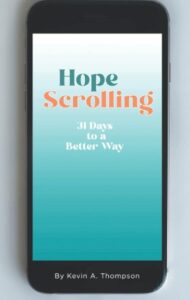
John: It is, isn’t it? And he and his wife, Jenny, have two children. He’s a marriage and parenting conference speaker. He’s an author. And we’re gonna be dialing into his book, Hope Scrolling: 31 Days to a Better Way. And I’m looking forward to learning about this myself, Jim, as obviously I’ve got some room to grow.
Jim: (laughs).
John: Uh, you can learn more about Kevin and his other books and this terrific resource, Hope Scrolling, at our website, and that’s FocusontheFamily.com/broadcast.
Jim: Kevin, welcome back to Focus on the Family.
Kevin: Oh.
Jim: Always good to have you.
Kevin: Thanks for having me. Great to be here.
Jim: Yeah, so much fun. Um, this is really good. Let me just ask you upfront. I mean, the doom-scrolling is what everybody calls when you pop up and you start looking through YouTube feeds and whatever your social media preference is. Where’d you come up with Hope Scrolling?
Kevin: Yeah. So just, uh, Jim and John, two hours from where I live, there are four or five just mega companies who are spending billions of dollars every single year to try to figure out ways to get our attention.
John: Mm-hmm.
Kevin: That’s their goal. And what they figured out is the best way to get our attention is not by giving us good news, not by filling our hearts-
Jim: Yeah.
Kevin: … and our souls and sending us out into life, because the truth of the matter is, hope-filled people scroll less.
Jim: Hmm. Interesting.
Kevin: And so they make less money.
Jim: You know what I heard? And, and, finish this thought, but I, I just want to interject. Anger is the greatest motivator for clicking.
Kevin: Absolutely.
Jim: Isn’t that crazy?
Kevin: Well, I, I found that during 2020. One of the things I, I really found was there was a correlation, uh, between, because obviously as a married life pastor, I, I know some insights into people’s lives.
Jim: (laughs).
Kevin: Right? And so I found a correlation between the men who had the worst marriages tended to be at church the most outspoken and critique of how we were handling different political and social, uh, situations of what was taking place.
Jim: Interesting.
Kevin: And it just shows that that dissatisfaction underneath in the heart expresses itself in, in some ways. And so these major companies, Google, Apple, YouTube, uh, Twitter, they’re, they’re spending these millions and billions of dollars to get our attention so that they can sell us to other people and then so they can sell to us. And, and so this book is primarily just my own kind of conviction, kind of my wife, uh, pointing out to me my own patterns and habits. She is so diligent and she gets up in the morning, she wakes up before I do, she goes downstairs, gets her Bible, and makes sure that she has the time to, to such an extent that sometimes I come downstairs and she’s like, “You’re already up? Like, don’t, don’t, don’t you need more sleep?”
Jim: (laughs).
Kevin: “Like, I’d rather spend time with the Lord for a little bit because you’re gonna be needy in some way.”
Jim: That’s funny. Yeah.
Kevin: But, but just to begin to make this subtle shift now into what, what story are we gonna enter into? We’re gonna live our lives with two stories today as Christians. We’re gonna have the higher story of the gospel and the truth of God’s kingdom, but we also live in this lower story of the reality of what the day-to-day is and what the news is pressing to us. We have to live in both of those things, but which one is going to dictate how we interpret the other? And generally speaking, whichever story we enter into first i- is going to be the story that sets our perspective for the rest of the day. And, and so why not focus more on the hope of the gospel rather than the doom of culture?
Jim: Let me ask you, in the book, uh, you mentioned a research study-
Kevin: Yeah.
Jim: … or survey that fellowship of Christian athletes did. Yay to them. That’s how I became a Christian was through FCA. But, uh, what was the findings and what was the study?
Kevin: So six or seven years ago, FCA came with, uh, up with an app and, uh, where you have this daily interaction with scripture. And so they ran this over a period of time to watch, uh, because they would give you an assessment beforehand of how you scored in, in various areas. And then based on that, they would feed you very specific scriptures to try to help you in, in whatever areas those students were struggling with, whether it was, was sexual sin and purity, uh, issues or discouragement, anxiety, all those things. And, and then after a year, they would feed you that same assessment. So they had all this data coming in to see what was the transformation that took place, but not only that, probably something the students didn’t know is they had the data of how often those students were actually reading the text message.
Jim: Oh, okay.
Kevin: So they would send you a text message. If you clicked on it, it would take you then to the passage of scripture. If you didn’t click on it, it, it, you, you would know what was read and what was unread. And what they found was something extremely interesting is there was a dramatic change in scores at one specific threshold. So students who, who, who clicked on the, the app and, and found the scripture two or three days a week, their scores didn’t change one bit. But the moment you got in the pattern of four days a week, there was a dramatic change-
Jim: Huh.
Kevin: … in the scores. And it begins to show, not with perfection, but with this rhythmic discipline that if you can enter into God’s story on a regular daily basis, it will begin to impact how you see yourself and I think how you see this world.
Jim: Well, it’s so true. And it’s so self-evident, if you’re reading the word and praying and doing that together with your spouse, ideally, um, th- there should be a difference.
Kevin: Yeah.
Jim: Right? And when you don’t do those disciplines, there isn’t a difference.
Kevin: Mm-hmm.
Jim: And that’s the truth. We see that in our own research here at Focus on the Family. You have to apply spiritual truth in order to receive spiritual blessing, I think.
Kevin: Mm-hmm. Yeah.
Jim: Um, in that context, have you seen this in your church too? Is it-
Kevin: Oh-
Jim: … uh, playing out that way?
Kevin: Oh, there, there’s no question. I mean, even, even back if you look at, at five to six years ago, six years ago now with, with 2020, I, I saw a, a dramatic difference in the cultural turmoil that was going on with the church members who I knew were in a, a discipleship group that were strategically reading through scripture versus those church members who were not involved in a regular Bible setting. Now, they might have been doing something privately on their own, but I don’t, I don’t know that, but there was just this dramatic difference. And here’s, Jim, I think one of the things that’s interesting to me is, I think part of it is, if you do not read the minor prophets, you might struggle to truly understand some of the issues going on in our day-to-day.
Jim: Hmm.
Kevin: And so if all you do is kind of cherry-pick aspects of the gospels here and, you know, the good parts of the Psalms (laughs)-
Jim: Right.
Kevin: … let’s not read the bad parts-
Jim: Right.
Kevin: … then, then you, I think you can really struggle with this contrast between this really good God and the sorrow that we see. And, and there can be almost this angst of, of a blame toward others who don’t believe in Jesus and go, “Oh, societal problems are, are their fault.” But whenever you begin to read the prophets specifically, you, you see the charge that God’s people have, uh, of now influencing their culture to such an extent that, that we have a responsibility to what’s going on. And, and so I just found, uh, during the, the whole 2020 craze that those who were in a strategic, uh, interaction with the whole of scripture responded in a radically different way than those who weren’t.
Jim: Yeah. You, you observed too, one simple fix for most couples works to improve their trajectory. What is that one simple fix? Everybody’s going, “Yeah, what is it?”
Kevin: (laughs) Yeah. I had, I had a couple come into me one time and, and they’re right in the throes of life of, of kids and careers, all that. Thankfully, I’m, I’m a, I’m just a decade beyond that, right?
Jim: (laughs) Right.
Kevin: And so their marriage wasn’t horrible, but it wasn’t where they wanted it to be. And so it’s interesting, as we were sitting there talking, I just noticed that, one, the credibility of that couple seeking help now, and not waiting ’til it was horrible. And, and, and so I applauded them for that.
I said, “Here’s what I want you to do.” He had, he had a very busy job. I said, “E- every day at 2:00, I want you to set an alarm on your phone, and when that alarm goes off, I want you to take two minutes and simply think about your wife, think about what she’s going through with her kids at home, and she’s about to go pick up the little ones at school. She has the smallest one that’s still at home. Think about her day. Think about how, uh, in, in just a few hours whenever you go home, how can you best contribute to her and, and what mindset do you need to get in, uh, to enter into that house in a, in a proper way?” Then I told the wife, I said, “Hey, it can’t be as strategic with you. You got little kids at home and at school, uh, but when you put the smallest one down for a nap, as that one is drifting off to sleep, I want you to be intentional and take two minutes and think about your husband and just think about what’s his day, what’s his pressure, all that. I just want both of you to take two minutes and let’s see how that goes.”
Jim: Hmm.
Kevin: Six weeks later, I’m at church. I happen to run into the wife and, uh, she comes up to me and she goes, “Hey, you know, it’s been awhile.” And I thought, “Oh, yeah.” Oftentimes I don’t, I don’t get the checkup, like, what happened here?
Jim: Yeah.
Kevin: Did my, my, was my advice horrible? And I asked her, I said, “How are things going?” And she said, “Kevin, it’s amazing. Nothing has changed, but everything has changed.”
Jim: Huh.
Kevin: And I said, “Really?” She goes, “It’s amazing how just that reality of two minutes of fixating on one another and thinking about each other. Now, whenever we, we come, he comes home, we connect in a meaningful way, it changes our interaction at night. It gives me compassion toward maybe if he comes home frustrated. It gives him compassion, if he comes home and the house i- is in chaotic. Uh, just taking that intentional time of attention now has changed everything.” I think it’s true in marriage. I think it’s true with our relationship with Jesus.
Jim: I- in this book, Hope Scrolling: 31 Days to a Better Way, uh, you talk about three questions. The first is what’s the hope?
Kevin: Yeah.
Jim: I mean, this is in everybody’s heart.
Kevin: Mm-hmm.
Jim: What is the hope?
Kevin: Yeah. So what, what I love about Hope Scrolling, here’s, here’s a little bit of a danger of devotional books is sometimes devotional books cannot actually point you to scripture. A- and so my, my goal with Hope Scrolling is I want you in scripture and, oh, by the way, here are some words that might help you get there in some way. So each of these 31 days just takes a simple passage of scripture. And one of the first things I want you to do is as you read it, go in and just every time you see God mentioned, Father, Son, or Holy Spirit, just mark that, notate that some way physically in, in the book. In seminary, we always learned the triangle was the symbol of the Trinity. And so I would just take that and every time the Father, Son, or Spirit mentioned, I just draw a triangle over that word. And it begins to show you how the Bible is about God. It’s not about us.
Jim: (laughs).
Kevin: And about how He’s popping off the page.
Jim: Yeah.
Kevin: So the very first question I always wanna ask whenever I’m reading scripture is what is the hope about God? Where is His character, His nature, who He is? Let’s begin with Him, then we can get to us, then we can get to others. But let’s begin with who God actually is, because we’ll have that perspective about God’s sovereign power, His control, His love, His holiness. It will begin to impact now how we view everything else.
John: Yeah, this is Focus on the Family with Jim Daly, and we’re talking to Kevin Thompson today, and, uh, I love the direction of the conversation. It’s so counter-cultural right now.
Jim: (laughs).
John: It’s, there’s so much, uh, gloom and despair. Uh, Kevin has written this terrific devotional called Hope Scrolling: 31 Days to a Better Way. You’ve heard him talk about his approach. This is gonna be good for you as an individual, for you as a couple, maybe a small group at church, uh, somebody in your neighborhood might wanna do this with you. Uh, get a copy of the book or more than one from us here at the ministry. We’ve got the link at FocusontheFamily.com/broadcast.
Jim: And Kevin, let me ask you this. You mentioned a story about this prisoner that you befriended. Now, first of all, way to go to do a little prison ministry, but, uh, I’ve, I’ve done a little bit of that, but that, that’s a lot of commitment. But what happened with this, uh, prisoner that you knew?
Kevin: Yeah. So, so Jim, uh, you know, it’s been about six years since I’ve been coming here to Focus, and what a privilege it is. And so six years ago, I, I transitioned from Arkansas here to where I am now in California, but back in my old life in, in Arkansas, I, I just noticed at one point that I, I, in the pastor, I wasn’t spending a lot of time around non-Christians. So I’d begin to figure out, how can I spend more time around non-Christians? So one opportunity was the local university, uh, was in need of adjunct professors of speech. And so I thought, oh, that’d be fun. I love communication and study it. I thought, “I’ll go teach these 19-year-olds intro to speech.” And so I walked into my very first class, 24 19-year-olds walked through the room, but then there was one 35-year-old who came in, who was my age, same age as me. And, and over the time, we, we built a very significant relationship in part because we were kind of making fun of these 19-year-old kids-
Jim: (laughs).
Kevin: … and the foolishness that was going on in class. But come to find out that we had grown up in very similar ways and gone to school and all those things. And then our lives took a minor divergence from one another. I went to seminary and he got addicted to heroin. So, uh, just a minor change-
Jim: Mm. Yeah.
Kevin: … between the two.
Jim: Wow.
Kevin: And, and those poor decisions eventually led him into prison. And so while I was pastoring a church, he was serving his time. Well, he had gotten out and was putting his life back together and that’s how he ended up in my spe- freshman speech class. And we built a good relationship. He, he was uncertain about faith, but he was intrigued about faith. And so I invited him to church. And over that course of that semester, and then even beyond that, after he was outside of my class with the two years that he was there at the school, we had a great relationship. I did a couple funerals for family members of his, uh, but he just never would cr- cross the line of faith. He was so close. He wanted to believe. You could tell he wanted to believe, but just couldn’t quite process it.
He did a great job turning his life around, eventually moved out of state. Well, well, then I moved to California. I lost track of him. And I’ve always wondered kind of what happened with him. Uh, well, last year whenever I was sitting in my office, I, I got a letter from the Arizona Department of Corrections and I, I thought, “I don’t know anybody in Arizona that’s in prison.” And I opened that letter and, uh, the letter began that, “Kevin, you may not remember me, but I took your freshman speech class so many years ago in Arkansas.” And he said, “I’m writing this with a trembling hand at, at this moment. I, I totally understand if you don’t wanna ever respond to this letter or if you don’t wanna even know or say that you know me,” because what happened is he had relapsed in, in, in his addiction and made a, a horrific choice. And that, that choice eventually landed him in the Arizona Department of Corrections and, and all likelihood, maybe for life because of his prior convictions that took place as well. But he told me about that the, the night before, he was just laying in bed thinking about faith and, and he thought about me and thought about our conversations and he just came to the realization that there is no way that God could truly love him and, and be real and powerful and sovereign with where his life had ended up.
Jim: Mm-hmm.
Kevin: That it’s just impossible. And, and so he made the decision. He said, “Tomorrow, whenever I wake up, I’m gonna decide to be an atheist. And from that point forward, I’m gonna be an atheist.” So the next morning, he, he woke up, he made the decision to be an atheist, and, and he went back to the library that you could rent stuff out at, at the prison, and he took the Bible back that he had leased out, and he gave, he gave it back. He said, “I felt so good about myself. I had a direction now. I kinda just felt this freedom now in my atheism.” And he said he checked out a radio that you could have for maybe an hour or so, got back to his cell, laid down on his cot, reached over, turned on the radio, now gonna spend his first kind of relaxing nap as an atheist, and the first voice he hears is mine as I am talking to the two of you-
Jim: (laughs).
Kevin: … uh, about stay in your lane.
Jim: Yeah.
Kevin: And I mentioned in that moment, remember, stay in your lane is this idea of you’re supposed to control everything that belongs to you, but then you have to accept what belongs to God. And so in that conversation, the three of us talked about, you have to control, you have to own everything that you have done.
Jim: Mm.
Kevin: You can’t blame anybody else. It is fully your responsibility. You cannot live in denial of what you have done, but at the same time, don’t live in denial of what God has done for you. And you can live in the reality of both of those things, the consequences of your own sin and the beauty of God’s grace. And he wrote that letter and he said, “Kevin, I was an atheist for 30 minutes and now I believe.”
Jim: (laughs) That’s amazing. Focus on the Family, reaching in everywhere.
John: Wow.
Jim: But that was great that you were on the program. That had to blow his mind.
Kevin: He, he said in the letter, he said, “Here’s what I don’t understand, Kevin, is I am in Arizona and the first voice I hear is a voice from Arkansas that’s moved from California that’s taping in Colorado speaking to this prison in Arizona.”
Jim: (laughs) That’s something.
John: I love that.
Kevin: But that’s the beauty of God. That’s the hope that we have.
Jim: Yeah.
Kevin: That, that’s the power of why we need to-
John: Mm-hmm.
Kevin: … on a daily basis-
Jim: Wow.
Kevin: … enter back into scripture, because let’s face it, if the first thing that I do this morning is I scroll the news, I’m gonna feel so desperately hopeless and, and, and almost helpless in what I can do. But when you and I remember the power of a present, loving, compassionate God that invades our lives, then we begin to see God’s gonna show up somehow today and I wanna be there-
Jim: Yeah.
Kevin: … whenever He does.
Jim: That’s incredible. That’s a great story and we’re privileged to be a part of it, really. So that’s the, what’s the hope?
Kevin: Mm-hmm.
Jim: The hope in Christ-
Kevin: The hope about God.
Jim: … for every circumstance.
Kevin: Yeah.
Jim: The next hope of the hope questions is how is that hope for you?
Kevin: Yes.
Jim: Now, that’s grammatically a little odd to me, but explain the question.
Kevin: So the, so the que- we, we wanna begin with what is the hope about God? How, how did this, every single passage is gonna show me something about the character and nature of God that exudes a concept o- of hope, right? So after we see and discover what that is, it doesn’t just stay there in God’s character. Now it wants to invade my character. So the question then becomes, how is this good news for me, uh, on this day, whatever I’m experiencing? So w- whether you are sitting beside your spouse in a hospital room right now and you’re reading scripture or you’re celebrating this great merger that’s about to take place, you’re gonna sell your business and, and your retirement is about to take off. You’re a student who’s on their way to school this morning and you haven’t studied for the test and you’re scared about it, or, yeah, this is your first day at, at, at cheer practice and you get to be the captain and everything’s great.
No matter where you are in life, you take the character and nature of God is found in scripture and say, “Okay, how does this apply to me? A- and how is this now going to change my world?” And you, you have this bas- basically this transformation, allow, allow the Holy Spirit to transform your heart and to encourage you as you’re launching into this day so that you can be the salt and light that God wants you to actually be.
Jim: Yeah, that is so good. And, and again, this is the backdrop of how you create discipline spiritually to be able to see fruit in your life.
Kevin: Mm-hmm.
Jim: You know, beliefs, well, really values, then beliefs and then behaviors that come out of that.
Kevin: Mm-hmm.
Jim: And there’s where, you know, if you’re living a spiritually light life-
Kevin: Yeah.
Jim: … you may not enjoy the fruit-
Kevin: Yeah.
Jim: … of that journey because it won’t be rooted in the right things, right?
Kevin: No, that’s exactly right. And, and think about, this is what we know. We’ve exp-… Here, here’s the thing about the three of us. We’ve experienced the goodness of this, of what it’s like whenever we have a character that exudes Christ and the impact that we can have. We’ve also experienced the other side, that we have been void of Christ, we have, we have done the doom-scrolling, we’ve walked into a room and brought it more down than we have brought it up. And so what we want for our listeners is not this judgment or, oh man, you need to do better, right? It is this invitation into a much better way.
John: Yeah.
Kevin: Yeah, just think about, go back to, to the fruit of the Spirit you quoted earlier, just think about that idea of love, joy, peace, hope, patience, kindness, goodness, faithfulness, gentleness, self-control. Think about the goodness that is there. That’s a better way to live life, and that is literally offered to every single one of us today on the table if we want to take it. But here’s the thing, you’re not gonna get it by scrolling your phone. You are gonna get it as you humble yourself, experience Jesus in the midst of scripture, and then allow His Spirit to penetrate your heart and to begin to change who you actually are.
Jim: It’s so true. You move from Arkansas to California. You observe that, uh, in California, the church community that you’re engaged with had a, kind of a harder edge toward California-
Kevin: Yeah.
Jim: … the politics of California.
Kevin: Yeah.
Jim: What did you learn in that observation?
Kevin: In, in many ways, what breaks my heart is how many Christians now are looking at the sinfulness in California, and they’re mocking it and leaving.
Jim: Mm-hmm.
Kevin: Moving somewhere around the country and, and just going, “I’m, I’m washing my hands of this.” Now, there’s plenty of reasons to move a- away from California. I get that. Uh, but, but there’s a, a million reasons to move away from California, but the gospel isn’t one.
Jim: Hmm.
Kevin: Here’s the truth. As Christians are mocking and leaving California, it’s intriguing to me that as Jesus came over and looked at Broken Fall in sin-filled, Jerusalem, He wept over it and died for it, and that’s what we should be doing. And so there should actually be nobody that’s more hope-filled than a Christian in the midst of California, because what greater chance do we have than to make a difference in the lives of this very influential state that we all know ha- has struggles in many ways and perspectives that we would never buy into. One, one of the things I, I tell people all the time, I get to wake up every day of my life and say, “How can I make marriages in California better?” Well, that’s job security, right?
John: (laughs) Yes.
Kevin: Right? There’s plenty of need. Focus on the Family will always be needed, but what a… Imagine the difference between saying we’ll always be needed and we grow bitter about that-
Jim: Yeah.
Kevin: … because of the sinfulness and the brokenness of the world.
Jim: Yeah.
Kevin: Now, we need to weep over the fallenness of others and ourselves, no question. But then we have to bring in the truth of the gospel and have an excitement of, oh my goodness, the life that we get to invite people into if they can see what’s going on.
Jim: You know, and it reminds me, we’ve had a guest on and we were talking about, I think it was Lutzer-
Kevin: Mm.
Jim: … the theologian, and he was talking about the idea that when we read the scripture, we look at what’s in it for us.
Kevin: Yeah.
Jim: Eternal life. And we kind of get a, a me focus on that as opposed to what he believes God intended, which is you participate with me, God, in bringing the kingdom of heaven to earth.
Kevin: Mm-hmm.
Jim: So we are agents of His.
Kevin: Yes.
Jim: But it is one of the harder things to do. We are ruggedly independent.
Kevin: Mm-hmm.
Jim: We like to say, “Lord, accept me, Lord. I, I apologize for my sins. I, I’m a sinner saved by grace.” And that’s good and that’s eternal life.
Kevin: Mm-hmm.
Jim: That’s the promise. But now you gotta do the work of heaven.
Kevin: Yeah.
Jim: “Oh, Lord, I didn’t really sign up for that.”
Kevin: (laughs) Yeah.
Jim: You know? And so when you get into this-
Kevin: Mm=hmm.
Jim: … it does take us to that next question, uh, which is how can you share hope?
Kevin: Yeah.
Jim: So that’s the third of the three questions.
Kevin: Yeah. And, and it, it, it would be a very fair critique to look at this and go, “Hey, Kevin, you got the questions out of order,” that the questions really should be Jesus first, others, and then yourself, that’s how you get joy, right? I mean, we learned this as kids. But I did this intentionally and, and it’s this. It’s because now whenever you finish this time and this experience with God, I want your last thought not to be about yourself. I want your last thought to be, how can I go out and make a difference in the world? So we’re gonna start and ask, what’s the hope about God in this passage? How does that hope apply to me? Now, how can I notice this? How can I take this hope? Not just, “All right, God, go touch them.” How can I take this hope into the lives of my neighbors, my coworkers, my family, my friends? And, and I would say, especially sitting here at Focus on the Family, the very first place I need to ask that question is how can I take this hope to Jenny, Ella and Silas?
Jim: Hmm.
Kevin: Let’s begin with, with the, all right, Jesus said love your neighbor. Let’s begin there, but then let’s move beyond that.
Jim: Yeah.
Kevin: And so whenever I walk into the church office, it, it would be easy for people to think, “Oh, you walk in a church office. Man, what a hope-filled place.” No. No, they need hope brought to them as well.
John: Mm-hmm.
Kevin: I need the gospel just as much as anybody.
Jim: Mm-hmm.
Kevin: And then the neighbor that’s across the street, the lost friend that’s down the road, how is it that if God has so opened my eyes to His grace, I can’t help but take that grace to other people, and what opportunities do I have today to spread hope in the lives of others? Again, they are bombarded with doom. What if not living in denial of that pain? What if in the midst of that pain, I can bring some good news as well?
Jim: Yeah, it is so good. It’s a great way to state it. We don’t wanna live in fear. And I really appreciate how you have leaned into the practical side of hope, uh, not just talking about what we believe, but how our daily habits shape the way we actually live, which is what makes the difference being Christian. Thanks again for being with us today. And let me turn to you, our listener. Focus on the Family is here for you. Uh, we want to help you have a thriving relationship with the Lord. That’s really our most basic goal is for you to have that relationship with Jesus so you can live abundantly in His peace, which will trickle out to all your other relationships.
John: Mm-hmm.
Jim: I’ve experienced that, John. I think you have too.
John: Indeed. Yes.
Jim: And if you’re not sure where to begin, we have so many great resources to help you. Our website is full of great articles and insights to encourage your faith walk. In fact, we have a free PDF you can download called Coming Home, and, uh, that will give you kind of the steps needed to take to, um, start your relationship with Jesus. And let me also mention, uh, the Screen Fast that we would want to encourage you and your family to participate in. We have an emergency kit, that’s what we call it-
John: (laughs).
Jim: … that will help you discover fun things to do with your family in place of screen time. And Jean and I did this when we were raising the boys, and it’s a good thing to do. Another outstanding place to start is Kevin’s solid devotional, Hope Scrolling: 31 Days to a Better Way. You’ll walk through scripture and pick up some great habits to start looking for hope and ways to share that hope. And we’ll send that to you for a donation of any amount. Be part of the ministry. Uh, any donation size is fine. Five, 10 dollars is fine. And, uh, when you give to Focus on the Family, you’re helping us reach people who are in need of help. Last year alone, 1.8 million people contacted us for help. And when they contact us, you are part of that when you help us and support the ministry. So let’s reach for two million, two and a half million this coming year. Let’s help them.
John: Hmm. Yeah, contact us today, be part of the team, uh, get the help you need when you call 800, the letter A, and the word FAMILY. 800-232-6459, or at our website, we’ll have a link for that Coming Home article, that downloadable PDF that Jim mentioned, uh, the Screen Fast Emergency Kit, and then certainly ways to donate and get Kevin’s book. Uh, you’ll find all of that and more at FocusontheFamily.com/broadcast. Thanks for listening to Focus on the Family with Jim Daly. I’m John Fuller, inviting you back as we once more help you and your family thrive in Christ.