




Opening:
Excerpt:
Bill Farrel: Every relationship is one breakthrough away from being a great relationship.
End of Excerpt
John Fuller: That’s relationship expert Bill Farrel, and he and his wife Pam joined us on the last Focus on the Family radio program to talk about how to handle transitions in your marriage. And they’re back today with more hope, humor, and wisdom. I’m John Fuller and your host is Focus president and author Jim Daly.
Jim Daly: John, I always enjoy when the Farrels come to visit. They bring out such heart to relational matters, and they’re open and honest about their own struggles and challenges, what they’ve learned. And that’s where we all can learn too, when we hear about those experiences. It just goes to show not every marriage is perfect. I don’t think there is a perfect marriage. You may have a really good marriage, but I don’t know that it’s perfect. If it is, call us. Let us know about your perfect marriage. Many couples, indeed, I think all couples, need a boost from time to time to allow them to get back on a healthier path, and that’s why Focus on the Family is here. It’s why we do what we do.
For instance, we recently received a comment from a listener – to show how your investment is taking root in the hearts of people. This woman is from Virginia. Here’s what she said: “About one year ago, I heard your guest speak about the harmful nature of sexual relationships outside of marriage. I was actually having an affair at that very time. And the Lord used the words on your broadcast to convict me. I immediately ended the affair and amazingly, the Lord worked on my husband separately. We have now been fully restored in our marriage. Thank you Focus.” And let me say thank you for allowing that to happen and making it happen. And she continued, “I listen to your program every day and continue to learn so much.” John, that’s a – that’s putting it all together, that’s keeping it all together. And I wanna say thank you to those of you who contribute to this ministry. And if you haven’t in a while, please consider doing that. We are touching lives in the name of Christ, and it would be so wonderful if you would join us in that mission.
John: And we can tell you how, particularly through our Friends of the Family monthly giving program, when you call 1-800, the letter A and the word FAMILY – 800-232-6459.
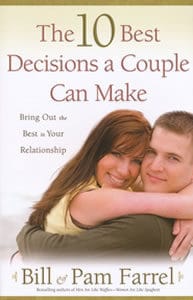
Jim: Bill and Pam, you’ve been sitting patiently. You are authors and speakers – in fact, we’re gonna be diving into one of your books today, titled, The 10 Best Decisions a Couple Can Make. I – John, how about you? Do you think that’s uh…?”
John: I need more than ten.
(LAUGHTER)
Jim: Maybe the next book is The 20 Best Decisions a Couple Can Make. Uh, the book itself guides you through 1 Corinthians 13 – the love chapter – it’s full of personal stories, Bill and Pam. I so appreciate that because that’s where we learn so much is from uh, the stories of others. And there’s also practical tips to help keep your marriage thriving and healthy. So welcome back to Focus on the Family.
Body:
Bill: It’s good to be with you, ‘cause we know every couple has to make decisions, ‘cause their life’s changing.
Pam Farrel: It is our – our great decision is being here with you.
Jim: Oh, you know, we spoke last time about transitions in life and, particularly, midlife – those crises that we hit in our marriage. Uh, we did concentrate on the women’s side of the equation. What’s it like for men? What are they going through? I know they go through those changes as well. What are they experiencing?
Bill: I – for men, it usually happens late 40s, early 50s. And I think it’s a combination of factors. Um, the first thing is men don’t experience a lot of change in their life. Like women don’t have an option. Their lives are changing all the time, ‘cause it’s the way God designed them. And…
Pam: Hormones.
Bill: Yeah for…
Pam: Gotta love ‘em.
Bill: …us men, life’ll stay pretty static. You know, it – there’s stresses and there’s demands, but our bodies kinda stay the same and our schedules often kinda stay the same and we – we kinda get used to dealing with life as it is. And then suddenly we hit our 40s, early 50s and things start to change and we’re not used to it. Um, often things’ll change physically. You know, prior to that, men – men just rely on their strength. Like it’s great having testosterone run through your body, because every cell of your body feels strong.
John: Hm.
Bill: You know, you feel like you could pull nails with your fingernails and you – you just have this strong approach to life. And then suddenly somewhere in your 40s or 50s, you come to the realization that this isn’t gonna last forever.
The – the big thing though I think that happens is that midlife for men, it’s a transition in life from being highly productive to being influential. And because our bodies start to deteriorate, we can’t work at the level we – we were used to. ‘Cause in our 30s and 40s, we could work. We could just get after it. We get intense. We get focused. And now suddenly, we can’t rely on that like we used to, but we have more wisdom to share. And being influential is more responsible than being productive, ‘cause now people rely on us. People want to know what we have to say. People want to hear our advice. And they’re watching our example. And so, men have to decide, do I really want to rise to that level? And that decision – “Do I want to rise to that level” – is traumatic for a lot of men.
Jim: Why so? Is it the fear that they will fail?
Bill: Yes, because they haven’t been thinking, “I’m a role model. I – I want other people to benefit from the way I live. I want people to watch my life and make decisions in their life based on what they see in me.” See, most men haven’t prepared themselves for that moment. And suddenly, it starts to happen. And now the grandkids start askin’, “Grandpa, what would you do?” And colleagues start askin’, “Hey, you’ve been at this for a while. What – what would you do with this situation?” And suddenly now, the stakes are higher. And men who are prepared for it, see it as a great opportunity in life. That’s why for some men, they talk about this midlife transition, like being one of the greatest times of their life, because they harnessed the wisdom and they harnessed their influence and they’re seeing their influence go forward and they love it.
Jim: You know, an example of that, I have a friend who is a successful businessman. And he is active uh, in influential circles.
Bill: Mmhmm.
Jim: But active more like a passive guy in – when he was in his 30s and 40s. He said to me – this is so funny – he said to me the other day, “So I’m sitting at a table, Jim, and I’m used to somebody at the table being the older wise guy. And all of a sudden, I looked around the table and I realized, I’m the older wise guy now.”
(LAUGHTER)
Pam: It’s me.
Jim: “It’s me!” And he said, “A question was asked and everybody looked at me.” And he said, “It was the weirdest realization…”
Bill: Yeah.
Jim: “…that I’m the guy now.”
Bill: Yeah.
Jim: That’s – that’s what you’re talking about?
Bill: That’s what I’m talkin ‘about.
Pam: Exactly.
Bill: And if – and if you’ve embraced it, that’s a great moment, when you realize, “I’m the guy!” But what happens so often is men aren’t prepared for that and they don’t say with enthusiasm. They’re like, “Oh, no, I’m the guy.”
Jim: Let me transition a little bit. Let me ask you this question. Uh, it’s a more common question today and this one too, from a listener who wrote us and said, “In my household, my husband is the stay-at-home parent. And I work full time outside the home.” Let me pause there for a minute to say, that’s great that they made that decision, that one parent should be home with the kids.
Pam: Mmhmm.
Jim: I think that fundamentally…
Pam: Exactly.
Jim: …is the right decision.
Pam: Yeah.
Jim: Who’s gonna go out and you know, vocationally do it – we have traditionalists, which I am one. I tend to believe more in the male role, the female role. But I get the fact that more women are graduated from college in graduate programs today. They are active. I just applaud the fact that they are wise to have one parent at home. She goes on to say, “Do you have any advice on how we can make this successful in our family situation?” So reverse the roles a little bit. Mom’s out workin’. Dad’s at home. How do they make that work in a godly way and honor the Lord and do family well in that scenario?
Pam: Well, we’re from the area of the country that this is kinda common. Uh, we live in California and so, um…
Jim: Many things are common there.
Pam: Yeah.
(LAUGHTER)
Some good and some not so good. But in this case, it’s the same principle that applies. Those men band together that are stay-at-home dads. They get together, encourage each other. They look for mentor men who’ve gone through transitions. Even in our own church when Bill was a senior pastor, um, his assistant had a health crisis. And that put him on disability at a very young age and his wife was the primary bread earner, but he chose to get retrained so he could shepherd um, in the church, but yet, be the dad at home. And um, so we had both role models in our church. We had Bill um, being the typical traditionalist. And then the other pastor, um, who just because of his health, had to make other choices, but both families – the kids flourished. That’s the main point. And…
Jim: That’s the goal.
Pam: That’s the goal. And every situation we all need mentors and even more so when it’s something unusual. We might need somebody else who has gone through this. And um, one of the things that we talk about in mentoring is you know, sit down together and say, “Who has the kind of marriage we want to have? Who has the kind of family we want to have? Who has the kind of influence and ministry or a business that we want to have? Let’s go talk to those people.” Be proactive.
Bill and I a – approached um, Jill Briscoe and um, when I was a young pastor’s wife, because at the time, Stuart and Jill were like the only people we knew who were pastoring, writing and out speaking. And they spoke together and separately. And that’s exactly what Bill and I did and when I approached Jill, um, I said, “You know, it’s kind of unusual.” And she replied back as, “Yeah, we’ve always been the example of the unusual.” And that’s okay. That’s okay. Go find somebody who has the kind of life that you’re trying to build.
Jim: Now I’m thinking of – we’ve got Mothers of Preschoolers, MOPS, of course, and lots of young moms know that. The unfortunately thing, if somebody starts Dads of Preschoolers, it’s “dopes”.
(LAUGHTER)
Pam: No, you don’t want that.
Jim: You’d have to come up with something new.
Bill: But I think we all know, this is – this is kinda always gonna be the exception. And anytime you live a life that’s not quite in the mainstream, you just have to be more deliberate.
Jim: Yeah.
Bill: So this couple that’s gonna do things – I think it can be done. They just have to deliberate about it. So I would encourage them, every year they oughta have a goal-setting meeting, where they sit down and they say, “Okay, this year how are we gonna make this work?” They should be prepared, about every seven years, life changes. And so, they should have the big meeting every seven years. “Okay, wh – what does the next season of our life look like?”
Jim: Hm.
Bill: “And – and how do we divide up responsibilities at home, so that we’re doing what we are strongest in, and we’re keeping a sense of dignity for the person who’s at home taking care of the kids?” And as long as they’re deliberate about it, they can be very successful at this.
What tends to happen is when people feel like life happened to them – so if this – this man feels like, “I have to stay home,” he’s gonna eventually resent it. But if he feels like, “We decided as a team that this is the best way for our family,” he’ll buy into it and he’ll have a strong sense of accomplishment in life.
Jim: Well, what’s interesting is how many women feel like that, too, and uh, I think it’s important again for us um, you know, I think Jean, my wife, is doing the most important thing she can do and that’s to raise our two boys, you know, not alone obviously, but…
Bill: Sure.
Jim: …to be there – a consistent parent in their life. We need to lift that up again and…
Bill: We do.
Jim: …make sure that people feel valued, whether you’re mom at home or you’re dad at home, that you’re doin’ the right thing by being…
Pam: Or…
Jim: …in their lives.
Pam: …or you’re sharing that role. I mean, tag-team parenting, working shift hours. Like there’s all kinds of ways to make it work. The important thing to do is to sit down and decide together, “What’s best for our family?”
Jim: What are some of those things that you can do? We’ve talked about, you know, women and that moment of midlife reevaluation and the vulnerability. In fact, you said it, Pam. Women are most vulnerable with affairs at that point, when they’re just feelin’ like they’re not appreciated and all those things. What can we do to safeguard our emotions and our um, decision making to not allow that to happen, if possible? What do we do to put some protection in place?
Pam: Some of it’s like common sense. Like let’s have a date night once a week, where we’re actually talking and communicating.
Jim: So communication in marriage?
Pam: Yeah, talking about our schedule and talking about our kids and our goals and praying together. Um, we call that our “Love Business Meeting.” And we typically have that – we work out together and then we go to breakfast and we have this little sit down. If things go well, woo-hoo, a little red-hot monogamy in the morning ‘cause the kids are off, out of – out of the house, you know? Um, the second time of the week…
Bill: I – I like that meeting.
(LAUGHTER)
Jim: Yes you do.
Pam: A little payoff.
Jim: It’s your favorite meeting of the day.
Bill: And I would say, in – in response to that, that the goal of that meeting is to – is to find a way to keep our hearts connected, which is…
Jim: Which is probably God’s goal, too.
Bill: Yes, ‘cause what tends to happen in marriage is we load up life with responsibility. And so over time, couples start to evaluate each other based on behavior, rather than on the connection we have to one another.
Jim: Hm.
Bill: And that becomes a problem in marriage because nobody can be good enough for long enough to meet everybody else’s expectations. And so the goal – Philippians 1:7 is a good example of it. Paul was writing to this church and he said, “You know, it’s right for me to feel this way about you, because I have you on my heart.” And that really is the goal of marriage. When you keep the emotional connection with one another, you tend to go through these transitions together. If you lost that emotional connection, then you start to evaluate each other and you find all those deficiencies in each other.
Pam: And so those…
Jim: That is really well said.
Pam: …date nights…
John: Yeah, it was.
Pam: …and having that attitude like we’re in this together. Bill will say things when we’re in a very stressful situation, he’ll just lean in and he’ll say, “I’d rather be stressed with you than on a hammock with any other woman in Hawaii right now.” You know, I’d rather be – I – I will say to Bill, “I’d rather be busy with you than in a convertible with any other rich guy right now.” So we’ll just like try to throw a little humor in there and like, we’re in this together. Um, when things get really bad, we’ll just hold hands and we’ll – one of us will say, “Let’s pray, because God will give us a solution. We’re in this together with God, and so He will get us out of this. He has a way.” And so if we have that attitude…
Bill: And we do that to try to remind ourselves that the trouble is temporary, but memories that come out of them live forever.
Pam and Jim: Mmhmm.
Jim: It’s good.
Pam: Exactly. And you know, sometimes it is those moments of crisis that bring you close together. You know, it’s midlife transition we talked about. Well, when Bill’s hit, um, it came out of – seemed like it came out of nowhere.
Bill: We – we were traveling. And I – and I wasn’t feeling well. And I pretty well figured out, “I think I have a sinus infection, so I – I’m…”
Jim: Those are nasty.
Bill: “…gonna go to a doctor and – and get this thing treated.” So I went to a doctor and he looked at me and said, “Bill, how long have you had high blood pressure?”
John: Hm.
Bill: And I looked at him and I said, “I – I don’t have high blood pressure.” He said, “Well, you do today.” And that was huge for me, because it runs in my family. My grandfather died at 47 of a stroke related to high blood pressure. My dad, even though he’s alive today, he had a stroke at – at 48 and has continued to be impaired physically ever since then.
Pam: It’s like paralyzed half his body.
Bill: And – and I had just decided I wasn’t gonna participate.
Jim: Right.
Bill: I’m gonna stay in shape, eat okay, so that this doesn’t become a reality in my life. And suddenly now, it’s part of my reality. And my goal was to go home, see my doctor, get it taken care of, put it behind me and move on. Well, even though as guys we like to wrap things up that quickly, we didn’t wrap up that quickly. It became quite a struggle for me. And – and I was one of those guys that could feel it. Like a lot of people have high blood pressure and they can’t tell. But my blood pressure was that I could feel it. My joints ached and my eyeballs hurt. And so I knew. And so, I was goin’ through this, “How am I gonna keep up with all of my goals? How am I gonna keep up with my aspirations when I feel like this?” And it wasn’t goin’ well for a while.
Pam: And I was praying, “Lord, you know, I’m praying that Bill will be alive the next day. I know the family history here.” So a little stress on my side of the equation, praying for my husband. Um, but my heart was drawn closer to him ‘cause he’s in a crisis right now. And um, then right after that little window of time, our son got hit in a football game. Um, was um, he was in ICU for eight days, blood transfusion and all of that. And we brought Caleb out of the hospital and um, our two boys, that – I looked at Bill and I said, “Okay, you’re not feeling well. Caleb’s not feeling well. You need to take care of each other, ‘cause we need groceries on the table. I’ll go do our speaking engagement.”
The first night, um, I got a phone call that our son was hit in a football game and um, had a concussion and knee injury, might end his opportunities for a scholarship. The second night, uh, I got a phone call that our college son was pulled from the football game with a shoulder injury, might end his opportunities for a divisional win scholarship that he was going for or worse for those boys. The third day, I got a phone call that my 40-year-old brother had just had a heart attack. Could I come take care of his kids? “Other than that, Mrs. Lincoln, how’d you like the theater?”
Bill: Yeah.
Pam: Yeah, a lot of pressure.
John: Hm.
Pam: Who do I save first? And something must have been on my face to show the stress. Um, my friends would say, “Pam, how you doin’?” And I didn’t know how to answer it. So I took that question to God. “God, how do I answer these people?” And He simply asked me a question: “Pam, what kind of person do you want to be?” I said, “God, I want to be the kind of person that can choose joy no matter what life sends my way, ‘cause Your Word says in Nehemiah 8:10, that the joy of the Lord is our strength. And this family needs strength right now. So I choose you, Jesus. I choose joy.”
And so, my friends would say, “Pam, how you doin’?” And I decided to answer them, “Woo-hoo, choosin’ joy!” And um, it was amazing, uh, that it caught on in my friendship circle – we’d start, “Choosin’ joy! Choosin’ joy! Choosin’ joy!” I began to pray Job 42 over Bill’s life, that God would give Bill more in life’s second half than even in the first.
And it takes sometimes about three years for when the Titanic is hit, for the ship to right itself. And during those three years, we just kept praying and we printed out all the verses about God’s favor, God’s joy, God’s anointing. And we just began to pray those over our family and over our future.
And it’s amazing. When you start to choose joy and choose Jesus and look for the blessing every day – we went on a God hunt. “Who got a Post-It note of God’s goodness? Who got a postcard of God’s goodness?” The family started to see the goodness of God return to our life. And all the kids got scholarships. Bill’s health returned. We got double the opportunity. Hey, even Focus on the Family called us during that time to have us come be on the air.
Jim: But you know, I need to ask the question, because that is a great outcome. Some people listening are still traveling the road. They’ve been praying. They’ve been trying to choose joy, but they haven’t had that kind of outcome. What do you say to that person?
Pam: Give God time to be good. Um, my son, during that season said, “This just doesn’t seem fair. This just doesn’t seem right.” There’s some decisions that were made towards dad and his health issues and just seemed like he was livin’ Job’s life. And my son said, “Just doesn’t seem fair.” And I said, “Let’s give God time to be good, ‘cause God is good, even when people are not good. God is good, even when circumstances are not good. God is good, even when I am not good. God is good. Let’s focus on the goodness of God.”
Jim: Hm.
Pam: “Let’s give God time to be good.” And that’s what I would encourage couples that feel like they’re right in the middle of the storm – hold each other tonight and say, “I believe that God longs to be good to us.” That is Scripture. Um, God longs to be good. That’s in His very nature. And we just sometimes get impatient in this media-driven, instant gratification world. Um, we want the instant “Take away this pain.” And God wants to give us character and carry us through the pain, so we will be better and closer and more intimate at the end of the tunnel.
John andJim: Hm.
Jim: Let me ask a – I think a bold question. Is it ever too late for a couple? I mean, someone listening today is upset. They’re angry. Uh, they just can’t see another day with their husband.
Pam: Mmhmm.
Jim: Is it too late?
Bill: I – I would say to you, sometimes it feels like it’s too late. In reality, it never is, because marriage is a reflection of the Gospel of Jesus Christ. And the way the Gospel works is in a moment of time, somebody can go from being lost to being found. Somebody can go from being the enemy of God to being an adopted child of God and it can happen in a moment.
Jim: What does it take in the human heart? I know God can work those miracles, but what’s my role and responsibility?
Pam: Sometimes we can only deal on our side of the equation. We can’t control the other person. We can only control our attitude toward that person and our character and who we’re gonna become. Like, we don’t want to – if our spouse is making decisions that are unhealthy, Bill encourages them, “Get off the crazy train!” Like don’t let their bad choices pull you down. Decide.
Bill: ‘Cause there is a special intimacy for people who are in pain. Like Jesus was rejected by the people that cared about Him the most. Jesus had to stand alone at the most important time in His life. And when everybody was against Him, He bought salvation for us. And so when people are struggling in pain, when they feel like they’re rejected by the people that love them the most, there’s a special intimacy with Jesus that He gives at that moment if we’re willing to receive it.
Jim: Hm.
Bill: And that softens our hearts. And when our hearts are soft, God turns His attention on the people we’re praying for, rather than putting His attention on us, tryin’ to correct us. And so if people will say, “God, I don’t know how this is gonna work out. I don’t know how You’re gonna turn this, but I’m gonna cling to You. And I’m asking You to give me that special place of intimacy that You give to those that are hurting, ‘cause I’m hurting right now. And would You somehow, someway, turn the heart of my spouse so that this thing can be recovered?”
Pam: “And Lord, let me be a vessel of love. Like no matter what the people around me are choosing, let me reflect Your character, because there’s no downside to becoming a more loving person.”
Jim: He loves the expression of faith toward Him.
Bill: Yes.
Jim: Doesn’t He?
Bill: Yes.
Jim: It’s like He longs…
Bill: Yes.
Jim: …for that. When He sees…
Bill: Oh, He loves it.
Jim: …that, He moves.
Bill: Yeah and He – I mean, the Bible tells, “The eyes of the Lord run to and fro throughout the earth, that He may strongly support those whose heart is completely His.”
Jim: Think of that.
Bill: Yeah, it’s – it’s not a passive thing. It’s not like, “Oh, well, now I gotta help that person.” It’s that God’s looking for people who will do that.
Jim: He longs for that.
Bill: Longs to do it.
Jim: “Show me that…”
Bill: Yeah.
Jim: “…step of faith and I am there for you.”
Bill: Yeah and we think it’s up to us. That if I say the right thing, do the right thing, be the right person, that suddenly, magically it’s all gonna turn. In reality, the kind of problems that we see people get into, sometimes the only answer is God turning the hearts.
Jim: Yeah.
Bill: And there’s no substitute for the Holy Spirit doing that. And one of the most common commands in the Bible is “Wait on the Lord,” which none of us like to do.
Jim: We’re not good at it.
Bill: And in moments like this, when we say to Jesus, “I’m just gonna cling to You and I’m gonna wait for You to do something,” it’s a hard place for us to go, but it’s the place that Jesus, like you said, longs for us to be, because then He goes into action and then does what only He can do. And that’s why some families have a tragic story of what didn’t work out. And other families have this story of a miracle that took place…
Jim: Mmhmm.
Bill: …because God got involved and the people who were trusting God to do something, just clung to Him and said, “I don’t know how to fix this, but I’m trusting You to do something.”
Closing:
John: And we’ll bring this conversation to a close. That’s Bill and Pam Farrel on Focus on the Family, and they are so encouraging. They have such solid insights about navigating the challenges that come up in marriage.
Jim: And that’s one reason we keep bringing them back to Focus on the Family. It’s been great these last couple of days to talk about how to weather midlife transitions with your spouse. I love the Farrels’ main message: Put God at the center of your marriage, then stick together and help each other. That’s what it’s all about. And I gotta admit, sometimes I struggle with that with Jean. I do. And uh, this is a real encouragement to me to keep moving forward.
Let me also remind you that we are here for you through the joys and the struggles. Focus on the Family wants to help you have a thriving marriage. So if you’re facing some difficulties, call us. We have many resources available to you, including counseling and our Hope Restored marriage intensives – which is a place you go in Branson. It’s usually four days, and they can really put you on the right track. Post-2-year surveys show that about 80% of those couples are doing better and still married.
We also have a great book by the Farrels – The 10 Best Decisions a Couple Can Make: Bringing Out the Best in Your Relationship. And you know what? In the last year, together, we have helped save over 170,000 marriages. And that translates to an average of about 460 marriages a day. And that’s about a marriage every three and half minutes. And we couldn’t do this work without your prayers and generosity. Your monthly gift will make it possible to provide the hope and ongoing support necessary to help restore marriages through Focus on the Family. You’ll help husbands and wives provide a stable home for raising children who would otherwise suffer through the pain of divorce.
The bottom line is family is where the action is for our culture. If we want to have a better culture, a Christ-centered culture, we need to do our jobs in the family as Christians. When you make a monthly pledge of any amount today, we’ll send you a copy of the Farrels’ book as our way of saying thank you. And if you can’t commit to that, we’ll send it to you for a one-time gift of any amount. So help us minister to couples when you partner with us today.
John: Donate and get your copy of The 10 Best Decisions a Couple Can Make and find out more about our counseling services and Hope Restored, all at focusonthefamily.com/broadcast