Autism
What 10 Things Should I Do If My Elementary-Aged Child Has Autism?
These 10 tips can help you understand ASD and guide your elementary-aged child with autism through the early school years.






August 3, 2026

Over the past few decades, the number of children diagnosed with autism has increased significantly. This may be due to better diagnosis or to the expansion of the definition of autism. Dr. Meg Meeker discusses what parents can do if their child is diagnosed with autism.
Estimated reading time: 10 minutes
Autism spectrum disorder, or ASD, has gained a lot of attention over the past decade. Whether you are a parent of a child with autism or have a friend or family member who is, it is important to know some key facts about ASD.
Annie knew that her son, Byron, was different than the other kids at pre-school. While other kids were social, played well together, and adapted to changing tasks and schedules quite well, Byron didn’t. He had trouble communicating and interacting with his classmates and the teachers, refusing to make eye contact and using verbal language skills that clearly lagged behind the others. Once he found a toy or project he was interested in, he would become fixated on it.
Annie had noticed these things before preschool started, but now that he was engaging with others on a routine basis, it was more noticeable. After talking with the teachers and a few trusted friends, she decided to learn more about autism spectrum disorder, the signs and symptoms of autism, and chose to pursue a professional diagnosis.
Byron receiving the autism diagnosis opened the door to understanding and allowed Annie, her family, and the teachers at Byron’s school to support him in the best possible ways. Understanding what autism is and what the signs and symptoms are can help a child and their family to receive necessary support and create a structure that is beneficial to the child.
Autism is a neurological and developmental disorder that manifests itself on a spectrum according to the severity of symptoms. What we previously only called autism, we now refer to as autism spectrum disorder because of the wide range of symptoms. General symptoms in children with autism include:
The list above is not comprehensive. To learn more about the variety of behaviors exhibited by people with autism, visit some of the websites listed at the end of this article for a more complete picture of autism. If possible, get connected with a pediatrician to discuss any concerning symptoms.
Autism differs from one child to the next. Severe symptoms include developmental delay, difficulty performing simple tasks, or inability to talk. Less severe symptoms include social awkwardness, difficulty showing affection, flat affect, or discomfort when making eye contact with others. All children with autism may exhibit repetitive behaviors, appear aloof, or have difficulty with affection.
Symptoms of autism are now classified into three levels. Each level describes the different spectrums in which autism can present itself. Autism looks different for every child, and it is important to remember that your child’s autism will be different than others. However, it does not change your ability to love and care for your child with autism.
Here is how the three levels are broken down:
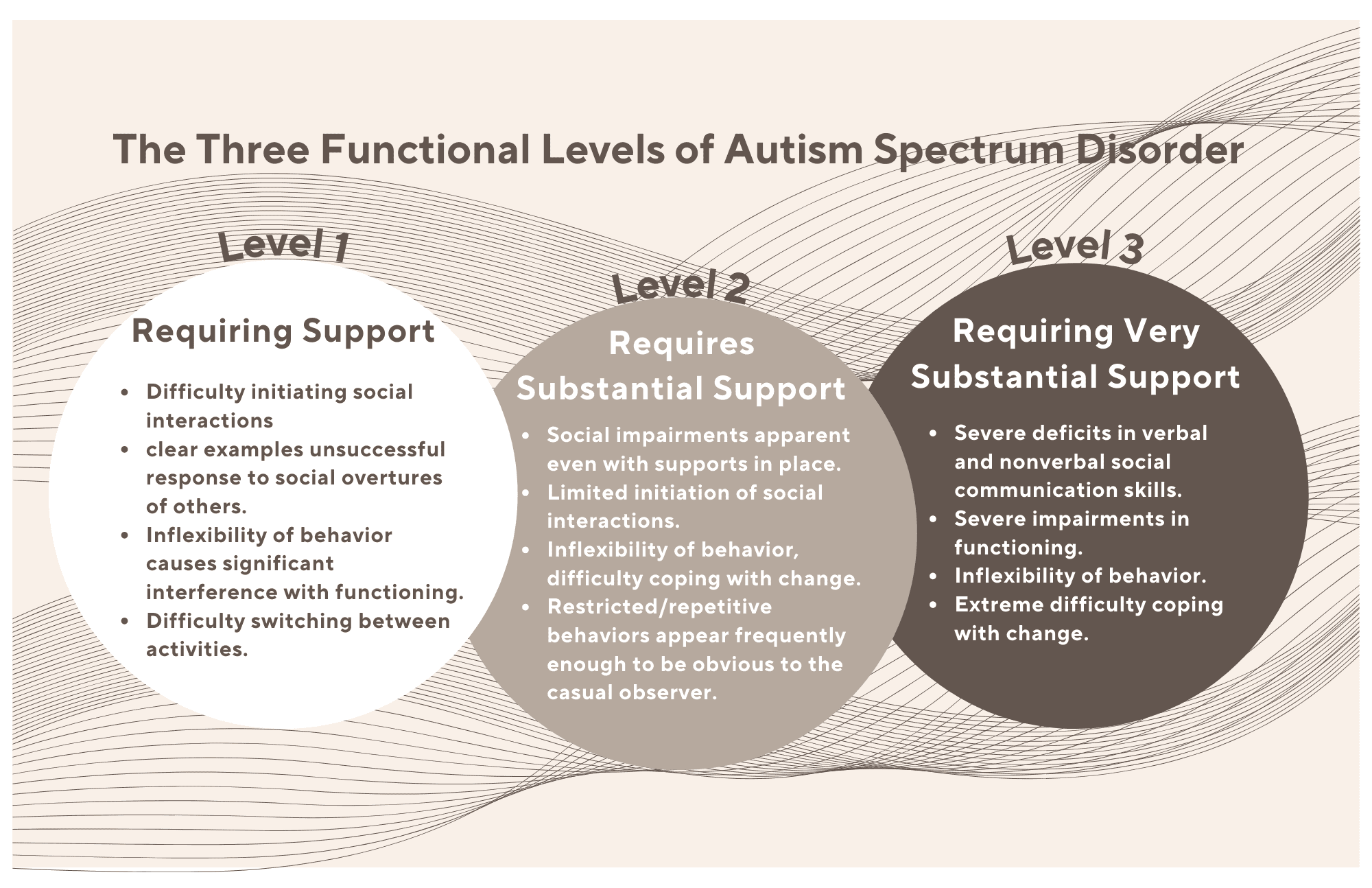
Asperger’s syndrome is technically no longer a separate diagnosis but is now classified as part of the autism spectrum. The symptoms of what was formally known as Asperger’s are similar to those of level three, but they are milder. You may have heard it referred to as high-functioning autism; however, this verbiage has been changed. When referring to functionality, the levels from above are used.
Children with mild level three symptoms may not be diagnosed until they are older because many people have very mild symptoms. Some people aren’t even diagnosed with it until adulthood.
The prevalence of children being diagnosed with autism is rising because of the “growing awareness of autism and changes to the condition’s diagnostic criteria.” In the United States, 1 in 31 children have been diagnosed with autism spectrum disorder according to the CDC. These increased diagnoses of autism have been shown to be primarily in mild to borderline cases, while moderate and profound autism diagnoses have slightly declined since 2000.
First, write down a list of behaviors that concern you and things you’ve noticed in your child. Second, make an appointment with your pediatrician to vocalize your concerns. Ask for a longer appointment than usual so your doctor can do a careful exam and take a thorough developmental history of your child.
If your doctor isn’t sure if your child has autism, ask to return to the office in two months for reevaluation or ask for a referral to a physician who is well-versed in diagnosing autism spectrum disorder. The earlier you can get a diagnosis, the better. From there, you can begin taking steps to help your child and understand the way their brain works. Once your child has received the diagnosis, you can begin thinking of treatment plans depending on the level of severity of your child’s autism
During the early years of your child’s life, particularly the first two years, visit your pediatrician regularly. Part of each exam is for checking your child’s development and picking up any subtle delays.
Often, an outside observer can pick up subtle issues that a parent can’t see simply because they are with the child all the time. The opposite can also be true. Parents may pick up signs very early. Each situation is different depending on the child and will look different for everyone.
First, as discussed above, go to your pediatrician for an evaluation. Usually, a seasoned pediatrician can make the diagnosis and recommend professionals in the area to help your child.
You will probably also need to see a pediatric neurologist to have your child’s nervous system evaluated. In addition, you should have a child psychiatrist evaluate your child.
If your child is very young, discuss the timing of these visits with your pediatrician. You may need an occupational therapist to help your child with sensory issues or other special needs. Finally, you may need to consult a nutritionist or dietitian. Many children with autism are picky eaters and can have difficulty taking in enough calories. Certain medications used for attention or hyperactivity issues may diminish your child’s appetite.
If you have a local ASD support group or association, join it. Parents who have dealt with ASD and professionals who have invested their careers in treating it will be valuable. They can give you guidance on all the best resources in your area.
While we don’t know what causes autism, it is best to diagnose it early so children can receive help. Treatment of autism varies according to available services in your community, but it revolves around psychosocial intervention, specifically Applied Behavioral Analysis (ABA) therapy. Many physicians add medications to the treatment, but psychiatrists or developmental-behavioral physicians should be the ones to prescribe the medications.
Some parents and professionals advocate changing a child’s diet. Some avoid dairy while others remove gluten, vegetables, or certain proteins. I’ve heard stories of children with ASD being unable to tolerate certain foods. Many parents manipulate their child’s diet to see if anything helps. I have had parents tell me that eliminating corn, dairy, gluten, or adding natural supplements has improved their child’s symptoms.
These stories may be true. The problem is, we don’t have solid scientific research to back any of these claims. If you read that a specific dietary change or supplement helped someone’s child, remember that the story is anecdotal. The change that helped them may do nothing for your child. A parent may adamantly insist that something caused or helped their child’s autism, but usually the change coincided with the diagnosis of autism or new autistic behaviors.
My reason for discussing these isn’t to discourage or malign parents who do these things, but to explain that while a change helped one child, it may not help other children. When parents try every technique others offer, they can end up running down dozens of bunny trails to no avail. Parents may come to believe that they have control over their child’s disease and blame themselves for failing to find the specific antidote. This only leads to frustration and guilt.
You should get support for yourself and your family so you can share resources and concerns and discuss frustrations. Some parents prefer to lean on friends and family for support, and this is great. But many parents find it helpful to join autism support groups. It is critical for all parents of children with ASD to create a strong support system.
Raising autistic children, regardless of the disorder’s severity, presents tough challenges for parents. One of the worst things you can do is isolate yourself and your child and refuse good support, so reach out to your local autism network and visit some good national organization sites to find answers to your questions.
Remember, your child is made in the image of God. Though the journey ahead may be difficult as you navigate your child’s autism, know the Lord is with you. There is hope and help in the Father and in a community of people who are walking through the same thing as your family.

General symptoms in children with autism include, but are not limited to:
Problems communicating and interacting with others, limited interest or activities, lack of or delay in language development, repetitive use of language and/or motor mannerisms (such as hand flapping and twirling objects), little or no eye contact, lack of interest in peer relationships, lack of spontaneous or make-believe play, persistent fixation on parts of objects.
If you suspect your child has autism, write down a list of behaviors that concern you and things you’ve noticed in your child. Then, make an appointment with your pediatrician to vocalize your concerns. Ask for a longer appointment than usual so your doctor can do a careful exam and take a thorough developmental history of your child.
First, go to your pediatrician for an evaluation. Usually, a seasoned pediatrician can make the diagnosis and recommend professionals in the area to help your child. You will probably also need to see a pediatric neurologist to have your child’s nervous system evaluated. In addition, you should have a child psychiatrist evaluate your child.
Treatment of autism varies according to available services in your community, but it revolves around psychosocial intervention, specifically Applied Behavioral Analysis (ABA) therapy. Many physicians add medications to the treatment, but psychiatrists or developmental-behavioral physicians should be the ones to prescribe the medications. Some parents and professionals advocate changing a child’s diet.





Dr. Meg Meeker is a pediatrician and the author of multiple books, widely recognized as one of the country’s leading authorities on parenting, teens, and children’s health. In addition to sharing a medical practice with her husband, she is a fellow of the American Academy of Pediatrics and works as an adjunct clinical assistant professor at Michigan State University. She is also the founder of the Strong Parent Project, a unique online learning community to equip and encourage parents.
These 10 tips can help you understand ASD and guide your elementary-aged child with autism through the early school years.

Having your toddler assessed for autism is the first step in understanding how to help them thrive with ASD.

Undiagnosed autism in marriage may result in confusion and pain for both spouses. If you discover that your spouse has autism, don’t lose hope for your marriage. You can move forward by accepting the differences, resetting your expectations, and finding help.