



Preview:
Becky Harling: Holy Spirit, examine my life. Show me where are my weak spots that I’m not seeing? You know, am I too negative? Am I too busy where I just don’t have time for friends? Am I, you know, so shy that I’m not taking any initiative? Where do I need to change? And then if you have somebody close to you, ask them, “Where do you see that I could grow in order to be a better friend?”
End of Preview
John Fuller: That’s Becky Harling, and she joins us today on Focus on the Family with Jim Daly. I’m John Fuller.
Jim Daly: You know, John, friendship is one of the greatest gifts that we can have in this life. It’s tangible. It’s right there in front of us. I’m sure even with our spouses, those of us who are married, started f- in a friendship, right? You’re kinda testing those waters.
John: Mm-hmm.
Jim: But we don’t spend a lot of time talking about healthy ways to develop friendships. And I think in our culture today, it’s really needed because, uh, we’ve just become more distant from one another, right?
John: Yeah.
Jim: We always laugh about, you know, putting your garage door up and pulling in, you don’t really know your neighbor. Well, as the Christian community, I think it’s gonna be wise for us to do a better job in that area. But particularly for women, it’s so desperately needed. Uh, there is a connection there. The way God has wired women, they need it. They need that connection to bounce things off. Men, we can be loners. We’re that hunter-gatherer kind of mentality, you know? If I don’t have a friend, so what? Who needs ’em?
John: (laughs).
Jim: That’s not healthy either, it’s not a get outta jail card, but today we do wanna concentrate about developing friendships within women. And I’m, I’m gonna confess, I’m getting, (laughs) I’m interested in, in accomplishing this today, but I’m coming from a deficit.
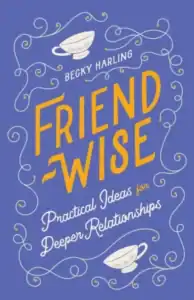
John: Mm. Well, Becky Harling will help us all better understand, uh, as you said, having these friendships and how to cultivate them. She’s a speaker, author, and mom, and a grandmother. And, uh, she’s a certified coach with the John Maxwell team and is the author of a number of books. She’s been here before talking about some of them. Uh, we’re gonna cover the book Friend-Wise: Practical Ideas for Richer Relationships. It’s a great little read, and we’ll encourage you to get a copy from us here at the ministry.
Jim: Becky, welcome back to Focus. So good to have you.
Becky: Hey. It’s great to be with you guys again.
Jim: Yeah. So I, I kind of fessed up in the beginning there. And you might-
Becky: You did.
Jim: … say, why? Well, because Jean will listen to this program, and she’s gonna say (laughs)-
Becky: (laughs).
Jim: … “You’ve never given any thought to that.” (laughs).
Becky: (laughs).
John: (laughs).
Jim: Which isn’t exactly true, but it’s fair. I think we men don’t… You know, it’s kind of the thing. You go play golf with a guy, and you get home, and your wife says, “So how’s Bob?” “I, I don’t know. He’s got a new driver.” Right?
Becky: (laughs).
Jim: We didn’t spend four hours talking about much. And we’re completely content with that.
John: Mm-hmm.
Jim: There is a difference there. Women tend to be tighter relationally. They’re into one another’s lives in a different way. Speak to the importance of friendship.
Becky: Friendship is actually really important for both men and women (laughs).
Jim: Like, yeah. (laughs) Okay, you gotta convince me. No, I’m, I’m… I get it.
Becky: And, you know, if you look at the studies, it’s really interesting. Did you know that friendship, deep friendship can lower your blood pressure? It helps with anxiety. It lowers your stress level. And one research article written and published in Time magazine said that it increases your happiness as much as if you had $133,000 raise a year. Now, that would make anybody happy, right?
Jim: Wow.
Becky: And so friendship is something we really need in our culture. Women definitely need good friends. Although I have to say, like, in… I have some kids that are raising, you know, kids. And so, in high school, I feel like sometimes the guys do it better-
Jim: Interesting.
Becky: … because they go out and they play basketball or soccer together. And if there’s a disagreement, they’re able to say, “Hey, let’s just go pound it on the pavement,” and they’re done. Whereas the girls, they want the relationship, and they go in, but it turns into backbiting, and gossiping, and all of that.
Jim: Okay, that’s fair.
Becky: You know, so-
Jim: Yeah.
Becky: But I think friendship makes our lives so much richer.
Jim: Yeah. Spiritually, you know, we’re Christians, so what does God want in this life for us when it comes to developing friendship? Can’t I just be a loner?
Becky: No. Um… (laughs).
Jim: Give it to me.
Becky: I mean, really, to be a loner is unbiblical, in my view, because God created us for relationship with Him, and His heart aches with longing for relationship with us. And also, it, spiritual formation happens best within community.
Jim: Yeah.
Becky: And so, you know, I think this is something that we sometimes struggle with here in America particularly, you know, because we really value our independence. And so it’s like, “Oh, it’s just about me and my relationship with God, and then everything else should go perfectly.” But that’s not God’s design for us, you know? He has wired us to be in deep friendship, the kind of friendship where you can talk to each other and say, “Hey, I see you struggling with this. Let’s, let’s pray together about it. Let’s-”
Jim: Yeah.
Becky: “… go there, you know? Let’s encourage one another.”
Jim: Well, and that’s so good because a good friend is gonna do, uh, produce good things in your life.
Becky: Yeah.
Jim: In other words, they’re gonna challenge you with good things, affirm you when they see something good happening. That’s what a good friend does.
Becky: Absolutely.
Jim: And that’s invaluable. And we don’t have enough of those key relationships like that. Let me ask you about this. I mean, I think there’s plenty of articles about toxic friendship.
Becky: Oh, yeah.
Jim: So boundaries are kind of important too. Um, how do you manage that and what does a healthy boundary relationship look like and what does an unhealthy relationship look like?
Becky: So, toxic friends are friends who always wanna take from you or injure you, and they’re not offering anything in return. And honestly, sometimes as Christian leaders, we’re all Christian leaders, we have to be careful about this because we can use people as our friends because they can accomplish our vision, right? But that’s an example of a toxic friendship, you know, or where one of the friends has all the power and the other doesn’t. Uh, a healthy friendship includes boundaries. Boundaries make good neighbors. And so, you know, notice in the Lord’s Prayer where Jesus teaches us to pray, “Forgive us our trespasses as we forgive those who trespass against us.”
Jim: Mm-hmm.
Becky: Well, when people trespass against us, they’re breaking our boundaries. So when you have a good, healthy friendship and you say, “I’m so sorry, I can’t do that right now,” your friend doesn’t push back on your boundaries and push and push for more and more than you’re able to give. They, they respect your boundaries and they allow you to live within those boundaries.
Jim: Yeah. You know, and that’s so good. I mean, even think… I’m just playing out in my mind as you say that, what it’s like to sit, to have coffee or whatever with somebody. And, you know, we’ve really developed a good friendship. Let’s talk about those boundaries in our relationship. I… You can play that out. It, it’s a very respectful thing to do.
Becky: Yeah.
Jim: “Here’s where I can show up for you or I wanna show up for you. Here’s where I might struggle.”
Becky: Yeah.
Jim: Um, speaking of that, that vulnerability in friendship can be really dicey.
Becky: Mm-hmm.
Jim: Um, because if you have a good and true friendship, you can share things that are going on in your own life, your thought life-
Becky: Yes.
Jim: … maybe in your marriage if you’re married. And those things have to be handled very carefully by the friend. And it does give you power that you better control, ’cause when you get, uh, informed about somebody’s quiet life, their secret life-
Becky: Mm-hmm.
Jim: … you need to respect that and not share that with other people.
Becky: Yeah.
Jim: But something in the human heart, it’s like, “Oh, I know something about Becky.”
Becky: (laughs).
Jim: “Hey, John, do you know-”
John: Mm-hmm.
Jim: “… Becky? She likes steak.”
John: Yeah.
Becky: (laughs).
Jim: But whatever it might be, speak to that importance, though, of guarding-
Becky: Yeah.
Jim: … confidentiality and vulnerability.
Becky: Yeah. If you don’t guard confidentiality, you’re gonna lose the friendship. Uh, let me give you an example from my own life. Um, probably 10 or 15 years ago, I had a friend, and I kinda jumped into the friendship because I thought, “Oh, we both have a heart for prayer, both have a heart for ministry.” I thought, “This is gonna be great,” you know? But… And I shared really vulnerably with her about a lot of my backstory, about a lot of the things I currently struggle with and things like that. Then after several months in, I began to realize that this friend was sharing what I had shared with her with others. And what it did is it severed the trust.
Jim: Absolutely.
Becky: And I needed to back way up from that friendship. And I did because it wasn’t healthy for me anymore, you know? She didn’t respect my boundaries. She didn’t respect my confidentiality. If you’re gonna be vulnerable with a friend, you have to feel safe.
Jim: Right.
Becky: It comes down to safety.
Jim: Yeah. And that’s on all of us in our friendships to make sure that we’re handling those things correctly. You know, I’m thinking of so many business guys we get to meet supporters of Focus on the Family.
Becky: Sure.
Jim: And even outside of my circle, uh, you know, you talk to a business guy and he’ll say, “Yeah, I’m never gonna do business with a Christian again because of-”
Becky: Yeah.
Jim: “… how they didn’t perform somehow. They didn’t pay me what they owed me. They did-…” It’s so heavy. It, it really is heavy on my heart, especially in this area of friendship where you can hear somebody saying, “Yeah, I’m not gonna trust that Christian anymore ’cause I shared something with them, and they ended up sharing it with others.” We don’t want that as a community of believers. We need to hold each other accountable, ourselves accountable-
Becky: Right.
Jim: … that we’re behaving correctly in these relationships to honor the Lord.
John: Yeah.
Becky: Yeah.
Jim: First and foremost, right?
Becky: Yeah, absolutely. And, you know the way I look at it is when somebody shares something with me in confidentiality, I view that as a treasure. They’re sharing something with me that’s really a treasure about them. And I don’t have the right to tell somebody else that.
Jim: Right.
Becky: So I have to hold that confidence.
Jim: Mm.
John: This is Focus on the Family with Jim Daly, and our guest today is Becky Harling. We’re talking about her book, Friend-Wise: Practical Ideas for Richer Relationships. And we’ll encourage you to get a copy of the book from us here at the ministry when you stop by focusonthefamily.com/broadcast.
Becky, on, uh, on this broad term of friendships, you had a family situation, kind of an emergency with one of your daughters that led you to some real insights about a friendship. Uh, what was that story?
Becky: Yeah. So our youngest daughter has asthma, and she was getting ready to… Um, she was actually starring in a play where she was Cinderella. And it was, I think it was the second night. It wasn’t opening night, and… Interestingly enough. But she started to panic about some of the role and, as a result, her asthma took over and she couldn’t breathe. And for whatever the reason, we didn’t have her inhaler there. And her other sister, her older sister said, “Carrie, look at me.” And she put her hand on her chest, and she put Carrie’s hand on her chest. And she said, “We’re gonna breathe together and take deep breaths together.” And, you know, I, she got Carrie’s breathing slowed down. She got Carrie’s slowed down. And it was such a beautiful moment to think about the fact that-
Jim: Mm.
Becky: … we have to be attuned to one another. And attunement means that we’re, we’re living in sync with one another. And sometimes in families, that’s hard, right? I mean, sometimes we have really messed up families or toxic families, and there the friendship is really perhaps challenging. But where we’re able to develop those deep friendships in family is really a treasure.
John: Mm-hmm.
Jim: Becky, you know, we’ve kind of talked about the negative side of those relationship, but the positive side, let’s make sure we mention that. You have a, a dear friend, Margaret, who embodies that, it sounds like.
Becky: Yeah. Margaret is amazing. Um-
Jim: Yeah. I mean, you’re smiling from ear to ear just hearing her name.
Becky: I know. She’s-
Jim: That’s beautiful.
Becky: She truly is amazing. She’s much older now. And, but, you know, there was a season in Steve and my life where there, there were really hard things going on, I was still recovering from cancer, he was pastoring a really large church that was very messed up, and Margaret just re- really got close to her and her husband, Dan. And Margaret was so encouraging, you know? And she would call me and she would say, “Oh, Becky, you do such a great job with Sunday dinner. And, you know, you’re doing such a great job with your kids.” And I would go out to coffee with her, and I would leave feeling like a thousand bucks-
Jim: (laughs).
Becky: … you know? And I said-
Jim: That’s great.
Becky: … to Steve, “Everybody needs a friend like Margaret-”
Jim: Yeah.
Becky: … where you call her and you just say, “I need a little encouragement today.” And she brings it. She’s still like that.
Jim: You know, l- let me ask you about that, that desire to have a friend like Margaret.
Becky: Yeah.
Jim: You, you know, I’m trying to think of the profile of the women seeking that.
Becky: Yes.
Jim: And you’ve got the person who almost is so desperate, it’s, you, you respond with caution, right?
Becky: Yes.
Jim: They’re so desperate to have-
Becky: Yes.
Jim: … the friend like Margaret. “Can you be my friend like Margaret?”
Becky: (laughs).
Jim: And you, and you start backing up-
Becky: Yeah.
Jim: … because it feels smothering.
Becky: Yes.
Jim: And then you have the other, which is very natural, it develops naturally, and you end up with the encouraging friend like Margaret. There’s probably two or three other examples. But speak to that. How do you discern, like, what is this person needing rather than just giving? Like, it sounds like Margaret is, she’s just a delightful person to hang out with.
Becky: She is. And I, before I get into discerning what a person needs, I think there’s something like if you want really good friends, be a really positive person, (laughs) you know?
Jim: Right.
Becky: Because if you’re always like a Debbie Downer, if you’re always complaining, if you’re always seeing the bad side of things, it’s really draining to be your friend, honestly, you know?
Jim: Yeah.
Becky: So bring the positivity and let the relationship-
Jim: Yeah.
Becky: … progress slowly and naturally.
Jim: I’m thinking of those, um, situations where it really matters, you know, where difficulty has struck, whatever that might be. Could be health. It could be emotional issues with your children. There’s a whole, you know, host of things that we experience in this life where friendship, deep friendship shows up, and it’s such a comfort on our, you know, wellbeing that they just bring this soothing capability. You know, “Don’t be too upset with your teenager. Bob and I went through that. Here’s how it ended up. We need to look at the long haul here-”
Becky: “It’s gonna be okay.”
Jim: “… not the short run. It’s gonna be okay.” Because we’re frantic.
Becky: Yeah.
Jim: And, uh, you know, something like that. What, what are some of those experiences that you and your husband had? Uh, you mentioned the church difficulty, but were couples, it wasn’t a light touch. It wasn’t just, “We’ll be praying for you.”
Becky: Yeah.
Jim: Which is nice. And we say that to one another, and hopefully we follow through with it. But showing up at your home or doing something that demonstrates this relationship means a lot to us. Give us some examples of that.
Becky: Yeah. So I think of our friends, Greg and Jill. You know, we met them during just… It was just rough. You know, the church was exploding. I think death threats were coming to the house, to my husband. I mean-
John: Mm.
Becky: … it was just all manner of chaos in the church.
Jim: That’s horrible.
Becky: Meanwhile, I was still recovering from cancer and going through just a lot of extended family issues. And both Steve and I just felt like we were completely drowning. And we have four kids. And, um, so Jill and Greg just came alongside of us, you know? Whenever our youngest daughter would have a concert, they would show up. They’d say, “We’re here with you.” You know? The nights that we were like, where it had been a horrible meeting or whatever, where we had gotten bad news, they’re like, “You know what? We’ll just bring pizza over. We’ll eat dinner together.” And they mentored our kids. They, you know, went to their different school activities. I remember one night, Greg sitting at the table, ’cause Steve was so exhausted, S- Greg was sitting at the table helping our daughter with her homework, you know? And just doing things like that for them.
And those are good friends. They’re the kind of friends that show up. They don’t care if your house is a mess. They don’t care if you’re just completely overwhelmed with life.
Jim: Mm.
Becky: They’re gonna come alongside of you because they love you.
Jim: Yeah. That’s so, so good. You mentioned in the book too about, uh, shared joy and humor and how important they are to-
Becky: Yes.
Jim: … lasting friendship. The… You know, humor is a great bond. I think that’s where, that’s where-
John: That’s where guys-
Jim: … where we’re gonna connect as men.
Becky: Yeah.
Jim: ‘Cause, you know… And sometimes that’s sarcastic. I mean, we’re on each other. Almost the formula is the, the closer you are as, as men, as buddies, the more ribbing we do to each other-
Becky: Yeah.
Jim: … ’cause we can trust each other. Now, I know some people are gonna say, “That’s really unhealthy.” It, it… There is kind of a guy code to that. There is a line you don’t wanna cross, but ribbing each other is just part of what we do. And it starts about, “Oh, in 3rd grade.”
Becky: Yep (laughs).
Jim: But (laughs) it’s just how we communicate. But speak to that importance of joy and humor in relationship. And I think you had a friend that had gum in her hair-
Becky: Oh, okay.
Jim: … or something.
Becky: This is the best story ever. I’m a big believer in humor. I use it a lot when I speak, and I just enjoy friends who have a great sense of humor.
Jim: Yeah.
Becky: So my friend was telling me about this time. She was at a women’s conference, you know, and all the women that needed prayer went down front, and they ran out of prayer counselors. And so she volunteered and went down front, and she… You know, she was kind of hugging this woman who had long hair. And my friend had gum in her mouth.
Jim: (laughs).
Becky: It came out of her mouth-
Jim: Oh, no (laughs).
Becky: … and got stuck (laughs) in the lady’s hair. At which point, my friend panicked. So she was, like, trying to work it out of her hair while still praying. And she’s saying, “Jesus, Jesus, Jesus.”
Jim: (laughs) “Help me, Lord.”
Becky: “Jesus, Jesus.” (laughs) And, you know, the other person still has her eyes closed. So finally, my friend gets the gum out of her hair and then popped it back in her mouth-
Jim: Oh, my.
Becky: And, which is a little gross, but she was desperate and then said, “Amen.” And then-
Jim: That’s friendship.
Becky: … the woman never knew (laughs).
Jim: Oh my goodness. (laughs).
Becky: But we died laughing, you know, because it’s like, you have to make fun of yourself sometimes.
Jim: Well, that’s true.
Becky: And I think that’s a way to bring humor into your friendship.
Jim: (laughs).
Becky: I mean, my friends know that I have done some bizarre things, you know? And we laugh together over it because, you know, I, I d- really, I don’t have my act together all the time. I don’t have my act together probably 76% of the time (laughs).
Jim: Right.
Becky: And you just have to laugh.
Jim: I think it’s a great medicine for the soul-
Becky: It is.
Jim: … in this life. You know, and it, it is hard. You know, someone listening is going, “Yeah, I’ve never really had that sense of humor,” what, what do you suggest with a friend that, you know, humor is not a natural thing for them? They look at the world very straightforwardly. Scientifically, you might say. It’s black and white. What, what do you say to them to encourage them to look at things with a little lighter spirit?
Becky: You know, uh, you have to learn how to make fun of yourself.
Jim: Start there.
Becky: I think that’s where I would start.
Jim: Yeah.
Becky: You know, when was the last time you tripped down the stairs and made fun of yourself for being clumsy? Or when was the last time you said something completely awkward to somebody and then-
Jim: Yeah.
Becky: … you had to laugh about it afterwards, you know? You just kinda have to start by not taking yourself so seriously.
Jim: (laughs) That’s so true. Well, but those of us in faith-
Becky: Yeah.
Jim: … this life is serious, Becky.
Becky: Well, sometimes.
Jim: No, but you-
Becky: (laughs).
Jim: … you know what I’m saying.
Becky: Yeah.
Jim: And I think the Lord is the source of humor.
Becky: He is.
Jim: It doesn’t come from the, the other guy.
Becky: No.
Jim: I don’t think. And I think the Lord can do a belly laugh.
Becky: I do too.
Jim: I think He laughs with us. And-
Becky: If, in fact, if you read through the Gospels, you realize how much sarcastic humor Jesus uses.
Jim: (laughs) Right.
Becky: It’s amazing. But sometimes you have to dig deep to figure that out, you know?
Jim: Yeah.
Becky: But like building the house on the rock or the sand, He was being funny.
Jim: Yeah. Yeah. E- even the Lord, when He blinds the army-
Becky: Yeah.
Jim: … in the Old Testament, right? The army against-
Becky: Yeah.
Jim: … Israel is blinded and they’re out there in the field knocking into each other.
Becky: Yeah.
Jim: I mean, that, there’s a level of humor to that. Like, wow, Lord, that’s funny.
Becky: Yeah.
Jim: And so, any- anyway. Um, you also encourage not to overlook… And I, I put this in the context of adult children, and it was so warming to my heart not long ago, Trent, my oldest son, said to me, “Dad, what I really love about our relationship right now,” he’s in his mid-20s.
Becky: Mm-hmm.
Jim: “Is it’s like our friendship developing in a different way.”
Becky: Yeah.
Jim: And it’s just great to hear from your children that they see the relationship. They still know you’re dad or mom-
Becky: Yeah.
Jim: … but there is something different and it, you know, we’re not controlling their lives. We respect them-
Becky: Right.
Jim: … and how God has created them. And they respond to that to say, “I really enjoy just spending time with you as a friend now.”
Becky: Yeah. Yeah.
Jim: Isn’t that awesome?
Becky: Yeah. It is awesome. And, you know, and so it’s important to develop the skill of not over-functioning, you know, where you try to just do (laughs) everything for them, you know?
Jim: That is a great point. That might be the gold nugget of the program here.
Becky: (laughs).
Jim: Avoid over-functioning in the parenting role.
Becky: Yeah.
Jim: Wow, that’s a neon sign.
Becky: I, I mean, we’re, we’re famous for doing this. You know, our kids confide in us and we overfunction ’cause we don’t want them to feel sad or lonely or afraid. We don’t want them to struggle financially, so we overfunction.
Jim: Yeah.
Becky: You know, but we have to reign that in. It’s interesting ’cause our son now works with my husband, and about five years ago, they switched roles. So our son is now the CEO, and my husband reports to him (laughs).
Jim: Wow (laughs).
Becky: And so it’s, it’s very fun hearing their banter back and forth.
Jim: There seems to be a little back at you in your voice there toward your husband. I see like it’s-
Becky: It’s not really (laughs).
Jim: (laughs).
Becky: It’s just humorous to watch, you know?
Jim: It’s gotta be though.
Becky: Yeah.
Jim: Little payback for you.
Becky: Yes, yes.
Jim: “Hey, honey.”
Becky: Yes.
Jim: “Why don’t you ask your boss if you can get time off this weekend?”
Becky: I know, right?
Jim: But that’s pretty good though. Y- Becky, right at the end here, as we’ve run out of time, this has been really fun, but at the same time, some people, again, uh, struggle. And, y- y- you know, we don’t always look in the mirror to say, “Why would it be that I don’t have deep friendships?” And that, like you said, is a great place to start. Maybe you just take things too seriously, you’re the Debbie Downer. All the things that you’ve alluded to, you don’t make a very good friend.
Becky: Mm.
Jim: How do we, if we’re in that spot, but we’re not self-aware yet that maybe that’s the vibe we’re giving, how do we assess that and then change the, the direction all in the hopes of meeting that need that “I would love one or two really deep friends?” What do you do?
Becky: I, you know, I love to talk about the principle of taking a little self-management meeting. You know, you have a little self-management meeting in front of the Holy Spirit and you say, “Holy Spirit, examine my life. Show me where are my weak spots that I’m not seeing? You know, am I too negative? Am I too busy where I just don’t have time for friends? Am I, you know, so shy that I’m not taking any initiative? Where do I need to change?” And then if you have somebody close to you, ask them, “Where do you see that I could grow in order to be a better friend?”
Jim: That’s a great question.
Becky: And people are usually willing to help you there.
Jim: Yeah. No, that’s so good. And I, you know, this has been helpful. I came into this a little like, okay, how to develop friendships, right?
Becky: (laughs).
Jim: I even told you, John, I said, “Okay, this one’s gonna be interesting.” But you’ve really shed some great light on the need to have friends.
Becky: Yeah.
Jim: And the need to be a good friend. So thank you, uh, for being with us. It’s been good.
Becky: Thanks for having me. It’s always fun with you guys.
Jim: Yeah. And let me turn to the listener. God designed us for relationship. We’ve talked about that throughout the program. Good friendships are worth cultivating. Here at Focus on the Family, we wanna help you do that, to build strong relationships, healthy connections with people that God has placed in your life. And to not only be a receiver, but to be a giver. I’ve heard Becky say that very clearly. We have lots of resources to help you do that. Our website is filled with articles and programs like this one, practical biblical insights to help you strengthen your relationships, not just with friends, but with your spouse too (laughs), which is important.
Another outstanding resource is Becky’s great book, Friend-Wise: Practical Ideas for Richer Relationships. It’s that practical guide to becoming the kind of friend you’d like to be and, uh, you’d like to have, frankly. And if you can make a gift of any amount, we’ll send you a copy, uh, of it as our way of saying thank you for being part of the ministry and helping other people.
Let me give you an example of that. We received a note from Ray, a donor, who said this, “I’ve been listening to Focus on the Family since I was a young mom. Now I’m a grandmother, and you continue to minister to me. My husband and I are facing a difficult new season after his stroke left him paralyzed, but God continues to show us the way. Focus has been there to help us along the journey. Thank you for faithfully supporting families through every season of life.”
John: Mm.
Jim: Be a part of it.
John: Yeah. What a wonderful note, and we encourage you to join us in ministry when you make a donation of any amount today.
Jim: And John, let me remind everybody, we’re coming into 2027, which is Focus’ 50th birthday.
John: Pretty amazing.
Jim: Yeah, the whole year. We were started in 1977 by Dr. Dobson. So we’re gonna celebrate that through the whole year, and we would love for you to participate with us. Let’s reach more marriages for Christ. Let’s encourage and help more families in crisis and, uh, really, uh, save children in foster care, save babies from abortion. Does it get any better than this?
John: Mm.
Jim: And I’m looking forward to a wonderful celebration.
John: Well, as we enter, uh, these last couple of months of this year, it’s a perfect time to deliver hope and joy to families, uh, through your support of Focus on the Family. So please, uh, call today and know that your gift will be doubled dollar for dollar through a special match opportunity. God will use your gifts to make twice the impact today. So donate when you call 800, the letter A and the word FAMILY, or stop by focusonthefamily.com/broadcast.
And coming up next time, how Christian families can and should approach the topic of foster care and adoption.
Preview:
Chaplain Ted Stackpole: Adoption is because children need a family. It’s taking care of the need that a child has, but if we’re always thinking that it’s taking care of a need that we have, then we’re gonna be in a crisis mode when things don’t go how we had thought it was going to be.
End of Preview
John: On behalf of the team, thanks for joining us for Focus on the Family with Jim Daly. I’m John Fuller, inviting you back as we once more help you and your family thrive in Christ.