




Opening:
John Fuller: Hard to believe, but the new school year is here and with it, of course, comes homework and if you have more than one child, I can bet that you relate to this scenario from our guest on today’s “Focus on the Family,” Cynthia Tobias.
Excerpt:
Mrs. Cynthia Tobias: Michael did his homework at the kitchen table, quietly just like a good child should. But Robert, he goes out in the living room and every day during the fourth grade, every night for homework, he was on his stomach on top of the coffee table, with his feet (Laughter) dangling in the air, doing his homework. And both boys did their homework and I had to say, “Well, we’re just not gonna put anything on the coffee table, ‘cause the bottom line is, oh, my goodness, if he does his homework and that works, I’m in favor.
End of Excerpt
John: Well, it’s true that every child is different in the way that they learn and get things done. And today you’re going to be hearing more about that from Cynthia Tobias and about how you can help your child succeed this school year. Our host is Focus president and author, Jim Daly and I’m John Fuller.
Jim Daly: John, what happened to summer? (Laughter) Where did it go?
John: I do not know.
Jim: (Chuckling) I don’t know about you, but I’m ready, I think, for it to be over. Man, we did so much camping and hiking this summer. I’m worn out.
John: There’s somethin’ about the routine that a new school year brings. I think we all kinda look forward to this in some ways.
Jim: Yeah, we’re settling into the groove, well, except for the homework part. My boys are not big homework fans.
John: No, what about that.
Jim: But here at the beginning of a new school year, I think it’s wise for us to visit this topic and get our mind-set as parent to, hopefully, have a good year, to engage the teachers and help our kids with the new classes and just do what we can to make it the most successful year that they’ve had. The school year can be overwhelming for both kids and parents, because of all that’s demanded of us. And I just want to remind us to be encouraged and hopefully, we’ll hear some eye-opening insights into your child’s heart and how he or she may be thinkin’ about the upcoming school year.
John: Well, to do that, as I said, we have one of our favorite guests back. It’s Cynthia Tobias and we sat down with her in Seattle. We had a small conference room there anda handful of friends joined us for this conversation. Here’s how that went, on today’s “Focus on the Family.”
Body:
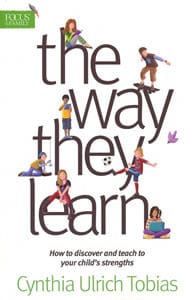
Jim: Cynthia you are so insightful and we want to cover your book today, The Way They Learn. This is one of the classic “Focus on the Family” programs over the years. So many parents have benefited from your insights.(Laughing) So, welcome back to “Focus on the Family.”
Cynthia: Thank you. Great to be here.
Jim: Let’s see, Cynthia, let’s start right out of the gate. What’s one thing parents can do as we’re starting school? What’s one thing they can do this year to help insure their kids, you know, have a good experience at school?
Cynthia: By far the No. 1 thing would be to focus on strengths. You know, there’s a lot of talk about strengths and all that into it. But really, focus on strengths. What’s good about your child? What do they do well? Where are they? You don’t have to be an expert to know what is their learning style? How am I gonna figure it out? Just be the observer that you are as a parent. Where are they happiest? When are they most successful, when they’re playing and when they’re relaxing? And how can we transfer strengths like that to the tasks that they’re gonna have to learn to do in school?
Jim: Cynthia, so often parents fail at this. I mean, we’re the adults and they’re the children. But we fail to understand how to observe them, how to encourage them. Where are some of the areas that we fail in our parenting?
Cynthia: Well, it kinda starts with our marriage. You know we often marry somebody opposite, because we think it’s gonna be a refreshing perspective. And on a day-to-day perspective, it’s not that refreshing. (Laughter) And the reason for the marriage as much as the parents is, because we’re living proof that our way works. I mean, that’s natural (Laughter) And so, if I’m the parent and you’re the child, I want you to do it my way. Why would I do it your way? It doesn’t even make sense to me.
John: I’ve heard that so much in my home of late.
Cynthia: Exactly. (Laughter) I want you to do it because I know that this works and I’m your parent. And I’m charged by God and by the Bible to train you in the way that works. And we forget that the Creator and Designer, there are just no two alike. I had twins and I can say to you that there are no two alike.And we celebrate that until we get a kid who we look at each other and say, “Where did we get this one?” (Laughter) And he’s not like you; he’s not like me. How are we supposed to deal with someone who’s so strange to us?
Jim: What do you need to do to connect with that child? Rather than see the differences, how can you build the bridge?
Cynthia: Well, you need to pull back a little and slow down and kind of watch, observe and instead of interacting. I remember reading a book on twins where it said, you know, you need to spend five or 10 minutes a day with each one by themselves. And you need to not correct, not direct. Put them in a safe place and just watch what they do and give them as little instruction as possible and watch how they do it.
‘Cause you know, we’re constantly saying, no, don’t do that; don’t go on the slide backwards and don’t do this and don’t do that. And so, we never really get a chance to see what do they enjoy? And how can I really nurture that and make learning [possible]. So when they go to school and even before they go to school, how can learning be something they really like to do? And thatthe joy of discovery is what we’re missing a lot in the classroom. So, at the very least as parents, we can keep that and nurture it and keep that celebrated.
Jim: Let’s bookmark that, ‘cause I want to come back to that. But when you talk about different personality types and styles, of course, there’s that great Scripture in Proverbs about training up a child in the way they should go. That really caught your attention and you mention that in the book, The Way They Learn. How do you apply that Scripture and what’s really being said in that Proverb?
Cynthia: Several years ago, I spoke at the McCord Air Force Base out there with one of the chaplains. And we talked about Proverbs 22:6, which is “Train up a child in the way he should go and when he is old, he will not depart from it.” And the chaplain, who’s actually kind of a Greek and Hebrew scholar, he reads the Septuagint for light afternoon reading.
John: Oh, my goodness.
Cynthia: He came up to me and he said, you might be interested to know that, that particular verse, he said, “The verb ‘train’ is used uniquely there as it is used nowhere else.” He said, “In the original language it was the word they used for when the baby was first born, for the clearing of the mouth so he could breathe. And the word literally translated means ‘Create an environment for life.”
Jim: Hm.
Cynthia: And he said, “If you look in the Amplified Bible, for example, Proverb says, train a child in the way he should go and according to their individual gifts or bents.” So, that’s actually inthe language, as well. And really, in creating an environment for life means, not constant criticism, not constant forcing to conform, but looking at outcomes and goals and obviously, keeping things in boundaries, but really finding what will be creating a life, anenvironment that my child enjoys, loves, wants to come home to, feels confident? I mean, if we can create confident learners from the very beginning in school, then we’ve given the best gift of all when they leave school and they go out into the world.
Jim: You’ve said something there that really caught my attention and it’s our passion as parents to set up the rules and the boundaries and then we guard them jealously.
Cynthia: Uh-hm.
Jim: It seems like the right thing to do, but you’re saying that may not be job one.
Cynthia: That’s right. In fact, there’s a lot of research that backs this up. You know, I had one lady came up to me after a PTA meeting and she said, “Oh, my fifth-grade daughter, she uses her learning style and all her strengths and stuff, she uses it as an excuse. She says that on Thursday nights, she can only do her homework between 8 and 8:30 while she watches her favorite TV show.” (Laughter) She said, “I think that’s just a big fat excuse.” And I said, “Well, there’s one way to find out. As long as it’s a television show you approve of, this Thursday night, let her do her homework between 8 and 8:30 while she watches the show. But what should you do at 8:30? You collect the homework.
Now if it’s done and done correctly, you have to say, “Whoa, I could never do it this way, but you obviously can, ‘cause it works.” But if you collect it and it’s not done or not done well, you get to say, “Nice try. We won’t be trying that again.” Because the bottom line will still always go back to, you say you want to do it that way. Hm. [I’ll] give you three days to prove that works. ‘Cause you as the parent are still in charge of the outcome and the accountability, but you give your child a little bit of room to experiment, to say, what would it take and where would I work best? And that’s a very positive thing.
Jim: How do you as a parent, how do you get to that point where you can flip that switch and rather than have the fight, “You are not gonna do your homework during that program. Turn that TV off now.” How do you sit back and all of a sudden, “Okay, let’s rationalize this. Go ahead and give it a try.” I mean, it sounds so easy the way you say it.
Cynthia: Yeah (Laughter) Well, I’m big on the question that you have to ask and answer as a parent, as a teacher, anybody. The question is, what’s the point? What’s the point? As a parent, I have to say, is the point that I have them sitting quietly at their desk with a light like they’re supposed to? Or is the point that they do their homework? Michael did his homework at the kitchen table, quietly just like a good child should.
Jim: And these are your twins.
Cynthia: These are twins, two minutes apart, Pete and Repeat. (Laughter) But Robert, he goes out in the living room and every day during the fourth grade, every night for homework, he was on his stomach on top of the coffee table with his feet dangling in the air (Laughter) doing his homework. And both boys did their homework and I had to say, “Well, we’re just not gonna put anything on the coffee table,” ‘cause the bottom line is, oh, my goodness, if he does his homework and that works, I’m in favor.
Jim: Well, and you stress that in your book, throughout the book, talking about that question, what’s the point?
Cynthia: That’s right.
Jim: And you have to ask it how many times a day?
Cynthia: Many.
Jim: Maybe 20, 30 times a day? (Chuckling). What’s the point here? And you’re really coaching yourself by asking that question, aren’t you?
Cynthia: Yeah and then of course, what you’re saying to your child, too is, prove it. You know, if the child says, “I … I need to be on the floor, watching TV with headphones on and having something to eat or drink while I’m doing my homework, in order to do it,” you say, “Oh, [you’re] gonna have to prove that one to me.”
Jim: Let’s talk about the learning styles and in your book, what are they? Describe ‘em for us.
Cynthia: Well, you know, there’s five different models that we talk about and one of my favorites that we start with right away that is pretty basic and people usually think they know what it’s all about is the modalities, or how you remember. And that is, everybody has three puzzle pieces, ‘cause they really are puzzle pieces, not something you can just test.
But you know, the auditory learn by hearing and the visual learn by seeing and the kinesthetic learn by doing. That’s what most people think. And even though that’s partially true, when we really get into the research, there’s more to it. And if you have a child with a big auditory piece of the puzzle, they learn best by hearing, but not hearing you. They learn best by hearing themselves. So, your auditory child tends to talk too much, tends to process things verbally.
Jim: Why” Why?
Cynthia: That’s right.
Jim: That one? (Laughter)
Cynthia: And they just talk and talk and talk, you know, they’re the chatterbox and you never have to wonder what they’re thinking. That’s the upside. But the downside is, you know, you often want to say, “Wow! I think your dad would like to hear a little bit more of your day for a while.” (Laughter)
Jim: That’s not fair.
Cynthia: Give me a break. (Laughter)
John: That was just a friend of hers. That really wasn’t here.
Jim: Right.
Cynthia: That’s right. But for the auditory person, they aren’t gonna learn and remember things until they ask questions about it. And one of the things we know about auditory kids is, if you don’t let them talk, they will keep interrupting you until they do. Because it’s not like there’s anything else they can get in until they get this thought out.
Jim: Hm.
Cynthia: You know, my classic example of the third-grade teacher who says, “Boys and girls, today we’re gonna talk about animal cruelty.” “Oh, my aunt, she has this dog.” And she says, “We don’t have time for everybody’s story. Just hang on to your aunt’s dog story.” But that doesn’t work, because if I’m a highly auditory kid, my aunt’s dog story is bubbling up to the top (Laughter) and I don’t have room for anything else to go in until my aunt’s dog story comes out.
Jim: You can’t hear anything.
Cynthia: So, if I can’t tell the teacher, then I have to turn to the kid next to me and get it out there. And then I’m ready to hear more from the teacher. But by then, I’m in trouble again for inappropriate socializing. So, as an auditory child, I’m trying to process things and sometimes it’s a great compliment that I’m talking and asking questions. And you’re thinking I’m just interrupting to hear the sound of my own voice. But I’m tryin’ to process it by saying, “So in other words, really?” And I’m repeating what you said, because then when I hear my own voice say it, I remember it and I don’t remember it from your voice.
Jim: Right, well, and often as parents we take that as just irritating, you know, that the child’s just irritating us.
Cynthia: Let’s face it, it kinda is.
Jim: Hey, well it is (Laughter) irritating. I mean, from the child’s perspective, the child’s doing what God has created in that child’s heart, explore, explore.
Cynthia: That’s right and they’re not annoying you on purpose. Most of the time, they’re not.
Jim: Yeah.
Cynthia: They’re just figuring out how they’re wired.
Jim: Right.
Cynthia: But if you’re not an auditory person, you will like peace and quiet and sometimes auditory teachers, for example, they say, “Shh!” more than anybody else, because they need to talk. And so, they want all the kids to stop talking and here the auditory kids are just bubbling up, needing to react or ask a question and it’s very frustrating because they can’t do it.
Jim: That’s one. Let’s go over a couple of others.
Cynthia: If you look at the visual kid, I’m very visual and highly kinesthetic, but a visual kid, we don’t talk that much. We watch. We observe and for the visual child, even though we learn best by seeing, we are also greatly distracted by it.
For example, if you don’t show me something about what you’re talking about right away, then I make up my own picture. And it’s almost never the same picture that you had in mind. So, my mind is creative. I look like I’m daydreaming. I’m thinking, “Oh, wow. Those shoes don’t actually match her skirt.” And (Laughter) I’m automatically distracted from the teacher. I just need to see something and I need to see it in my mind, even if you get me to imagine it. Like a classic example, if I’m a visual kid and I’ve got an auditory parent and my auditory parent says, “Hey, come here. I need you to go down to the kitchen and take that blue mug by the side of the sink and take it out to the patio table.”
And I say, “Okay.” And I turn around and, right away I’m not exactly sure what my parent just said, but I don’t want to go back and ask again, ‘cause the auditory parent says it slower, louder, yells, telling me I’m not paying attention. So, I just go and do what I kinda think it was and it almost never turns out.
Now the one thing the auditory parent could do for me as a visual child is to say, “Listen, I need you to go down to the kitchen. You know that blue porcelain mug, the one that’s sitting by the side of the sink?” pause, pause, pause. What am I doing?
Jim: Processing it.
Cynthia: Yeah and then I say, “Oh, yeah, yeah,” ‘cause my visual mind is, I’m saying, yeah, yeah, the blue one there. I need you to take that mug out to the patio table,that big round white one and put it there.” Now the chances of my doing exactly what you’ve told me are almost 100 percent, because you took just a little bit of time and you let me track with you visually in my mind, what are you talking about?
You can tell me 10 times and you can say, “I’ve told you 10 times. How many more times do I have to tell you?” I need to see it. I need to create it in my own mind or you need to show me a picture and then suddenly, I connect and I can remember, ‘cause I can see it in my head.
John: Hm. Well, this is a special “Focus on the Family” program. We’re in Seattle, the Seattle area.
Jim: Yeah, don’t give anybody …
John: We’re not actually in Seattle proper.
Jim: Bellevue, Seattle, be careful.
John: We’ve got some friends here in a conference room and our guest is Cynthia Tobias, the author of a book that we’ve talked about before on this broadcast, The Way They Learn. Jim Daly, our host, I’m John Fuller. Jim, one thing I so appreciate about what Cynthia’s saying here is, not only am I better understanding my kids as we talk, but I’m understanding myself (Laughter) and my spouse, as well. It just helps bring clarity to all of those relational dynamics.
Jim: Oh, it does. You know, I’m sitting here thinking, oh, all the mistakes I’m makin’ as a parent. But you can overcome those things.
Cynthia: Absolutely.
Jim: You’ve covered two of the styles, Cynthia. Let’s get through the others and then we’ll come back to more general questions. So, we’ve got auditory and visual. What are the others?
Cynthia: The kinesthetic, the third piece of the puzzle. And remembering is, you know, kinesthetic, we always just figure that’s learned by doing. But everybody learns by doing.
Jim: Or learn by moving.
Cynthia: Yeah.
Jim: That’s what that reminds me of
Cynthia: That’s exactly what it is, ‘cause kinesthetic is born to move and about 40 percent of the population the last research.
Jim: Is it that high?
Cynthia: [It’s] very high [and they are] somewhat kinesthetic, which means, we can’t just sit still for any long period of time and listen without doing something. Give me something to do. I can’t just “not move” and it’s very difficult for a highly kinesthetic kid; [they need you to] just get to the point. I mean, so in other words, what? I mean, I’ve got a short attention span. So, it’s not like I have a neurological disorder. I’m just highly restless and I’m active, ‘cause every part of me was born to move. And if I’m born to move and you won’t let me move, I only think about one thing while you’re talkin’ to me, the fact that I can’t move.
John: I’ve gotta move soon here.
Cynthia: I can’t concentrate.
Jim: There’s hardly an environment for that child where they can do well, because everything is rigged against that child.
Cynthia: That’s true.
Jim: And they gotta sit quietly in class. You gotta be quiet and you can’t move. Maybe recess is the one thing they can just go and excel.
Cynthia: Right, which is what they they punish you for, [making you go]without recess.
Jim: Right.
Cynthia: If you’ve moved too much in class, you can’t go to recess and then you’re sunk.
Jim: Then you don’t get it.
Cynthia: But yeah, and the highly kinesthetic individual, if you think about it, classrooms by and large don’t really prepare you for the real world anyway. I mean, some of your high kinesthetic occupations, you know, artists, mechanics, dancers, I mean, just about anybody who moves all day. I had a guy call in on a radio show back on “Focus,” several years ago. And he called in and he said, “I don’t agree that you should let kids move.” He said, “I have a second grader. She moves all the time.” And he said, “I told her, ‘You’ve got to learn to sit still, because someday you’ll a job where you can’t move.’” And I said, “Are you calling me from work?” And he said, “Yes.” And I said, “Where are you calling me from?” And he said, “My truck, never mind.” (Laughter)
Jim: He’s moving all day.
Cynthia: Like are we supposed to train our children the way we think it should be or do we say, this child is constantly restless? They’re gonna do great things with physical things. And that’s not a bad deal. Get them moving in some way, if it doesn’t distract other people.
John: Cynthia as you’re describing this type of learning style, I imagine there are many moms thinking, you’ve just described my boy. I mean, it feels to me, just by observation, that many, many boys fit into this category.
Cynthia: Right. In fact, one of the researchers, Walter Barbe, one of the researchers says if you have a kinesthetic, especially a kinesthetic boy, and when you ask ‘em to line up, he’ll either be at the front of the line or he’ll be pushing the back of the line, ‘cause it’s a constant push, push. Let’s go. Let’s go. Let’s go. Let’s just do it. We aren’t gonna sit still. Andin men or women it’s a high level of activity and energy.
John: And those boys get into a lot of trouble in the early years at school because they haven’t quite learned to oh, control that need.
Cynthia: They do and the interesting thing that parents can do is, that for a highly kinesthetic child—boy or girl—instead of having us sit down and do homework quietly after school, you know, go out and shoot hoops with me while I’m memorizing the multiplication table. Or let run up and down the stairs while I’m looking at my spelling words. ‘Cause even if I’m highly kinesthetic, if I’m just moving, if you talk to me while I’m moving, I remember. If you talk to me while I’m sitting, I’m only thinking about moving.
Jim: All right, John, now here’s the question. What type of learner are you?
John: Am I? Well, based on what Cynthia said earlier about how we can not remember things (Laughter)
Jim: But it could be age.
John: Did you catch that? I mean, (Laughter) well, it could be the age, yes. (Laughter)
Cynthia: No, no.
John: But I was thinking that I do want quiet and I don’t process aloud a whole lot, so I’m probably more of a visual learner. How about you?
Jim: I think audio and I remember when I was 5-years-old, my mother’s best friend, we called her Aunt Penny, but I remember I was doin’ the “why thing,” and I was probably yakking a lot and she turned to me and said, “You have diarrhea of the mouth.” (Laughter) Would that be an auditory learner?
Cynthia: Yeah, I’m afraid so. (Laughter)
Jim: That crushed me though, I gotta tell you.
Cynthia: Oh, I’m afraid so.
Jim: It did; it really kinda put a dent in me. I think I didn’t talk for a day or two.
Cynthia: Although interestingly, John, there are some auditory kids that aren’t necessarily talking out loud as much as they constantly talk to themselves. And these are the kids that’ll read a little bit slower because they’re sayingthe sound of the word is very important. So, they don’t skip words; they actually pronounce the words inside their head.
John: And that slows them down.
Cynthia: And they usually make a thinking noise. And they can’t think with anybody else’s noise, but they’re constantly making kind of a humming or a bupp, bupp.
John: I’ve got one or two of those kids, I think in my home.
Jim: I bet you do. Hey, Cynthia, what are the two main ways that people process information? You also talk about that in The Way They Learn. Talk about that.
Cynthia: Right, in fact, this is one of the models that’s the most statistically significant as far as the research goes. And Herman Witkin, who was a psychological researcher during World War II and just in a nutshell, his research showed with about an 88 percent reliability factor for those who know what that is, that’s very significant, he did his research throughout the world, not just the United States. And he figured out that there was about 50-50, that if you look at a continuum that’s kinda 2-quart jars on one end and 2-quart jars on the other, 50-50 regardless of gender, however wired from the very beginning when we get that DNA, that 50 percent of the population is wired very analytically.
So, when information comes in, the analytic mind wiring automatically focuses on specifics, details, piece by piece specific facts, break it down, one, two, three. And that’s how we work a lot of things—school, a lot of systems very analytically.
But there’s the other 50 percent of the world that was born wired differently, equally intelligent, equally capable, equally gifted, but not wired analytically, wired what we would call more globally or intuitively. In other words, and that’s where I end up, but on that end, we’re wire[d that] when the information comes in, we need context. We need an orientation where we’re trying to figure out, okay, what does this have to do with anything I care about?
Jim: Okay.
Cynthia: I don’t automatically look at details.
Jim: And is that’s way that you process.
Cynthia: That’s right.
Jim: So you’re saying something that’s important though–the IQ issue–because an analytical parent might view that global child the way they’re thinking very differently.
Cynthia: Right and the chances of you having one are tremendous.
Jim: What’s the conflict between those two?
Cynthia: The chance of you marrying the opposite is tremendous, ‘cause you need a left hand and a right hand, but you’re really frustrated. You know, it’s just like I can remember getting in trouble in school for the analytic teacher who said “Take out a piece of paper and number one through 10.” And I’m lookin’ around goin’, “What are we doing?”
Jim: You want to know the answer before you act.
Cynthia: Yeah. We’re taking out a piece of paper and numbering one through 10 and then I say, “Why?” And I get in trouble for being a smart aleck, but I just don’t know what it is. Am I taking a test? Are we skipping a line? I need, as a global learner, I just need you to put a context around it. What are we doing? Give me a whole thing.
And the analytic parent or teacher can sometimes think, “Why don’t you just do what I tell you? Just pay attention and you’ll know what it is.” But the global mind says, “I don’t know where we’re going. I don’t know what this is all about. I mean, if you could just give me a little bit of context. I’m not stupid. I just need a little bit more.”
Jim: Cynthia, there is so much more to cover. I think you are touching a lot of us as parents emotionally and how we’re struggling probably with some of the issues that we face with our children and trying to learn how to communicate with them better.
Cynthia: That’s right.
Jim: That really is what we’re talking about, how to communicate with your child. Let’s come back next time and continue the discussion and there’s a few more questions I’ve got. John, you’ve got some, too
John: I have a number of questions myself.
Jim: Well, let’s do that from the Seattle, Bellevue area, let’s … let’s come back and talk it over.
Cynthia: Great.
Closing:
John: And what an eye-opening conversation we’ve had, as you heard there. I’ve learned a lot. I have some questions about my own learning style and my kids and if you feel the same, you’re gonna want to get a CD of this two-part conversation with Cynthia Tobias and a copy of her book, as well, The Way They Learn. You’ll find these and other resources at www.focusonthefamily.com/radio or when you call 800, the letter A and the word FAMILY.
Jim: You know, John, there [are] a handful of resources that are those epiphany resources. Cynthia has hit with her book, The Way They Learn. It is one of those things every parent should have in their library and read it.
John: Yeah, there’s kind of an “ah-ha” moment when you do so.
Jim: And it is one of those core things. In fact, one mom named Sue shared this with us. She said, “I’m the mom of four children and two of my children have serious health issues. There have been many times over the years where I felt I couldn’t express my pain and frustration. I began listening to “Focus on the Family” during my alone time. It was God’s way of speaking to me. It opened me up and gave me words to cover topics that were just too hard to start. Focus brok