




Day One:
Brandi Wilson: I had to recognize that God will never leave me lonely. I might not be surrounded by people, but I was surrounded with His presence if I chose to seek Him.
John Fuller: Well, that’s Brandi Wilson discussing ways that God healed her heart after an unwanted divorce. Welcome to Focus on the Family with Jim Daly. I’m John Fuller.
Jim Daly: John, this is gonna be a difficult discussion. Um, there’s a couple of ways that people end up without a spouse. One can be death of that spouse. That’s common. We’ve had, um, spouses on the show talk about that loneliness in that context.
John: Mm-hmm.
Jim: Today’s is different. Today’s discussion is gonna be about a couple who just didn’t make it. And we’ll unfold that, uh, today and tomorrow. But this is important for us to talk about, what happens when divorce comes unexpectedly for that spouse that isn’t anticipating this. They made their commitment to love each other until death do us part, and then something happens.
John: Mm-hmm.
Jim: And that can be infidelity, it could be abandonment, it could be abuse, whatever it might be. But you end up by yourself, and maybe with your kids. So today’s discussion’s gonna have that emotion, and we’re gonna talk about that percentage of people that end up in divorce court, even though they’re Christians.
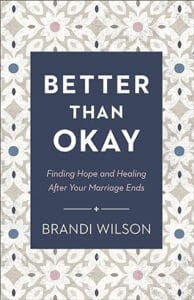
John: Yeah. And God’s goodness and faithfulness can still reign in that circumstance and, uh, bring healing. And we’re gonna hear about that from Brandi Wilson today. She’s an author, mom, and life coach, and Brandi has written a book about her experiences. Uh, it’s called Better Than Okay: Finding Hope and Healing After Your Marriage Ends.
Jim: Brandi, welcome to Focus. Good to have you here.
Brandi: Thanks so much for having me.
Jim: Yeah.
Brandi: Honored to be with you guys.
Jim: Yeah, I appreciate it. And this is a difficult subject. I mean, there’s no way around that. There’s going to be people listening and viewing on YouTube that are coming from all kinds of perspectives, you know?
Brandi: Mm-hmm.
Jim: And they, they may be divorced themselves and this will bring up issues.
Brandi: Mm-hmm. But it’s a good thing to talk about.
Jim: Yeah.
Brandi: Because divorce is so common in our culture today. I come from divorced parents. My mom was a single parent mom and she had five kids.
John: Mm-hmm.
Jim: I was about five when she divorced my dad. She remarried at eight. So I’m coming with it-
Brandi: Yeah.
Jim: … from the view of the child.
Brandi: Yeah.
Jim: And I know you have sons. How many sons do you have?
Brandi: I have three sons.
Jim: Three sons.
Brandi: Yes.
Jim: And what are their ages roughly?
Brandi: They are 18, 20 and 23.
Jim: Okay. Okay, good.
Brandi: So, I guess they’re men.
Jim: Yes (laughs).
Brandi: I know.
Jim: Isn’t that always awkward to say, “Oh, the boys. I mean, my young men.” (laughs).
Brandi: It happens in the blink of an eye. Yes.
Jim: They start looking at you funny when you call them boys.
Brandi: Right (laughs). Right.
Jim: Mom, have you noticed? I’m a grown man. Well, let’s get going. Describe, uh, the life that you had before your divorce.
Brandi: Mm-hmm.
Jim: What was happening? What were the good things?
Brandi: Yeah. I married my college sweetheart, um, and we planted churches. We started churches. The first one we started, um, right outside of Bowling Green, Kentucky. We’d attended Western Kentucky University and planted a church there and served for five years before moving to Nashville and starting a church in Nashville, Cross Point Church. And Cross Point boomed. Um, it grew significantly. It was considered one of the fastest growing churches in the nation, seven years running.
John: Hmm.
Brandi: And I loved being part of that ministry. I loved being able to lead the staff. I loved serving the people of Middle Tennessee. Um, the church grew to five campuses in Middle Tennessee during our 14 years there. And I really felt like that was the place I was gonna be serving until we chose to retire. Um, my kids were all born while the church was growing, and I loved the life that we had created. And then in 2016, my now ex-husband, suddenly resigned and walked away from the church and the ministry.
Jim: Did you have a clue what was happening up until that point?
Brandi: Um-
Jim: Were you, you know, did you have that sixth sense about maybe something’s wrong with my husband?
Brandi: I had a sixth sense, and oftentimes in situations like that, Jim, there is a lot of manipulation and blame that goes-
Jim: Mm-hmm.
Brandi: … that is put on you. So I really believed I was the weak link in the marriage. I believed that, you know, I wasn’t loving well, I wasn’t managing time well, I wasn’t … And I was doing everything I knew to do, but it had been communicated to me. And I think when you were in a situation like I was where your husband’s, you know, for lack of a better word, popularity and impact is growing across the nation. He was an author. He was traveling for all of, you know, his personal, um, accomplishments as well. And everywhere I went, everyone told me how great he was, that he had a message he’d given and saved their marriage or a message he’d given them the courage to start a business. So everywhere I went, the message I was getting is how amazing he was, and yet I knew the person I lived with at home, that that did not compute.
Jim: Yeah.
Brandi: There was not a congruency between this person on stage and the person that I was living with.
Jim: You know, uh, and I know you’re very careful to, to, uh, respect your ex-husband, and that’s always good.
Brandi: Mm-hmm.
Jim: That’s great for the young men in your family.
Brandi: Yes.
Jim: But in that regard, when you look back on that, um, I mean, the Lord was using that-
Brandi: Mm-hmm.
Jim: … to build to impact people. I’m sure many, hundreds-
Brandi: Yeah.
Jim: … if not thousands of people came to Christ-
Brandi: Yeah. Mm-hmm.
Jim: … were nurtured in the faith, et cetera. Isn’t that a jarring realization that, like, this is so good and then this is so bad. And in that case, I mean, he succumbed to affairs, correct?
Brandi: Yes. Yes.
Jim: Just to be blunt so we know what the issues are.
Brandi: Yeah.
Jim: And it wasn’t one or two, it was more serial in its orientation.
Brandi: Yes. Yes.
Jim: And, uh, you know, so it, unfortunately, it preyed on a, a weakness, obviously, that he had.
Brandi: Mm-hmm.
Jim: But describe that reconciliation, if you ever thought in those terms, like, “Okay, Lord, you accomplished a lot through this-
Brandi: Mm-hmm.
Jim: … but man, I’m crushed.”
John: Mm-hmm.
Brandi: Yeah. I think there was a lot that did not make sense to me, and that is one of the pieces of that, that I struggled with. And, and I feel like one of the gifts God gave me in the midst of my marriage falling apart is that my two closest friends were married to mega church pastors. So I also had a visual of what healthy male leadership looked like.
Jim: Mm-hmm.
Brandi: Um, men who actually led churches larger than ours, who were good, godly Christian men serving their families and their wives. So to be able to have those men in my life to help me see the problem wasn’t the church and the problem wasn’t God, the problem was actually my ex-husband really helped me be able to focus on where the un-health was and lean on God in a way that really brought me a lot of freedom.
Jim: Have you, again, at a 40,000 foot view, and then we’re gonna get more deeply into your specific story, but when you look at that as a former pastor’s wife-
Brandi: Yeah.
Jim: … and you look at the accolades and all those things that are occurring-
Brandi: Mm-hmm.
Jim: … and then we, you know, there are a lot of failed pastors-
Brandi: Mm-hmm.
Jim: … and ministry leaders-
Brandi: Yep.
Jim: … in this country, um, what do you think’s going on there for these men that end up in this situation where they have multiple affairs and-
Brandi: Mm-hmm.
Jim: … what … I mean, it’s amazing right now. I keep saying if you can just cross the line without an affair, people patch on the back go, “Way to go. You were such a good leader.”
Brandi: Exactly.
Jim: It’s kind of a low bar.
Brandi: Yeah.
Jim: Right?
Brandi: Yeah.
Jim: But what’s your observation of that coming through what you’ve come through, just to the general issue of the church, not, leadership in the church not being able to do some fundamental things well.
Brandi: Yeah. I think, um, people who don’t live transparent with anyone in their life, there’s always hiding that happens behind the scenes. There are things that they’re trying to downplay. Um, there’s a lot of manipulation with people who are serving under them so that they’re continuing to receive that support. But at the end of the day, I think we all have some demons and baggage and things that occurred in our childhood or our teen years that we have to be willing to do the hard work of dealing with our own emotional health and mental health. And if that isn’t done, then we end up succumbing to these sins that destroy not only our lives, but the people who we are connected with.
Jim: And it doesn’t excuse it, but that axiom, you know, hurt people hurt people.
Brandi: For sure.
Jim: And it, that’s kind of what you’re saying. These are patterns.
Brandi: And hurt leaders hurt a lot of people.
Jim: Yeah. And right, exactly. And these are patterns that are developed in your childhood typically-
Brandi: Mm-hmm.
Jim: … wounds that you have, you bring them into marriage.
Brandi: Right.
Jim: They’re not dealt with and then, boom, then things begin to fall apart.
Brandi: Yeah.
Jim: Um, let’s move more specifically into your story. You, your family came from a happily ever after kind of orientation where you didn’t have divorce in your family-
Brandi: Right.
Jim: … on your side of the family.
Brandi: Right.
Jim: I can’t imagine the shame of that, the feeling of shame to be one of the only on your side of the family-
Brandi: Yeah.
Jim: … to now go through a divorce. Describe that feeling like calling your mom and your dad, or your extended family, to say, “Yeah, this isn’t working out.” How did they respond?
Brandi: Yeah. My parents were incredibly supportive and loving and kind through all of it. They were shocked.
Jim: Understanding?
Brandi: Understanding, yes.
Jim: For you.
Brandi: For me.
Jim: Yeah.
Brandi: Yes. They were shocked when I called them. Um, you know, because we served at a church, I was very protective of what I communicated even to my parents at the time. Um, and to be quite honest, I didn’t know, know all of the truth of things that were occurring behind the scenes. So there were a lot of things I didn’t know that were happening that I, so therefore I couldn’t communicate them. Um, they allowed me the space to be able to grieve and heal. Something is very special about having your mom between you and God-
Jim: Mm-hmm.
Brandi: … because you know that she is on her knees praying for you in ways that no one else can-
Jim: Yeah.
Brandi: … and no one else does. So to be able to bring them in on that and to know that they were, you know, storming the heavens on my account and the account of the boys really did bring me a lot of peace and some safety in a season that felt very unsafe.
Jim: It’s gotta feel very cloudy-
Brandi: Yes.
Jim: … to understand. I mean, it’s like you’re in a fog.
Brandi: Mm-hmm.
Jim: Uh, we’ve got two friends who are going into divorce court now, and Jean and I have been praying every morning-
Brandi: Yeah.
Jim: … for them and, you know, you start to pray those prayers, “Lord, open their hearts up to reconciliation. Help them to see the error that they’re walking toward, the damage, the destruction.”
Brandi: Right.
Jim: And that’s just become a daily prayer. But again, it’s so common.
Brandi: Mm-hmm.
Jim: Yeah. In, in our friendships now, our Christian friendships.
Brandi: Yes.
Jim: And you’re saying, “Lord, what’s happening?” Was that a point in your, uh, walk toward divorce? Did you realize at a point that it’s, okay, it’s done? Did you give up hope?
Brandi: Um, I gave up hope on the marriage and my ex-husband changing-
Jim: Right.
Brandi: … but not on what God was gonna do in my life.
Jim: And you could differentiate between those two things?
Brandi: Yes. We have-
Jim: Did it take time to be able to differentiate?
Brandi: Um, I felt like when God gave truth, it happened very quickly for me. It was during a joint counseling session.
Jim: Mm-hmm.
Brandi: Um, the next to last one we had, and I really felt like it was a gift of God. My ex-husband came in with a journal and he started at the beginning of our marriage and he went through every infidelity that had occurred.
Jim: Mm-hmm.
Brandi: Um, a lot, I, I did not know about all of those. Um, and in that moment, I knew that this was not a mistake, this was a pattern of behavior, and he was not willing to do what needed to happen to change that pattern of behavior. I can look back and say God healed my heart very quickly in regards to my marriage. I grieved a lot of the loss of the future of my family and what I thought retirement would look like in the empty nest and grandkids. Um, so I, there was a lot of grief tied to it. But I really recovered from the loss of my husband, quicker than I even did the loss of the church. I grieved the loss of the church for a really long time.
Jim: Oh, that’s interesting.
Brandi: Um, because I loved what God had given me the opportunity to do and how I had served.
Jim: Mm-hmm.
John: This is Focus on the Family with Jim Daly and our guest today is Brandi Wilson and, um, she’s captured her story and, uh, insights into a book called Better Than Okay: Finding Hope and Healing After Your Marriage Ends. We’ll encourage you to get a copy of this book from us here at the ministry. Uh, you can do so, uh, when you stop by FocusontheFamily.com/broadcast. And Brandi, uh, you mentioned earlier that your husband’s voice in, in your head was one of your not enough.
Brandi: Mm-hmm.
John: How, how did you discern God’s voice in the midst of this and why is that so important?
Brandi: Yeah, I think there are lots of lies that were told that impact us from early in our lives to current. And I was actually in a coaching session with an executive coach and talking about the coaching business I myself have and doing the business side of things and, and just the fear of, “Am I gonna be able to take care of myself and my kids? And what does this look like financially? And what if I can’t do it?” And, and He stopped me and He said, “Whose voice is telling you those things?”
John: Mm.
Brandi: And I had to have some self-reflection of whose voice is that I hear in my head. And He challenged me to replace the voice that I was hearing of my ex-husband and all the things that I, I didn’t think I could do or didn’t believe in myself or that I was worthy of and to replace it with the voice of God. So it just became a mantra. Uh, stop, think, and pray when that happened of I would hear the negativity in my head, I would stop, identify it, I would think through what the truth of God was and then pray that it would be replaced. Um, the voice of God would replace the voice of my ex-husband in my head.
John: Yeah.
Brandi: And because, you know, our brain is very, very smart and it’s very capable of running the same message over unless we intentionally-
John: Mm-hmm.
Brandi: … decide to change that. So we can change those neuro pathways in our brain if we’re intentional to do it.
John: Mm-hmm.
Brandi: So, um, yeah, being able to lean on God and r- remember who I was and how He had uniquely created me and the abundant life that He was providing-
John: Yeah.
Brandi: … brought me a lot of hope when those negative thoughts would creep in.
Jim: Yeah. How much time, has it been seven years?
Brandi: It’s been eight years.
Jim: Eight years now.
Brandi: Almost eight years.
Jim: So just to give context to the listener, the viewer.
Brandi: Mm-hmm.
Jim: Um, I wanna go back to something you said because I think it’s so critically important. It was easier or faster to-
Brandi: Yeah.
Jim: … let go of the relationship with your husband than it was for the church.
Brandi: Yeah.
Jim: And in that context and recognizing that, um, did you build … How would you describe the, the lessening of the intensity with your relationship with the husband, like building a wall-
Brandi: Yes.
Jim: … you know, where you were, um, protecting yourself-
Brandi: Mm-hmm.
Jim: … I guess might be the way to say it? You could allow yourself to grieve about the loss of being an integral part of the church-
Brandi: Mm-hmm.
Jim: … but that place of relationship with your ex-husband, is it cutting that off? Is it building a wall? Is it all of it? And is there any aspect of that that’s healthy or unhealthy? I mean, it’s survival.
Brandi: Right. It is survival.
Jim: So just, if you can articulate that-
Brandi: Mm-hmm.
Jim: … I’m just really curious about-
Brandi: I think-
Jim: … survival in that moment.
Brandi: … for me … Now I walked through all of this with a trusted Christian therapist. Um, so I had someone who was an expert in doing emotional work, cognitive behavioral therapy, um, all of that kind of stuff. Now, I, one of the things I think is important is for me, I had to recognize that the marriage had not been a healthy marriage for a long time.
Jim: Mm-hmm.
Brandi: So for me to be able … Hindsight is 20/20.
Jim: Yeah.
Brandi: We’ve all heard that. To be able to look back and see that there was a lot of dysfunction, there was a lot of infidelity, there was a lot of lies, there were a lot of manipulation that happened, there was a lot of deception and hiding, that allowed me to stop romanticizing-
Jim: Ah.
Brandi: … what the 20 years had-
Jim: Okay, that’s good.
Brandi: … been presented-
Jim: Yeah.
Brandi: … to the public because we were in a leadership role, and to actually look at the truth of the relationship. So when being able to look back and realize, like, “I was lonelier in my marriage than I am now as a single person-”
Jim: Hmm. Yeah.
Brandi: … was a huge awakening for me. So I think to be able to recognize what was the truth, what was the reality of the relationship, it wasn’t as perfect as it looked like it was. There was a lot of pretending that happened.
Jim: You know, I think, I think there are many marriages that feel lonely.
Brandi: Uh-huh.
Jim: Um, there may not be that open dialogue for whatever reason-
Brandi: Mm-hmm.
Jim: … you know, past wounds and all the things we’ve talked about.
Brandi: Yeah.
Jim: Um, how do you guide a friend in that direction to say, okay, if there’s not that big no-no-
Brandi: Yeah.
Jim: … then here’s some things you can do to improve your marriage so you don’t fall into that.
Brandi: Yeah. I’m a huge fan of marriage, Jim.
Jim: (laughs).
Brandi: I’m a huge fan. Just because my marriage ended does not mean that I don’t believe in it.
Jim: You may be more of a fan because of it.
Brandi: Yes. I-
Jim: Yeah, I mean, seriously, I understand that.
Brandi: I believe I will be married again and get to experience a healthy, happy marriage. So I would encourage those people who were struggling in their marriage to find a therapist, to be able to work through, to deal with some of the communication patterns and the habits that they’ve gotten into that aren’t healthy for their marriage. And to do the work, if you’ve got somebody who’s willing to stay in it with you, to spend the time-
Jim: Yeah.
Brandi: … in the work to figure out why is this not working and what can each of us do to be better partners to one another.
Jim: Yeah. Which is so good. And that’s Hope Restored. I mean, we have this intensive program-
John: Mm-hmm.
Brandi: Yes.
Jim: … for four days. People can come and it’s got a post two year 80% success rate.
Brandi: That’s great.
Jim: And some people have signed divorce papers. So it’s really-
Brandi: Yeah.
Jim: … I think it’s one of the best things happening in marriage.
John: Mm-hmm.
Jim: And certainly people that need that kind of attention, call us-
John: Get in touch.
Brandi: Yeah.
Jim: And, uh, get in touch with us online or what have you. And, uh, we can start that process for you.
Brandi: Mm-hmm.
Jim: Let me ask you, uh, again, continuing in the journey here. Uh, so now you have the three young men.
Brandi: Mm-hmm. Yes.
Jim: And they were eight years younger, so they were in their teen years-
Brandi: Mm-hmm.
Jim: … and maybe 11, 12 at the time. Um, joint custody.
Brandi: Oh.
Jim: That kind of messy thing.
Brandi: It’s messy.
Jim: That, you know, that just feels so … I mean, like the hair on my neck stands up thinking about that. And people get through it, and I’m not saying it as a shaming thing. I’m saying, like, Lord, help me never to have to do that ’cause it, you know, it just would be so hard.
Brandi: Mm-hmm.
Jim: But you described in the book so well, like the boys going into their dad’s car.
John: Mm-hmm.
Jim: Describe that for me, the feeling of watching them drive away.
Brandi: That’s probably the most difficult piece and the piece that felt most unfair. No one, you know, is holding their baby in the hospital after delivery and says, “I can’t wait to spend, you know, 50% of the time with you and every other Christmas. It’s just as parents, we want to be in our kids’ life 100% of the time.” Um, I am fortunate that my parenting plan was a 70/30 split, so the kids were with me 70% of the time. But every other weekend, I watched them crawl in his car and leave knowing that they were gone for four nights. And it felt so painful to watch them crawl into that car and to leave, and know that I wasn’t gonna get to interact with them. They, a couple of them were so young, they didn’t have cell phones at the time. So how do you talk to them and what does that look like? And it, it was the time that I was the angriest. It was the time that I was the most broken. It was the time … You know, the chapter in the book about that is called I Cussed a Lot because there, you know, times that grief-
Jim: Just that emotion.
Brandi: … just like tears, and yeah, sounds like swearing. So it was a really tough time for me to be able to have to navigate what is it like to not have my kids in my home for the next four days.
Jim: What, what was a practical thing you did in that place to help offset the negative emotions? Did you have a friend or what, what really helped in-
Brandi: I always-
Jim: … in that specific area?
Brandi: I always planned something to look forward to.
Jim: Uh-huh.
Brandi: Um, I always had … I had to balance, because the way I’m wired, I could, if they were gone for four days, I could plan all four of those days from the time the sun rose until the time the sun went down. And I also knew that choosing to be alone was gonna be beneficial and healing for me as well.
Jim: Mm-hmm.
Brandi: So I balanced a little bit of, okay, I need some time to myself, I’m an introvert. So I would work in yoga classes with a girlfriend, coffees, going to the movies. I would really try to be intentional about planning my time so that was-
Jim: When the kids were out, when the kids were gone.
Brandi: When the kids were out, yes. So that I had things to look forward to-
Jim: Yeah.
Brandi: … while they weren’t there.
Jim: That’s really good. Let me ask you, uh, about loneliness.
Brandi: Mm-hmm.
Jim: I mean, we described those years as being lonely in the marriage ’cause things weren’t healthy.
Brandi: Yeah.
Jim: They were dysfunctional. But then you go through divorce and I, I would imagine you have episodic expressions of loneliness.
Brandi: Yeah.
Jim: Like it starts very deeply-
Brandi: Mm-hmm.
Jim: … and you’re troubled and you’re worried about what your future will be-
Brandi: Mm-hmm.
Jim: … and the loneliness is the deep end of the pool, and then over time that may get better. What’s been your experience with loneliness?
Brandi: Yeah, loneliness is tough. Um, I was lonely in my marriage. I was also lonely as a single mom. Um, I think one of the things I still struggle with in regards to loneliness is I don’t have a co-parenting relationship with my ex-husband where, when there’s a significant event in our kids’ lives, whether it’s a graduation or, you know, they have a, a great performance at a football game, I, we don’t get to look each other in the eye and say, “Man, they’re a great kid.” We are so proud of them. And that brings a lot of loneliness-
Jim: Uh-huh.
Brandi: … being the single parent in seasons like that. Um, so loneliness is real, and loneliness is something that needs to be dealt with. And for me, I, I had to recognize that God will never leave me lonely. I might not be surrounded by people, but-
Jim: Huh.
Brandi: … I was surrounded with His presence if I chose to seek Him.
Jim: Yeah.
Brandi: And that really brought me a lot of peace in those moments where I was feeling the loneliness, where the silence was too much, to be able to know that He had never left me and, and He wasn’t going to abandon me.
Jim: Right. And you, would you agree that those depths of loneliness today are far more shallow-
Brandi: Yes.
Jim: … than they used to be?
Brandi: Yeah, I think there’s healing in the lonely-
Jim: Yeah.
Brandi: … in a way that we don’t expect. But we have to, my therapist challenged me once. She was like, “I think you just need to sit in it.” And I’m like-
Jim: That’s not very comfortable.
Brandi: “… I don’t, I don’t wanna do that.”
Jim: Yeah, exactly.
Brandi: “Who wants to do that?”
Jim: Uh-huh.
Brandi: Um, but it’s, I trusted her, so I chose-
Jim: Yeah.
Brandi: … to do that, to sit in that loneliness.
Jim: Yeah. And you feel, looking back, that was healthy.
Brandi: I do feel like that was healthy.
Jim: Yeah. Let’s end on this note with gratitude, uh, ’cause it’s kind of the opposite of what we’re talking about-
Brandi: Yeah.
Jim: … that loneliness, that grief. But you stressed in the book, the need for gratitude.
Brandi: Yeah.
Jim: There have to be women and men listening or watching right now going, “Whoa, whoa, that is a big turn, Jim.”
Brandi: (laughs).
Jim: “You just went from where I was connecting with you, grief-”
Brandi: Uh-huh.
Jim: “… and now you’re saying I’ve gotta find this well of gratitude.”
John: Mm.
Jim: “Is that even possible?”
Brandi: It’s totally possible. I’m such a big believer in the practice of gratitude. And I think for me, it happened in the midst of the separation, um, where, you know, nothing around me felt good. Everything felt terrible. I was hopeless, I was scared, I was fearful, I was terrified, I, I had all of these emotions that are not easy to feel.
Jim: Yeah.
Brandi: Not negative emotions, they’re just not easy to feel. So nothing felt good to me. And I woke up one day, and I just remember saying to myself, like, “I believe God is still good. And if God is still good, how can I look for goodness around me? How can I look for God’s goodness in my everyday life?” So that day, I committed to writing down four to five things in my life that day that had pointed to the goodness of God, and they were not big things. They were not huge, you know, everything falling into place the way I wanted it. Sometimes it was ice cream on the porch with my kids, or-
Jim: Right.
Brandi: … it was getting to go on a walk with a girlfriend. Or, you know, it was sim- one day it was, I got a new hairdryer.
Jim: (laughs).
Brandi: And it, it wasn’t, even though hairdryers are very significant to women-
Jim: Yes.
Brandi: … it wasn’t the fact that I had gotten a hairdryer that was significant. It was the word new. There would be new things to come in my life.
Jim: Mm-hmm.
Brandi: Gratitude is not something you just wake up feeling, it’s something you have to choose.
Jim: It’s an attitude.
Brandi: It is an attitude.
Jim: Yeah.
Brandi: And there are so many things you cannot control in the course of a divorce and life falling apart, but you can control your attitude.
Jim: Mm-hmm.
Brandi: So to be intentional about looking for the goodness of God in your life really helps shift that perspective to where you’re able to see God in a way that a lot of other people can’t in the midst-
Jim: Yeah.
Brandi: … of your suffering.
Jim: And that’s a perfect place to end today, ’cause I think, uh, leaving people with that hope-
Brandi: Yeah.
Jim: … that idea of gratitude. This has been terrific. I, I so appreciate the rawness of it-
Brandi: Mm-hmm.
Jim: … in your ability now, eight years later, to speak about it, talk about it, ’cause it’s very helpful.
Brandi: Thank you.
Jim: ‘Cause there’s, again, there’s people right now, I’ve got two friends that are in it.
Brandi: Mm-hmm.
Jim: And I can’t wait to give them a copy of your book.
Brandi: Mm.
Jim: If you’re in that spot, or you’re close to that spot, or you have friends in that spot, and you don’t know how to be a friend in that way, get ahold of us, get a copy of this great resource from Brandi, uh, her book, Better Than Okay: Finding Hope and Healing After Your Marriage Ends is a great resource. You know, so here at Focus, that’s what we’re talking about all the time, how to keep your marriage together. I do get some criticism from time to time saying, “You make an idol out of marriage.” We don’t wanna do that either. We know there’s gonna be single people and they’re gonna go through life that way. God bless you. Paul instructed you, if you can do it that way, do it that way.
John: Mm-hmm.
Jim: But for those of us that did get married and are married, we’ve gotta honor the Lord in that in every direction. And sometimes it’s tough. It’s hard. Even if you know the answers.
John: Hmm.
Jim: Uh, we are selfish, sinful people. So get ahold of us, get a copy of this book, and if you can make a gift of any amount monthly or one time, we’ll send it as our way of saying thank you for being part of the ministry. If you can’t afford it, we’re gonna get it to you, so call us, and we’ll trust others will step up and take care of that.
John: Mm-hmm. Yeah, donate generously as you can, and, uh, you’ll find a way to do that online. And, uh, we also have details about Hope Restored, which Jim mentioned earlier, our marriage intensives, and ways you can connect with a counselor. Uh, we’ve got caring Christian counselors here who can refer you to somebody in your area if you’re going through something and, uh, just don’t know who to talk with. Uh, our number is 800, the letter A, and the word FAMILY, and we’ve got all the details at FocusontheFamily.com/broadcast. And on behalf of the entire team, thanks for joining us today for Focus on the Family with Jim Daly. I’m John Fuller inviting you back, as we once again help you and your family thrive in Christ.
Day Two
Brandi Wilson: I will deliver your kids to the promises that I have for them. And I just felt God say to me, “You might be a single mom, but you are not parenting alone.”
John Fuller: Brandi Wilson is back with us today on Focus on the Family with Jim Daly to share insights and experiences, uh, on how divorce impacted her family and how God showed up and has brought restoration to her personally. Thank you for joining us. I’m John Fuller.
Jim Daly: Uh, John, last time we talked about the devastation of divorce. I saw that through my five-year-old eyes-
John: Mm.
Jim: … watching my mom and dad go through that. But I, I didn’t have a lot of information.
John: No.
Jim: Here one day, gone tomorrow was kind of my dad’s story. Uh, but we talked about the grief, the anger, the shame, the loneliness, and we ended with this idea of gratitude. And if you missed last time, uh, download it, go to, get the app and you can listen that way. All the episodes are there. But it’d be really good to get that perspective from our guest, Brandi-
John: Mm-hmm.
Jim: … last time. And then we’re gonna pick up today and talk about the co-parenting battles, what it means to be a single parent, how do you trust God and all of those things.
John: Mm-hmm.
Jim: And hopefully come out healthy and moving ahead.
John: Mm-hmm. Yeah, it was a really rich conversation last time. And, uh, as was noted then, Brandi Wilson is an author. She’s a mom of three boys, three young men.
Jim: Three young men (laughs).
John: And, uh, a life coach. Brandi has written a book called Better Than Okay: Finding Hope and Healing After Your Marriage Ends.
Jim: Brandi, welcome back for day two. Appreciate it.
Brandi: Oh, thank you. Happy to be with you guys again.
Jim: Yeah. And we said it last time, just your openness. It, it’s what connects people. You know, this person’s real. Uh, uh, for the viewer or the listener that hasn’t listened to the last program, I mean, you’re, you and your husband are writing this rocket ship of building churches in Tennessee. And how many campuses in the end? Five?
Brandi: There were five. Yes.
Jim: Five campuses. How many people were coming?
Brandi: It was about 8,000 people a weekend.
Jim: Yeah. I mean, that’s a big deal.
Brandi: Yeah.
Jim: And, uh, it was very public.
Brandi: Mm-hmm.
Jim: I mean, obviously you guys are leaders in your community and then, um, you filed for divorce and for reasons that were justifiable biblically-
Brandi: Mm-hmm.
Jim: … with your husband’s, uh, continued infidelity. Uh, let me ask you about friends-
Brandi: Mm.
Jim: … in this moment because, you know, one of the things here at Focus, we’re dealing with this every day and, uh, we have counselors that are talking with people that would like to talk to them. By the way, if you’re in that spot, call us.
John: Mm-hmm.
Jim: Uh, but everybody has a perspective on your marriage.
Brandi: Mm.
Jim: And I’m sure in your position-
Brandi: Yeah.
Jim: … as the pastor’s wife, people are coming at you with, “You’re too sad, you’re too happy, you’re too,” whatever.
Brandi: Mm-hmm.
Jim: But did you experience that? Like, like everybody’s an expert in parenting and advertising.
Brandi: Yes.
Jim: And I would say at the moment of the breakup of marriage. Did you encounter people that were giving you advice?
Brandi: Absolutely.
Jim: Or telling you, “Hey, don’t be so light-handed about this. Be heavy hearted about it.” It’s almost like they need something from you-
John: Mm-hmm.
Jim: … to comfort them-
Brandi: Yeah.
Jim: … about your divorce.
Brandi: Yeah. Yeah. I think people love to give their opinion on what you should be doing or should not be doing in times like that. And it’s one of the reasons I felt, um, it was very important for me to kinda shrink my life down-
Jim: Mm.
Brandi: … to where I talked to three friends on a regular basis and my therapist, and these were three friends who I trusted who had walked through life with me, who knew what was going on, um, there was longevity of friendship there. And then my therapist I had been with for a while. And I really took some time to figure out what I myself needed to do. I, that was a very important question for me to start to answer is what do I need? Um, I had spent a lot of time taking care of the needs of my ex-husband and, and my children, as I should as a mom, but in the midst I had kind of gotten lost to what I myself needed.
Jim: Yeah.
Brandi: So that became a super point of growth for me to just reflect on what do I need.
Jim: Yeah.
Brandi: And, and if I allowed all of those voices to speak into it, it brought confusion and there was enough confusion going on.
Jim: Interesting. Yeah.
Brandi: So I really just spent, gosh, several months really only talking to those five people on a regular basis in order to be able to be in touch with myself-
Jim: Yeah.
Brandi: … and what I felt like God wanted for me moving forward.
Jim: In coaching women, which you do-
Brandi: Yes.
Jim: Um-
Brandi: Yep.
Jim: … when you have that woman, maybe in a similar circumstance, do you give her perspective on that? How, how do you deal with a friend that’s giving you way too much information?
Brandi: Yeah.
Jim: Do you engage it and say, “You know, Betty, I appreciate this, but this isn’t really helpful to me right now”?
Brandi: We work on responses just like you’re talking about-
Jim: (laughs).
Brandi: … to have a memorized two or three sentence response-
Jim: Yeah.
Brandi: … when people ask what you’re going to say. Um, just because it takes off the pressure, you don’t have to think on the spot. It allows you to be able to communicate with honesty and also be direct and give a answer that is respectful without airing too much dirty laundry.
Jim: Yeah.
Brandi: Um, so yeah, we work on, let’s come up with two or three sentences that you can memorize-
Jim: Yeah.
Brandi: … and you can give in situations like that so you’re not caught off guard.
Jim: That’s really good. Do you have one that starts with bless your heart?
Brandi: (laughs).
Jim: (laughs). I just-
Brandi: Being from the south, of course.
Jim: Well, bless your heart. (laughs).
Brandi: (laughs).
Jim: No, I mean, it’s funny, but it’s true. Uh, let’s speak to the boys.
Brandi: Yes.
Jim: Um, I mean, this is your experience-
Brandi: Yeah.
Jim: … and this is their experience.
Brandi: Mm-hmm.
Jim: Um, that idea of the agony of divorce, how, how did your boys, again, give us their age back when this was happening-
Brandi: Mm-hmm.
Jim: … because moms and dads are gonna connect with this. My heart goes out to any child that has parents going through this.
Brandi: Mm-hmm.
Jim: But how, how did they respond? And did you do anything to, like, alleviate guilt that they might’ve felt that somehow they con- you know, kids do this?
Brandi: Yeah.
Jim: How did I contribute to this?
Brandi: Mm-hmm. Yeah. My kids at the time of separation would have been 9, 11, and 14.
Jim: Mm. Critical years.
Brandi: Um, yeah, critical years. So two in elementary school, one in middle school, and yeah, they were devastated. Uh, it happened very quickly. Um, now my ex-husband and I had done an in-house separation, so by the time he resigned, we’d been living separately in the same house for over six months. So, you know, my kids were aware and we had communicated that something was going on, but one of my sons told his therapist that he didn’t know what happened because mom and dad got along and then dad got a toothache and now we were getting divorced.
Jim: So that’s how he processed it?
Brandi: That’s how he processed. Dad said he was sleeping in the basement because he had a toothache and couldn’t sleep in the same bed with mom anymore. So that’s how he processed what was going on. Dad got a toothache and now they’re getting divorced.
Jim: Mm-hmm.
Brandi: Um, what I ended up finding out on the back end was my two older children had actually seen a lot of communication on my ex-husband’s phone that very clearly communicated what was going on.
Jim: Ah.
Brandi: So they had more information than I actually had-
Jim: Yeah. Wow.
Brandi: … at the time and seeing these text messages that kids should not have seen.
Jim: Yeah.
Brandi: Um, so I think some of those pieces help take off that responsibility of what did we do and why is this happening to mom and dad? I’m also a big proponent of giving your kids age appropriate truth.
Jim: Yeah.
Brandi: You know, we’re never gonna ask a four-year-old to carry a 50-pound suitcase, but we can give a four-year-old an appropriately sized backpack.
Jim: Yeah.
Brandi: Um, and then as they grow, they can carry more. And the same is, is true with giving your kids age appropriate truth. If kids aren’t given age appropriate truth, they’re like us and they create stories in their head.
Jim: Yeah.
Brandi: And those stories usually blame themselves. So-
Jim: Yeah.
Brandi: … so I think it’s really important.
Jim: And I think that clarity is so good. I remember when my mom was dying of cancer, you know, it was the weirdest thing ’cause they didn’t wanna tell me, the nine-year-old.
Brandi: Yeah.
Jim: And so you, you’re kind of putting pieces together-
Brandi: Right.
Jim: … as a child, but you’re not sure if you’re seeing and hearing the things that are accurate. But there’s something that’s going on-
Brandi: Yeah.
Jim: … and you can tell. And in my case, you know, nobody took the time and I’m sure they, it was awkward for my older siblings and for my mom and my stepdad. But, you know, just to tell me this is what’s happening. So I went from mom had a toothache-
Brandi: Yeah.
Jim: … basically to mom’s dead.
Brandi: Yeah. Yeah.
Jim: And that, that’s a big leap.
Brandi: Right.
Jim: You know, to not include me in the fact that she’s sick-
Brandi: Yeah.
Jim: … we’re not sure what’s gonna happen-
Brandi: Right.
Jim: … and begin that dialogue. And I’m a big proponent of age appropriate disclosure to children.
Brandi: Yes.
Jim: And I think we do more harm. I mean, every time your son goes to the dentist now, he’s probably gonna-
Brandi: Right.
Jim: … have this PTSD thing.
Brandi: Yeah. Yeah.
Jim: You know, it’s weird how that stuff connects.
Brandi: Mm-hmm.
Jim: You know, we’ve referenced a bit about being engaged with a counselor, and I just need to make that connection-
Brandi: Yeah.
Jim: … and for you to, uh, talk about that spiritual link to good Christian biblical counseling. That’s what we’re talking about.
Brandi: Yeah.
Jim: Not some strange thing. And-
Brandi: No. Yeah.
Jim: … just speak to that, uh, benefit for you to have that counselor, both for you and for your boys.
Brandi: Yeah, it was so beneficial to have someone who was not living in the day-to-day of the trauma and tragedy that we were experiencing, to help us see the situation clearly. I feel like that’s, lots of times, what a good, solid, biblically-based Christian counselor brings is-
Jim: Yeah.
Brandi: … they bring a perspective that you aren’t allowed to see or aren’t able to see in the midst of that trauma. So I did a weekly therapy session with my therapist. I continued with her for eight years, almost, and then she moved and recently started with something else, but … Someone else. But I believe, yeah, having a therapist for you, having a therapist, um, for your kids is super important to help them process, to help them navigate. Uh, the therapy center that we used in Nashville, lots of time therapy for my kids would look like shooting hoops, um, with the therapist in the backyard. Or it’s art and it’s, you know, integrated into what they are typically enjoying doing sports and art and creating things. So to be able to find those people who are biblically based to help you as you navigate your kids-
Jim: Yeah.
Brandi: … through the grief and trauma they’re experiencing.
Jim: You know, in that context, the battle, I would imagine, I haven’t been through something like this, but I, I would imagine the battle of biting your tongue and making sure you’re not dishonoring-
Brandi: Mm-hmm.
Jim: … uh, your ex-spouse, uh, is tough-
Brandi: Mm-hmm.
Jim: … because, you know, you want the, you could justify things like, “I want the record to be straight. I want my kids to know exactly the truth or …”
Brandi: Yes.
Jim: E- e- even in age appropriate ways, that could end up tipping bitterness and resentment toward your ex-
Brandi: Mm-hmm.
Jim: … where your kids don’t want, they can’t carry that baggage.
Brandi: Yes.
Jim: How did, how did you manage that with your young men, your boys-
Brandi: Mm-hmm.
Jim: … to make sure that you, uh, it feels odd, but to not disparage your ex-husband-
Brandi: Mm-hmm.
Jim: … uh, in that divorce process?
Brandi: Yeah, you’re right. I think it is something that every parent needs to work hard on to not say negative things about the other partner, the other parent. Our kids view themselves as half mom and half dad.
Jim: Mm-hmm.
Brandi: So if you’re talking negatively about dad, the kid automatically feels that reflection and that negativity projected onto them. So I think it’s important to be able to, um, stay above board in what you’re saying. And that’s not easy-
Jim: Yeah.
Brandi: … because there are situations where the truth is not told or truth is twisted. So I think to be able to also come to them in those situations with truth, um, in a way that is not dishonoring. For instance, I remember a conversation with one of my sons when he was a teenager and he called to tell me the difficulty he was having in communication with his dad. And I was allowed to affirm what is going on in his life. I didn’t want him to be the type of adult I was when I got divorced, that I didn’t trust myself, I didn’t trust my experience, I didn’t trust my intuition. So I was able to affirm, “Yeah, sometimes communication with your dad is really difficult. I understand that because that’s what it was like being married to him, and I’m sorry. Give him some tools, maybe try this, this, and this.” But to be able to affirm what their experience is-
Jim: Right.
Brandi: … so they trust themselves in a way that isn’t dishonoring can happen.
Jim: Mm-hmm.
Brandi: It actually helps them to be able to move into the relationship they have with that other parent in a healthy way because they’re able to see the situation clearly.
Jim: And that’s so good to help that child understand that he’s seeing, he or she is seeing things accurately.
Brandi: Mm-hmm.
Jim: I think for me, that was a big dose of confidence for me-
Brandi: Yeah.
Jim: … ’cause in the end, as I moved through all of that-
Brandi: Mm-hmm.
Jim: … I could see that my assessments were accurate-
Brandi: Yeah.
Jim: … at 9, 10, 11.
Brandi: Mm-hmm.
Jim: And that gave me great confidence-
Brandi: Right.
Jim: … about how I read the world, how I view the world, how I process relationships.
Brandi: Yeah.
Jim: You know?
Brandi: Yeah.
Jim: It’s not 100%, let me tell you.
Brandi: Right, right.
Jim: But you, you start to develop that confidence as a child, and it’s so good as a mom to say, “No, you’re seeing that accurately.”
Brandi: Yes.
Jim: “But here’s how we gotta move ahead.”
Brandi: Right.
Jim: Y- you mentioned, um, Joshua 3 and, and how that really helped you scripturally. What was Joshua 3 about and how did it help you?
Brandi: Yeah. It was during my separation, um, when I was battling a lot of fear and I sat down to have my quiet time that morning, and I was reading in Joshua 3 and, and that’s when the Israelites have been brought to the edge of the Jordan River, which is at flood stage, um, and the promised land is on the other side of the Jordan. And they have been wandering in the wilderness for 40 years. And, and I had read this story over and over. I’d probably done it on a flannel board in, you know-
Jim: Right.
Brandi: … Sunday school when I was a kid. But I saw it differently this time because when I read that story, what had happened was the Ark of the Covenant, the priest were carrying the Ark of the Covenant and they got to the edge of the Jordan, and the Bible says that when the priest put his first foot into the river, the Jordan piled up in a heap upstream.
Jim: Huh.
Brandi: So the priest carried the Ark of the Covenant to the middle of the Jordan. They stood on dry ground while all of Israel passed through to the promised land. And I think when I compared that story to where I was in my parenting, one of the things I was most terrified by was spiritually leading my kids. So when I correlate it to that story, in my head, I had to lead my kids through the wilderness. I had to have enough faith to take that first step into the Jordan. I had to then stand on dry ground in the center while all of my kids passed through into the promises that God had for their lives, and I was overwhelmed from feeling like I had to do it all. And I was having this moment with God of, “I don’t think I can do it.” And I just felt Him press into my heart, “Because you’re doing things I haven’t asked you to do. Your job as their parent is to stand on dry ground and hold my truth for your kids, to stand on dry ground and trust that I’m going to lead them through the wilderness, to trust that I’m going to hold back the waters of disappointment in their life, to trust that I will deliver your kids to the promises that I have for them.” And I just felt God say to me, “You might be a single mom, but you are not parenting alone.”
Jim: Wow.
Brandi: And it just brought such relief to everything I was experiencing as the person who was spiritually leading my kids. So yeah, that was a moment where I had the clarity of this is tough and you’re carrying a weight, but you are not parenting alone. God loves your kids more than you do. And just as He is going to use this experience in your life to bring glory and purpose, He can do with the same with your kids’ lives. I have to trust that He is gonna use this divorce in their lives in order to craft the story that He has for them.
Jim: Hmm.
John: Great encouragement today on Focus on the Family with Jim Daly from Brandi Wilson. And, uh, we so appreciate her, uh, insights which are captured in a book called Better Than Okay: Finding Hope and Healing After Your Marriage Ends. Uh, get a copy of that book from us here. Uh, the link is at FocusontheFamily.com/broadcast.
Jim: Brandi, let me ask you the fear. You know, uh, intact families-
Brandi: Mm.
Jim: … moms can be very fearful-
John: Mm.
Jim: … um, fearful of what their kids are becoming or not becoming and … So just with the mom’s heart-
Brandi: Yeah.
Jim: … in general, uh, how did you beat back their, those feelings of fear, what would happen to your sons-
Brandi: Mm-hmm.
Jim: … without, you know, the, the normal presence of a father, kind of a normal marriage for them to be able to watch.
Brandi: Yeah.
Jim: How did you beat back those fears?
Brandi: Yeah. I, um, that was a tough one because you do wonder what kind of scars are gonna be left on their hearts that are gonna impact their relationships in the teenage years and as an adult. And, and I think for me, I did have, um, a voice in my life, a pastor and his wife who I’m good friends with in Austin, and he, as a child around the age of nine, experienced the divorce of his parents.
Jim: Mm-hmm.
Brandi: His dad was super involved in the church, and it was a scandal. And he and I had a lot of mutual friends, and during the course of the divorce, there were three significant times where I crossed paths with, uh, with mutual friends, and they would look at me and they would say, “Hey, I saw Mac last week, and he said to tell you the boys are gonna be okay.”
Jim: (laughs).
Brandi: And I would be like, “Okay.” “No, he wants you to know the boys are gonna be okay.” And it felt like such a significant message of you have to trust that God has your kids. And we do, as moms, worry about everything.
Jim: Yeah.
Brandi: And to get that, you know, affirmation from a man who would walk through something very similar at very similar ages, who’s now serving God in the church, was just a reminder that God can use those stories. And I think for me, I recognize there’s a lot of things I can’t control in this situation, but I can control that I’m not gonna give into the spirit of fear. Because when I give into fear, then I build these walls of protection around me rather than trusting God to protect us, and to carry our stories, and to go ahead of us when we’re in those situations that are tough in order to prepare the next steps in our journey.
Jim: Did you, in that regard, did you, were there men around you or in the church that, that were able to speak into your son’s lives as well? Did you ever find that-
Brandi: Yeah.
Jim: … kind of connection with anybody to-
Brandi: Yeah. Our next door neighbor at the time of, of the divorce was also a pastor. He pastored another church in Nashville-
Jim: (laughs).
Brandi: … and my kids adore him. Um, and he became super significant and he was outside in the front yard playing football with my kids on a regular basis-
Jim: Wow.
Brandi: … once dad moved out. My oldest son was good friends with one of his sons and he traveled with them. And, and when we stepped back into church again, we actually went to his church. It was smaller than our church-
Jim: Hmm.
Brandi: … but it felt safe because we knew he and his wife and his family. So that is the first place that we attended when we had left Cross Point. And I’ll never forget leaving that Sunday, my middle son would have been around 11 or 12, and we got in the car and we’re driving to lunch and he says, “You know what I like about Pastor John?” I said, “What?” And he said, “He’s the same person in our front yard playing football as he is on stage.”
Jim: Mm.
Brandi: And I said, “You are so insightful. I am so happy you see that. Yep, that Pastor John is the same in our front yard as he is on stage.” And that was a big moment for my kid to verbalize-
Jim: Yeah.
Brandi: … that they saw the difference and what they had experienced with their dad-
Jim: Mm.
Brandi: … and what we had experienced with the pastor next door.
Jim: Yeah, that’s so good. That’s one of the compliments I get from my sons. I love it.
Brandi: Is it really?
Jim: “Dad, you’re the same no matter if you’re at Focus or here at home.” And-
Brandi: Yeah.
Jim: … that’s a good way for all of us to be, right?
Brandi: Yeah.
Jim: Be who you are and-
John: Be consistent.
Jim: Yeah, be consistent even if it, it needs work (laughs).
Brandi: (laughs).
John: Yeah. (laughs) Yes.
Jim: That’s for sure. You know, you talk about the importance, with women particularly, um, to have a good network.
Brandi: Mm-hmm.
Jim: You’ve referenced it last time and today.
Brandi: Yeah.
Jim: Build on that a little bit for that woman that’s listening that may be in that spot right now.
Brandi: Yeah.
Jim: Uh, but she’s alone.
Brandi: Yeah.
Jim: She doesn’t have the network. How do you recognize that then how do you develop it?
Brandi: Yeah. Yeah. It’s one of the first questions that I ask when I start working with a new client in coaching is, “Tell me what your support system looks like,” because it is that valuable to have people around you who can lift you up and remind you of whose you are when it comes to situations like this. As far as building it, you have to work to build that. It’s not like I went through this divorce and my support system just showed up.
Jim: Yeah.
Brandi: I had spent years doing life with these people and, and walking through lots of ups and downs. Um, so you have to be one who’s willing to engage and to reach out to people. I think lots of times, isolation feels safe because when we’re walking through something dark, there are questions we don’t have answers to and there are next steps that we aren’t aware of-
Jim: Sure.
Brandi: … what’s going to happen. So to be able to choose transparency and choose vulnerability in the midst of walking through hard times is going to be super important. So you have to be willing to reach out and engage and find those people who you want to do life with, you want to support, and that will also support you when things aren’t going easily.
Jim: Um, let’s go to the title, Better Than Okay.
Brandi: Mm-hmm.
Jim: It kind of sounds like, you know, you can really be better than okay. And is it okay to be better than okay-
Brandi: Yeah.
Jim: … as a Christian after divorce?
Brandi: Yes.
Jim: Really?
Brandi: Absolutely. Yes. I actually ended up with that title because, um, when I was working with my editor and we were talking about conversations I have with women who are walking through divorce, one of the first questions they ask is, “Will I be okay?” And I had, I personally have gotten to a point where I answer authentically by saying, “You’re gonna be better than okay.” And yeah, that’s the truth. I think, you know, in Christian circles, the phrase is used a lot, “It’s okay to not be okay.” And that’s true as well. There are gonna be times in our lives where we’re not going to be okay, we’re not gonna feel okay. And there are gonna be seasons in our life where, yeah, we are better than okay, because we have clung to the hope that God provides us in those times of suffering. We have allowed Him to transform our life and to make us into a new creation where we can walk a different path for our future.
Jim: Well, and the simple truth, it’s okay. Don’t feel guilty for feeling okay and better.
Brandi: Right, right.
Jim: But some women would, right?
Brandi: Yes.
Jim: You know?
Brandi: Yes, they would.
Jim: “I feel guilty feeling healthy.”
Brandi: Yeah.
Jim: (laughs).
Brandi: Yeah.
Jim: “And I shouldn’t.”
Brandi: Right?
Jim: Isaiah 61, let’s end here. This is great. You just, uh, are so good at, uh, inculcating scripture into all of this, you know, bringing scripture into the whole season. So Isaiah 61, right at the end here, why did that scripture speak to your heart?
Brandi: Yeah, I think it, it speaks to the prosperity that God has for our life in, um, a way that, you know, prosperity is not usually-
Jim: Right.
Brandi: … referred to, but-
Jim: It’s not the Rolls, Rolls Royce (laughs).
Brandi: Right. No, it is the fact that God does have a life of abundance for you when you walk with Him. I think, you know, when we talk about healing from something like divorce or death or, you know, any significant trauma or tragedy in our life, it is often easy to, to be able to neglect that the impact that has had and move forward without doing that healing work. And, and the reality is, could God do healing work in our life without us? Yeah, He totally could. He’s God. But He desires to do that healing work, that transformation with us. God wants to partner with us. He wants every day for us to join hands in that healing that we’re doing. And I think that’s the prosperity of our lives, to be able to walk hand in hand with God every day as that healing is happening so that we do feel closer to Him in the midst of our suffering and our trials-
Jim: Right.
Brandi: … than we might on those days where we’re feeling better than okay.
Jim: Yeah. He wants our will-
Brandi: Yes.
Jim: … ingness.
Brandi: Yes.
Jim: Right?
Brandi: Yes.
Jim: He wants our will to be part of that healing process. Brandi, this has been so good. Thank you so much, again-
Brandi: Mm-hmm.
Jim: … for that vulnerability and being open with this. It, you know, it takes time to be able to get to this place. And then writing a book Better Than Okay: Finding Hope and Healing After Your Marriage Ends, that had to be a journey just writing this.
Brandi: Yes, it was.
Jim: And compiling it.
Brandi: Yeah.
Jim: But again, it’s here for people who are hurting. And if that’s where you’re at, or maybe you have some friends, you’re going, “Wow, they need to see this, read this,” get ahold of us. If you can make a gift of any amount monthly or a one-time gift, we’ll send it as our way of saying thank you for helping other marriages, because the, we don’t pay shareholders. All that goes back into ministry, right?
John: Mm-hmm.
Jim: In addition to that, if you can’t afford it, call us. It’s not about the dollars. That’s helpful, but if you can’t afford it, we’ll get it into your hands and trust that others will take care of the cost of that. Then also the two core things, we have caring Christian counselors. If you’re hurting for whatever reason, get ahold of us. Uh, we have counselors who can talk with you and point you in a better direction, pray with you, provide other resources for you. And then we have Hope Restored, which is our four day intensives for marriages that are in trouble. And one last thing, uh, University of Chicago, uh, survey years ago took two groups of people. You’ll find this interesting, Brandi.
Brandi: Mm-hmm.
Jim: They took a group of, uh, couples who are headed to divorce and said, “Go through with your divorce.” They took another group that were headed to divorce and said, “Are you willing to go to counseling?” And they looked at those two groups and over a five-year period.
Brandi: Mm-hmm.
Jim: And the irony was the number was the same. 85% of those that went through with the divorce regretted it.
Brandi: Mm.
Jim: Isn’t that interesting?
Brandi: Yeah, it is.
Jim: And on the other side, 85% were grateful and they had a better marriage.
John: Mm.
Jim: So the point being there, uh, if you can fight for your marriage, it’s a good outcome.
Brandi: Yeah.
Jim: But as Brandi has expressed these last couple of days, if it’s not going to work, and especially if your spouse is not in a healthy place, there’s still life after that divorce.
Brandi: Mm.
Jim: So thank you for being with us.
Brandi: Thank you so much for having me.
John: Mm-hmm. And to access any of the resources that we have to help you, uh, at whatever point you’re at, uh, get ahold of us by stopping by FocusontheFamily.com/broadcast or call 800, the letter A and the word FAMILY. And on behalf of the entire team, thanks for joining us today for Focus on the Family with Jim Daly. I’m John Fuller, inviting you back as we once again help you and your family thrive in Christ.