




Preview:
Valorie Burton: Your vision is a tool. So if your vision is clear, and I would say from a, the standpoint as a believer, you’re asking God, “What’s your vision for me? Where am I headed? What does that endpoint look like?” And it should pull you forward. So the rule is focus on the vision, not the obstacle.
End of Preview
John Fuller: Well, that’s Valorie Burton, and she’s with us today on Focus on the Family with Jim Daly to share about developing resilience so you can overcome obstacles in your life. Thanks for joining us. I’m John Fuller.
Jim Daly: You know, right from the get-go, John, if the listener, the viewer, if you’re in a bad spot, life just isn’t moving in a good direction for you, we’re here for you. Focus on the Family’s been at it almost 50 years. We have great resources to help you kind of move through that log jam of life-
John: Mm.
Jim: … and be able to, uh, begin to get back on top of things and make sure you’re, you’re feeling good spiritually, emotionally, hopefully physically, and, uh, all of it to drive you toward a deeper relationship with Christ. Because we, as a Christian organization, we think that’s where the fountain is at. The answers are found there, and then you apply them to your life. And today, we’re gonna talk about taking steps to prepare for those challenges ahead of time, building resilience so you can, you know, not only get through it, but conquer this life in a way that the Lord intended.
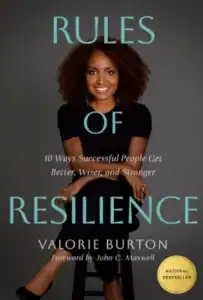
John: Right. And Valorie Burton is our guest. Uh, she’s a bestselling author, international speaker, uh, a life strategist. And, uh, she’s delightful. We’re gonna be talking about one of her books called Rules of Resilience: 10 Ways Successful People Get Better, Wiser, and Stronger.
Jim: Valorie, welcome to Focus on the Family.
Valorie: Thank you. It is so good to be here.
Jim: It’s good to have you here. Thanks for making the trek and the journey. So with resilience, you know, you can walk away with a lot of, you know, slightly different perspectives about-
Valorie: Yeah.
Jim: … what resilience means.
Valorie: Yeah.
Jim: So what is the definition of resilience?
Valorie: So most of us, when we think of resilience, we think about bouncing back from setbacks. Um, I think of it as being able to thrive and grow and be effective in the face of adversity and challenges and change. But the difference in how I define it in this book is that it is a personal system you create that enables you to withstand stressors and, uh, and challenges. And so whether you realize you’ve created a system or not, you have.
Jim: Yeah.
Valorie: And so what I wanted to do was be able to tell people, “Okay, what, what are the three pillars that make up this system?” So you can look at it and say, “Ooh, I’m good there, but here’s where I have room for improvement.”
Jim: Yeah. You did a degree in psychology.
Valorie: Mm-hmm.
Jim: So often in the Christian community, we’re, yeah, we kind of bounce from what we’ll say is, is psychobabble because we wanna be rooted in the Word. But man, when you get into it, and of course Dr. Dobson was PhD in child development-
Valorie: Yeah.
Jim: … from the USC School of Medicine. And he saw this route where you could incorporate good science, honest truth telling science with biblical truth. And the two will not conflict. They usually run-
Valorie: They do not.
Jim: … together because of the architect of the universe-
John: Mm.
Jim: … God. He put it together. He created our brain. He knows how we tick. He created how we tick. And so when you study psychology, especially as a Christian, these things tend to get reinforced. You’re going, “Oh, wow. There’s a scripture that talks about that.” In that context, to give that big disclaimer for you-
Valorie: Yeah.
Jim: … how many ways can human beings fool themselves about resiliency? And what I mean by that is a person who’s trying to just code it with maybe a spiritual, um, you know, icing and just to put the good foot forward-
Valorie: Mm-hmm.
Jim: … but deep down inside, uh, it’s not there.
Valorie: Yeah.
Jim: And they’re faking it for whatever reason, to show an outward resiliency that isn’t there. Speak to that need for understanding what it means to have deep resiliency, not the flippant comment when at church on Sunday, “How you doing?” “I’m good. I’m good. Yeah, I’m good.” And you’re not.
Valorie: Yeah.
Jim: How do you manage that? And how do you become more honest, first, with yourself and then with people who say, “Man, I heard you lost your, your mom or your dad or your spouse or I heard about the affair your…” What is a healthy way to respond with that?
Valorie: Yeah. So I think it’s really important that we understand that a hallmark of resilience is authenticity. Real resilience does require us to be honest about our fears, about what’s not working.
John: Mm.
Valorie: And a lot of times if we don’t know the answer to how to fix it, we can pretend it doesn’t exist. One of the rules, one of my favorite rules of resilience here is don’t pretend, don’t defend.
Jim: Ah.
Valorie: What that means is don’t pretend things are okay that are not. And we can conquer what we’re willing to confront, but if we won’t even say, “Hey, our marriage is struggling right now.” Or, “I really don’t like this career (laughs) that I’m in. I don’t know how to get out of it, but-”
Jim: Yeah.
Valorie: “… like, could I do something different?”
John: Mm.
Valorie: Or, “I’m stressed and overwhelmed.”
Jim: Yeah.
Valorie: “And maybe as a mom, I feel like I shouldn’t be, and I feel all the pressure of what everybody says I should be able to do, and I should just be happy about things all the time.” If you’re able to say something’s not right, then you could admit what you need to work on. The don’t defend part is… So, so not pretending is about yourself, right-
Jim: Mm-hmm.
Valorie: … about pretending stuff’s okay that isn’t. The don’t defend is when someone notices there’s a problem or they state the obvious and you want them to pretend, right? (laughs) So you-
Jim: Pretend with me.
Valorie: Yeah, pretend with me-
Jim: (laughs)
Valorie: … and then you get defensive about what they’re saying.
Jim: Wow.
Valorie: So, you know, real resilience requires authenticity, which takes courage, but we know that God hasn’t given us a spirit of fear.
Jim: Mm-hmm.
Valorie: That we are to be strong and courageous. He wouldn’t command us to be courageous unless He knew we were gonna feel fear.
Jim: Yeah.
Valorie: And it requires humility. The humility to say, “I, gosh, I’m scared.” Or, “I don’t know the answers- (laughs)”
John: Mm.
Valorie: “… right now.” That feels very vulnerable.
Jim: Yeah.
Valorie: And I think in many ways it requires us to be able, in, in certain situations, especially in relationships, to have empathy.
Jim: Mm-hmm.
Valorie: To say, “I might not feel this way, but if I was walking in this person’s shoes with the life they’ve lived, with the challenges they’re going, I might, I don’t know what I would do.”
Jim: Yeah.
Valorie: And that takes humility too, but it opens the doorway to conversations that can actually help you grow.
Jim: Boy, so true.
Valorie: Yeah.
Jim: One of the things I’ve often noticed in that kind of application, we often say, you know, “I, I wanna talk or walk with people that have a limp.” Another way of saying that is people that are only on the mountaintop don’t go very deep. And people from a valley where they’ve had the hard knocks of life and have turned to God for help are usually the people that have great wisdom, that know what they’re talking about, that know about life and those kinds of things. Speak to that aspect of differentiation between a life of ease and then a life of difficulty. And what are the benefits of both?
Valorie: Well, first of all, we can’t measure resilience unless there’s been a challenge, right? So if someone says, “Oh, I’m resilient,” the first thing you think is, “And what have you been through?” (laughs)
Jim: Right.
Valorie: Right?
Jim: “I didn’t get my lunch money one day.”
Valorie: Yeah. Yeah.
Jim: (laughs)
Valorie: Yeah. So we grow through our challenges when we’re resilient. We don’t just go through them. And we have to recognize that there is that opportunity. One of the rules is find the opportunity in the challenge. There is an opportunity to grow your resilience when you’re going through things.
Jim: Mm. Your father, uh, who it sounds like you guys have had a great relationship-
Valorie: Yeah.
Jim: … which is so awesome.
Valorie: Yeah.
Jim: I always love to hear that. And, uh, but he went through some difficulty with a congenital heart issue.
Valorie: Yeah.
Jim: But you were able to, I’m sure, talk with him and, and he kind of maybe directly or just indirectly developed a system to deal with his difficulty.
Valorie: (laughs)
Jim: Speak to that.
Valorie: Yeah. So, um, my dad, in his mid-50s, going for a routine physical, and the doctor is like, “Your heartbeat is a little, um, abnormal.” Which he had heard before. My dad retired from the Air Force after 24 years. He played sports in high school. They did an angiogram and, uh, the doctor, when they came out, he said, “I’ve got good news and bad news.” He said, “Good news is your arteries are in perfect condition, like no blockages, nothing.”
Jim: That’s good.
Valorie: “So the bad news is one of them’s going to the wrong place.”
John: Oh.
Valorie: He said, “This is a, a birth defect that normally would kill you at six months old, but definitely by the age of 10. We’ve never seen anyone get to this age with this condition.” It was obviously a shocker. He did have the open-heart surgery. But when we were curious about why, like, I wonder why didn’t he have other issues. They said, “Well, you know, he could have had a heart attack in his 20s or his 30s. They would have just said it was a fluke.”
Jim: Yeah.
Valorie: They would never have known that there was this birth defect. They said, “But, you know, you’ve, you’ve never smoked. You’ve always been pretty healthy physically, and we think these were basically preventive choices that you made-”
John: Mm.
Valorie: “… that actually compensated and helped keep you alive all this time.” So the, the idea there, as I said we have, our adaptive skills, the internal resources, the protective resources, the external, but then there’s the preventive choices. What could you do today? And this is my favorite coaching question around this. If you were looking back 5 or 10 years from now, in any area of your life, your relationships, your finances, your health, what would you wish you had done? And so that’s what happened with my dad. It was like, because he had made some other good choices, not knowing there was a problem-
Jim: Right.
Valorie: … he was kind of cushioning himself from a, a problem that he didn’t even know could have taken his life.
John: Mm-hmm.
Jim: Yeah. So in these 10 rules of resilience, number one, let’s hit number one. We’re not gonna cover them all-
Valorie: Yeah.
Jim: … but hopefully people get a taste of it. So what’s number one?
Valorie: It’s expect the unexpected.
John: Mm.
Jim: Okay, that’s good.
Valorie: Expect the unexpected, and you gotta be ready to handle it.
Jim: That’s your dad right there.
Valorie: Yes. Expect the under- unexpected, be ready to handle it. And that means, you know, we can have our best laid plans. (laughs) We all know that we typically don’t go to, from A to Z in a straight line.
Jim: Yeah.
Valorie: There’s a setback. Things don’t go as planned. And if you prepare for that, if you expect that, that when it doesn’t go as planned, it doesn’t take as long for you to recover and find your plan B.
Jim: Mm-hmm.
John: Mm-hmm.
Valorie: It’s, “Oh, yeah. (laughs) I, I didn’t know what was going to be a setback, but I could pretty much guess that there was going to be one, and that’s the unexpected.”
Jim: Th- the most obvious question with that one is for that person that struggles when the setback comes, it’s so deep.
Valorie: Yeah.
Jim: And even as a spouse, you might, as the spouse, go, “Wow, that’s a molehill.”
Valorie: Yeah.
Jim: “Not a mountain.”
Valorie: Mm-hmm.
Jim: Um, h- how does that person find deeper resiliency when that is the typical reaction from you? You know what I mean?
Valorie: So when you’re the person that is feeling overwhelmed by the challenge, but maybe you have a spouse that minimizes it?
Jim: Well, yeah, or not, that’s an aspect of it, but that you’re, you’re low resiliency, if I could say it that way, that you’re, you’re always making a mountain out of a molehill.
Valorie: Yeah. Yeah.
Jim: It’s not a big deal. We can get through this.
Valorie: So if you expect the unexpected, then when these things happen, if in advance you’ve said the unexpected is gonna happen. I can’t predict what it was. Some things you can predict. I’ll give you an example. We bought a house a little over eight years ago. It wasn’t just a house; it was a property.
Jim: (laughs)
Valorie: We had been living in a normal house with, you know, in a cul-de-sac.
Jim: I can tell you really like this place. (laughs)
Valorie: It’s wonderful. It is absolutely-
Jim: It’s a project. I can hear.
Valorie: It’s a project.
Jim: It’s a project.
Valorie: So because it’s a project, okay, and my husband, Jeff, and I, I’d say we’re both visionaries, that means-
Jim: (laughs)
Valorie: … we’re very optimistic. (laughs) Right?
Jim: Right. Exactly.
Valorie: So when we bought it, Jeff was still flying commercially.
Jim: Money pit. (laughs)
Valorie: Like, I mean, it’s like, “Okay, you’re gone two weeks a month. We got acreage. We got all this stuff.” And the house was, you know, 40 years old, so we were renovating. There was always something going wrong. And so after a while, after about a year and a half, it’s like, “Maybe we should move.” (laughs)
Jim: (laughs)
Valorie: And this happened like once a year until I was writing this book. And I realized I keep… My husband, he’s, he’s like, “Yeah, okay.” He’s very laid back. I am like, “I’m tired of these things.” And then I said, “But if I expect the unexpected, if I expect that, yes, there’s gonna be some fences that need mending or, you know, maybe we’re gonna have to replace something in the house and that’s just… Every year there’s gonna be something and it’s gonna be something big. So let’s have the expect the unexpected fund.” Right? It, it’s no surprise, right? It happens all the time.
Jim: Yeah. Septic tank. (laughs)
Valorie: Septic. We’ve replaced the septic tank.
Jim: (laughs) I, I knew that would be on your list.
Valorie: We’ve replaced multiple HVAC units.
Jim: (laughs)
Valorie: We’ve had all kinds of things happen. And now, when it happens, rather than … Uh, I might at first go, “Ugh,” but then I go, “Oh, this is part of the unexpected.”
Jim: Yeah.
Valorie: And this place has been such a blessing, and it’s realized some dreams both of us had, and we’ve been able to host family reunions. And it’s lovely. It’s wonderful.
Jim: Mm.
Valorie: It’s a blessing, but it’s not a cakewalk.
Jim: (laughs)
Valorie: There are things that happen we don’t expect. And it’s completely lowered my stress level, and I’m not talking about moving.
Jim: Yeah, that’s good.
Valorie: Yeah.
Jim: That’s good.
John: Well, Valorie Burton is our guest today on Focus on the Family with Jim Daly. And, uh, we’re so enjoying the conversation. Her book is called Rules of Resilience: 10 Ways Successful People Get Better, Wiser, and Stronger. And, uh, we’ll encourage you to stop by our website to get a copy of the book at focusonthefamily.com/broadcast.
Jim: Valorie, let’s move to vision. This one can get, (laughs) pardon the pun, a little blurry.
Valorie: (laughs)
Jim: I didn’t think of that until I just said it.
John: Mm-hmm.
Jim: But, but vision for people, like, what should my vision be? We talk about mission statement-
Valorie: Yeah.
Jim: … vision statement. So in the context of resiliency, what, what does it mean to have vision for something?
Valorie: Your vision is a tool. So if your vision is clear, and I would say from a, the standpoint as a believer, you’re asking God, “What’s your vision for me? Where am I headed? What does that endpoint look like?” And it should pull you forward. So the rule is focus on the vision, not the obstacle. Gives you that perspective.
Jim: It might be too personal and just tell me and we can move on. But what, what are elements of that that were important to you? What, again, I’m, I’m sorry. I just need the practical tools.
Valorie: Yeah. Yeah.
Jim: A vision statement for my marriage. You could tell how Jean might get frustrated here, like, “What are you talking about, Jean?” What, what do those elements look like? What… You know, “I wanna be happy. I wanna be joyful. I wanna love you. I wanna be committed to you.”
Valorie: Yeah.
Jim: Yeah.
Valorie: Can I read part of my vision statement from the book?
Jim: Of course.
Valorie: Part of my vision manifesto. So it’s unique to you, but what you wanna be doing is writing in the present tense what vision looks like, uh, for you. What ideally you wanna be doing in your everyday life. And when you read in the present tense, it does something to your brain because you’re saying, “This isn’t what I’m going to do.”
Jim: It’s what I am.
Valorie: It’s what I am. And so I, I’ve even, like, actually recorded myself reading my vision manifesto.
Jim: Yeah.
Valorie: And I listen while I’m on the elliptical or (laughs) taking a walk.
Jim: Good for you.
Valorie: And sometimes what it does is I might be dealing with a challenge in that moment. When I read this, it reminds me of who I wanna be. So I’ll read mine for my relationships. I am kind, I am gentle. I am loved and I am loving. I’m supported. People’s lives are better when they cross paths with me. I allow others to be responsible for their choices and me only for mine. My approach to relationships is healthy, peaceful, and reciprocal. My marriage is joyful, unified, and romantic.
Jim: And the question is, what is the balance for Christians between pursuing their vision and accepting God’s will for their life?
Valorie: So I think be content in all things is not the same as be happy about it.
Jim: That’s right.
Valorie: Right? (laughs) So I think of Jesus’ word specifically in this world, you will have tribulation. Cheer up. (laughs)
Jim: (laughs) Grow up.
Valorie: “I’ve overcome the world.”
Jim: Cheer up.
John: Yeah.
Valorie: Cheer up. What do you mean cheer up in tribulation? So there is a, um, an acceptance of the things you don’t control. So this goes back to another rule. Might be my favorite rule. Control the controllable, accept the rest.
John: Mm.
Jim: Yeah. That’s true.
Valorie: Control the controllable. So we know, this is a psychological, uh, concept of internal locus of control. The people who are most resilient and most successful have an internal locus of control. When they’re dealing with challenges, they ask, “What do I have control over?” “I do have control over my attitude. Uh, I do c- have control over my prayer life. Uh, I have control over certain things that I can do or choose not to do.” And they let go of the things they don’t control. Whether this is, you know, you dealing with a, a boss or an organization where things are shifting, this could be the things going on in the world. You don’t have control (laughs) over-
Jim: Yeah.
Valorie: … what other people do.
John: Mm.
Valorie: That doesn’t mean, accept the rest doesn’t mean that I approve of the rest. It means I look at it and I realize I’m not in control of everything.
John: Mm-hmm.
Valorie: So I’ve got to learn how to operate within it. I’ve got to learn to say, “Lord, if I don’t know how to be content, can you show me?”
Jim: Right.
Valorie: I think that’s the most powerful thing because we don’t have to know how to do it in order to eventually grow into being able to. And I think that’s a really, a really important concept. It’s something I’ve certainly learned because some things we can’t do on our own.
Jim: You know, uh, and it’s so true. And one of those other common things that we say is, “Oof, that person really has low self-awareness.” You don’t wanna be that person people are saying that about. I’ll give you an example. And it, you know, again, I mean this for constructive purpose, but I remember in my late 20s, Jean and I were already married and I had a good friend who, um, was lamenting that he had, he, he didn’t have a girlfriend and how badly he wanted to be married. But I’ve given it over to the Lord and I knew he hadn’t.
Valorie: (laughs)
Jim: You could just hear it in everything he was saying. It was, you know, and he was aiming quite high for the type of girlfriend he would like. First of all, beautiful, you know, and then all the other attributes. And I, you know, I was trying to be a good friend, and I just said to this person, I said his name and I said, “It doesn’t sound like to me you’ve given it over.”
Valorie: Mm.
Jim: And it really, I could tell it was an arrow, but i- it’s, it was that lack of self-awareness I was sensing. Like, “Bro, come on, you’re saying you’ve given it up and given it to the Lord, but you haven’t.”
Valorie: Yeah. Yep.
Jim: And that’s just an application of how, you know, real world circumstances work. You could probably share examples of that but speak to that awareness issue inside your heart and inside your relationship with Christ. And then with those right around you, the need to be aware of what you say and what you do need to line up.
Valorie: Yeah. So, um, having what I call it thought awareness.
Jim: Mm-hmm.
Valorie: Being aware of what you’re saying to yourself about your circumstances but also being aware of where you may have an opportunity to, to grow. I call these growth gaps. So take your friend, for example, wanting to get married. I, in, in the book, I would describe that as a performance goal. That’s something very measurable.
Jim: Right.
Valorie: You have the girlfriend or not have the girlfriend.
Jim: Right.
Valorie: Right? Um, but every goal that we have that’s a performance goal, that’s measurable, we need a growth goal to go with it because there’s a reason we haven’t reached the goal already. So how will you need to grow in order to get to where you want to go? You may need to grow in your faith. You may need to grow in your trust of God.
Jim: Yeah.
Valorie: You may need to grow in your communication. You don’t communicate well and you’re throwing people off. (laughs) So understanding what’s the growth goal that goes with this performance goal.
Jim: And Valorie, let me ask this question. This might be the most important question I’ve asked during our entire time. I first have an image and then the question. The image is being on a riverbank, wanting to be on the other side, but there’s no bridge, there’s no way to get there. And that person, you’re asking the right questions, you’re saying the right things. That is the building of the bridge to that other side.
Valorie: Yes.
Jim: But they’re standing there perilously incapable of asking themselves those questions. How do you go from that paralyzed moment of, I’ve got, something might… The problem might be me.
Valorie: Yes. This was my question is I was at that bridge, right, at 36, divorced with no kids. And knowing that was still my dream, it was very scary to hope for it.
Jim: Wow. There’s a lot of women and men in that spot.
Valorie: So you can have something you want, and you won’t admit it because you’re so afraid you’re gonna be disappointed.
Jim: Yeah.
Valorie: “Am I kidding myself? Should I keep hoping for this?” But you know the definition of faith? In Hebrews 11:1, “Faith is the substance of things hoped for, and the evidence of things not seen.”
Jim: Yeah.
Valorie: The very definition of faith is that you have to be hoping and sometimes hoping is the scariest thing you can do-
John: Mm.
Valorie: … because you’re so afraid you won’t get it. And when you choose to hope, my, my thought was not only that I would walk through that fire that was so hard and it would not consume me, but I decided I will be better and not bitter. And that became a coaching question.
Jim: Wow.
Valorie: How could I be better?
John: Mm-hmm.
Jim: Mm-hmm.
Valorie: That’s where my hope went. So from a practical standpoint, I started looking for people that were better on the other side of a divorce. And I was like, “Is that possible? Well, if it’s possible, that’s what I want because I sure don’t wanna be worse. And I definitely don’t wanna be bitter. And I definitely don’t wanna close my heart to love and to what God’s put in my heart.” So that became my learning.
Jim: Mm.
Valorie: And so I think opening yourself to hearing others’ stories of resilience and what can I learn from that-
Jim: Yeah.
Valorie: … is a big piece of the puzzle.
Jim: You know, when you look at Scripture, there’s so many stories of the apathetic human being.
Valorie: Mm.
Jim: Believer, nonbeliever. I mean, the, the biblical stories are full of people that just rest in their bad place. They don’t become motivated to go to a better place with the Lord. Why are we wired like that? Or why, why are we defaulting to that? It is irrational to stay in a bad place.
Valorie: It can feel easier.
Jim: Is that it?
Valorie: Yeah.
Jim: It’s just more comfortable?
Valorie: Hope requires discomfort.
Jim: Hm.
Valorie: (laughs) Requires you to get out of your comfort zone. And so it can be easier to stop hoping to say, “I thought God said I could have marriage. I, I thought He could heal in this area. I thought we could get out of debt and maybe eventually be in a better place financially, but I don’t see it happening yet. And why do I keep putting forth the effort?”
Jim: Yeah.
Valorie: When you stop hoping, you start settling.
Jim: Yeah.
Valorie: And so I think that’s what happens in the settling. You’re not happy about settling.
Jim: Yeah.
Valorie: But it’s more comfortable.
Jim: You know what’s interesting? You look at, uh, prison or during war, you look at prisoners of war. One of the things psychologically, enemy combatants do is to try to take hope away, to put you into despair. I mean, it’s a real recognition spiritually of what the enemy is trying to do to steal, kill, and destroy.
Valorie: Yes.
Jim: He’s trying to remove any sense of hope because hope is a characteristic of God.
Valorie: Yes.
Jim: And you remove that from the human spirit, we become just not healthy.
Valorie: And hope is also a requirement of resilience.
Jim: Mm.
Valorie: It’s that little, that, that little light that says it could get better or I could find a way to weather this, right? I could find my contentment. I’m not content right now. Maybe, you know, sometimes we’re in circumstances that are not gonna change, but we have to find a way to be able to show up in that and learn how to be okay.
Jim: “Lord, what can I learn here-”
Valorie: Yeah.
Jim: “… in this moment.”
Valorie: Yeah. And, and the hope that we-
Jim: And that’s hope.
Valorie: … could somehow be okay.
Jim: Yeah.
Valorie: That’s still hope.
Jim: Yeah.
Valorie: Yeah.
Jim: That’s good. Valorie, this has been terrific. I could just keep going. It’s like sitting in the living room-
Valorie: (laughs)
Jim: … and having a life discussion here. I could see why you’re so good at coaching and corporations pull you in to help people think differently about how to get around this obstacle or … So thank you so much for your great book, Rules of Resilience: 10 Ways Successful People Get Better, Wiser, and Stronger. It includes many more insights that we didn’t cover today.
We have copies for you here at Focus on the Family. When you make a gift of any amount, we’ll send you a copy as our way of saying thank you for supporting the ministry and helping other families. We are a nonprofit ministry, so your donations go straight into ministry to help people like Anne. She is a stay-at-home mom of three teenagers. She wrote in and told us this. “I listen almost daily to your broadcast. The variety of your shows provides guidance and encouragement to me as a mom and wife, but also as a Christian. God is really working through this ministry.”
So partner with us and be part of what God is doing. He sees it. He sees you give that gift and then it accrues to your account in heaven. Let’s go save people. That’s a great thing to do.
John: Mm.
Jim: And if today’s program impacted you because you’re struggling with some heavy challenges, we have caring Christian counselors here for you. It’s absolutely free to get that initial consultation and they’ll give you some next steps to grow and find healing.
John: Yeah, you can set up a counseling consultation or donate and get your copy of the book when you call 800, the letter A, and the word FAMILY, or look for details at focusonthefamily.com/broadcast.
And thanks for listening to Focus on the Family with Jim Daly. I’m John Fuller, inviting you back next time as we once again help you and your family thrive in Christ.