




J.D. Greear: A quiet life is a setup for a loud testimony. It’s a way of living in a way that serves your neighbor, blesses them, makes their lives better in a way that they say, “Hey, I need to know what’s motivating you. I need to know the hope that you have,” and that sets up an opportunity for a loud testimony.
John Fuller: That’s Pastor J.D. Greear, and he’s our guest today on Focus on the Family with Jim Daly, uh, talking about how you can make an impact on the culture around you for Christ. Thanks for joining us. I’m John Fuller.
Jim Daly: You know, John, as a reminder, Focus is here for you. I mean, we’ve got marriage and parenting content. We have so many things to help you, assessments, and even marriage intensives.
John: Mm.
Jim: Actual counseling at four locations. But also, how to live in this culture is a key theme for us here at Focus on the Family. And, uh, I think some of us do that maybe well and some of us do that not so well.
And so today we’re gonna talk with our guest about how to engage a culture, really, with one purpose: to introduce people to Christ, which is the glorious goal.
John: Mm-hmm.
Jim: And I’m looking forward to it. This is an area for me that I get energized about, right?
John: You do, yeah.
Jim: Yeah. And it’s, uh, I think it’s just great to think about, “How do we reach people for Christ” because that is the goal.
John: Mm-hmm. Yeah. So truth and love, those are things that we, uh, need to really embrace as we engage with those around us.
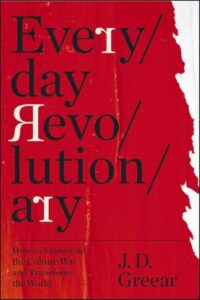
Pastor J.D. Greear, uh, is pastor at the Summit Church and he’s written a book that addresses, uh, how we can do this more effectively. It’s called Everyday Revolutionary: How to Transcend the Culture War and Transform the World.
Jim: J.D., welcome to Focus on the Family.
J.D: Thank you so much, Jim, for having me. I was telling, uh, John earlier that it’s an honor for me because I grew up being discipled in the backseat of my parents’ car listening to Focus on the Family.
Jim: (laughs).
J.D: My parents, they just always had it on and we drove around Winston-Salem, North Carolina being…
Jim: That had to be extremely boring for a young boy, (laughs).
John: (laughs).
J.D: Well, maybe it should have been, but I was fascinated.
Jim: Well, that’s good.
J.D: Yeah. Yeah.
Jim: Did you hook into Odyssey? Adventures in Odyssey?
J.D: Of course. That’s right. Yeah.
Jim: Yeah. Uh, J.D., let me open with this. I was just at a conference here at The Broadmoor, speaking at this conference. Young people, it’s all 30-something, 40-something young professionals, mostly Ivy League grads, not all Christians, but many Christians.
And one of the themes they were talking about in one of the sessions they did was, “This isn’t a culture war. This is spiritual warfare.”
J.D: Mm-hmm.
Jim: I thought, “Wow, what an interesting way to rephrase that.” ‘Cause “culture war” kind of sets us up one human being against another human being.
J.D: Right.
Jim: “Spiritual warfare” is about God and His kingdom versus Satan and his tribe.
J.D: Yeah.
Jim: Speak to that.
J.D: Yeah. I mean, so terms end up, you know, having a life of their own. And a lot of times when you think culture war, people think yard signs and Facebook posts and angry-
Jim: And Republican and Democrat?
J.D: Right, right. Angry diatribes, that sort of thing. And… But I mean, sometimes what we… When people say culture war what they mean is they mean clarity about truth in the public square.
Jim: Right.
J.D: And that’s something Christians are very supportive of. One of the things that I try to present in Everyday Revolutionary is that faithfulness to Jesus and our generation is not less than clarity about controversial issues, it’s just a lot more. And I really try to build it off of the example of Daniel in the Old Testament.
Jim: Yeah.
J.D: Daniel is so courageous and bold in his truth declarations that he gets thrown in the lion’s den because of it.
Jim: Mm.
J.D: And yet he is so beloved by the king, King Darius, whose wicked decree put him there, that that king stays outside the lion’s den all night long weeping, hoping against hope that Daniel will make it through the night. You know, and I don’t think he was doing that just because he missed Daniel’s prophetic diatribes. I think he was doing that because he knew Daniel was genuinely his friend. He loved him.
Jim: Hmm.
J.D: Uh, he couldn’t imagine Babylon without Daniel. And so my question is, “How do we as believers, how do we become like that in our society?” I always tell the church that I pastor, I say, you know, “Our goal is we want, (laughs), we want our community to say, ‘We may not believe what those crazy people over at Summit Church believe, but thank God they’re here because if not, we’d have to raise our taxes.'”
Jim: You know, I’ll attribute this. I haven’t publicly, but Dr. Al Mohler, we were at a board meeting and we’re talking about a situation, and he made such a great comment. He called me later that night and he just said, “You know, Christians should never go out of their way to be hated.”
J.D: (laughs).
Jim: “That’s not the badge you’re looking for.”
J.D: Right. Yeah.
Jim: Right? “And don’t let-”
J.D: But the Gospel’s offensive enough without you also being that.
Jim: Well, that was the point. That’s exactly it. He said, “Let the Gospel be the offense, not your personality.”
J.D: Yeah.
Jim: And that’s a great instruction, I think, for us.
J.D: Mm-hmm.
Jim: Uh, what are the three relationship types, uh, that you write about in the book? I think it’s around “tourist, immigrant, and exile.”
J.D: Yeah.
Jim: You know, first, give us the quick definition and then what does it say about us spiritually in those three phases?
J.D: Yeah. So, um, Daniel was in exile in Babylon and Peter and Paul in the New Testament pick up on that language and say, “That’s what we’re supposed to be in our Babylon’s,” which is, you know, a metaphor for wherever you live right now.
Jim: Mm-hmm.
J.D: Um, okay, so if you think about the three possible options that you can be if you’re not from a place, uh, you can be a tourist. A tourist is somebody who, you know, they never put roots down. They hardly unpack their bag.
Jim: They’re there for the weekend, (laughs).
J.D: They’re there for the weekend. If there’s a problem in the community, that’s not your problem, you’re there to see the sites. Um, a lot of Christians are like that when it comes to the world. They’re just passing through. They’re, you know, holding hands singing kumbaya, waiting for the Rapture. Uh, you know, they never really think of this world as something that their problems, it’s… Is our problems.
Jim: So you’re really saying they’re non-engagement?
J.D: They’re non-engagement.
Jim: They’re not engaged.
J.D: And, and they’re just so separate. They’re so separated. And that actually is… You know, Jeremiah, the prophet who lived at the time of Daniel said, “Don’t do that. I put you into Babylon so that you could seek the prosperity of the city,” Jeremiah 29:7, “and pray for its prosperity.”
Jim: Mm, mm.
J.D: “Make its problems your problems.” So that’s tourist. Well, the other one is immigrant. That’s when you’re not from a place but you really want to make it your home. You want to switch your citizenship there. And a lot of Christians, you know, we have that problem because we’re like, “Well, this world really is my home. I wanna pile up all my treasure here and I wanna… I become more of a citizen of, of the United States than I do the Kingdom of Heaven and I reflect its values even more than heaven’s values.”
Um, the right posture is not tourist or immigrant, it’s an exile. An exile is there. You plan to live there, you plan to care about the place and get integrated into it and take on its problems as your own, but the whole time you are reminded that “This is not really my home. My home ultimately is in a different kingdom.” And we as believers are, we are citizens of heaven that are living in exile right now –
Jim: Yeah.
J.D: … in the kingdom of man.
Jim: And it’s such a beautiful thing.
J.D: Yeah.
Jim: I mean, you don’t… There’s not perhaps an avalanche of that testimony, but I’ve had that experience in the gay community with people that I know there where they’ve moved closer to Christ, and yet that’s the goal.
J.D: Right.
Jim: You know, to help them. Here’s the thing though, and this is maybe for listeners and viewers: I think when we’re in a good place that pride in us can rise up and it makes us something of a Pharisee or a Sadducee that we begin to look down on the sinner.
That’s a really dangerous place to be with the Lord. How do we keep that perspective that we say it, we’re all sinners saved by grace?
J.D: Right.
Jim: “But have you seen those sinners?”
J.D: (laughs).
Jim: Right? We kind of have that-
J.D: Yeah.
Jim: … attitude like “We’re bad, but we’re not as bad as them.”
J.D: Right.
Jim: Who does that sound like?
J.D: Right, yeah. Our world-
Jim: It’s right out of the New Testament.
J.D: Our world says that when it comes to something, since we’re talking about homosexuality, I’ll use that one. There’s really only two options. You’ve got alienation or affirmation.
Jim: Great.
J.D: And what Jesus presented was a completely different option. Again, He was clear on truth. I don’t think He ever pulled punches on that way, but what people sensed when they were around Him is they sensed Him drawing them close. They sense a love. When John describes Jesus, he puts grace before truth because Jesus led with grace. It’s what people, what people remembered about Him.
Jim, one of the things, you know, as a part of a very conservative church I want to point out to our people is that, um, Jesus’ Crucifixion was a joint project between the so-called secular left and the religious right. I’m not saying they’re morally equal or morally equivalent. I’m not saying they’re equally bad. I’m just saying when it came down to it, it was both sides that hated Him.
Jim: That’s… I never thought of it quite like that. That’s interesting.
J.D: Yeah, the left hated Him for what He said about truth.
Jim: Yeah.
J.D: The right hated Him for how He brought sinners close. And what I believe is that if you and I are representing Jesus, we’ll probably take flak from both sides.
Jim: Yes, (laughs). I have experienced that.
J.D: (laughs). I’m sure, I’m sure you have.
Jim: But it’s so true.
John: Mm. This is Focus on the Family with Jim Daly, and our guest today is Pastor J.D. Greear and, uh, we’re talking about some of the content in his terrific book, Everyday Revolutionary: How to Transcend the Culture War and Transform the World. And you can get your copy of that book at our website, that’s focusonthefamily.com/broadcast.
Jim: I don’t want to lose this so I… Let me dig a little deeper, J.D., before we move to another topic. But the difference between leading with the Gospel or leading with political messaging, it… This is one of the great grapples that I have at Focus on the Family because so much of what conservatives do, um, in the Republican Party, just to be blunt.
J.D: Mm, mm.
Jim: Pro-life, pro-marriage, pro-family. So we find a natural home there politically because-
J.D: Right.
Jim: … that’s what they’re standing up for.
J.D: Yeah.
Jim: And, you know, I talk with the Democrats and I’ll say, “If you were more pro-life, more pro-family, more pro-marriage in the context of the Bible, marriage between a man and woman, you’d have a lot more people in your party.”
J.D: (laughs). Right.
Jim: But, you know, so it… I’m always, I think, a little offended that we get labeled that we’re only political. It’s where the values are lining up. I really don’t care if it was an R or a D.
J.D: Right.
Jim: But I will discern where do they line up.
J.D: Right.
Jim: So am I saying that correctly and then when I get hit with the political thing-
J.D: (laughs).
Jim: … just shrug it off or how do you process that?
J.D: Yeah, I think so, Jim. Um, because, you know, there are certain issues that when you talk about them, um, you’re going to sound partisan, even if you don’t mean to.
Jim: Right.
J.D: When we’re talking about the sanctity of life, when we’re talking about sanity on gender and marriage and religious freedom. Yes, you sound partisan. But I’m like, “I’m not trying to sound partisan. I’m just sounding biblical.” And we’ve just got to be okay with that.
What I think we can do though, even with that, is we can be wise and, and prudential about how we leverage labels and how we… What we even lead with. If I could tell you a quick story?
Jim: Yeah, I like this. This is great.
J.D: Okay. So there was a, uh… I got a letter one day at our church from a young lady that I’d never met before. I didn’t know I’d met her, I had never met her before, but she, um… There was a picture of her at our church being baptized. And she said, “I want to tell you a story, um, about how I came to the church.”
She said, “I was invited by some friends of mine, um, who… And I started to come.” She said, “I very quickly discerned that you made me quite angry.” She said, just when, when I talked about the sanctity of life and some of these hot button issues. She said… “And one day,” she said, “You said something about, uh, you know, in support of a pro-life position on,” it was called Twitter then.
Jim: Yeah.
J.D: And, uh, she said, “I sniped back at you.” Now, Jim, I never respond on Twitter-
Jim: Sure, right.
J.D: To, to-
Jim: I don’t even read it.
J.D: Right. I don’t know what came over me, but I did. For whatever reason, I responded and I said something back to her and she said something back to me, and we went back four or five times and I forgot about it. I remember her handle for Twitter, was something like “Left Linda” or something like that.
Jim: (laughs).
John: (laughs).
J.D: Just something that clearly identified-
Jim: At least she’s honest, yeah.
J.D: At least she was honest. She said, um… Then she told me, she said, uh, she said, “I was ‘Left Linda,’ who did that with you on Twitter.” She said, “I kept coming to the church.” Again, she heard the Gospel, she got saved, and she said, “Now I’m in the process of rethinking everything.”
Jim: Wow.
J.D: Everything. But what she said next is what… The reason I’m telling the story is she said, “I wanna thank you though, that even though you were clear about controversial truths, I wanna thank you that you didn’t make this the ‘Republican church'”
Jim: Mm.
J.D: “Because if you had made it the ‘Republican church,'” she said, “I never could’ve stepped foot inside it.” You know, political realignment often happens when somebody comes to Christ, but political realignment is downstream. It’s the result of discipleship.
Jim: Right.
J.D: It should not be the gateway to it.
Jim: And it’s very difficult to, you know, use politics to convert somebody, (laughs).
J.D: (laughs).
Jim: I mean, because your angst goes up.
J.D: Yeah.
Jim: You’re there to defend your position.
J.D: Right.
Jim: No matter who you are, the Democrat or the Republican and that… I don’t really see that model expressed in Jesus’ parables.
J.D: No, quite the opposite.
Jim: And He’s talking to people where they’re at.
J.D: Right.
Jim: And then asking questions.
J.D: Yeah. In fact, there’s a story, I talk about this a lot in the book, um, Luke chapter 12, where a brother comes to Jesus to complain that his brother is cheating him out of the inheritance.
Jim: Right.
J.D: Uh, the great preacher D. Martyn Lloyd-Jones said, “This is a legitimate social justice complaint because this brother is being cheated out of it.” Jesus’ response is to say to him, “Man, who made me a judge over you?” And then He proceeds to preach a sermon on greed that would’ve applied to both brothers. D. Martyn Lloyd-Jones said, “Why did He do that?”
Jim: Uh-huh.
J.D: Was it that He just didn’t… You know, does Jesus not care about justice?
Jim: Caught him at a bad time.
J.D: Right. Yeah.
Jim: (laughs).
J.D: He said, “No, of course Jesus cared about justice.” And of course, Jesus would have given a very good answer. He said, “But two things would have happened had Jesus weighed in on that issue.”
He said, “First of all, He would have cut off anyone who was disposed to agree with the first brother.” And he said, “Secondly, He would have had a list of people a mile long the next day trying to get them to… Trying to get Him to weigh in on their issue. And that would have taken Him away from the primary calling He had, which was to seek and save the lost.”
And what that means practically for me is that means that there are certain discussions I will step out of so that I can keep my focus on the primary discussion.
Jim: Yeah. So good.
J.D: Yeah. And that primary discussion is the Gospel and the Lordship of Christ.
Jim: Yeah.
John: Mm. As we do that, J.D., um, you made reference in the book to living a quiet life. There’s a passage in one of the epistles about doing that, being quiet in our lives.
Jim: It sounds so hard to do, (laughs).
John: I know-
Jim: I’m an extrovert.
J.D: Yeah, exactly.
Jim: Quiet life? Kidding me.
J.D: Well, for guys like us.
John: For you, and then for those who are, you know, on social media.
J.D: Yeah.
John: Or buying into all the back and forths, how do we live a quiet life representing Christ well?
Jim: Please, tell me.
J.D: Yeah, that’s right. Well, keep in mind that the guy who used that phrase, 1 Thessalonian 4:11, uh, “live quietly”, is the apostle Paul.
Jim: Mm-hmm.
J.D: Who I would also not describe as a guy who lived a sheepish life, right?
Jim: Right.
J.D: I mean, this is the guy that, what, stood in the Ephesian amphitheater and told the entire Ephesians crowd, “You’re worshiping gods that are not gods at all.” You know, how was he telling us to live quietly? And he doesn’t mean that you are muting your testimony.
John: Mm-hmm.
J.D: What he is saying is that the bedrock for your testimony is a life like Daniel’s that was so involved in blessing the community around you that they would, and now let me use the Apostle Peter’s words, “Ask a reason for the hope that is within you.”
Jim: Mm.
J.D: A quiet life is a setup for a loud testimony. It’s a way of living in a way that serves your neighbor, blesses them, makes their lives better in a way that they say, “Hey, I need to know what’s motivating you. I need to know the hope that you have,” and that sets up an opportunity for a loud testimony.
Jim: You know, J.D., I can remember before coming to Focus in 1989, I know that’s been a while.
John: It’s been a while. Back in 1900s, (laughs).
Jim: Yeah, back in the 1900s, but I worked for International Paper. And I remember going to lunch, and this will lead into the question, that’s why I’m telling this story. But, you know, I’m 27, 28, and I’d be at lunch with businesspeople and when the lunch would come, I’d say, “Hey, you guys mind if I pray over lunch?” And they’d put their cigarette out.
J.D: Yeah.
John: (laughs).
Jim: Set their martini down. It was so funny. And then I’d just say a little prayer. But it does lead into this idea that you talk about, uh, faithful work outside of the church.
J.D: Mm-hmm.
Jim: And so often, I remember somebody I consulted, a business guy when I was looking at “Should I go into work in the nonprofit world with Focus.” And he was saying, “Man, I want to discourage that because we need Christians in the public sector, in the, in the private sector to be able to be a witness. If all the Christians just go work in churches and Christian ministry, we’re not gonna have…”
So I thought about that. It really did slow the decision down. But, um, speak to the importance of waking up every day if you’re not working at a church and you’re not working at a Christian ministry, how do you go about getting amped up to go, “Okay, Lord, I’m heading in to be the plumber, the electrician, the engineer, the doctor,” take your, uh, vocation. But do we connect that directly to our faith?
J.D: Yeah. You know, Billy Graham very famously said, before he died, that the next great awakening, he believed, would not happen in the stadiums that would happen in the workplace.
Jim: Mm-hmm.
J.D: And we have ample biblical support for that because, I mean, if you just read the Book of Acts, uh, I mean, I’m sure… I know the apostles loved the local church. The local church was the center of their ministry program, and yet most of the preaching that they do is outside of the local church context, at least in Acts.
Jim: It’s where the action is.
J.D: Is where the action is, that’s right. There are 40 miracles in the Book of Acts, 39 of them happen outside of the church.
Jim: Yeah.
J.D: I always tell our people, sort of tongue in cheek, but I’m like, “That means as a pastor who works inside the church, I’ve got access to about 140th of the power of God.”
Jim: (laughs).
John: (laughs).
J.D: I, I know that’s not great hermeneutics, but you get the point.
Jim: Totally.
J.D: Is that most of what Jesus wants to do in our communities is not gonna happen from the pastor and the pulpit, it’s from people in the workplace. And the workplace gives people a chance to put the values of the kingdom of God in contrast with the values of Babylon.
Jim: Um, you know, you write in the book about the local church investing in community. That’s true of all of us. I mean, as a household as well as a community of believers through a church, what does that look like for the church to invest in community?
J.D: Yeah, I was preaching through the Book of Acts and I came to Acts 8 where it says that Philip, as a result of the ministry that he had in Samaria, um, that there was much joy in the city because of the Word that he preached and the works that he did. And so, Jim, I asked our congregation, “Do y’all feel like there’s much joy in our city as a result of our presence here?”
The next chapter, uh, Acts 9 talks about a disciple by the name of Tabitha who makes cloaks and coats for people in her community. And when she died, people gathered at her bedside and they wept because of all the good things she’d done for them.
Jim: Mm-hmm.
J.D: And I said to our congregation, “Do y’all feel like our community would weep if we were gone?”
Jim: Great question.
J.D: And we felt like the answer about those questions was no. And so I scheduled, literally, I scheduled a meeting with the mayor. And this mayor was not… I mean, he’s not on our team, Jim. I always… I kind of joke about him. He’s kind of the left… To the left of Mao Zedong is kind of how I thought of this guy.
Jim: Mm.
J.D: I said, “Mayor, we… Mr. Mayor, will you tell me the, the most needy parts of our city?” And without batting an eye, he said, “The homeless, the orphan, the prisoner, the unwed mother and the high school dropout.” I went back to our congregation and just said, “I felt like the mayor of our city has given us a blueprint for how we should bring the joy of Jesus into these areas.”
Not all the ministries that we’ve started in those areas came from my head or inside the offices of the church.
Jim: Yeah.
J.D: But now for 20 years, we’ve seen ministry after ministry after ministry develop. Um, we have numbers, uh, as an example, of foster kids, um, that are now taken care of by families at the Summit Church. I told the mayor just this past Sunday, um, I had him back at church and I said, “Hey, our goal is we are going to… We’re not going to stop this until there are more families in The Summit Church that are ready to receive foster kids and then there are foster kids in the program.”
Jim: Oh, you got my heart.
J.D: Yeah. Well, that’s… That’s just… I mean, and it may be something different for your church, but it’s a commitment to loving the city and bringing joy to it in the name of Jesus, yes.
Jim: Yeah.
J.D: But by meeting physical needs.
Jim: You know, one thing I’ve said, when you look at the number of churches, and you know, we use this analogy often about a lot of things, but there’s about 360,000 churches in the US, and there’s about 350,000 foster kids in the foster program.
J.D: Wow, wow.
Jim: That’s one kid per church.
J.D: One kid per church, wow.
Jim: And it is tough. It’s not easy. It’s not for the faint of heart to take a child in, but I would love to see that New York Times headline that says, “Christian Church Wipes Out Waiting Foster Care List.”
J.D: Amen. That’s right.
Jim: Wouldn’t… That would-
J.D: Wow.
Jim: … so inspire everybody.
J.D: Mm-hmm.
Jim: Uh, outside of the church too.
J.D: Right.
Jim: Because now you’re walking the talk and I… God bless those Christian families that are doing it and Jean and I were so, uh, you know, rewarded internally with doing it ourselves. It wasn’t easy.
J.D: Yeah.
Jim: You know, but there’s a lot of demand for really good parenting, but, uh, it was rewarding. Let me ask you this. Um, in the book, you get down to three reference points that you give Christians to be courageous witnesses for Christ. This so goes along with our Truth Rising documentary. If you haven’t seen it yet, please watch it.
J.D: Okay.
Jim: I’ll send you the link.
J.D: Yeah.
Jim: But it talks about courageous Christians that, first of all, it sets up the Western civilization, it’s, it’s heady. And then we get into examples like a de-transitioner, Chloe Cole, and Jack Phillips the baker and many others, uh, who had that Daniel moment –
J.D: Yeah.
Jim: And stood and said, “You know what? This is not right.” And how God got them through those things, it’s beautiful. But in that way, uh, those reference points, what are they?
J.D: Yeah, great question, Jim, because you’ve got, um… The first thing is that we have to participate in what some Christian theologians have called “the commons.” That’s a concept that goes all the way back to St. Augustine. And it means that we do our work in secular places and a lot of times the people who benefit from our work are not… They don’t share our convictions.
Jim: Right.
J.D: Um, you know, the homeowner or the home builder, excuse me, that builds a neighborhood and there’s an unmarried couple that buys one of his houses or there’s a gay couple that buys one of his houses, he’s not become complicit in their sin because he provided the home. That’s just participating in “the commons.” That’s one, and that’s as old as, as Christian history itself.
But then there’s a second thing, a second principle, you have to hold intention with that one, which is we have to, um… We can never fellowship with the works of darkness, which means that I can’t participate with you in your sin.
Jim: Hmm.
J.D: A good example is, um, you know, I would have a real problem… I could not be a part of a ceremony of celebration for a gay wedding. Even if the two people were my friends, you know, that I was trying to reach for Jesus, I couldn’t do that because I would be participating in and affirming something that was wrong.
Jim: That… You know, let me punch that real quick, because again, Al Mohler and I talked about that. He said, “The wedding itself is a public testimony that you support this.”
J.D: Right.
Jim: That’s what being at the wedding’s about.
J.D: Yeah.
Jim: And he said, you know, he had that situation that-
J.D: Right.
Jim: … was posed to him and he said, “I care about you. I love you. If you will allow me, I’ll come to the reception, but I can’t go to the wedding ceremony.”
J.D: I can’t, I can’t… a formal ceremony.
Jim: What a brilliant way to do that.
J.D: Right.
Jim: And it’s respectful.
J.D: Right.
Jim: Uh, but you know, he was reiterating the actual wedding is a public, a testament-
J.D: Yeah.
Jim: … of this joining of this couple.
J.D: Yeah. And what happens when the minister says, “If anybody has any reason-”
Jim: Yeah.
J.D: “… why these two should not be wed, speak now or forever hold your peace.”
Jim: Right.
J.D: If I’m in the audience, I’m gonna feel like I gotta be like, “I got a reason.” Yeah.
Jim: Yeah. Right.
J.D: And so that-
Jim: Yeah.
J.D: So… But that’s second principle is while we are participating in “the commons,” we cannot fellowship with darkness. The third one though is as we engage in those first two, um, even when we’re clear that I can’t be a part of this and I can’t affirm this, maybe it has to do with how you’re being asked to use pronouns or refer to gender. I mean, there’s a million examples we could come up with. Um, even there, I can still lead with grace.
Jim: Mm-hmm.
J.D: I wanna be filled with truth. I never want to… I never want it to be said our generation that we did not teach the whole council of God with clarity. But if we’re going to reach this generation, we’re going to be like Jesus and that we lead with grace, and that we’re characterized by grace, and that we’re not just filled with truth. We’re filled with that holy, beautiful, love that doesn’t just push people away and put Facebook posts up about them but draws them close.
Jim: Yeah, I agree. I think the spirit right now with everything going on in the culture, even, you know, the assassination of Charlie Kirk.
J.D: Mm-hmm.
Jim: There’s an opening to show that boldness.
J.D: Yeah.
Jim: And to do it well. Not do it nasty, do not… You know, don’t attack people verbally, but be bold-
J.D: Right.
Jim: … and show your convictions.
J.D: Yes.
Jim: I think the moment is now, I think God has really created that platform.
J.D: Yeah, amen to that.
Jim: And, uh, I hope those of you listening have been inspired to make an impact on the culture.
If you want to learn more about being a witness for Christ in your community, get a copy of Pastor J.D.’s book, Everyday Revolutionary. We have copies for you here at Focus on the Family, a great way to purchase that resource. Or you can make a monthly pledge of any amount, we’ll send it as our way saying thank you for joining us in ministry.
Focus on the Family does depend on monthly donations to create and offer resources, and that’s what enables us to make a difference in the culture. Transformation happens from the inside out. One family at a time. Last year alone, we had 173,000 decisions for Christ. Be a part of that in God’s economy, support the ministry and be engaged. One mom told us that our resources have been crucial in helping her navigate her relationship with her son who announced that he is transgender a few years ago after he graduated from college.
John: Mm.
Jim: She said, “You have helped me to accept this from a Gospel perspective with a biblical worldview and a gracious spirit. Your resources have been amazing.”
When you partner with us financially, you join with us in helping so many moms and dads, husbands and wives who are in difficult situations. Support the ministry with a monthly gift if you can, or make a one-time gift, whatever you can afford, and we’ll send you a copy of the book as our way of saying thank you.
John: Yeah, donate today when you call 800, the letter A, and the word FAMILY, or you’ll find details at focusonthefamily.com/broadcast.
Jim: You can hear more conversations about representing Christ and the culture on my podcast, ReFOCUS with Jim Daly. Hear discussions about LGBT issues, navigating politics as a Christian, and getting involved in your community. You can find the link on our website.
John: It’s a great show. And thank you for listening to this episode of Focus on the Family with Jim Daly. I’m John Fuller inviting you back next time as we once more help you and your family thrive in Christ.