

Young Girl: Love never gives up, love cares more for others and for self. Love doesn’t want what it doesn’t have. Love trusts God always, always looks for the best, never looks back but keeps going to the end.
John Fuller: That’s a paraphrase of a well-known Bible verse that is so straightforward, even a child can understand the truth there. And love is our focus on today’s episode of Focus on the Family with our president Jim Daly. And I’m John Fuller.
Jim Daly: Well, John, biblical love is selfless, just like that paraphrase of 1 Corinthians 13 describes, and even though it’s simple enough for a child to understand, it can be difficult to live out on a day-to-day basis, especially in challenging circumstances. And today we want to feature a story about selfless love, the kind of love that we see in Jesus Christ and how He loves each one of us. Today’s speaker is a great example of that selfless love. His name is Robertson McQuilkin. He served for 22 years as President of Columbia International University before leaving that position to care for his wife, Muriel, but I’ll let him tell you how that came about. This is an amazing story of loyalty and devotion. And you know, we just don’t hear enough stories like this one. So I’m, uh, looking forward to today’s message.
John: As am I Jim. And with that, let’s go ahead and hear now from the late Dr. Robertson McQuilkin on Focus on the Family.
Dr. Robertson McQuilkin: I once knew a girl. She didn’t try to draw me to her, she just did. And not only me, but to many other males. First thing that caught my eye about her was her pretty face. But soon I discovered that, uh, she had a personality to go with it, vivacious, full of laughter, talented in art and music, smart but the best of all, she has… Was an exuberant lover of God. I loved that woman. But I wasn’t too good at expressing it. So she taught me, in fact she taught me many things about love. And that’s what I want to tell you about. Six things Muriel taught me about love. My parents were the old school. They didn’t believe in expressing affection, especially in public. I never saw my parents embrace for example, I’m pretty sure they did. Here I am.
Audience: (laughing).
Dr. McQuilkin: But when I brought Muriel home to visit, mother ridiculed her mushy ways, forever hugging and saying she loved me right in front of the family yet. So the first thing Muriel taught me about love was that it needs to be expressed passionately, frequently, like King Solomon, and the bred, sun browned Shulamite forever talking love. And the Holy Spirit thought so much of their love talk that He put it in a book of the Bible. He must have approved of that love talk, we call it the Song of Songs. That is the best of all songs. But love expressed verbally or even physically, may not be genuine love. It might be lust or some other desire to get what one wants … security. The motive for love talk can be to get, not to give. So, in Scripture we find the term “love,” more often a verb than a noun–a verb describing action, more than a noun describing feeling. Muriel spent 35 years demonstrating her love for me by her actions. In fact she seemed to live for me. Certainly not for herself.
She was oblivious to her own rights or desires or even her own welfare. She taught me that love, to be genuine must be acted out 24/7. Her creative mind the most creative I ever knew, you know I’m prejudiced, was constantly bursting with new ways to set all the wrongs in this world right. But above all, she seemed to live to bring my goals to fruition. Paul instructed us in how to love our mates. “Husbands,” he said, “love your wives,” how? “As Christ loved the church,” that’s you. And how did Christ love the church? And gave Himself up for it in Ephesians 5. Jesus Himself put it this way. “Greater love has no one than this, than one lay down his life for a friend,” in John 15. The love, then, is to lay down life, dreams, ambitions, rights, pleasures, if need be, for the best interest of one’s or one’s loved one.
And sometimes it would seem easier to lay down life in one heroic blaze of martyrdom than to lay it down daily in small increments.
Another thing Muriel taught me about love–about married love–is that it partners. She was always a full partner and [when] we were in church planting in Japan, she just knocked herself out in doing, uh, teaching and evangelism; she was a full partner. So, when we came back for me to lead what is now Columbia International University, she assumed she’d do the same, but I said “I don’t think that’s gonna work.” And the other faculty wives told her the same thing.
One day she came home crestfallen because when she’d asked them, “what am I supposed to do?” they replied, “Well honey, you don’t have to do anything!” That’s just what she didn’t want to hear. So, she pitched in to make my work prosper. As the first lady on campus, she was a great entertainer. Students were drawn to her for counsel, and she taught women’s classes and she provided for the married students–something that we had neglected up until then. She had a daily talk show on the radio. She created a segment for a popular children’s program on TV. And when the board wanted to reimburse her for some of her activities, she said, “No, no, no, no, no, we’re already paid,” she felt with the partnership.
Now, I don’t tell that to you as a model for anybody. No other marriage is going to work that way, but every marriage needs to be a partnership. Just as she mobilized her brains and energy to make my work succeed, she taught me! To do the same thing for her dreams. That will tighten any marriage.
Once I had an interesting experience with this Ephesians 5 passage; couple came to me for counsel, they were in constant conflict. So I said, “Well, let’s turn to Ephesians 5…” and the wife burst out, “No need! My husband reads it to me every night!” (laughter) Now I didn’t ask, but I knew what part he read: and it wasn’t “love your wife as Christ loved the church” – wasn’t that part. It was “Wives be in subjection to your own husbands.” I discovered that many of our married students, the husbands are reading Ephesians 5 every night to their wives. And then the men’s organization asked me to speak to them, so I decided to speak to them on “Little Woman: Booster or Buster.” This was in the 70s before Christians had joined the feminist revolution. So I told them, “You guys are Americans! You’re not some kind of Saudi sheik or Japanese goshugain, you’re here in America. You talk things over, seek consensus, postpone the decision. That’s the way of love. And then I used myself as an example, I said, “You know, in our, whatever it was then, 30 years of marriage, I haven’t pulled rank on Muriel more than five times! When we couldn’t come to resolution and it had to be decided and I said, “Well, honey, someone has to call this shot and I guess I’m the designated player!” Well they liked the speech, and they invited me to come back and give the same speech the following year. And I thought, “Well, I’ll do it better. I’ll bring Muriel along and she can give the ladies’ viewpoint on it.” So I was giving my speech, she was sitting on the front row, and I got to this part about how many times I’d pull rank on her, and uh you know, “Wives be in subjection to your husbands…” and I thought “Ooooh, my, she might not remember it the same way I do!”
Audience: (laughter)
Dr. McQuilkin: But I plunged in, and said it anyway, and then, (chuckle), I turned to her and said, “Honey, is that right?” And very forcefully, she said, “THREE!”
Audience: (laughter)
Dr. McQuilkin: She knew every one of ‘em (laughing) and what the occasion was. Married love is full partnership, Muriel taught me that.
And then, love is companionship. When young men would come to me and ask how they could have a good marriage, what they really wanted to know was how they could have a perfect marriage and I would say, “I don’t know. There’s only one way I know to have a perfect marriage and that’s to marry Muriel and you can’t do that, because I’ve already got her. Audience: (Laughter)
Dr. McQuilkin: But in 1978, 25 years ago, that bright light in my life began to dim. We were in Florida with friends and she told a story–a long story, five minutes maybe–and then a few minutes later, she started in on the same story. And I said, “Honey you already told us that.” And she laughed and went ahead with it. And I thought, “That’s never happened before. What’s going on?” But it happened again and again. They called … she was 55 years old. They call that kind of Alzheimer’s “early onset.” Now over 80, one out of four Americans falls to Alzheimer’s, but 55? So, her first loss was the ability to hostess, so we catered the meals for guests. She was reading to a blind student, reading the textbooks for a blind student. Later I discovered … she’d put it on tape so that other blind students could use it. I discovered they weren’t using the tapes. Her artistic ability failed. They canceled her radio show.
But still Muriel taught me about love. She wanted to be with me. And, uh, the board wanted me to stay on forever. I mean, things were going great, booming right at the peak of well, and so they employed a living companion from Muriel. And the purpose was to keep her because she wouldn’t stay at home. She was half a mile up the road on campus. She wanted to be with me. So she’d come down and the secretary would say, “I’m sorry, but there’s someone in the office.”
And she’d go home, and then she come back again. So this living companion was supposed to be with her and Muriel called her, her jailer. And she would escape. One day, she made the round trip, she speed walked, made the round trip 10 times. That’s 10 miles. That night, when I took off her shoes, I found bloody feet. So next time I went to see my doctor for my annual I told him this story, and he choked up. And he said, “What love.” Content, totally content, when with me, totally uncontent when I’m away.
To love is to passionately desire to be with the person. Like Solomon! Like the Shulamite! That’s the whole theme of the Song of Songs, the passion, of both, to be with the other!
Well, in 1990 in February, I realized that I couldn’t do what the school needed and what Muriel needed.
Somebody else could do the school. Nobody else could do, Muriel, she had to have me. So that night, in the middle of the night before our annual board meeting, I made the decision, uh, to leave the dreams and the work just at its peak to care for Muriel. The next morning I told the students and the faculty, already had told the board that this was probably the easiest big decision I’d ever made. And the reason it was so easy was it had been made 45 years before, 40 years before. When I promised I will, still death do us part. As a man of integrity, I keep my word. And then I said it’s not just that though, it’s fairness. She’s cared for me unstintingly all these years. If I should care for her another 30 years, I’d still be in her debt. But I said integrity and, and fairness could be so stoic and so dry. And it’s not that way. Actually, I love her.
I don’t have to take care of her I, I get to take care of her. And so I told them and we began a new chapter in our lives. Love is companionship. And the fifth thing Muriel taught me about love is that it is enduring. David asked the question about who is God’s companion? Who is acceptable to Him? And His answer, “those who keep their promises, even when it hurts,” Psalm 15 or another translation, “those who keep their promises, no matter how much it may cost.” So it’s a matter of integrity of commitment, commitment to God, and to one another. Love feelings may blaze up and die down. But commitment is the bond that holds, commitment without the warm feelings however, isn’t much fun. A biblical model Muriel taught me is that true love endures.
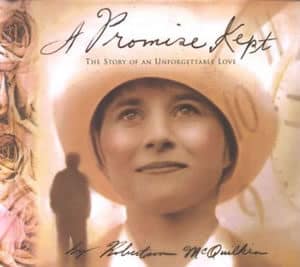
John: This is Focus on the Family and we’re listening to Robertson McQuilkin, and, uh, you can get his book, A Promise Kept, with more lessons that he and Muriel learned while coping with Alzheimer’s. We have that here. We’ll send it out to you when you make a generous gift of any amount to the Ministry of Focus on the Family. We’ll also include a free audio download of the entire presentation. So donate and request those that FocusontheFamily.com/broadcast or call 800, the letter A and the word FAMILY. 800-232-6459. Let’s return now to more from Robertson McQuilkin.
Dr. McQuilkin: After Muriel was abed, she’d lost all her abilities to speak, hadn’t spoken in a year. And she couldn’t feed herself, she couldn’t stand, she couldn’t walk. And, uh, it was Valentine’s Eve and I was on my exercycle, the foot of her bed. And I said, “Honey, I just read that you and I are victims. We don’t feel like victims, do we?” And she didn’t talk but I talked to her, still do. So, then, the next morning, I was again, w- while she was waking up, I was on the exercycle. And I said… I said, you know, I told her I loved her. And I said, “You love me, don’t you?” And all of a sudden, she opened her eyes and smiled. And for the first time in a year she spoke, and she said, “Love, love, love.” I jumped off the cycle and ran around and embraced her. And I said, “You really do love me, don’t you?” Well, she didn’t know what to do to answer that, but she wanted to respond. So she said, “I’m nice.” Last words that she spoke.
Fast forward for 10 years. Last week I was, had someone come in to stay with her while I went to a committee meeting and, and this was a new sitter, she was a missionary on furlough. And I was changing and fixing Muriel and I, and I explained to her how Muriel was so healthy. I said, “You know, look at her skin and her… she never gets sick ever. Never had a b- bedsore, and she’s just in wonderful health. My big prayer is that I outlive her.” I told this lady. And so then I went over to Muriel and I said, “Am I going to outlive you, honey?” Here’s somebody who hasn’t talked for 10 years. And she didn’t speak. But she grunts a lot, you know, if I clean her teeth or do something she doesn’t like, you know, that kind of complaint. But when I asked her, am I gonna out live you? Just as clear as day she said, “Uh-uh.” (laughs).
Audience: (laughs).
Dr. McQuilkin: I hope it’s not prophetic.
Audience: (laughs).
Dr. McQuilkin: But that’s it. Till death do us part. That’s the deal. Soon after I resigned, about two years after I resigned, some new students took a liking to Muriel and I wanted to sit with her. And they’re a couple. We were sitting out in the garden and the young, the husband said, “Do you miss being president?” And I said, “You know, I never thought about it. But the answer is no, I don’t miss being president. Uh, I like my assignment. I like to learn how to cook. She wouldn’t eat it if it wasn’t very tasty, so I had to learn how to cook and keep house and garden, so I like it.” It was an honest answer. I went to bed and I got to thinking Lord, now You don’t have to explain to me why that’s your business, your no obligation, so I don’t ask you, I live in a fallen world and suffering is part of our…
But I said if the coach puts the player on the bench, it’s obvious he doesn’t need him in the game. So if sometime you want to tell me why I’m not in the game, I’d be much obliged. I went on to sleep. The next day, at that time we were still walking, she could still walk sort of and I’d hold her hand to keep her balanced so we walk around the block. We were coming down the block that has a steep embankment on one side and a curb and a very busy street on the other side. And we never met anybody there. I was very grateful because we couldn’t pass and I couldn’t let go of her hand. But this day, I heard some shuffling by me, I looked around, here was the local derelict, three sheets to the wind weaving down the street and I said, “Well, he’ll never catch up.” But he did. And he weaved right out onto the traffic and back in front of us and he turned around and he said, looks us up and down, he says, “I like that. I really like that. That’s good.”
And then he turned around and weaved off down the street mumbling to himself. “That’s good. I like that. That’s real good.” And I chuckle, you like affirmation from whatever the source.
Audience: (laughs).
Dr. McQuilkin: And, uh, went back to the garden, sat down there. And then I said, “Lord, was that you speaking through the lips of a half, inebriated old drunk?” It was and if you say it’s good, that’s all I need to know. And so it is with you. Whatever your assignment, if you’re in God’s place of assignment, that’s good. That’s real good. So that’s the end of the story of what Muriel has taught me about love. How could you teach me anything now? She lives a bit unaware of anything.
Yes, she could. May I tell you? I’ve been setting you up. A couple of years ago, when I was looking at her lying quietly and sleep, that’s when she’s most like earlier days. And I was thinking of how lovable she is and how I love her now, perhaps more than ever, and the heartache is, she can’t love me back. And I thought, “Lord, is that the way it is between you and me? You pouring out your love on me by day and by night, caring for me, protecting me, providing for me, longing for my constant companionship? And all you get in return are a few grunts when things don’t please me?” How sad for him.
Sad because love for him is the ultimate purpose of life. In John 17, we have recorded a conversation between the Father and the Son. Now there’s unity, my friend, there’s love, there’s intimacy, and the Son is speaking to the Father. The problem with this passage is, that it’s been so co-opted by the ecumenical movement to teach unity among believers, important as that is, that we may miss the point and what a point!
Listen to it with fresh ears. There’s a Son speaking now to the Father. My prayer for all of them, that’s you, all of them, is that they will be one how just as you and I are one father. That just as you are in me and I am in you. So they will be in us so that they may be one as we are. I in them and you in me all being perfected into one. Oh, my friend. That’s His purpose. He created us in love, out of love for love.
John: What a touching story of faithfulness and devotion and unconditional love. That’s the late Dr. Robertson McQuilkin on Focus on the Family with Jim Daly. You know, Jim, some listeners are fully aware first-hand of what the challenges are of care giving for a spouse.
Jim: I can tell you after having Jean take care of me with a broken ankle a few years ago, I can see just a glimmer of how difficult that can be for the caregiver. And yet Dr. McQuilkin, counted it all joy like the Apostle Paul. Of course, uh, he was blessed to be in a position to be able to retire early. And not everybody has that luxury and I get that. Muriel passed away in September 2003, five months after Dr. McQuilkin gave this very speech.
In a letter to their friends and supporters, he wrote, “For 55 years, she was flesh of my flesh and bone of my bone. So it’s like a, a ripping of my flesh and deeper my very bones. Some may think I feel relief from the burden. After all, it was 10 years of total caregiving. But it doesn’t work like that. There’s a bonding with the one who is totally dependent on you and takes love to a deeper level. The pain is greater, not less.”
John: Hmm, that is really touching.
Jim: Yeah, it really is, John. And I should note that Dr. McQuilkin did find love again in 2005. He married Deborah Jones and they had 11 years of happiness together until he died in 2016 at the age of 88. And you know, a strong and enduring love is what we want for everyone who is married. And that’s why Focus on the Family is working hard to provide the resources that you need. Just one example is our free online marriage assessment to help you identify the strengths and weaknesses of your relationship. You take a quiz and then you’ll be guided to articles that will help you in those areas of weakness that it will identify.
John: Mm-hmm.
Jim: Here’s a note we received from Kristen a few weeks after she and her husband took the assessment. She said, “The discussions we’ve had since completing the marriage assessment have been a bit emotional. But we’ve had some revelations that caused a major breakthrough. We are experiencing what I’d call a second honeymoon. Thanks, Focus on the Family for all you do.”
John: That is (laughing)-
Jim: How about that one?
John: I don’t know that anybody thought a 5 or 10 minute quiz would bring a second honeymoon.
Jim: (laughs).
John: But what a great outcome. And Jim, over a million couples now have completed that assessment. So I can only imagine how many others are experiencing, well, breakthroughs like that.
Jim: Wow, it’s amazing. But we can’t do this work alone. We need your financial partnership and your prayers for this ministry as well. The best way to help is to become a true sustainer of this ministry by making a monthly pledge. It doesn’t have to be a large amount. It’s the consistency that really helps us even out the budget, month to month and year to year. And when you make a pledge of any amount, we’ll send you Robertson McQuilkin’s book called A Promise Kept. It’s a much deeper look at his marriage to Muriel and how they walked through so many difficult years together. And that’ll be our way of saying thank you for partnering with us. And if you can’t make that monthly commitment right now, we understand that. We can send the book to you for a one time donation of any amount as well. And when you get the book from us, we’ll include a free audio download of Dr. McQuilkin’s complete presentation. So get in touch with us today.
John: You can get your copy of this beautiful little gift book, A Promise Kept, when you make a donation by calling 800 the letter A and the word FAMILY. 800-232-6459, or donate online and request the book and your free audio download at FocusontheFamily.com/broadcast. And when you’re online with us, look for that Free Marriage Assessment that helped Kristen and her husband and also look for a link to our Loving Well Podcast, another great resource for married couples. Thanks for listening to Focus on the Family with Jim Daly, I’m John Fuller inviting you back as we once again help you and your family thrive in Christ.