



Preview:
Chris McKenna: I wish I could say if your child had this, this, this, and this, they shouldn’t have social media. And if they don’t have those things, they’ll be okay.
Jim Daly: Yeah, it’s not-
Chris: But it’s really not like that.
Jim: Yeah.
Chris: It’s like dropping them into a digital soup. But if you imagine, you know, chunks of meat or vegetables in a soup with a lot of spices, you can’t control what spices each piece absorbs or doesn’t absorb, but it’s going to absorb something.
Jim: Mm.
Chris: And that’s what it’s like when we drop our kids into any of these digital spaces.
End of Preview
John Fuller: Well, technology can seem overwhelming. And today we’re gonna be talking about practical advice for you as a parent to navigate tech. This is Focus on the Family with Jim Daly. Thanks for joining us. I’m John Fuller.
Jim: (laughs) I’m just envisioning, John, all the parents going, “Yay, finally.”
John: (laughs).
Jim: “Let’s talk about tech.” Because it is a problem, right?
John: Mm-hmm.
Jim: I mean, the technology’s neutral, but there’s a lot of danger out there with our kids on technology, with ourselves-
John: Mm-hmm.
Jim: … on technology. And so we need to create an atmosphere within our family that’s open, that we’re communicating about it, that there’s accountability, ’cause that’s all good. And it’s all to protect one another within the family, right?
John: Mm-hmm. Yeah.
Jim: So it’s gonna be good. I mean, most of the inquiries we’re getting now in parenting rest in this technology space. What are we gonna do? It’s important to be intentional, to have a plan, not to be haphazard, because if you are, you’re probably gonna end up with, um, some difficulty in that parenting journey.
Today’s guest brings passion and expertise. It’s always good to talk to somebody like that. He’s testified before the U.S. Senate about protecting our kids when it comes to social media. And every day he’s helping our legislators, educators, and leaders in the U.S. and around the world develop better technology for our children.
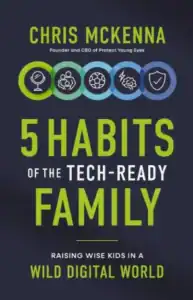
John: Mm-hmm. Yeah. Chris McKenna is the founder of Protect Young Eyes. Uh, it’s an organization dedicated to equipping families to better protect their children from harmful tech, and really teach them discernment, to use it wisely. Chris and his wife, Andrea, have four children, and one just recently headed off to college. Uh, and Chris has compiled a decade of research and practical advice into a great little book called 5 Habits of the Tech-Ready Family: Raising Wise Kids in a Wild Digital World. And you can learn more about Chris and his work and this great book at our website.
And while you’re there, check out our “Parents’ Guide to Technology,” a free resource for you from the Plugged In team.
Jim: Chris, welcome to Focus on the Family for the first time.
Chris: Yeah. Thank you, Jim.
Jim: Uh, Chris, you have experience as a certified financial planner. How in the world did (laughs) you get into technology then?
Chris: Right? That’s the question I ask myself all the time.
Jim: Yeah.
Chris: But, you know, looking back, you can see how the Lord weaves things together. I spent over a decade risk advising large companies.
Jim: Mm-hmm.
Chris: But now I’m in a space where understanding risk and mitigating risk is exactly what we need to be doing as parents. Because in the same way that I couldn’t, you know, remove all business risk at a company-
Jim: Mm-hmm.
Chris: … the objective was to implement certain steps, controls, monitoring, to bring it down to a spot where it was acceptable. And I think the same principles apply today in the digital age. We can’t bubble wrap, we can’t totally get off of the grid, but how do I identify risk and then do certain things very intentionally to bring that risk down to a spot where it’s manageable?
Jim: Yeah.
Chris: That’s really the goal.
Jim: Let me ask you, you know the dark side of the internet.
Chris: Mm-hmm.
Jim: You had some issues as a young man-
Chris: Mm-hmm.
Jim: … um, a teen, right, when it came to pornography and some things like that. That’s very common today, unfortunately.
Chris: That’s right.
Jim: So for us as parents, when you’re looking at that, um, and that experience, share that part of your testimony. And again, I said in the setup there that, you know, technology can be neutral or is neutral. It’s what we do with it, right? We make choices to look at things that we shouldn’t look at. So let’s start with that component.
Chris: Yeah. So I was exposed, as a lot of men my age were, to pornography as a young boy. And it, for me, was a bit like a landmine that was sort of sitting there undiscovered for a little while. But then here comes the ’90s and here comes the internet, this new version of connecting with others and information. And for me, and I refer to this in the book, it’s not mine, Dr. Cooper came up with this, but this triple A engine that the internet then became related to addiction, anonymous, affordable, and accessible, right? And that was a fuel that was just too much for me. I couldn’t handle that. So now here comes pornography with that. And so carried that compulsive use of then pornography into marriage and saw the destructive force, right, that it was.
I thought I was hiding it, and yet years later when the Lord convicted me to come clean and to just bring that out into light and to let Andrea know what was going on, like for her, it was this aha moment of, “Now I have a label for this unnamed distance, right, that has existed between us.”
Jim: Mm-hmm.
Chris: And so through Christ and accountability, a great group of guys, and Covenant Eyes, and software and just all the intentional steps that needed to be taken to eradicate that-
Jim: Mm-hmm.
Chris: … now turning that misery into a mission is really the goal to protect young eyes.
Jim: You know, and to give it some perspective, I mean, to understand that whole thing better, they say, uh, pornography addiction is more addictive than like, cocaine. I mean, for your mind, your, your brain chemistry-
Chris: Right, right.
Jim: … the dopamine hit. I mean, it really is, it’s, uh, I don’t know, it’s latching onto the normal brain function, then creating disorder with it.
Chris: It is. I mean, all the beautiful neurological responses that the Lord has designed-
Jim: Mm.
Chris: … for intimacy with a person-
Jim: And the bonding.
Chris: … when it’s hijacked by pixels, neurologically has the exact same impact as all those chemicals just roll and you soon find yourself ignoring the real and being drawn to the digital. And you’re absolutely right. And for our kids, we have to understand that if that’s the struggle we have with our supposedly more fully functioned-
Jim: Yeah.
Chris: … decision making part of our brain, they don’t stand a chance without our help.
Jim: And I, I would say that’s probably the highest concern parents have is our boys, and a growing number of girls-
Chris: That’s right.
Jim: … are looking at things that really will distort them for a long time and take a lot of effort to unwind-
Chris: To unwind.
Jim: … as you described.
Chris: That’s right.
Jim: You have a great example, in fact, about your mom, uh, using this backpack analogy.
Chris: Yeah, sure.
Jim: What was it and how does it work?
Chris: Well, it’s, the illustration that I use is really to remind parents that when we hand our kids today’s technology, and I wanna talk maybe a little bit about that sort of phrase about neutrality, we can come back to that.
Jim: Mm-hmm.
Chris: But when we hand our kids technology, we are handing them MIT trained software engineers.
Jim: Hmm.
Chris: And it’s really not a fair fight. So the illustration I use is, you know, imagine that you’re a seventh grader with a backpack and you have in there the typical things, a history book, maybe a notebook and some pencils. And before you walk out the door, your mom says, “Wait, wait, I wanna shove some things in.” I’m gonna show my age with the things that I’ll say, but, “Here’s the DVD player, here’s the CD player, here’s all your CDs, here’s a digital camera, here’s your baseball card, your Ken Griffey Jr. rookie card, Mad Magazine, five porn magazines,” zips it all up and says, “Take all this to school. Now you’re not allowed to touch any of it. And I know your friends have all these same entertaining things in their backpack, and you’re not allowed to touch any of their things either. And, if I catch you in your backpack or looking at things your friends have, you’re grounded for a month. Have a great day at school.”
Jim: Right. So like you’re giving them this temptation-
Chris: That’s exactly what it’s like-
Jim: … that they’ve gotta manage.
Chris: … to hand a child a smartphone today.
Jim: Yeah. Yeah.
Chris: And so, you know, the phrase I attach to that is we ask our kids to exert a daily level of self-control that we never had as children ourselves.
Jim: Yeah.
Chris: And just have to keep that perspective in mind, to keep the empathy high and the condemnation low.
John: Mm-hmm. Yeah. One of the things you referenced is the importance of grace in this process of training and discipling their kids.
Chris: Yeah, absolutely.
John: Uh, how important is grace and how does it fit into this part of the conversation?
Chris: Well, we want them to run to us, right? If we’re gonna hand them a device, getting back to the risk conversation, that automatically increases the risk of harm in their life, they will make a digital mistake. They will send something, share something, or see something that breaks our heart. That’s not the variable. The variable is how are we going to decide to respond to that when it happens? And that means we have to decide before it happens how we’re going to respond, to decrease the risk that we respond with the emotional part of our brain instead of the grace before truth part of our brain, which is what they need to hear so that when it happens again, they still run back to us.
John: And what does that look like in the moment?
Chris: Well, in the moment, it means you’ve done the preparation, you’ve practiced. Yeah, I tell parents all the time, if you want to be ready for that conversation, then make a list of all the horrible things that you hope never happen to your child online.
John: Mm-hmm.
Chris: And then go into your room, shut the door and look in the mirror and say each one of them out loud and afterwards say, “I’m not gonna freak out. I’m not gonna freak out. I’m not gonna freak out.”
John: Mm-hmm.
Chris: Not freaking out is the number one way to build digital trust. And so we have to practice that.
Jim: I think John’s getting at to what is that first sentence you’re gonna say out of your mouth-
John: Mm-hmm.
Jim: … to this child.
Chris: Right.
Jim: (laughs) So what does that look like-
John: Mm-hmm.
Jim: … to s- to not freak out? “Honey, I’m so glad you came to me with this and let me-”
Chris: Yeah.
Jim: “… talk to you a little bit about,” whatever it is.
Chris: Well, I, I think there’s even something before that.
Jim: Good. This is what I’m looking for.
Chris: And I think it’s, “I’m sorry that that happened to you.”
Jim: That’s good.
Chris: “I’m sorry that I didn’t protect you, I wasn’t there to prevent that from happening.”
Jim: Mm.
Chris: Approach with humility right out of the gate. And the phrase that we want parents to just have echoing in their brain is, “This isn’t their fault.”
Jim: Yeah.
Chris: Not that that decreases consequence. What kind of parent would I be if I wasn’t discipling you towards something and maybe taking your phone away? But when we remember what we’re putting them up against, most of the time, it’s not their fault. It’s so sophisticated.
Jim: You know, that’s a good insight because I think typically we do read that moment as, “You chose this.”
Chris: Mm-hmm. Mm-hmm.
Jim: And then the anger comes out rather than the humility and the understanding.
Chris: That’s right. Yeah.
Jim: So that is a good way to set that environment up for reacting correctly-
John: Mm-hmm.
Jim: … because we’re gonna assume, “You chose to do this, this is so horrible. This is an embarrassment.”
Chris: That’s right.
Jim: “Why would you do this?”
Chris: Right.
Jim: Fill in all the blanks. And then it’s almost like a trigger for you, the parent, right?
Chris: Absolutely.
Jim: So that’s really critical. I like that. You go on to talk about digital trust. I think it’s building kind of in this area-
Chris: It is.
Jim: … within the book. Building digital trust, what is that?
Chris: So you’d find that under habit two. Everything for me sort of fits into frameworks. It’s that CPA brain of mine-
Jim: Okay.
Chris: … you know, that wants things to fit that way. And in the second habit where we pursue authentic connection, building digital trust is important because what we have found is that in homes where digital trust is high, digital friction is often lower. And you build digital trust primarily by doing two things. Talking about what we did before, number one is not freaking out, right? Deciding early on that you’re not gonna freak out. And then primarily even with younger kids, it’s practice being curious with their technology, sitting alongside them-
Jim: Mm.
Chris: … and watching technology with them. I tell the story of sitting alongside my son who had discovered this YouTube channel with hydraulic presses that just crushed big things. And you’d be surprised at how entertaining it is to watch massive hydraulic presses bonding with your son as we’re just going, “Whoa.”
Jim: Yeah. How it’s made and stuff.
Chris: How it’s made and then watching a bowling ball explode under this hydraulic press, right?
Jim: Good stuff.
Chris: Good stuff. You just, you create that curiosity. Because if all of our conversations with our kids as parents are consequence, negativity, and yelling, then what are the chances they’re gonna come to us in the middle of that digital crisis?
John: Yeah. I appreciate that so much.
This is Focus on the Family with Jim Daly, and our guest today is Chris McKenna. 5 Habits of the Tech-Ready Family is his book. The subtitle is Raising Wise Kids in a Wild Digital World. And we’ll encourage you to, uh, get a copy of that from us here at the ministry when you stop by focusonthefamily.com/broadcast.
Jim: Chris, I, I appreciate this next question because, uh, this is something we all struggle with, with parents. Jean and I had to struggle with this. It’s the big question, when do our kids or when should our kids get a smartphone? And you say delay is the way.
Chris: Delay is the way.
Jim: And for us, it was really, it worked out well.
Chris: Sure.
Jim: But in that regard, for the desperate parent, because what’s the average age now where kids are getting smartphones that have access to internet?
Chris: Oh.
Jim: Eight, nine.
Chris: Elementary school, right?
Jim: Yeah.
Chris: That kind of middle upper elementary school. Yeah.
Jim: And it’s often this balance between the children having safety, you know, they have a phone so they can call.
Chris: Mm-hmm. Right.
Jim: But what, what do you suggest with all of that bundle?
Chris: So we have a lot more tools today than we did when you were raising your kids.
Jim: Yeah.
Chris: And I wanna-
Jim: Well, thank you.
Chris: Yes (laughs).
Jim: (laughs).
Chris: It wasn’t your fault. It wasn’t.
Jim: I’m old.
Chris: (laughs) Yeah. But I wanna also decouple social media from smartphones.
Jim: Mm-hmm.
Chris: Because oftentimes parents see those things as a decision that has to come at the same time and that’s not true. So what’s the right age to give your kid a smartphone? I’m talking about an iPhone or an Android well into high school.
Jim: Yeah.
Chris: Because we have all kinds of options at our disposal today that step a kid along. When I say delay is the way, that is a slow tech strategy, not a no tech strategy.
Jim: Mm-hmm.
Chris: So if you want to stay in touch with your kid who’s going over to a friend’s house around the way, then there are phones that can get rid of the internet. I don’t think any child who isn’t in high school needs to carry 100 million people and a hundred million choices in his or her pocket.
Jim: Mm-hmm.
Chris: But if I wanna know where you are, talk, text, GPS, great, there’s a device for that and we can give you that. And so it’s really an individual decision, but u- use those steps as a way to practice toward the insanely intelligent technology, which is an iPhone.
Like, we have to understand the sophistication of that device should never be the first device for a child. So specific to phones where you went with 15 and 17, you made a judgment, you looked at your sons, they were ready in different ways at different times just due to the way they were. I also want that to be a component too. So I could say wait until age 15, but I want parents to look at your kids individually-
Jim: Mm-hmm.
Chris: … and ask what they’re really ready for.
Jim: Yeah.
Chris: And you can assess that by taking a few of these steps along the way to see how they behave and interact with it. Can they handle it?
Jim: You know, and I think one of the biggest issues there are parents being educated as to the options that they have.
Chris: That’s right.
Jim: Back then, I don’t feel like we had many options.
Chris: Right.
Jim: The phone came out, and we didn’t have ways to manage access to certain things as we do today.
Chris: Mm-hmm. Mm-hmm. Correct.
Jim: So that even is something that’s relatively new.
Chris: If they wanna connect with their friends, which by the way is a good pure motive, earlier on I said that attachment and connection are these two phases that young people go through. The drive to connect with friends is as strong a feeling as hunger to adolescence.
John: Mm-hmm.
Chris: Like survival level instinct. And so I wanna try to honor that. We had it too. We wanted to be with our friends. And so how can we find a way to honor that to keep you connected? It’s not just a flat out no, but let’s find what your motivation is. I’m gonna try to find something that doesn’t harm you to allow that to happen.
Jim: Yeah. You know, let’s move it up just a little bit.
Chris: All right.
Jim: Kind of where I’m living now, and that is you have college age kids and your 20s. The kids are in their 20s.
Chris: Sure.
Jim: And they’re home for whatever, the weekend, Christmas break, or they’re back, you know, doing the boomerang thing and they’re waiting to find a job.
Chris: (laughs). Yeah.
Jim: What kind of discussion do you need to have as a parent? Now they’ve been on their own.
Chris: Yeah.
Jim: Um, your internet or router may be ablaze with they’re looking at things they shouldn’t look at ’cause you can set up those parameters.
Chris: Right.
Jim: Now how are you gonna manage this now that they’re adults-
Chris: Mm-hmm.
Jim: … but they’re under your roof, it’s gonna create some friction. What do we do?
Chris: Well, the first question I always ask parents who describe this to me is, are there younger siblings in the house?
Jim: Okay.
Chris: Because every digital device in a home, and this applies to parents too, has to be tuned to the most vulnerable person in the house.
Jim: The least common denominator.
Chris: That’s right.
Jim: Yeah.
Chris: And I didn’t say youngest because in my home with a son with Down syndrome, even though he’s 16 and not the youngest, he’s the most vulnerable.
Jim: Uh-huh.
Chris: So everything connected to the internet, even if big sister comes home from college for the summer, as she did this past summer, we have to make sure that no digital device in the home would do any harm to Grant. And so that’s, uh, just a first question out of the gate.
After that, there are non-negotiables. “I know you’re an adult, but this is our home and these are general parameters-”
Jim: Yeah.
Chris: “… that we have in our home about what is and isn’t appropriate while you’re here. I love that you’re here, and I want you here. But these things were true when you were 16, and they’re also true when you’re 26.”
Jim: Right.
Chris: Because there are very few things that are appropriate at 26 that were inappropriate at 16. I mean, usually those are pretty consistent.
Jim: Yeah.
John: Yeah. Yeah. We call those house rules.
Chris: That’s right.
John: So when you’re, when you’re in the house, we have some house rules.
Chris: Yeah.
John: And that’s just kind of how we roll. And then I have to abide to the same house rules (laughs) right?
Chris: That’s the part.
John: In terms of time and all that.
Jim: Yeah, that’s good.
Chris: Absolutely.
Jim: Uh, Chris, you mentioned the pyramid of protection. I think it’s a really insightful diagram-
Chris: Mm-hmm.
Jim: … but let’s, let’s discuss it. You, uh, talk about several components of this pyramid, uh, with the prayer being the base and then practical application. What’s the pyramid-
Chris: That’s right.
Jim: … constructed of?
Chris: That’s right. I mean, obviously put it on that foundation of prayer, but if we just pray and don’t do any of the practical, we could still have porn. And so we’ve got to wrap our kids in layers. And so if you can imagine a three-dimensional pyramid with five layers, so four lines that cut it going up vertically, bottom is relationship. We have to build that relationship. And the habits are oriented that way by modeling, pursuing connection, build that relationship.
Then we have what are more technical components going up. You referred to the router and having controls. That’s layer number two. Your router is the most important digital device in your home. And so many parents completely underappreciate the significance of the router. And then I have parents who contact me and said, “Well, I discovered that my kid found a browser and was watching porn on the treadmill downstairs because the treadmill connects to wifi.” Right? So when we connect the router, we actually control a number of problems in our home, whether they be secret access or accidental access where young kids type things in and Google shows them all kinds of things. The router can control all of that. That’s layer number two.
Layer number three is the device layer where on the devices that they’re carrying, which don’t connect always to the router because they’re on a cell plan like smartphones, you have software loaded onto it like Covenant Eyes, like using Apple’s native parental controls so that when it’s out and about, it’s protected. That’s the device layer. And that gets into the appropriateness of those kid-friendly devices.
The fourth layer is location. Where we use technology has a massive impact on how we use technology. So we avoid certain places, bedrooms, bathrooms, basements, sleepovers. School buses are a horrible spot for technology. And then grandma and grandpa’s house, we can get into that in terms of the risk that is grandma and grandpa’s house.
Jim: Well, that’s true.
Chris: It is. Because if parents listening to this have thought to themselves, “Wow, I haven’t thought about my router in a while,” I guarantee their parents haven’t thought (laughs) about their router for a long time.
And then the last layer is the app layer. So we use Y- YouTube’s parental controls. They’re horrible, but we use them, which is why we have all the other layers underneath to bolster those.
Jim: Chris, let me ask you, y- y- does the book kind of give you that indication? Do you have an appendix? (laughs). I mean, some of us listening are going, okay, I mean, they’re trying to write feverishly.
Chris: No need to. Yeah.
Jim: The, the router, what’s the router? (laughs).
Chris: That’s right.
Jim: And then what do I gotta do with that? Does the book kinda lay out maybe somewhere where you need to-
Chris: Yeah. Absolutely.
Jim: … think about all these things?
Chris: Yeah. So chapter six goes into great detail into all of these five layers, but then there’s a whole appendix with resources.
Jim: That’s great.
Chris: The ones that we trust.
Jim: Yeah.
Chris: Because if you were to look on your own, you would see there are hundreds of different parental control options and now you’re back to, “I don’t know where to go.” And so we’ve listed those that we trust the most and want parents to start there.
Jim: You know, there’s such a spectrum like we’re talking about with parents who are listening and watching on YouTube and, you know, they’re saying, “Well, my kids are good.” And that may be true. It’s really not a measure of that. It’s like you said, placing your child in a potentially compromising situation, giving them the backpack-
Chris: That’s right.
Jim: … with all those tools they shouldn’t have right now. And, uh, trying to control that environment for their safety, right? But in that regard, how would you encourage those parents listening, um, to act? I mean, maybe they don’t have the tools. They don’t even know what the backpack is. They’ve been giving… Their kids already got a smartphone and it’s pretty much unlimited.
Chris: Yeah.
Jim: “What do I do today for my seventh grader? I’ve already made that-”
Chris: Right.
Jim: “… mistake. I haven’t-”
Chris: Sure.
Jim: “… done the homework. What do I do now?”
Chris: So we tell parents that if you’ve said yes to something you wish you hadn’t, and you’re not going to take it away, you’ve decided it’s just too painful to rip it out of their life, then the phrase that we use with them is it’s time to get ridiculous.
Jim: Okay (laughs).
Chris: It’s time to get ridiculously involved, ridiculously direct, ridiculously informed, right? You do certain things where you’ve introduced risk, now it’s time for me to jump in and to ask you very specific questions. Say direct ridiculous things out loud. Why? Because you then activate the thinking part of their brain and you hope it creates a bit of a sticky moment, this awkward conversation.
Jim: Yeah.
Chris: Then in the midst of crisis where feelings are running wild, they’ll remember that ridiculously awkward conversation. So it gets back to the beginning. If we’re going to say yes to risk, I want more parents to say yes to some ridiculously intentional things to bring that down.
Jim: Yeah.
Chris: Very relational, very relational.
Jim: Have you, with the, with the families that you’ve counseled, do you find a certain profile of a child that’s more susceptible to these things? And what I mean by that, for example, when we read in the news where, you know, a teen girl, uh, has been vulnerable to this where somebody talked her into providing photos or things like that, does the parent, how does the parent who feels, is that the first assessment to say, “How is my child wired? Where are the potential weaknesses that they might have?” So you have a child that really is social, loves to be in friend groups, wants to be accepted. That should be a flag-
Chris: A- absolutely.
Jim: … to, to look out.
Chris: Yeah.
Jim: Um, but, but is there any kind of a child profile that you need to be more concerned about-
Chris: Yeah.
Jim: … than others?
Chris: No. And, and that’s-
Jim: Okay, that’s good.
Chris: And that’s what’s difficult about this-
Jim: Yeah.
Chris: … is I wish I could say if your child had this, this, this, and this, they shouldn’t have social media. And if they don’t have those things, they’ll be okay.
Jim: Yeah, it’s not-
Chris: But it’s really not like that.
Jim: Yeah.
Chris: It’s like dropping them into a digital soup. If you imagine, right, it’s soup time in Michigan because it’s, you know, that time of year. It’s mostly soup time in Michigan because of our weather. But if you imagine, you know, chunks of meat or vegetables in a soup with a lot of spices, you can’t control what spices each piece absorbs or doesn’t absorb, but it’s going to absorb something.
Jim: Mm.
Chris: And that’s what it’s like when we drop our kids into any of these digital spaces. They’re going to absorb certain things, which means by knowing them well, we can at least try to identify traits and characteristics that might make them more susceptible. But on the other hand, it’s so difficult to predict-
Jim: Yeah.
Chris: … which is why we delay, which is why we let their brain form as much as possible, which is why we pour into them relationally as much as possible and have so many conversations about technology that they’re rolling their eyes and finishing our sentences.
John: Mm-hmm.
Chris: I joke, you know, that’s sort of the, the algorithm that God shows us in Deuteronomy 6:5-9 when he says, “You wanna know what it takes to let kids know who I am when you walk, when you talk, when you lie down, when you get up, doorframe.” Like God is essentially saying be algorithmic before we knew the word.
John: Hmm.
Chris: And we need to be the same when it comes to digital spaces and technology.
Jim: Yeah. I mean, this is so good, Chris. I think it’s been a powerful half hour, so thank-
John: Mm-hmm.
Jim: … you so much for being with us. And, uh, you know, have shown us the insights that we need as parents to do the best job possible. It won’t be perfect-
Chris: Right.
Jim: … but the best job possible to make sure that our children are safe with this tech environment that we’re in today. So thank you for being with us.
Chris: My pleasure.
Jim: And listen, probably the best thing you could do, especially as we mentioned in the program, the appendix and the help that’s in Chris’ book, 5 Habits of the Tech-Ready Family: Raising Wise Kids in a Wild Digital World, is get it into your hands. So make a gift of any amount. If you could do it monthly, it’s great. A one-time gift is good. But if you can just make a gift of any amount, we’ll send it to you as our way of saying thank you for being part of the ministry.
John: Mm-hmm.
Jim: And we are so grateful for friends like you who make the ministry possible. Our research shows that over the past 12 months, together, we’ve helped more than 80,000 parents work through a significant crisis.
And Chris, let me say thank you for the content folks that come on the broadcast and the podcast. Uh, you’re part of this, right? You’re on sharing your expertise, you’ve written a great book, and, uh, it’s a way of doing partnership to do ministry together. So you’re part of that too, that 80,000 parents help through a crisis. So thanks for participating with us in that.
And as the Christmas season approaches, your financial support will help deliver hope and joy to families like yours. Your gift helps provide Bible-based resources like Chris’ book and the program today. Um, it also helps to encourage families in a crisis, lend a hand to parents and show compassion to children in foster care. There’s so much going on here.
Chris: Yeah. Sure.
Jim: Uh, it’s so much fun. So consider joining the support team today with a generous year-end gift. And when you donate, we’ll send you a copy of Chris’s terrific book, 5 Habits of the Tech-Ready Family, as our way of saying thank you.
John: Yeah. And right now, your year-end gift will be doubled dollar for dollar through a special match opportunity, and God will use that donation to make twice the impact on families. Call today. Our number is 800, the letter A, and the word FAMILY, or donate and get Chris McKenna’s great book, 5 Habits of the Tech-Ready Family, at focusonthefamily.com/broadcast.
While you’re there, look for our free online “Parents’ Guide to Technology,” which covers everything from social media to AI. It’s a great free resource for you as you help your kids navigate this digital world.
Thanks for listening to Focus on the Family with Jim Daly. I’m John Fuller, inviting you back as we once more help you and your family thrive in Christ.