

Jennifer Dukes Lee: Wherever you are, get yourself out in nature and see how God does work through rhythms, through seasons, through … You know, get yourself out and watch a sunrise or a sunset. It just has a way of un-hurrying your heart.
John Fuller: That’s Jennifer Dukes Lee sharing about the need to slow down to experience-
Jim: (laughs)
John: … all that God intends for us in this life. This is Focus on the Family with Jim Daly, and I’m John Fuller.
Jim Daly: Sorry about that chuckle, John. It’s just so funny. It’s so true. We move so fast and then even slowing down to talk so people can understand us-
John: Mm-hmm.
Jim: … and hear us as part of it, right?
John: Yeah.
Jim: And this is such an important aspect of life, and I think in this common era, we are moving so fast. We’ve got that FOMO. You know FOMO, right?
John: Oh, yeah.
Jim: Fear of missing out. We gotta do it all. We gotta be as busy as possible. We don’t want to miss a thing. Maybe even attach to our work methodology. You know, we’re gonna work super hard and not go home at 5:00, but stay till 8:00 and whatever it is.
John: Mm-hmm.
Jim: And, uh, that really impacts our wellbeing and our soundness emotionally, spiritually, I think even physically. And today, we’re gonna give you some insights on how to, uh, go a little slower. And in doing that, probably enjoy the journey far more.
John: Mm-hmm. Yeah. And this is something that I need to hear, Jim. Just personally, I fill in so much.
Jim: (laughs)
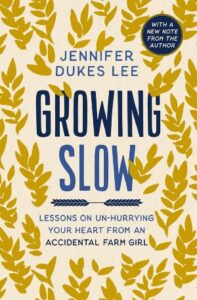
John: Uh, Jennifer Dukes Lee is with us. As I said, she’s got a terrific book, uh, capturing her experiences and insights about this concept. It’s called Growing Slow: Lessons on Un-Hurrying Your Heart from an Accidental Farm Girl. And, uh, you can learn more about Jennifer and this terrific resource at our website, and that’s FocusontheFamily.com/broadcast.
Jim: Jennifer, welcome to Focus on the Family.
Jennifer: Thanks for having me. You guys have been a part of my life since the early 80s.
Jim: Oh, wow.
Jennifer: And you don’t even know it.
Jim: Yeah.
Jennifer: Little, uh, church in Northwest Iowa, and we played these videos. There was, like, a video series, uh, with James-
Jim: Oh, yeah.
Jennifer: … Dobson.
Jim: Yeah, the original film series.
Jennifer: Yeah. I don’t remember the content-
Jim: Yeah.
Jennifer: … but I just remember that was my first introduction.
John: Introduction. Yeah.
Jennifer: And now, I get to be here.
Jim: I mean, it’s, it’s even for us, you know, the platform that was laid there, Dr. Dobson did such a good job, and people responded so powerfully to the advice that the guests would have, and we’ve just kept that rolling along.
John: Mm-hmm.
Jennifer: Love it.
Jim: And it’s great to have a great guest like you, like, back in the ’80s-
Jennifer: (laughs)
Jim: … Uh, to join us and to help people better understand what are the important things to look at when you’re moving through this life at light speed, right?
Jennifer: Mm-hmm.
Jim: Which is the whole point. The fact that you’re in Iowa is really interesting and, uh, you know, we’re gonna get into that, but you were that professional woman, and now you’re on a farm. (laughs)
Jennifer: Yeah.
Jim: Which I think is awesome. And we’re gonna talk about that slower pace, but you and your husband, Scott, um, you were kind of dreaming the big dreams and chasing those young adult ideals. Describe what your 20s were like and what you and Scott were into.
Jennifer: Both Scott and I had zero intention of ever moving back to rural Iowa. We did have our sights set on success, achievement, scaling, hustling, climbing the ladder. He went to law school and graduated and went into a career in insurance. And I was a political reporter at The Des Moines Register, which is a pretty exciting place to cover politics.
Jim: That’s actually a big paper. And every four years-
Jennifer: Yes.
Jim: … because of the caucus, that becomes one of the most important papers, right?
Jennifer: Exactly. So it was really exciting, but also really exhausting. Sometimes I look back on that and I think, “How did our marriage survive that?”
John: Mm-hmm.
Jennifer: We were like two ships passing in the night. When we started to think about having a family, our priorities began to shift, and we realized that we wouldn’t be able to be effective parents or effective spouses. I mean, it really is by the grace of God that our marriage survived- (laughs)
Jim: Mm-hmm.
Jennifer: … that time, but we made this unexpected decision to move back to the fifth generation family farm. I think we surprised even ourselves, but the idea of children has a way of shifting things in the interior journey of the soul. When we decided to move back, I’m telling you, people thought we were nuts.
Jim: Mm.
Jennifer: Like, “Jennifer, you’re on the cusp of something really great in your news career. Scott, you just spent a lot of money (laughs) on law school, and now you’re gonna go back and be a farmer?”
Jim: Yeah.
Jennifer: For a long time, I asked the question to myself, you know, “What if they’re right? What if we made a big mistake?” Because we had seemingly thrown a lot of potential away, a lot of the things that we had, uh, built over time. But it took me a long time to ask a different question, and that question being, “What if they’re wrong?” Because they weren’t living the life of burnout-
John: Mm-hmm.
Jennifer: … that was stressing us out.
Jim: Yeah. And let’s, you know, going back to the 20-somethings that you were in at the time and you were charging ahead, that’s not, you know, it’s kind of normal actually. And not everybody has a fifth generation farm. They could say, “Let’s give this up because we want a different phase of life.” And farming’s not easy. I mean, it’s got its challenges, but in that context, it was more holistic, it sounds like, as you begin to contemplate having children and, uh, uh, you know, just the idea of professionalism. I think for women particularly, and Jennifer, this may be the most critical part of the program we do today, and that is, uh, this idea that children are going to need much more of me and much more of Scott. How do we create that capacity? I don’t know that couples are in that space today, uh, is 28, 31, whatever it may be. And, you know, it is, let’s do all we can do financially to secure ourselves and make sure we can afford a baby. How often do you hear that today?
Jennifer: Mm-hmm.
John: Mm-hmm.
Jim: “You can’t afford a child.” Of course you can’t, but you find a way.
John: Yeah.
Jim: It’s amazing how it works, but in that context, I just wanna take us back there-
Jennifer: Yeah.
Jim: … for the listener that they’re right there. They’re 30-something and they’re still in the race and they haven’t come to that aha. Uh, just give that to us a little more deeply about being that woman who wanted children and then wanted to make sure the environment was conducive to parenting.
Jennifer: I wasn’t even following the Lord at the time.
Jim: Mm-hmm.
Jennifer: So let me just tell you that even though I wasn’t making decisions based on what God would have me do, God was still working in us and bringing us to a place where He drew us to Himself. But I think the challenge becomes for Christians and non-Christians alike, just look to the ads for proof, like hustle, grind, more money, more success-
Jim: More spending.
Jennifer: … more spending. And the quieter way, the slower way, the family way isn’t screaming and shouting at us all the time. So to counterbalance that takes a great deal of, of focus and a great deal of faith, which God grew in us on the farm. But I think that the idea for women is that you’re going to have to give something up to slow down. But what we forget is that we have so much to gain that we don’t need to choose the spectacular life, the spectacular home, the spectacular family doing spectacular things and hosting spectacular parties. God works in the unspectacular.
Jim: (laughs)
Jennifer: Ordinary life, regular life is holy ground, and sometimes you can only see that when you look back, but it’s just really hard to see it when you’re in the midst of it.
Jim: Yeah.
Jennifer: And I recognize that it’s hard because you want to, you want to chase and achieve. And I mean, I still get to be a smart, capable woman on the farm. It doesn’t change that. I just don’t, I don’t have to be doing it the same way I-
Jim: Yeah.
Jennifer: … was before, which is burning the candle at both ends.
Jim: You know, in that regard, the, the farm … I mean, what I loved about your book, you were very honest about, you got to the farm and then you kept yourself busy. (laughs) And so it wasn’t-
John: (laughs)
Jim: … it wasn’t like this formula that you said, “I’m so busy in my journalist life that, and my husband’s a lawyer, and we’re gonna go to the farm and kick back and take it slow.” You hit the farm running and you found yourself in the same busy.
Jennifer: That’s right.
Jim: What did it look like?
Jennifer: I know. I shocked even myself with this. And a lot of people will say, “Well, of course, you can grow slow. You live on a farm.” But hurry isn’t just an external issue. Hurry is something that hangs around-
Jim: Mm-hmm.
Jennifer: … your heart. You can have a kind of hurry sickness, a feeling like, “I just need to be busy. I need to get more done. I’m gonna wake up anxious. I need to hit the, the ground running.” And I needed to have a shift internally outside of the, you know, pastoral, uh, blue sky fields and livestock life that we were living and tend to the field of my heart that needed a divine farmer to come in and say, “We got some work to do here.”
Jim: Yeah. In that context, um, work in a farm, it, it’s predictable. You know what you gotta do? You gotta get up, feed the livestock, take care of this, plow that, uh, harvest this, whatever it might be. It seems like a rhythm that is doable because you know what’s expected, you know what you have to do, and you gotta get it done. Um, versus just adversity coming at you all day long, problem solving that’s coming out of nowhere, which is what we can experience in a more corporate environment-
John: Mm-hmm.
Jim: … you know, lawsuits, whatever it might be. I think that rhythmic thing is what God intended for us. Um, speak to the rhythm of things and how you began to learn to slow down.
Jennifer: Hmm. So God created our world with a rhythm. The sun comes up and it goes down. The Earth spins and it goes around the sun and we go through day and we go through night and we go through seasons, spring, summer, fall, and winter.
Jim: Mm-hmm.
Jennifer: And there is a definite predictability to it. You know, on a farm-
John: Mm-hmm.
Jennifer: … we get up with the sun and we go down when the sun goes down. (laughs) And each day offers us this new opportunity to rise again with the Lord and with the sun and to close out the day when it’s time. I literally say goodnight to the office at five o’clock.
John: Hmm.
Jennifer: I turn off the light and I say goodnight to the office. And we are, you know, it’s time to be a family again.
John: Mm-hmm.
Jennifer: But the, where I see that God really works in rhythms is in the seasons. And when we, uh, farm, uh, we’re planting literally millions of seeds in the spring, waiting for something to grow. And sometimes it can take a very long time to see those-
John: Right.
Jennifer: … first bits of plant come up. And then we have summer seasons where everything is green and all the rows are touching, but we fear, of course, storms, windstorms, drops.
Jim: Hail.
Jennifer: Hail, all those things, right? So there’s a lot of pressure to just kind of keep it going and at the same time, trusting that, that God is, is doing His good work in the fields-
Jim: Yeah.
Jennifer: … of our lives.
John: Mm-hmm.
Jennifer: And then comes harvest, fall, where there’s nothing quite so wonderful as holding that fully ripened thing in your hand and knowing-
John: Mm-hmm.
Jennifer: … all that went-
Jim: I wanna get into that.
Jennifer: … into this growth. Yeah. We, I, I love the seasons.
John: Yeah.
Jennifer: And then of course winter when things just kind of go dormant.
John: Mm-hmm. Yeah. We’re gonna talk about these seasons here in just a moment. Let me, uh, say that this is Focus on the Family with Jim Daly and our guest is Jennifer Dukes Lee. Uh, her book, Growing Slow: Lessons on Un-Hurrying Your Heart from an Accidental Farm Girl. Uh, it’s a terrific book full of insights and experiences and stories and, uh, it’ll encourage you. So get a copy of it from us today at FocusontheFamily.com/broadcast.
Jim: You know, related to summer, you talk about, and you mentioned already small things are big things. I can remember in college, I had a professor talking about wind power, but also she was working specifically on wave power. If we could harness the power of a wave. And I remember she gave a lecture, you know, totally void of spiritual understanding or anything like that, but the spiritual application is huge. When she said, “You think of a coastline and you think of rock.” Which we all think of as the hardest substance, you know, diamonds, rocks, a cliff, but water, potentially one of the softest things that hits us-
Jennifer: Mm-hmm.
Jim: … hits that rock every day. And over centuries-
John: Mm-hmm.
Jim: … it erodes it.
Jennifer: Mm-hmm.
Jim: The water wins.
John: Mm-hmm.
Jim: And I took that application to your summertime of little things are big things. Water is stronger than rock.
Jennifer: (laughs) Mm-hmm.
John: Wow.
Jennifer: That’s so true. I mean, that’s a growing slow process, and that’s the way, you know, when you think through the formation of these beautiful mountains, when you think through the formation of, of lakes over time, like how God uses natural processes slowly over time, to grow things and to build things, and even in a farm field, w- you don’t see the growth minute by minute. It’s happening incrementally. You see it over days or even weeks and months. And the same is true in our lives. These little things are growing up and around us and, uh, there’s a story that I wanted to share with you about these little things. You know, for, for summer, I’m telling you, sometimes I can just be like, “I gotta keep this going.” I gotta keep this growing and it’s hot outside and-
Jim: Yeah.
Jennifer: … and, you know, the bugs are flying around and there’s all kinds of things that keep you from just zeroing in and, and focusing on the small things. But I had this friend, his name was Dave, he was a pastor and he, it, it’s just like he had this instinctive knowledge that I was pushing just a little too hard-
Jim: Ah.
Jennifer: … on the farm, my husband and I, right? And so he would send me these long emails and he would say, “God delights in you, Jennifer.” And sometimes it’s the-
John: Mm-hmm.
Jennifer: … little things like that. Having a friend or someone we love remind us that God delights in us, not just in what we are growing in our fields or in our lives, like God delights in us wherever we happen to be in the growth process.
Jim: Yeah, that is so good.
Jennifer: Mm-hmm.
Jim: But even to send that note-
Jennifer: I know.
Jim: … I mean, that’s something we could do to somebody we care about, you know, God delights in you. And, uh, it’s such a great reminder.
Jennifer: Yeah. And so Dave has passed away-
John: Mm-hmm.
Jennifer: … and apparently, I wasn’t the only one that he used to send these messages to. After he passed away on his Facebook page, it was filled with people saying, “Dave, thank you for reminding me that God delights in me.”
Jim: Mm-hmm.
Jennifer: These bits of legacy, we think it’s the big things. We think it’s the, you know, the front page story, in my case, or, you know, a field of crops that produces an exceptional yield, but the things that matter the most, the mattering things are these little things that we can do for one another.
Jim: Yeah.
John: Yeah.
Jim: So we got spring and summer.
Jennifer: Yeah.
Jim: Let’s move into fall or autumn. What is the harvest like? What are some things that you learn spiritually about harvest? There, you know, the scripture’s so full-
Jennifer: I know.
Jim: … of the harvest metaphor. Jesus spoke about it. Paul, everybody’s talking about the harvest, uh, spiritually, obviously, the harvest of souls into-
Jennifer: Yeah.
Jim: … the kingdom of God. But you must really tangibly feel that-
John: Mm-hmm.
Jim: … when you’re working with your own hands-
Jennifer: Mm-hmm.
Jim: … bringing in the harvest with your husband, Scott.
Jennifer: Yes. I love going on ride-alongs, getting in the, the combine beside him and going through the fields. And he’s like a kid at Christmas.
Jim: Oh, wow.
Jennifer: He just loves the way that feels. And there is something really special about looking out and knowing all the effort that went into that. I mean, even, you know, for anybody listening that’s ever, like, grown a tomato, right? There’s just something really cool about saying-
Jim: Sure.
Jennifer: … “I did that. I grew that with God, like God and I co-created this thing. Oh, that’s so cool.” And that’s what it feels like-
Jim: Mm-hmm.
Jennifer: … on the farm. And I think that’s what it feels like, uh, when we harvest anything. You know, if you’re, let’s say you’re an empty nester, your kids have moved on and that feels like a real season. You’re seeing fruit in their lives and it’s something to celebrate and also harvest is a time where the thing is over.
John: Yeah.
Jennifer: So you have the joy and the celebration of having reached this point, but also a bit of sorrow and sadness that it’s over.
John: Mm-hmm. Yeah. Yeah. And in fact, that’s what I was gonna ask about that because sadness is a natural part of life. Um, we’ve gone through a season of losing some pets and some family members, which is of course a greater loss, but, uh, just trying to help our kids learn that sadness is, uh, it’s a season. It’s not necessarily going to define the rest of life. Address that from your perspective.
Jennifer: So yes, I describe myself in the book as the queen of unexpressed grief-
John: Mm-hmm.
Jennifer: … because ever since I was young, for whatever reason, I didn’t wanna cry.
Jim: Yeah.
Jennifer: I didn’t wanna be seen as being-
Jim: Weak.
Jennifer: … sor- weak and sorrowful and, um, so I became busy-
Jim: Yeah.
Jennifer: … doing things. I even remember from a young age when my grandparents would die. Like, “Let me write the obituary, let me write a poem, let me do this, let me help.” Like just do, do, do, so I don’t have to really deal with what is hurting.
John: Mm-hmm.
Jennifer: My father passed away a couple years ago, and it was a long goodbye. He had congestive heart failure and was on hospice. And because of some work that I had done internally and with the Lord, I let myself grieve and sometimes that was really hard because I didn’t wanna have to feel my feelings, but I feel like I’m in such a healthier place now after losing my beloved father because I allowed myself to feel what I needed to feel and to just, you know, cry before the Lord and even cry with my family and even cry with my dad.
John: Mm-hmm.
Jim: You know, in addition to the pace of life and all the things that we’ve talked about, that may be one of the golden nuggets out of our discussion today because I think this issue of unprocessed grief-
Jennifer: Yeah.
Jim: … is a killer for us physically, emotionally, spiritually, and we don’t even recognize it that we haven’t slowed down to the point where we could really grieve the loss of something, whatever it might be, certainly family members-
John: Mm-hmm.
Jennifer: Mm-hmm.
Jim: … and just the ability to do that. I, I remember as a nine-year-old and I was at my mom’s funeral and, you know, everybody was telling me, you know, “Don’t cry.”
Jennifer: Mm-hmm.
Jim: And that was the, that was the thing I walked away from at my mom’s funeral was-
John: Mm-hmm.
Jim: … if I don’t cry, then I’ve met somebody’s standard.
Jennifer: Mm-hmm.
Jim: And I remember fighting those tears back. And now, I mean, I’m thinking how stupid-
Jennifer: Yeah.
Jim: … that was to tell a nine-year-old not to cry at his mom’s funeral, right?
Jennifer: Right.
Jim: And, uh, so that’s one of the things I’m a big advocate for.
John: Mm-hmm.
Jim: Let your kids cry when there’s loss.
John: Yeah.
Jim: And, uh, the … Boy, David, King David, he was a man in touch with his emotions, you know, and I think the Lord loves that aspect of our heart. He wants us to be connected in that way.
Jennifer: Absolutely.
Jim: He wants us to feel life. He wants us to slow down and understand those seasons. Um-
Jennifer: And He models it, right?
Jim: Mm-hmm.
Jennifer: I mean, the shortest verse in the New Testament, we all know, “Jesus wept” so we can look to our Savior to know that it’s okay to cry.
Jim: Yeah.
John: Mm-hmm.
Jim: And with your dad’s passing, that kind of tips us into the winter season and, you know, the elements of that. Are there other examples? I mean, that’s a good one, but when you look at the winter season, what are some other things that you classify as wintertime?
Jennifer: So I think that, uh, this is an area where we wanna skip over, right? Talk about unexpressed grief and moving past things, like, let’s just skip winter.
Jim: Yeah. (laughs)
Jennifer: Like where we live, people are … We- they’re called snowbirds.
Jim: That’s why we move to Florida-
John: Mm-hmm.
Jim: … and California.
Jennifer: That’s right, right?
Jim: (laughs)
Jennifer: Like, just keep me in spring and summer and fall, skip winter and spring, summer, fall, and that’s the American way, right? Just keep producing, keep me-
Jim: Well, it’s interesting in the application.
Jennifer: You know, right? And so, like, winter is this season where when I wrote Growing Slow, I didn’t wanna write the winter season of the book. It split into seasons.
Jim: Interesting.
Jennifer: And I sent in two chapters. I’m like, “That’s enough because this is a really depressing way to end the book.”
Jim: Mm-hmm.
Jennifer: I get a note back from my editor, “More winter please.”
Jim: Oh, wow.
Jennifer: And so Scott and I, I said, “Scott, you gotta help me. What’s happening on the farm that is productive in winter because it seems like you and I are just looking out at these fields and just waiting and just itching for the sun to come out again so we can get out in those fields?” And we, he began to share some things with me about what’s happening on the farm. One of those things is that the, the ground needs the cold and dark of winter to, to kill off diseases-
Jim: Yeah.
Jennifer: … and pest cycles. Um, it’s snow when it falls, it pulls nitrogen on the way down, so it’s called poor man’s fertilizer-
Jim: Yeah.
Jennifer: … in Iowa. But the biggest thing that I think is so cool and has some metaphorical application here is that, um, when winter turns to spring, right at that period, we get rocks in our fields and we have to go out and we have to pick rock, which is funny because there’s more than one rock, but for whatever reason, it’s called picking rock. The reason we gotta get those rocks out of the field is because they’ll hurt the equipment come spring.
Jim: So these are things that are, been in the ground now they’re exposed?
Jennifer: Yeah. The, the frost-
Jim: Okay.
Jennifer: … thaw cycle of the land pushes them up and out.
Jim: Wow.
Jennifer: And this is the healing work of winter on a farm. And just imagine your heart as a field.
Jim: Mm-hmm.
Jennifer: Think about the things that you’ve carried in your heart for a very long time.
Jim: Mm-hmm.
Jennifer: Winter has a way when we quiet ourselves for God to have those push up and out so that He can remove them. Like, what, what would it be like in the winter seasons of our lives to let God pick rock.
Jim: Mm-hmm.
Jennifer: To let Him take those things out of the field of our life so that come spring seasons, we have healthy, productive fields. So winter might be the most important growth season of all.
Jim: Well, and He talks about it that way, the stoniness of someone’s heart.
Jennifer: Yeah.
Jim: Right?
Jennifer: It’s so good.
Jim: It’s the, the rocks of the field you’re talking about. It’s, if we can slow down, we can see God’s fingerprint everywhere.
Jennifer: Yeah.
Jim: And He, all of the signage-
John: Mm-hmm.
Jim: … that He’s trying to give us to say, “Here’s the way to go, here’s the pace you go at, here’s the things you recognize.” I mean, this is all good. Uh, right at the end here, let’s cover the five things to never forget-
Jennifer: Mm-hmm.
Jim: … that you mentioned in the book, and this is great. And in a minute, we’ll give you, uh, the direction on how to get your copy of this book, but let’s end with the five things not to forget.
Jennifer: Happy to do so. The first one to not forget is just to be right here and right now. Embrace the love- loveliness of the moment that we’re in. I heard it said before that you can get so busy and in such a hurry that you’re afraid you’re gonna be late to your own funeral.
Jim: Right. (laughs)
Jennifer: Right?
Jim: It’s an old adage, but true.
Jennifer: Yeah. Right? And so just to slow down and appreciate the loveliness of this moment, like, I have … In all my years as a farm wife, I’ve never once seen a corn plant freaking out.
Jim: (laughs)
Jennifer: Right?
Jim: It just does what it does.
Jennifer: It just does what it does and we don’t have to freak out either. So just be right here and right now. And the second thing is that nature never hurries. Like, wherever you are, get yourself out in nature and see how God does work through rhythms, through seasons, through … You know, get yourself out and watch a sunrise or a sunset. It just has a way of un-hurrying your heart. The third thing is that scarcity mindset breeds panic.
John: Mm-hmm.
Jim: Yeah.
Jennifer: And a growing slow mindset promotes peace. So in a scarcity mindset, we are often in a rush to acquire success and things. A growing, slow mindset, that peaceful feeling that you have is, is a reminder to your own stuff that there’s plenty to go around.
Jim: Yeah.
Jennifer: Like God is gonna take care of you. He has not forgotten about you. You don’t have to rush trying to get more.
Jim: Yeah, that’s so good. And there’s so many scriptures that line up with that.
Jennifer: 100%, yes.
Jim: Man, that is so good.
Jennifer: The fourth is, uh, the reminder from Ecclesiastes 3:1-11 is, it says that to everything there is a season. And, you know, if you look at those pairings, a time, you know, there’s happy times like time-
Jim: Right. A time to die, a time to be born.
Jennifer: Right. I mean, there’s some hard ones.
Jim: Yeah.
Jennifer: Yeah. But there’s also some really wonderful ones, time for dancing and for birthing and all of these beautiful things. And not every season gives us exactly what we want-
Jim: Hmm.
Jennifer: … but each help us to become all that we might become so that we learn to praise Him in the good and at the same time to trust Him-
Jim: Yeah.
Jennifer: … in the hard-
Jim: Exactly.
Jennifer: … to everything there is a season.
Jim: And what’s the last one?
Jennifer: That Jesus was never in a hurry.
Jim: (laughs) That’s for sure.
John: Oh, yeah.
Jennifer: You know, if we wanna learn how to operate-
Jim: That’s good.
Jennifer: … and move through this world, like, we should model the behavior of Jesus. And I’ve never seen Him running in scripture.
John: Mm-hmm.
Jennifer: I see Him sitting at a well. I see Him around dinner tables. Uh, He, He’s connecting with people all the time. I mean, even after He rose from the grave, what does He do? He’s like, “You know what? I think I’m gonna go back out to the lake, find the fellas, I’m gonna make a charcoal fire, and we are going to have breakfast.”
Jim: (laughs)
Jennifer: It’s such an unhurried, beautiful picture of our unhurried, beautiful Savior.
Jim: It’s so good. Jennifer, this is … I mean, I’m just calmer talking with you.
Jennifer: (laughs)
Jim: I feel it. But what a great resource, Growing Slow: Lessons on Un-Hurrying Your Heart from an Accidental Farm Girl. Uh, what a great story you have, that professional, you know, driving journalist at The Des Moines Register, and then on the farm with your husband, Scott, th- the lawyer (laughs) who has become the farmer. So thank you so much for being with us and-
John: Yeah.
Jim: … and spending time helping us to slow down.
Jennifer: Thank you for having me.
Jim: Yeah. And, uh, man, this is one of those resources. I think it could change your family’s trajectory. You know, there’s so many young families that are catching this. You know, they’re practicing the Sabbath. Uh, we’ve interviewed a handful of them, and it’s, it’s refreshing to see the 20-something, 30-something families that are going, “This doesn’t work for us, this pace. We’re gonna go back to scriptural truth and apply that.” Well, this would be a great resource if you’re in that space and need and want to do that. And I would encourage everybody to go there. I’m gonna talk to Jean about it tonight. (laughs) Let’s slow down. And, uh, you can get a copy of this by just ordering it from us here at Focus on the Family. If you can make a gift of any amount, I mean, $10, uh, that goes right back into the ministry, and we will use it to help marriages, to help parents, to save a baby’s life, and so much more.
John: You can do that online at FocusontheFamily.com/broadcast, or call 800, the letter A, and the word FAMILY. And next time, we’ll hear from Lee Strobel, a former atheist, who now talks about the resurrection of Jesus.
Lee Strobel: So everybody in the first century is conceding the tomb is empty. The real question is, how did it get empty?