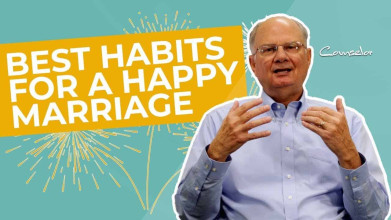




John Fuller: Today, author and researcher Shaunti Feldhahn shares the secrets of extremely happy marriages.
Preview:
Shaunti Feldhahn: And so, I had been looking for years to find out what can a woman say to her husband that has the same emotional impact on him that “I love you” does on a woman. And in this study, we finally found it and it’s “thank you.”
End of Preview
John: You’ll hear today how simple actions like saying thank you can maximize the happiness in your marriage. Welcome to Focus on the Family with Jim Daly. I’m John Fuller.
Jim Daly: John, I am really excited to air this message from Shaunti Feldhahn today and next time because she offers some great ideas that she learned from couples who have exceptional marriages. Isn’t that great? Her premise is simple. The best way to have a good marriage is to find out what the extremely happy couples are doing and emulate them. And in her work as a researcher, Shaunti has been able to survey thousands of married couples and then take the time to dig deeper into the relationships in which both the husband and the wife independently reported high degrees of satisfaction in their marriages.
John: Yeah, I like that approach to what she did there. And I should note that Shaunti received her graduate degree from Harvard University, and she was an analyst on Wall Street, so she’s got great credentials.
Jim: And John, before we start Shaunti’s message, uh, let me point out that this advice is for people who have generally good marriages and just need a tune up. It is not for people who are in a marriage that could be considered abusive.
John: And of course, if that’s your situation, get to a place of safety for you and your children, and then, um, when you’ve settled, give us a call. We have free, uh, consultations that we can offer with one of our caring Christian counselors, and we really wanna help. And the number is 800, the letter A, and the word FAMILY.
Here now is Shaunti Feldhahn speaking at a convened conference for Christian business leaders in Southern California. It’s today’s episode of Focus on the Family with Jim Daly.
Shaunti: Thanks for coming to this session on how to make a happy marriage. Uh, for all of you who are, well, pretty much everybody here, you’re an influencer. You have, as I was telling the people in the last breakout session, you have been given this incredible gift, um, by God of being put in a, a position to really influence others, to influence the people who work with you, to influence our culture in a way that a lot of people don’t have. And one of the things that means for you is that you also really need to be attuned to being an influence in how your personal life runs. Um, because we all know that, um, especially as believers, especially as those who try to follow the ways of Christ, we all know that our marriage is supposed to be a reflection of Christ and the church.
We all know that our marriage is supposed to look like the closeness that, that the Trinity have with each other, that, you know, God says, “This is me and Jesus.” And, and sometimes it feels like that and sometimes it doesn’t. And so, I’ve been studying what are the things that make it feel like that? What are the things that are gonna lay the really, really great foundation? Because sometimes, when you get into issues in your marriage, it can just feel like a snowball that just feels really hopeless. There are a lot of, it looks like really big issues, almost insurmountable. How are we gonna solve this? And they look so big and overwhelming that sometimes it’s easier to kind of just back off and focus on work, or focus on the kids, or whatever it is, and not necessarily be able to focus on putting that strong foundation back underneath us.
And when we’re in… Like I said, when we’re having marriage issues, it can seem big and overwhelming. It can seem like there’s all these things that we have to do. And instead, there is a principle here that is incredibly important about looking for the bright spots and seeing what those role models, the people who have the happiest marriages, have to teach us.
The first and the most important thing that the research found that is actually is a prerequisite for a happy marriage, we don’t think you can be happily married without this. And that is that these happy couples chose to believe the best of their spouse’s intentions even when they were legitimately hurt. The happy couples chose to believe the best of their spouse’s intentions even when they were legitimately hurt. Everybody gets hurt. Every couple, even the most happily married couples hurt each other’s feelings.
I love what one guy said when we were interviewing them and they said, “You know, you gotta realize that even the most awesome, godly, Christian husband and wife can be a jerk sometimes.” (laughs) Everybody hurts each other’s feelings sometimes. The issue is what you choose to believe about your spouse’s intentions towards you when that happens, because it is natural, it is a human tendency for us to naturally think, and let me like putting myself in a wife’s point of view, if Jeff, my husband, if he hurts my feelings, it is a natural thing to subconsciously think, you know, kind of this “Ow, like he knew who, how that would make me feel, and he said it anyway.” And you don’t realize it, but subconsciously, what you’re thinking is “He doesn’t care about me.” But we found that statistically the vast majority of people do care. And the happy couples didn’t do that. They switched it.
So instead when the hurt came, it was “Ow, but no, no, I know he loves me. I know he cares about me, so he must not have known how that would make me feel or he wouldn’t have said it.” And they switch it in their brain. Same thing with the husbands. It’s a common thought for husbands subconsciously to think, “Nothing I do is ever good enough for her, okay? And no, no, I know she appreciates me. So she must not realize how that makes me feel.” And that switch is what is 100% necessary to have the most happy and abundant marriage. And it actually matches with, um, some of the studies that have been done that I think are fascinating. There was a study that was done by, um, a professor at the University of Maryland, and, um, and they did this with a group of college students.
I love college students because for 20 bucks they will submit themselves to almost anything in the clinical setting. (laughs) Like you can do almost any experiment on these kids. And so, this study ended up being called the Power of Good Intentions, okay? And what these college students did is, or what the, uh, scientists did is they had these students hooked up. They had these kids hooked up to all these electrodes to measure their physiological responses. And they also had a device that had a cord that would run behind a partition, and it would administer an electric shock, like a painful electric shock to these kids. And, um, the kids were told one of three different things about the person on the other side that was hitting the button that was administering electric shock.
Some of them were told that, yeah, you know, they know that this is gonna administer a shock, but they think it’s gonna help you win money if they do this, so sort of good intentions towards them, right?
The second group was told, oh gosh, you know, that button, it’s sort of in the wrong place, and people just hit it accidentally. I’m sorry. You know, sort of that it was random. It wasn’t intentional. It was un- unknown.
The third group was told that, yeah, they kind of know they’re hitting the button, and they think it’s kind of fun (laughs), you know, to cause you some pain, right, so not good intentions. The level of the voltage, the shock was exactly the same across all three groups, exactly the same. The physiological responses were totally different. If the people thought they were trying to help them win money, the shock registered, the pain registered at a fairly low level. If they were told that it was an accident, it was a little bit higher. And if they were told it was on purpose, the pain was higher.
The physiological response was worse just because they thought that person had bad intentions. It works the exact same way in marriage. Your feelings will be hurt. You need to choose to believe that they didn’t mean to do it that way, that they care about you. And the good thing is that’s not just wishful thinking. We found on the survey that something like 99.37 something, something percent of people deeply care about their spouse. Even, by the way, this might shock you, it sort of shocked us. Even in the most struggling marriages, even in the marriages where they were at the most sort of desperate place in their marriage, it was something like 97 point something. Almost everybody cares. The key is whether you choose to believe it.
So let’s move on to the next topic. The next issue is that we found that one of the secrets of the most happily married couples was something that, again, they didn’t really realize that they were doing. Some people were doing this on purpose, but often, it was just sort of something they had discovered worked, and it was just a part of sort of daily life. Um, and that is that the wives all tended to do the same five little things for their husbands, and the husbands tended to do the same five little things for their wives. And so, what happened was, as each spouse did these little things without half the time even realizing that they were doing them, or they were a big deal, what was happening in the heart of their spouse is it was building up this feeling subconsciously, this is all subconscious, building up this feeling that “my spouse cares about me,” and building up this reservoir of goodwill so that when those inevitable shocks happened, it was easier to believe the best of their spouse because they know that they are cared for.
They feel cared for. So, what were those things? We don’t have time to get into all of them right here. Um, but let me just mention a couple on each side. The, um, happy wives for the husbands, they tended to tell their husbands thank you a lot. We had been looking for years and years and years after having discovered in the study of men, um, something that is no surprise to any man, but as a surprise to most women, that men have a completely different insecurity running under the surface than we women do. And that if we women, if our insecurity, our question is like, “Am I lovable, and does he really love me?” The men’s question is more, “Am I able, like am I any good at what I do?” And there’s a lot of insecurity around that. And we as women don’t realize you big, strong men look so strong and confident, and on the inside you’re kind of like, “Uh, I wanna be a great husband, but I’m not sure I know what I’m doing.”
John: You’re listening to Shaunti Feldhahn today on Focus on the Family with Jim Daly, and you can get her book The Surprising Secrets of Highly Happy Marriages for a donation of any amount when you call 800, the letter A, and the word FAMILY. Or contribute to the work here of the ministry and request the book at our website, focusonthefamily.com/broadcast.
And we have a free gift for you today, the Nurturing the Heart of Your Spouse audio collection. It has a full six hours of encouragement for your marriage, and includes messages from Shaunti, this one in particular, plus wisdom from Dr. Greg Smalley, Dr. Ken Wilgus and Dan Seaborn. It’s a great free audio collection, and you’ll find it at our website. Let’s return now to more from Shaunti Feldhahn.
Shaunti: And so, the need of men is to feel appreciated and respected like my wife trusts me. And I thought, okay, that’s good. You know, learning, and for women only, that “my husband needs to know that I respect him. That’s important. I love to hear I love you, so I need to say to my husband, you know, the parallel,” so I would follow my husband around the house and be like, “Oh, honey, I respect you so much.” And after a while, my poor husband was like, “Um, (laughs) I’m sorry. That just, like, I know what you’re trying to do, but it doesn’t have the same ring to it.” And so, I had been looking for years to find out what can a woman say to her husband that has the same emotional impact on him that “I love you” does on a woman. And in this study, we finally found it, and it’s “thank you.”
And it makes perfect sense, ladies, because if a man really has so much self-doubt, if that really is in our big, strong man, and if the question really is, “Man, I want to be good at this, but I’m not sure that I know what I’m doing,” then what could be more powerful than saying, “I noticed what you did, and it was good, and I appreciate it.” And that’s what thank you says. It hits all these notes, and it’s the little things of life, not necessarily the big ones. It’s, “Thank you for noticing that the light bulbs were out and changing them. Thanks for coming home early to take the kids to soccer, you know, when I wasn’t feeling well. Thank you for, I know you were tired and you took the kids out into the yard and you played ball anyway, you’re such a good dad. Thank you, thank you, thank you.”
And we have no idea how much that fills up a man in every way that he needs to be filled. These happy couples, the wives half the time, they didn’t even realize it was such a big deal to their husband, but it was one of the main reasons why they were so happy. Um, another thing that the wives tended to do for the husbands is, let’s just say that he knew that she desired him sexually. She had shown him that she desired him sexually, and that was actually something that either it was something that was a big deal to her, so it was a big deal to them as a couple, or she knew that it was something that really mattered to her husband. And so she was making sure that she was thinking about making that a priority.
And I wish we could go into more of the detail about what physical intimacy means to our husbands. We just don’t have the time for that here but suffice it to say that we women think of it as, in marriage, as being primarily a physical need. And it turns out that statistically for men, actually, it’s the importance of it is primarily an emotional need to feel desired by his wife. And then that gives a man a sense of confidence and a sense of wellbeing in all the other areas of his life. That’s something that is so unknown to so many of us as women. Now, for some women we’re flipped on this. There’s plenty of couples where it’s the wife who has the higher libido, but in the majority of cases, this is an area that absolutely tells our husband, “I care about you,” and gives him that certainty as a buffer against the shocks of marriage.
Okay, so flipping it, those are the little things that the wives tend to do for the husbands. Like I said, there were more of them. I wish we had time to get into them. The next, the parallel, um, side of things is what the husbands tended to do for the wives. And this is an area, again, where sometimes it was just a subconscious thing, but the husbands tended to show their wives physical signs of affection when they were out in public. And it’s not like, “Yeah, I’m doing this because I want sex later.” It was literally like the husbands would reach across and take their wife’s hand when they were walking across a parking lot, or when they were sitting together at church or they were at dinner and they were at some public place and they were sitting together, the husband would just reach over and put his arm around her in church.
And now, by the way, as a quick aside, when you see the other person do these things that I’ve been mentioning later, you know, when she looks for something and says, “Thank you,” or you’re sitting at church and he puts his arm around you, ladies or guys, you’re not allowed to say, “You are only doing that because she told you to,” right? Believe the best when your spouse tries those things. And guys, just be aware, we’re talking about these little things. They really do. Another little sign that, um, that really mattered to show your love for your wife was things like texting her, or leaving her voicemail during the day, just as almost that you have that flash, you’re pretty busy at work, but every now and then a flash comes across your brain of how much you care about her and you… If, what the women said is, if literally it’ll take 10 seconds and send that text message right when you’re thinking of it to say, “You know, I can’t wait to come home to you. I love you so much.”
It’ll take you 10 seconds. But the women said things like, “I saved that voicemail,” you know? Because it’s a little thing, guys, but it really does matter. So, that’s one of the types of things that the, the happy husbands tended to do for the wives. Another thing is gonna sound kind of funny, but every woman in the room knows how much this matters. Guys, you don’t realize it, but when you have had a bad day, or the two of you are a little bit at odds, you, you men can sometimes walk around with the black cloud hanging over your head. Something is triggered in your wife that you have no idea is there.
And it’s a really important principle, and if you can grasp this, it changes everything. Just like if women can grasp just how much self-doubt is inside their man and speak into that, it changes everything. See, guys, what you don’t realize about your wives is that she doesn’t feel permanently loved just because you said, “I do.” For you, when you get married, the question of whether she loves me is kind of, that’s sort of it. Like it just doesn’t come up in your head really.
And guys, you need to know that just because she walked down the aisle and you said your I dos, it’s not like, “Okay, onto the next thing.” Like there is no switch in a woman’s brain that gets flipped to the, “Oh, I feel permanently loved” position. And that she has this question just like you do that is still there. Your question is, like I said, it’s, “Am I able? Am I adequate? Do I measure up? Am I any good at what I do? Do I have what it takes?” That question is in there. It’s probably the result of the fall, right? It’s just in there for you as a man.
For her, the question is, “Am I lovable? Am I special? Am I beautiful?” And that does not change just because she got married to you. In marriage, it just morphs to, “Does he really love me? Would he really love somebody like me?” And if there’s an issue, if there’s a black cloud of doom following around, if you’ve had a conflict, that question gets triggered, and it’s rising up, and it’s that you had that argument over breakfast, and it’s roiling in its, in her gut, and it’s this, “Ah, are we okay?” And it’s a feeling like nothing is right with the world until that is resolved.
Ladies, you know what I’m talking about, right? It is such a subtle and incredibly potent feeling. And so, guys, just think about it this way. When you have that argument over breakfast, you’ve, you’re emotionally, there’s a problem, you’re like mad, and you’ve got to get to work, you’ve got a client meeting, you got to go. You get in the car, you back out of the driveway to go to work, and as you’re driving away, what happens to the thought of that argument, guys?
Audience: Disappears.
Shaunti: Click. It disappears. It’s gone, right. Ladies, in your mind, is it gone?
Audience: No.
Shaunti: (laughs) No. It’s, guys, what’s happened is that underground question has risen up, and that’s the, “Uh, are we okay?” And that is gonna be roiling in her gut until she is reassured. A powerful message of love to your wife is what the happy husbands did sometimes without even realizing that it was such a big deal, which is when you’ve had that conflict, to say something like, before you walk out the door, to say something like, “Look, I’m angry, black cloud of doom. (laughs) I’m angry. I need to get to work. I need some space. I can’t even talk right now, but listen, I want you to know we’re okay.”
It’s a huge issue for your wife. And even huger, if you will recognize that the black cloud of doom itself can cause that insecurity, and work to pull yourself out of that funk, and shake it off so that when you come back after work, or when you come back an hour later from your workshop, or whatever it is, that you’re okay again. That is a priceless, priceless signal of love, even though you didn’t realize that it was. So, write down the words, “We’re okay,” and that’s huge, just like “thank you” is for a man.
John: Some enlightening marriage tips from Shaunti Feldhahn on today’s episode of Focus on the Family with Jim Daly.
Jim: Yeah, this is eye-opening stuff, John. And I think if our wives were in the studio with us, they’d say, “Yes, she’s nailed it.” And I so appreciate Shaunti’s ability to break down these ideas for a great marriage into simple concepts that all of us can use each and every day. For example, I can say, “Don’t worry, we’re okay” when Jean and I have an argument on my way out the door or a disagreement.
John: Disagreement, yes.
Jim: And I know that I really do feel great when she thanks me for something simple, like taking out the trash. We guys like to be heroes for our wives, uh, don’t we?
John: Yeah, I, certainly that’s the, in my case, when she says, “Thanks for doing that,” I just feel like “I’ll do that 100 times now for you.” I just, I, I feel like I’m making it. I’m a better husband.
Jim: It’s such a powerful motivator, and the opposite is true as well. If we feel like we can’t do anything right in our wives’ eyes, uh, we lose heart, and we basically stop trying. We just feel defeated. And that is not a good dynamic to have in a marriage.
Well, let me just remind you that today’s program was intended to encourage those of you who have a reasonably healthy marriage that just needs a tune-up. And we have even more encouragement for you. Visit our website to download a free collection of inspiration and advice from some of our favorite marriage experts. Six hours of content, including this message from Shaunti.
John: Yeah, look for the Nurturing the Heart of Your Spouse collection at focusonthefamily.com/broadcast.
Jim: Now, if your marriage is in serious trouble, please give us a call for a free consultation with one of our caring Christian counselors. We have marriage specialists who will give you a call back, spend some time with you on the phone, and then refer you to a like-minded counselor in your area if needed.
John: Yeah, and let me just note the number is 800-A-FAMILY. And, uh, our counseling team might recommend that you attend one of our Hope Restored intensives, which are phenomenal. They have an 80% success rate with marriages that are struggling seriously. Uh, some of these marriages that are saved are on the brink of divorce.
Jim: That’s right, John. Hope Restored is truly a unique ministry to marriages specifically, using a four-day intensive strategy that helps you, uh, disconnect from the busyness of life, and focus on your spouse and your marriage. And that’s made possible through the support of our donors who are able to do ministry and help marriages by giving to Focus on the Family. So let me invite you to join the team, be an active supporter of marriages by donating today to bring hope and joy to couples who need encouragement.
And when you make a donation of any amount, I’d like to send you a copy of Shaunti’s book, The Surprising Secrets of Highly Happy Marriages.
John: Yeah, the book is a great follow-up to this broadcast. In fact, one online reviewer who called himself Grumpy Old Guy said it was the most useful and succinct marriage book he’s ever read, and he added, “No filler or fluff, just great ideas for husbands and wives.”
Jim: Well, if you can get to the Grumpy Old Guy, you’ve done something right, and that’s quite an endorsement. Get your copy of Shaunti’s book from us today. Right now, special friends of this ministry are offering to double your gift so you’ll have twice the impact.
John: Yeah, call now. Our number is 800, the letter A, and the word FAMILY, 800-232-6459 or online uh, you can donate and request your copy of The Surprising Secrets of Highly Happy Marriages at focusonthefamily.com/broadcast.
Remember that when you’re online with us, you can look for a free audio collection called Nurturing the Heart of Your Spouse. Six hours of great marriage material. It’s free, and you can sign up at the website.
By the way, if you enjoyed today’s program, tell a friend to tune in next time as we continue with Shaunti and hear more practical encouragement for marriage.
Preview:
Shaunti: We found that no matter what the happy couples, how they viewed each other, all the things that they did, one of the primary things that they considered about the other person was they considered that their spouse was their best friend.