

Day One:
Woman #1: When I found out that I was having a boy, I was really excited, but also nervous.
Woman #2: Having three sons, there is never a dull moment.
Woman #3: Out of the blue. They’ll just grab you and hug you and say, “I love you, mom.”
Woman #2: Always, um, activity and roughhousing.
John Fuller: Well, maybe you have some young boys growing up in your family and you can relate to those comments. Today on Focus on the Family with Jim Daly, we’re gonna be exploring that special relationship between mom and son, especially during the early formative years. Thanks for joining us. I’m John Fuller.
Jim Daly: John, here’s a no-brainer. I can’t speak for moms, but I can speak for dads and I love being a dad to my two sons, and it was so much fun. I’m not sure…Jean would agree, it was fun, and we loved every stage of that adventure, but regardless of what the culture says, girls and boys are different, (laughs) and it shows up-
John: Mm-hmm.
Jim: … on day one. And as you unfold that, uh, relationship with them, with your sons, you see the energy. Uh, men sometimes they’re just bouncing off the walls, running through the house, throwing things around. Yep, probably breaking things, spilling things, daring things, you know, jumping off of fences and trees and all those things. And, uh, today we do, as John said, we wanna talk to you about how to be the best mom you can be in that situation. (laughs) I remember one of the funniest, and it only happened one time. I came home from work, it was probably 5:30 and I walked through the door and Jean has the two boys, and they’re young, probably two and four. “Here, take ’em.”
John: (laughs)
Jim: “I’m done today.” And I mean, I was like-
John: Yeah.
Jim: … “Can I just change my clothes?” And, but she … It was the only day that happened and that must have been a bad day.
John: (laughs)
Jim: But, uh, we want to quip you so even bad days are good days.
John: Mm-hmm. And our guest is Molly DeFrank back, uh, into the studio with us. She’s been here before. She’s an author, speaker, and mom of six kids. Uh, she’s got three boys and three girls. She has a lot of experience, uh, as a mom-
Jim: (laughs)
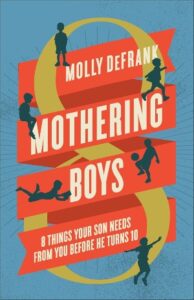
John: … and she’s turned, uh, her experiences in that physical world of boys, uh, that you were describing Jim, into a great book called Mothering Boys: 8 Things Your Son Needs from You Before He Turns 10. So, uh, get a copy of this book, learn more about Molly, uh, stop by our website, and that’s FocusontheFamily.com/broadcast.
Jim: And you know, in addition, John, I mean, the stuff we’re gonna talk about when it relates to moms and their relationship with their sons applies to dads too. So don’t, don’t tune out.
John: Yeah. There’s a lot for dads to learn here.
Jim: If there’s a day … Right. Exactly. Molly, welcome back.
Molly DeFrank: Thank you so much for having me. It’s such a joy to be here.
Jim: Yeah, it’s good. Thank you for traveling from California. We enjoy that. And we, I’m from California, so I love that. You’re from the middle part of the state, the-
Molly: That’ right.
Jim: … agricultural area. So you’re, you know, seeing a different part of California than where I grew up in Southern Cal, but welcome.
Molly: Thank you.
Jim: So good to have you.
Molly: Thanks so much for having me.
Jim: Now, six kids, that sounds Brady Bunch. She had three boys and three girls, so that’s awesome. That’s a lot though.
Molly: It’s a lot. Yes.
Jim: So most moms, the mom question I’d want to ask is, how do you manage that?
Molly: (laughs) You know, it is a lot of kids. So we have three boys and three girls. We have four biological kids, and then two came into our family through foster care.
Jim: That’s great.
Molly: Yeah.
Jim: Congratulations.
Molly: That’s great. Thank you so much. Yeah, they’re ages 9 to 16. So we, we got ’em all within-
Jim: (laughs)
Molly: … seven years of each other. So it’s loud, it’s crazy. The car is messy sometimes, but it’s, it’s full of joy and fun at the same time.
Jim: That’s so good. So you got the PhD in motherhood, obviously-
Molly: (laughs)
Jim: … just through experience. Let’s kick off with a funny story that you had in the book. I think one of your kids, two years old and you had a syrup disaster. What happened?
John: Ooh.
Molly: Oh, yeah. I love sharing the story-
Jim: (laughs)
Molly: … with, (laughs) with other moms who are in the trenches because lemme tell you, first of all, this ministry, this podcast, this show has ministered to me-
Jim: Oh.
Molly: … in my early motherhood when I was in the trenches, really in this, in the days of this story. Um, it is-
Jim: (laughs)
Molly: … hard raising young kids, especially those two, three, four-year-olds and especially boys.
Jim: Yeah.
Molly: Um, when, when my son was two, he was so much different than my older daughter. He was wild and bouncy. And in fact, I was concerned he had these sensory seeking behaviors.
Jim: (laughs)
Molly: So I took-
Jim: It’s called being a boy. (laughs)
Molly: That’s true. Yeah. Um, but I took a call from the doctor. I was, he was calling me back to, to address these concerns that I had. And so I looked at my son, he was in his high chair, he was set up with his waffles all cut up nice and small. And I said, “He’ll probably be fine here for a few minutes while I take this phone call in the other room.” And that’s probably when the narrator would’ve said, “He will not be fine.”
John: (laughs)
Molly: Because-
Jim: Always have an eye on that boy.
John: (laughs)
Molly: (laughs) You’re right. Rookie mistake. ‘Cause I came back in the room after this phone call, my son had managed to climb out of his high chair onto the wooden kitchen table. He grabbed the Costco-sized jug-
Jim: (laughs)
Molly: … of syrup, of maple syrup, poured it out onto the table, and then sat in it-
Jim: Oh.
Molly: … and was rubbing it onto his face and his hair. And I am looking at this kid like, “Are you kidding me?” This is unbelievable.
Jim: (laughs)
Molly: And I love sharing this story because, you know, this book talks about eight things your son needs from you before he turns 10. And for moms dealing with stuff like that. And if you’re raising a boy that age, you’re dealing with stuff like that. Right? This can sound lofty and stressful, but what I wanna encourage moms with is this book and these ideas are, are really things that you can use. They’re just a little bit of intentional mothering right in the trench.
Jim: Yeah.
Molly: It doesn’t cost a dime. It’s things you can do in the waiting room at the doctor’s office, in the car rides, in the conversation over dinner that really just give our boys what they need.
Jim: Well, and I think that, getting back to it, you also speak in the book about writing the book about the importance of noticing those positive things that your boys do when there’s so (laughs) many easy negatives, right? Just the energy and all that and messiness. But how did you practically address that with your boys to say, “You know, I love you. I see so many great things in your future.” I’m kind of doing it here for you.
Molly: Yeah.
Jim: But so describe that importance of reaffirming them. ‘Cause boys, you know, it’s interesting, uh, the way somebody once described it to me, boys, especially in the relationship with their mother, they’re really fragile.
Molly: Mm-hmm.
Jim: They don’t like shame. They don’t like disappointing you. I mean, it, it’s really interesting. I think girls and moms, daughters and moms, you can have it out hug and you’re off to the next thing together emotionally. Boys, when they feel like they let you down, it’s a male thing.
Molly: Mm-hmm.
Jim: Like, I did not perform the way I needed to.
John: Mm-hmm.
Jim: And it’s a disappointed mom and she’s angry and we don’t know what to do with that. So speak to that idea of belonging. Belonging to something big and important.
Molly: Mm-hmm.
Jim: And how do we get that son to realize that they belong to a big story?
Molly: Absolutely. Yeah. And you bring up a good point. And that’s really the first thing of these eight things that I encourage moms to instill in their kids is that sense of belonging. And we have this privilege of showing our young sons that they belong in our family. They are loved, they are fully known and fully loved. They have intrinsic inherent value because they’re an image bearer of God. And so we get to reflect that message. We get to live it out day in and day out in the minutiae, in the trenches, in the chaos, in the syrup. Um-
Jim: (laughs) In the syrup.
John: I love it. (laughs)
Molly: (laughs) Right? In the-
Jim: That’s gonna be the common theme here. (laughs)
Molly: (laughs) But, you know, it also goes back to when we see those negative traits, we see the positive and really wanna build up our sons in that. But we also know our sons probably better than anyone. And so we get to see these traits in our kids-
Jim: Mm-hmm.
Molly: That no one else on the planet is probably gonna … You know, if our kid is acting annoying maybe at school or being overly chatty or meddling, kids aren’t gonna say, “Hey man, you’re really struggling with this thing where you’re meddling in other people’s business and it’s kind of annoying, so maybe work on that.” They’re just gonna walk away and play with someone else. So that’s our job as moms to really kind of get that trait on the right track. And so I have a, a part in the book where I highlight these traits that can be maybe negative on a bad day, but those same traits, those same wirings on a good day can be used for good and for godly purposes. And, and there are Bible stories to support this. Like I’m thinking about if you’re stubborn on a bad day, you’ve got someone who’s firm in their convictions on a good day. And I think about Moses, who God came to him. God Himself showed up to Moses and was like, “Hey, Moses, I need you to go do this thing.” And Moses like four or five times was like, “I don’t know about that.” And you’re like, “Moses, God Himself came to you and is telling you.” Like that’s pretty stubborn to kinda make excuses for God. But then you see the same guy went to Pharaoh and he did, he advocated for the Israelites and he led 2 million people out of Egypt-
Jim: Mm-hmm.
Molly: … and for decades. And I’m thinking, “That’s some guy who’s, who is stubborn, he’s, he’s, he’s firm in his convictions.” I can’t think of another human who could do something like that.
Jim: Yeah.
Molly: So as moms, we get to, to notice these traits and say, “Gosh, how do we put this, this trait that can be hard and bad on a, on a bad day and kind of channel it for good?”
Jim: Yeah.
Molly: And there’s all kinds of examples in here.
Jim: The next one is relationship. And I think in that regard, um, you know, all these can help roll into identity, which is a real crisis right now. Who am I? Why was I created? Was I created? Did I come from mud? I mean, all those questions, uh, young boys might have and young girls too. But concentrating on young boys, relationship … Boys are lonely today. I mean, I think many experts in men would say that we’re loners already. You know, when we go to do something, we usually need to go do something. ‘Cause we don’t sit down and have coffee with guy friends. We don’t, “Tell me how, how’s your heart? Where you at Bob?”
Molly: Yeah.
Jim: We gotta go play golf or go do something shoulder to shoulder.
Molly: Mm-hmm.
Jim: And then hopefully, you open up to one another and you don’t come home and say, “Hey, you spent four hours with Bob. How’s his marriage?” “Oh, I don’t know. We never talked about it.”
John: Mm-hmm.
Jim: So hopefully, you can engage at a deeper level by sitting in the cart together, whatever it is you do together, but relationship matters. How do you begin to encourage your sons at a young age and toward the benefit of relationship and actually help make it happen?
Molly: Oh, yeah. Well, we just can’t overstate the importance of our son’s ability to build and navigate relationships. Two out of three young men say that no one really knows me.
Jim: Two out of three?
Molly: Two out of three.
Jim: That’s lonely.
Molly: That is so lonely. And, and also, have you heard of the Harvard study? It’s like the longest study on, um, they took hundreds of men over the course of multiple decades and they wanted to see what was the best predictor of health and longevity and happiness. And they looked at men from all kinds of backgrounds. Blue collar, white collar, different educational levels, income. They found the best predictor of happiness and longevity wasn’t money, it wasn’t cholesterol levels, it wasn’t exercise. It was the number and quality of relationships these men-
Jim: Yeah.
Molly: … had in their lives. So this is really important for our son’s long-term development. It’s no wonder there’s a six-year age gap in life expectancy for men and women, ’cause women do tend to be more relationship, but … Relational. Here’s the good news is moms, we are standing in the perfect position to build our son’s capacity to navigate relationships. And I really break it down ’cause I wanted to make it simple for moms of the youngest kids. So really, if you can build up that eye contact, those conversational skills and help them figure out how to navigate conflict, you’ve gotten them way more than halfway. So that’s what I’ve got the several really great ideas for moms to really pour into their sons in that way.
Jim: That’s good.
John: Molly DeFrank is our guest today on Focus on the Family. And, uh, you could find her insights and so much more in this great book, Mothering Boys: 8 Things Your Son Needs from You Before He Turns 10. Wonderful stories and really biblical insights and practical things that you can do as a mom to equip your son to do well in life. Uh, get a copy of the book from us when you call 800 the letter A and the word FAMILY or stop by FocusontheFamily.com/broadcast. And Molly, uh, going from syrupy snacks-
Jim: (laughs)
John: … we’ll go to salty snacks.
Molly: (laughs)
John: Uh, you had a story about Cheetos and this wasn’t, uh, kids outside of the home. This was kids inside the home. There was a fight, I can’t imagine.
Jim: (laughs)
John: Why would kids fight over Cheetos?
Jim: (laughs)
John: And how did you handle that?
Molly: Oh, yeah.
Jim: Why do adults fight over Cheetos?
Molly: Right?
John: (laughs)
Molly: That’s a good question.
Jim: (laughs)
Molly: Yeah. You know, I remember one day, um, I picked up my kids from school and then we had to go to another school to pick up another kid. And the kids are in the back seat and they’re tired and they’re hungry, and it’s right after school, and a fight broke out over Cheetos, okay?
Jim: (laughs)
Molly: Because fights will break out over anything-
Jim: I love it.
Molly: … as moms. So, um, and I just remember feeling so discouraged and I just wanted to get out of there and drive home, but the practice wasn’t over yet. And it just, it devolved, it broke down quick. And I realized, “Hey, you know what? We are stuck in this car. We better figure out a way out of this thing.” So I told my kids, I said, “Hey, listen, stop, here’s what we’re gonna do. You’re gonna compliment the person next to you. Okay? You’re gonna say one thing you love about that person.” So the kids were quiet for a second, and then my older son said, “Um, Mason has crazy hair today.” And I’m like, “Okay, well, this is not going very well.”
Jim: (laughs)
Molly: So I didn’t respond. And I said, “Mason, why don’t you try it with big brother, something you love about your brother, something you think is great?” And he said, “You know what? He’s really athletic and he’s good at cooking.”
Jim: (laughs)
Molly: And so-
John: Wow.
Molly: And he really busted out a good compliment. So the, the car fell silent for a second. And my older son, who was a little humbled by that, said, “Can I get a redo?” And so he gave-
John: Mm-hmm.
Molly: … a genuine compliment to his little brother.
Jim: Oh, that’s great.
Molly: And it started becoming contagious. So the siblings started complimenting each other. And after a few minutes, the entire climate of the car ride just changed.
John: Mm-hmm.
Jim: Yeah.
Molly: And I really had to resist the urge to drive the point home and say, “See, isn’t this better?” ‘Cause I knew-
Jim: Yeah.
Molly: … I could tell the experience made a difference for them. But, but really, I, I just wanna encourage moms, you know, some days, 90% of the times, I’m trying intentional stuff like that, it, it flops. (laughs) Some days they don’t work. But I would just, I’m really encouraged by a verse in Ecclesiastes, it’s sow your seed in the morning and at evening, let your hands not be idle for you do not know which will succeed, whether this or that, or whether both will do equally well. So we don’t know which seeds we’re planting will sprout. We don’t know. But that’s kind of beyond our pay grade, right? God calls us to plant these seeds and to water them, and then He gets to decide beyond that what happens with it. But just to encourage you, moms, there are opportunities all around you right. In the midst of conflict to teach your kids how to navigate that conflict, how to love each other in the conflict. And these lessons are so valuable for our kids.
Jim: And so I, I have a bonus question-
Molly: Yeah.
Jim: … in the marriage space here.
Molly: Oh, yeah.
Jim: So your husband, when he looks to maybe vacuum the car out for you, I’m assuming you don’t have white interior with (laughs) Cheeto fights-
John: (laughs)
Jim: … in the back.
Molly: And so … (laughs)
Jim: That’d be driving me crazy. I’d be saying, “Hun, no more Cheetos in the car.”
Molly: No. (laughs)
Jim: But it works.
Molly: Yes. (laughs)
Jim: That’s funny. Let me, before we leave this idea of relationship-
Molly: Mm-hmm.
Jim: … let me go back to the eye contact. And I, I, I kinda wanna, uh, hear your heart on this. We’ve had guests before in this space of mothering boys back to the shame factor. Um, boys struggle to look you in the eye when they’ve been naughty. It’s just really interesting. And these psychologists would say, “Don’t require your boys to look you in the eye.” Not everybody. Now this isn’t … You know, there’s no blanket statement here. This is just their opinion, but we often do that. And I did it as a dad, “Look me in the eye.” But they’re saying for boys, it’s a shame moment. And it’s hard-
Molly: Yeah.
Jim: … for them to look you in the eye because they know they did wrong. And so deliver it without requiring them to look you in the eye.
Molly: Mm-hmm.
Jim: Uh, how do you respond to that? And then again, you’re trying to say developing relationship, let’s have eye contact because that’s into the human soul.
Molly: Yeah.
Jim: So maybe differentiate between those two moments, a moment of coaching and then a moment of correction and how that could be a little different.
Molly: Yeah. Well, I think it’s particularly important for moms of young boys who are getting in trouble a lot, especially if they’re like bouncy and wild like some of mine were. Um, it’s really important for us to create spaces to have connective eye contact.
Jim: Face contact.
Molly: Yeah. Because so much of our relationship with our boys is going to be corrective. It’s gonna be directive. “Hey, go put your shoes away. Hey, stop doing that.” And we really need to work a little harder to look them in the eye and just say, “Hey, I love you. You’re my little buddy. I love being your mom. You’re awesome.” And they’ve actually studied that you can accelerate relational closeness through eye contact. I came across some really interesting research, um, that I know might be controversial, but it said there are people who studied, um, babies who nurse, and they said, “We don’t actually-
Jim: Mm-hmm.
Molly: … know if babies who breastfeed are better off because of the chemical compounds in the milk or because they get more eye contact with their mom.”
Jim: Right.
Molly: We don’t know what the difference is. So, so that, I mean, you could probably argue either side of that, and I don’t know what the answer is, but it was at least very interesting to see how important eye contact.
Jim: Yeah.
Molly: And positive eye … It’s something we need to work for.
Jim: I don’t know if we understand as human beings how those little things make such a difference in our development as infants, as toddlers, et cetera. I think we take for granted those things. We don’t observe as intuitively as we should. Just those subtleties of what helps develop a healthy human being and how God designed us to develop in that way. So when we start introducing different things than what God intended, and maybe you have to, there’s no guilt with this, but then you need to be aware so you can compensate for that. That, and I like that. That’s good. If you can’t breastfeed obviously, and you’re bottle feeding, just make sure you’re replicating that moment by looking at them as you bottle-feed them, et cetera. Same for dad as they bottle-feed too. It’s good.
Molly: Yeah.
Jim: But those kinds of things. Yeah.
Molly: Yeah. Yeah. And it’s a really interesting point, um, to your point about shame and eye contact. It makes me think about, even as adults, sometimes we have a skewed view of how God sees us. And sometimes, a friend had asked me an interesting question, how do you think God sees you when He looks at you? And sometimes we have this skewed view like, “Oh, He’s tsk, tsk, tsk.” You know? Or He’s like saying, “Ha, I’m so ashamed of you.” But, but where does that come from?
Jim: Yeah.
Molly: You know, and, and if we are able to model for our kids that no, your, your parents are just, are totally for you. And sometimes you need correction and sometimes you need to be dire- redirected. But, but guess what? In Christ, we are fully loved and fully known and our value never changes. So as moms, the more we’re able to look in our son’s eyes and them to feel fully known and fully loved, the more we’re really giving them a, a better, more accurate picture of how God sees us.
Jim: Yeah. Number three was authority. Now this, we could spend a long time on this, this right here would be the reason to get the book. So you can go into more (laughs) in-depth study of this issue of authority. This is probably one where boys really struggle. You know, it’s that proverbial thing. Don’t go over this line. If you do, you’re gonna suffer the most horrid consequence. And you walk away and the first thing the boy wants to do is put his toe over the line and then his foot, and then his body. And look what I’m doing. So in this area of authority, what’s like a single, uh, observation that you would want to make before we go to the next one?
Molly: Yeah.
Jim: Just to say what’s critical about authority.
Molly: Well, I think Tim Keller said it best that it’s respect for your parents. That is the basis for every other kind of respect and every other kind of authority-
Jim: Mm-hmm.
Molly: … in your life. So it is critical that when our boys are little and they’re testing those limits, and they will ’cause they’re human beings, right? When they test those limits, we have to hold the line. We have to enforce our authority and really, um, natural consequences, making our boys wait, making them practice patience. These are just the critical fundamental components. And, and, you know, you look around, our culture is not engineered for teaching kids to wait. It’s engineered for digital pacifier. “Oh, we’re waiting. I don’t wanna deal with it. Hand ’em the tablet, hand ’em the iPad.” That is not helping our boys. That’s eroding the skills we’re trying to develop in our sons. So it’s so important that we teach them that, “Hey, guess what? If mom says no, if dad says no, the answer is no.” Um, it’s also important, I think to, to share with our sons Bible verses. And I do recommend parents for your youngest sons, use different translations. Use N-I-R-V. That’s a very easy to understand translation of the Bible, but it’s everywhere. Colossians says, “Children, obey your parents in everything that pleases the Lord.” Let’s teach our kids to please the Lord. Teach them to obey their parents, teach them scripture. Um, I think it’s also really beneficial to model this struggle out. You know, when we pretend like we have it all together, we never struggle with this, that’s a lie, that’s gonna blow up. One day, the kids will see like, “Hey, guess what, we’re human beings too.” But when we’re willing to kind of share out with our kids, “Hey, you know, I didn’t wanna get outta bed for church this morning. I was so cozy, I didn’t feel like going, but I know that God says don’t forsake the gathering. I know that He calls us into life with believers.” So I said, “I’m gonna do what God says, and I’m so glad I went anyway.” And so sharing these tidbits with our boys really gives them permission to share authentically too and to, to struggle.
Jim: Yeah. I, I think in that space of authority, one of the big things is explain it.
Molly: Yeah.
Jim: Just explain it why this works and why it has to be this way and the need for it. I remember the boys stumbled into a bad word. They didn’t know the word, but they just stumbled into it. I’ll leave it at that. And Jean, they kept pressing Jean at home and they were young, probably like eight, and I don’t even know, 8 and 10, maybe a little younger. But Jean said, “Your father will tell you about it when he gets home.” So they made (laughs) these signs, “Tell us, tell us now.”
John: (laughs)
Molly: (laughs)
Jim: And they had written these posters and that’s all it said, “Dad, tell us, tell us now.” And I got home and I’m like, “What is happening?” And Jean said, “Hey boys, why don’t you go jump on the trampoline?” That’s a whole nother thing. But, uh, while they were out, Jean said, “Yeah, they stumbled onto a bad word. It’d be good if you could explain why they shouldn’t use that word.” So that all went down. But I was able to explain why you don’t use that word and what that word means and why you never use that word with anybody. And to their credit, I mean, they’ve been really good about, you know, curbing any of that with, especially around mom, but they’re just good at … But I think the, the why was important.
Molly: Yeah.
Jim: And I think sometimes as a, as parents and moms, we don’t stop to take the time to give them the fuller picture to, uh, tell them why that’s not appropriate and why that authority, why as your authority, I’m asking you don’t, don’t say that word again or whatever it might be. Fill in the blank. Okay. Right at the end, we gotta cover number four of the eight.
Molly: Okay.
Jim: Fun.
Molly: Oh, yeah.
Jim: I love this part. Jean would say, “Yeah, you do love this part.” (laughs)
Molly: (laughs)
Jim: Maybe too much so, but-
John: (laughs)
Jim: … but talk about the importance of fun in the relationship between mom and son.
Molly: Absolutely. Proverbs 17:22, “A cheerful heart is good medicine.” And we see that boys today are suffering from astronomical rates of depression and anxiety. Um, you know, it’s largely due to this digital world they’re living in, but also the breakdown of the family. So it’s so important for boys to experience this fun with their families. It ab- it actually has physiological benefits. It’s really interesting. Um, laughter reduces stress. It increases pain tolerance. It boosts the immune system. They actually tested out humor therapy with dementia patients.
Jim: Oh, wow.
Molly: And they found it to be as effective as anti-psychotic drugs.
Jim: Wow.
Molly: Yeah. It really-
Jim: That’s amazing.
Molly: Isn’t that incredible?
Jim: Just the dopamine releases, how God wired the brain.
Molly: Exactly.
Jim: That’s fascinating.
Molly: Yeah. It’s so incredible and shared, shared laughter deepens empathy and attachment. And there are so many ways for us to infuse fun. It’s really a super power for our kids. If they’re able to go through something difficult and still find the funny, it’s gonna help temper down that anxiety. Um, and you might be thinking too, you’re like, “Well, my three-year-old, my four-year-old boy that thinks he finds funny are words that belong in the bathroom only.”
Jim: (laughs) Yeah.
Molly: “So I would just encourage you mom that and dad that, hey, it’s also our job to educate our son’s sense of humor.”
John: Mm-hmm. Yeah.
Molly: To tell them like, “This is not appropriate humor.” But to show them things that are funny. And I have a lot of book recommendations in here for kids’ books that are hilarious that you can enjoy with your kids. (laughs)
Jim: (laughs) It’s good. Molly, this has been great. We’ve run out of time. Let’s hang on and, and go another day and, uh, explain the next four. So we’ve covered belonging, relationship, authority, fun. We got four more to go. Can you stick with us?
Molly: Absolutely.
Jim: Okay, let’s do that. I think you get the point here. These are really good things for moms to know about and think about and be creative with. Uh, the book Molly’s written Mothering Boys: 8 Things Your Son Needs from You Before He Turns 10. Pretty easy. Uh, but again, we’re so busy and life can get so hectic that if we’re not aware and then thinking about these things, it’s off the radar. So get the book and put it on your radar because these are valuable things that your sons will really benefit from, if you can deliver that as a mom. And I know you can.
John: Mm-hmm.
Jim: You can get a copy of the book from us directly. If you can make a gift monthly, that’s great. Let’s help other parents do a better job. And, uh, if that’s too difficult, a one-time gift is good as well.
John: Mm-hmm.
Jim: And when you send the gift, we’ll give you the book as our always of saying thank you for being part of the ministry.
John: Yeah. Join the support team. Request Molly’s great book, Mothering Boys and, uh, learn about the other resources we have for you here. Our website is FocusontheFamily.com/broadcast. You can also call us, of course. Our number is 800, the letter A and the word FAMILY. 800-232-6459.
Jim: John, here’s proof about the support that you provide Focus on the Family. So when I read this comment from Mary who contacted us, own it. If you’re a supporter to Focus, this is more to your credit than ours, we’re here, but you add the fuel that makes this ministry roar.
John: Mm-hmm.
Jim: She said, “Please know that your programs have indeed influenced my life. And those of my three sons in their growing up years, the Lord blessed and strengthened millions of families because of focus on the family, keep up the excellent work.
John: Mm-hmm.
Jim: Uh, that’s encouraging.
John: It is. And that’s why we’re here, Jim. I mean, we-
Jim: (laughs)
John: … we come in to work trying to help families with practical things and, uh, to help them biblically and to help them thrive in Christ. And so as you support the ministry, you’re helping us do that. And thank you and advance for your generous donations.
Jim: And Molly, thanks for being a part of that because the authors that come on that have expressed great content, um, it’s generous of you to come and be here with us. So thank you.
Molly: It’s an honor.
John: Hmm. And once again, our phone number is 800, the letter A in the Word family. And I want to tell you to swing by our website because there’s one more thing that I wanna mention. And that is our free online parenting assessment.
Molly: That’s great.
John: Which is gonna help you understand what your approach is to parenting, uh, how you might, uh, fine-tune it, some things that you’re doing well. It’s gonna give you some good conversation, uh, with your spouse. Uh, and you’re gonna be able to be stronger as a parent after taking this. It’s free, it’s online, uh, it’s our parenting assessment and it’s on our website. FocusontheFamily.com/broadcast. And thanks for joining us today for Focus on the Family with Jim Daly. I’m John Fuller inviting you back next time as we continue the conversation with Molly DeFrank and once again, help you and your family thrive in Christ.
Day Two:
Molly DeFrank: It’s really important for us to create spaces to have connective eye contact.
Jim Daly: Face contact.
Molly: Yeah. Because so much of our relationship with our boys is going to be corrective. It’s going to be directive. “Hey, go put your shoes away. Hey, stop doing that.” And we really need to work a little harder to look them in the eye and just say, “Hey, I love you. You’re my little buddy. I love being your mom. You’re awesome.”
John Fuller: That’s Molly DeFrank, sharing some of her passion and insights to help you parent your boys better. Molly’s back with us today on Focus on the Family with Jim Daly. I’m John Fuller, and thanks for joining us.
Jim: John, we had a great conversation last time with Molly. Good stuff. I mean, this is good mom stuff, but it’s also good dad stuff about what your boys need to know, eight things your boys need to know by the time they’re 10. And last time we did cover those four starters, which is belonging, relationship, authority, and my favorite, fun.
John: (laughs).
Jim: And, uh, today we’re gonna cover the next four as we roll out. But, you know, think of our boys today, and Molly did such a good job last time, painting the picture of where boys are at in the culture. We don’t do well in school. We’re not finishing high school at the rates we used to. Uh, we’re in the lower 10% of the class scores, in the bottom. We’re not in the top like we used to be. And I, I just think it’s not a competition in that regard, but it does show an indicator of the health and wellbeing of our sons. And we’ve got to identify that and say, okay, what is wrong and what’s going on? Endless comments about, uh, toxic masculinity. And it’s hard when that is in us to be male, to try to make us to not be male.
John: Mm-hmm.
Jim: And that really confuses us. We don’t know belonging, we don’t know identity. So we’re gonna continue that discussion today with the next four of those attributes that moms really, uh, can drill into their sons by the time they’re 10 so they are healthier in their journey in this life. And I’m looking forward to it. If you missed it last time, get the smartphone app because the entire inventory of broadcasts and podcasts are right there for you, including Molly’s program last time.
John: Mm-hmm. And you’ll find the details about the broadcast app and also Molly’s book, Mothering Boys: 8 Things Your Son Needs from You before He Turns 10, at our website, FocusontheFamily.com/broadcast.
Jim: Molly, welcome back. It was so good last time.
Molly: I have such a great time here. Thanks for having me.
Jim: (laughs). I so appreciate the comments last time too, that, uh, in your moment of need, you binged Focus on the Family podcasts. So (laughs).
Molly: Absolutely.
Jim: Just to give you a little help and hope. That’s what the ministry’s all about. For the moms that are in that spot struggling, get ahold of us. We’ve got caring Christian counselors, great resources. We are a, a treasure trove of great resources for marriage, for parenting, for all aspects of life. So get in touch with us if you need us. Uh, Molly, last time we talked about some great concepts. Uh, I want to kick off with bravery today. I like that, courage might be another way to say that, but little boys-
John: Mm-hmm.
Jim: … are developing that ability to risk, to win sometimes and to lose, and how to manage both well. But it’s kind of in us to be brave and to be courageous. And it is kind of sad that often in the culture we’re telling boys not to risk, not to be courageous, maybe not directly, but certainly subtly. How do you, how do you see that, uh, framing up today in, in the culture for boys?
Molly: Absolutely. Yeah. Jonathan Haidt, who wrote The Anxious Generation, um, he said it really well. He said that we are overprotecting our kids in the real world and underprotecting them online.
Jim: Wow.
Molly: So in order for kids to grow, in order for them to grow in courage and confidence, they need to take risks. They need to fall down and get back up again and say, “That wasn’t so bad. Or, look what I’m capable of. I couldn’t believe I could do that. Now I can do something even bigger.” And so this is this really important skill that we have the opportunity to instill in our kids, which is be brave, be courageous, give it a shot, use your gifts. Um, but they need to experience risk and failure in order to really grow in courage, and that’s the thing that moms sometimes can be hesitant to allow.
Jim: Sure. Uh, you had a great story in the book about your son who tried out for Lion King. Now, who doesn’t like Lion King. It’s got all this in there, little cub stepping up to be the king against Mufasa. What a great name. Mufasa. But, uh, in that regard, what did he learn in his tryout for The Lion King?
Molly: Oh yeah. I had this kiddo tried out. He wanted to be the lead in the school play. And he did a great job trying out, but, you know, they posted the sheet and he was basically hyena number three.
Jim: (laughs). Hyena number three.
Molly: And he was really sad about that. He was crushed.
Jim: Aww.
Molly: Um, he put himself out there and it didn’t go the way he wanted it to. He risked something and it, it didn’t go according to plan. And he was very sad. He came home, he was so hard on himself.
Jim: Yeah.
Molly: And I really tried to give this kid my best, like my best mothering encouragement.
Jim: Yeah. What was it?
Molly: You know, I’m telling him, “Listen buddy, I’m so proud of you for getting out there. You tried. You go out there, be the best hyena you can be. And who knows next year, like who knows what’ll happen.” But I told him, you know, I was giving him Romans 8:28, “God works all things out for your good, for his glory.” And I don’t know, I don’t know what he’s gonna do with this. It’s gonna be something good. Giving him all the good stuff. And it was like maybe two hours of this. And I was exhausted. He was taking none of it to heart. And I’m like, “Hey, where’s David? Where’s my husband? I need to tap out. This is getting draining.”
Jim: (laughs).
Molly: But I share this story because actually the following year, he tried out for the next school play. And what do you know, he was the lead in the school play.
Jim: Yeah.
Molly: Um, that little boy was Charlie in the chocolate factory. So it was really cool.
Jim: And he was Charlie.
Molly: And he was Charlie.
Jim: Oh, there you go.
Molly: So it was really great. But whether or not he did get cast as Charlie, the point was he tried out for something. He fell down and he got back up. And, and looking at my role in that process, I was called to speak truth and encouragement to him and telling him, “Hey, guess what? Your value and your worth doesn’t change. I don’t care if you try out for the team and you’re all the only one that gets cut. Or on your best day and you’re pitching a no-hitter out on the baseball field,” no matter what you’re accomplishing, your, your value stays the same like we talked about last time.
Jim: That is so good.
Molly: That sense of belonging. And so now when our boys have that inner sense of, of belonging and being fully known and fully loved, they can try and they can fail and they can get back up again because they know their identity is not at stake. That is unchanging. It is given to them by God. So-
Jim: Yeah, I like that.
Molly: They can learn from that.
Jim: You know, an example we had, uh, Troy had tried out for the basketball team as a freshman and there was three nights in a row and each night boys were let go and, you know, told you’re not gonna make the team. And they whittled it down. You know, it’s kind of that thing where you start with 30, 40 kids and you need 10 for a basketball team. So he made it through the first night, very excited. He jumped in the car. “Yeah, I made it dad, it was good. And, you know, had a practice,” and made it through the second night. And I was trying to like, you know, “This is great. You know, well done. And it’s great that you even just got through the first day and the second day now.” Third day he got cut.
John: Mm-hmm.
Jim: And you just have to decide, and this is like, like a dad thing, but moms can certainly play a great role here of comfort because you began in that moment as a boy to think you don’t have it.
Molly: Hmm.
Jim: ‘Cause that’s what that’s saying to you. And it, you know, to a degree it’s true. You don’t have it right now to be able to make that team. And it’s so good of you to be able to encourage and say, “Hey, don’t, don’t, you know, just do what you can do the best way you can do it. And then let’s go from there. And maybe next year you could try it again and maybe we can send you to a basketball clinic,” or whatever. But you’ve got to not discourage or do any damage to that child by saying, “I think you must not have tried your hardest ’cause I know if you tried harder, you would’ve gotten on the team.” That’s not helpful in that moment. But you gotta be really careful ’cause your tongue, man, as a parent, your tongue at that age, 8, 10, 11, 12, speaks, uh, so much life or death into your child.
Molly: That’s so true. And we have this power to encourage. And what I would also tell moms and dads too is when your son, when when you’re encouraging them with a good word and godly advice and encouragement, even when it doesn’t look like they’re taking any of it in or internalizing any of it, like, you never know what seeds are being planted. So I have been encouraged that, years later, to watch fruit come to bear from things that I’ve said or counsel I’ve given years earlier. So don’t be discouraged if you feel like I am doing these things and I’m still not seeing … Right. It takes years sometimes.
Jim: Just keep doing it.
Molly: Keep going.
Jim: Keep going.
Molly: Yeah.
Jim: You … In this area of bravery, maybe I can combine this so you can answer two questions in one, but this idea of allowing boys to, um, risk is really important. We kind of covered a little bit of that last time, but it’s so critical for them to be able to expand that, develop confidence. Boys need confidence. Sometimes they don’t feel like they have it, but they can project it and it’s good.
Molly: Mm-hmm.
Jim: And the more they believe in it, the better, right? But that comes over time. Can I hit the ball? Can I throw the ball? Can I be a gentleman? Can I do the right thing at the right moment? All those kinds of things are learned in these early ages of, you know, 2 to 10. And in that regard, just talking about the fruit tree there and the strength of a tree in nature versus a tree and what you referred to as the biosphere, maybe you can add that together, what, what a tree under stress does versus a weak tree.
Molly: Oh yeah.
Jim: And how that relates to us as, as boys.
Molly: Absolutely. Well, our kids actually need adversity in order to grow in bravery. And it’s very interesting because too many moms today, we over protect and we over orchestrate and overdo for our sons, even when they’re playing. But research shows that they actually need to take these risks and they need adversity in order to flourish. And here’s a really good analogy about that. Um, in the 1980s, there were, there was a group of scientists in Arizona, and they wanted to create a biosphere and they wanted it to, I think it was like eight people. They wanted to completely live and stay inside the stone.
Jim: I remember that.
Molly: You remember that?
Jim: Yeah.
Molly: Well, they had everything they thought they needed and it didn’t last very long. This experiment failed pretty quickly because after a short while, all the trees that started to grow before they even reached maturity, they just fell down. And they looked into it and they thought, “Gosh, what caused this?” And it turned out that trees actually need wind. They need to be blown by wind because that signals to the tree down in the roots, it says you need to build this stress wood in your roots and in your structure. You need to withstand this adversity that is going to come.” But in this overprotected dome, these trees did not have any adversity. They had no stress and therefore did not build any stress wood for their roots and structure.
Jim: Hmm.
Molly: And in the same way, our sons, they need difficulty and they need struggle-
Jim: Yeah.
Molly: … in order to grow. And so we can’t steal those opportunities from our son. They … Our sons, they need those.
Jim: Let’s move to tenderness. Now this one can be controversial. Are we trying to make our boys, you know, overly tender in our anti-male culture? But tenderness plays a role. I like David in this place in the Bible. He seemed like a … He’s a warrior. I, I would never wanna face him on the battlefield. Yet at the same time, he seemed to express such tenderness and awareness. Speak to this value of tenderness.
Molly: Well, absolutely. And you know, the, the chapters I’m talking about tenderness, I kind of break it down into building a sense of wonder in our boys.
Jim: Hmm.
Molly: Because if they’re staring at a device, they’re not appreciating nature and all of these things that God has made. They’re not appreciating relationships with other people. And really developing that sense of wonder is what allows us to respect and revere God. And we take our boys outside and we say, “Look at this beautiful creation. Someone made this, that’s the God of the universe,” and it allows us to really wonder and marvel at Him. And I talk about having, instilling in our boys this accurate appraisal, which I mean you could call humility, which is just where they get to look at the world and, in a tender-hearted way, say, “Wow, whatever God made these things, I am smaller than Him. I, I’m looking at what I have and what God calls me to be, and I, I don’t measure up.” And that’s kind of what I’m talking about with this accurate appraisal of self, which leads us to grace, which is what I talk about in this theme. Um, we wanna raise strong boys with soft hearts. We wanna raise boys who are willing to take inventory of, of their sin and where they can improve and also appreciate the love of a good God. So I, you know, in this, um, section, I really talk about preaching the gospel to your boys. You know, don’t just rely on, “Oh, they get this at Sunday school, they get this at church on Sundays.”
Jim: That’s good.
Molly: No, preach the gospel all the time to your sons. Um, preach it over and over again and, and help them see that they’re deeply and unconditionally loved, but they’re also flawed and prone to sin and they need help outside themselves. Um, I heard, I was reading up and researching this book about moms of, of some of these faith giants in the past. And one of them, one of these boys said, you know, “My mom used to plead with us to accept Christ.” And I really dwelled on that ’cause I’m thinking, I’ve never heard anyone say that before. But I sure do plead with my boys, “You, you have to turn in this assignment.”
Jim: (laughs).
Molly: Or, “Hey, you’ve gotta stop pestering your sister.”
Jim: That’s a good point.
Molly: But it’s like, what’s more important-
Jim: Yeah.
Molly: … than the eternal salvation of our boys?
Jim: That’s really good.
Molly: So on the bedrock of relationship and that rapport we have to plead with our son, “There’s no more important decision you’ll make in your life than to trust Christ, to put your faith in Him. So what do you think about that?”
Jim: Uh, you had a, a story in the book where you hit a time where you were really struggling with one of your foster kids. How did grace show up in that circumstance? And I guess that tenderness wrapped in grace.
Molly: Mm-hmm. Mm-hmm. Yeah. So I had been, my favorite time to pour into my kids is on the drives to school. That’s when I’ve got a captive audience. Um, they’re not going anywhere. They’re stuck with me (laughs). So we’ll read a Bible verse or a proverb, or we, we’ll talk about an old hymn and I’ll kind of talk through it with them. And, you know, I got real life kids and life is real-
Jim: (laughs).
Molly: … and people are trying to eat breakfast and dropping it and cry. And so these moments don’t always go smoothly.
Jim: Mm-hmm.
Molly: But I had been teaching my kids, we’d been listening to the song, Amazing Grace, and I’d been talking about the word grace and what it means, and, and how it means unmerited favor, which means you, you don’t deserve it, but you’re, you’re given this love and forgiveness anyway. And I didn’t think the kids had been listening, to be honest with you. But one day we were driving around with a foster child who’d been through a lot, but she was having a bad day and it was coming out, and she had kind of said something mean. She said, “I hate everyone. I hate this family. I hate everything.” And it was so deflating ’cause I had been trying so hard all day. And the car fell silent for a moment. And then one of my sons piped up and said, “Look, hey you guys listen, an opportunity to show this girl grace,” and I about lost it.
Jim: Wow. That’s beautiful.
Molly: Because it showed me, oh my goodness. Again, like we had been talking about, I was thinking these seeds I had been planting were just thrown in the wet spaghetti and it was falling to the ground. But no, some of it stuck.
Jim: Mm-hmm.
Molly: Some of these seeds had planted in their brains. And, and it just was so deeply encouraging to me. So it shows me that these little deposits that you’re making as moms in these in-between moments, even if kids are hitting each other with their Bibles.
Jim: (laughs).
Molly: Um, I remember one of my kids said, we keep, um, New Morning Mercies in our car. Sometimes we’ll read that. And one of my kids threatened at one point, “I’m gonna hit you with New Morning Mercies.”
Jim: (laughs).
Molly: I thought that was like the funniest phrase. Like, oh brother. But anyway, even when it’s chaotic, these kids are still gleaning little things from everything you’re doing.
John: Hmm. This is Focus on the Family with Jim Daly and our guest is Molly DeFrank and we’re talking about the content in her book called Mothering Boys: 8 Things Your Son Needs from You Before He Turns 10. Uh, so much good content in this. Get a copy of the book from us and, uh, other helpful resources we have for you at FocusontheFamily.com/broadcast.
Jim: And John, lemme just add, you know, for the grandparents listening, this is a great book to, to give the kids, the adult kids, the parents of your grandkids in the most, uh, appropriate way.
John: (laughs).
Jim: “Hey, I heard this the other day. I went ahead and ordered the book, here’s a copy, but it sounds great,” and then hopefully they could take it from there.
John: Yeah.
Jim: But a good idea as well. Um, Molly, you were talking initially like tenderness and then we tipped into creativity a bit there. But every mom kind of dreads the words, “I’m bored.”
John: (laughs). Yes.
Jim: And Jean had such a good attitude, ’cause we had a big, we have a big basement and it was the boy basement, right?
Molly: Yeah.
Jim: All the Legos and erector sets and marble things that they could create. And you know, to this day the boys will say, you know, “You really sparked our creativity and our play and our imagination by letting us run in the basement and build things and do things.” Now, I learned, just last night I learned this story. We had a, a, a, uh, jogging machine down there and we had one of those kind of big soft balls that you work on your core. (laughs). Trent told me last night at 25, they used to take that ball, turn the the treadmill up to 50 miles an hour and then put that ball through.
Molly: (laughs).
Jim: And they said that, that treadmill jumped all over and would shoot the ball out the back end. So you might want to pay attention.
Molly: (laughs). Yeah.
Jim: But, uh, but I mean, I love that idea of creativity and, uh, the, I’m bored. So is it okay to be bored? And then what do you do with it?
Molly: Absolutely. And we are terrified of boredom, um, to our detriment and to our kids’ detriment because they need it. Boredom is not a problem for us to solve as parents. It’s an invitation for our kids to use their creativity and look around and think about what they’re good at and what they’re into, and to make new neural connections. Maybe go knock on the neighbor’s door, make a friend, build those relationships.
Jim: So I just wanna make sure, boredom has a benefit? Because I, I could err on the side of keep ’em entertained as long as possible. You’re saying that’s not necessary?
Molly: No. No. And in fact, the average eight-year-old kid is spending five and a half hours per day consuming digital entertainment. So this is not a good hobby for our kids. It’s actually eroding our kid’s ability to think and to problem solve because they’re just passive spectators. Um, you know, when we use digital entertainment to avoid boredom, it’s kind of like, have you seen those little like overweight dogs that people will put in a stroller (laughs) when they get tired?
Jim: I’ve seen that.
Molly: It’s like-
Jim: And sweaters.
Molly: Yeah. And sweaters.
Jim: Sweater, stroller.
Molly: Right. You’re like, it’s so ironic ’cause if you just took the dog out and let him walk, he’d be in shape, you know? But it’s the same thing with boredom. This-
Jim: That’s interesting. Good analogy.
Molly: This is a skill that our kids need. Um, and there are so many talents that they have. You know, I will tell you, and I, this goes back to my first book, but I assumed my oldest three kids, their favorite hobbies were each a different video game. And then I took all their digital entertainment away for a time.
Jim: Mm-hmm.
Molly: Um, I do think there’s a place for it, um, in moderation, but took it all away. And after we did this detox on them, they each had a, a favorite hobby that had nothing to do with a device.
Jim: Yeah.
Molly: So I would say if you’re a parent and you’re like, “Well, this is what my kid likes to do for fun, it doesn’t have to be.” So I really encourage parents to get your kids outside, especially for boys. Did you know the average boy is more active than 69% of girls?
Jim: Wow.
John: Hmm.
Molly: Yeah. I read that. I thought it was interesting.
Jim: Its kind of in the genes. I mean, movement and action are part of who we are.
Molly: Not only that, they’re actually identifying a new condition they’re calling virtual autism, where these kids will come in and they’ll present like they have autism, but upon closer scrutiny they’ll see, oh, no, this is not autism. These are kids who have been sitting, not moving around. They haven’t been hanging upside down on the swings or running around in circles.
Jim: Physical activity.
Molly: They haven’t had enough physical activity so they’re exhibiting symptoms that resemble autism.
Jim: Wow.
Molly: But it’s not. So do not underestimate the digital impact on your kids. And I say for your youngest kids, they should have almost no interactive, um, digital entertainment. Our youngest kids should not be gaming. I encourage you to try a detox. If you wanna pick up my earlier book, it’s very helpful. But yeah. Get your kids outside. Change how you hear, “I’m bored.” It’s not a problem for you to solve.
John: Yeah, and we’ve covered Molly’s book, uh, Digital Detox in a previous program and recommend you look for the link at FocusontheFamily.com/broadcast.
Jim: Molly, we’re at number eight. So this is like the reverse countdown. We went one to eight, not eight to one (laughs), but here it is. Emotional durability. First, define that for me ’cause that sounds like one of those words that we can all walk away thinking we heard what it meant, but tell us what it means.
Molly: Yeah. Yeah, I think moms need to teach their sons how to understand voice and process their emotion in healthy ways. I think we are the front lines, and they’re most likely to share these feelings and open up a little with us. And I think really where we go wrong as a culture sometimes is we pretend to kind of go one of two ways. You know, sometimes there’s this trend to like overshare and share all the time, and just wallow in your feelings, which is unhelpful. But on the other end of the spectrum, sometimes we’ll say, “Well, then we- men should be, or boys should be stoic and never have any feelings at all.” And I don’t think, I don’t think that’s right or biblical. I even look to Jesus and it says in Hebrews, “During the days of Jesus’ life on earth, He offered up prayers and petitions with fervent cries and tears.” He … We see Jesus had compassion, He was moved with compassion for people. He wept when Lazarus died. We see all kinds of examples of emotion. Um, so I think it’s so critical for us to, to teach our sons how to name their emotions.
Jim: Huh.
Molly: How to process them, what is an appropriate place to share those emotions. Um, they have actually looked into this and just naming how you’re feeling helps you calm down.
Jim: Yeah.
Molly: It’s pretty powerful.
Jim: I’m smiling because I, I, you know, I should have bought the chart of the faces.
John: (laughs).
Jim: But I would draw them every time. I mean, that’s so (laughs)-
John: You still draw faces on some notes.
Jim: Well, I do actually. But you know, I used to take, you know, happiness, joy, sad, angry, and to get, especially my firstborn, Trent, and I’d try to get to where he’s at. Like, tell me and I’d quickly scribble this out (laughs) and he’d point to one, you know?
John: (Laughs).
Jim: He was so upset he couldn’t even speak.
Molly: So sweet.
Jim: And, you know, he’d point to anger or whatever. I said, “Okay, that helps me now.” And then I’d go from there. But yeah, find some tool, maybe something you could buy (laughs) that you don’t have to keep writing. But to identify those emotions, that’s really good. I’m trying to think in that, you know, again, two to or one, two to eight, nine, ten-year-old phase-
Molly: Mm-hmm.
Jim: What does durability emotionally look like?
John: Hmm.
Jim: I mean I, I, I’m not even sure that I could identify what that would begin to look like.
Molly: Yeah. I think it’s just the idea that you can feel something, but it doesn’t have to debilitate you. Um, and you might, if you’re listening and you’re, you’re a parent, you might have kids all over the map on this. I know I got one kid who is very stone-faced sometimes. Like, this kid will be opening up Christmas presents or, or birthday presents around the family and you see no expression in his face. And at the end I’m like, “Are you okay? Like, did you have fun?” He’s like, “Yeah, this is the best day of my life.” I’m like, “Can you tell your face,” because Grandma and Grandpa-
Jim: Is this … I’m sorry, is this your husband or your son?
Molly: No, this is one of my sons.
Jim: (laughs). No, I’m teasing-
Molly: It’s like (laughs)-
Jim: We’re … Husbands are the same way. What do you mean, this is the best day of my life?
Molly: Right, yeah.
Jim: Can’t you tell?
Molly: I know. You’re like, “Can you be more expressive? It’d be great.”
Jim: (laughs).
Molly: So, you know, some of these boys, you need to kind of help give them language to process. You’re like, “Hey, if someone gives you a compliment, it’s good to say thank you.” Or-
Jim: Yeah.
Molly: You know, this, this is coaching they need. But you might have another boy, and I do, where really big emotions, really big feelings. And the coaching for that boy was like, “Hey, it’s good to have your feelings. It’s good to share your feelings. Not everywhere with everyone.”
Jim: (laughs).
Molly: So we’re in the middle of the grocery store and, you know, for sure when you’re two and three, that happens. But when you’re getting to be five and six, like share that with me in the car, you know? So there’s appropriate ways to just feel your feelings, name your feelings, and then what can we do? We’re not, we’re not a slave to our feelings.
Jim: Yeah.
Molly: And that’s the really pow- empowering thing. It’s like we can feel these things. Um, I look at the Psalms and all over the Psalms, I see, you know, the psalmist will say, “I’m feeling hopeless or I’m feeling afraid,” and these feelings are voiced.
Jim: Yeah.
Molly: And then it’s like this coaching of, “And here’s what I know to be true about God.” And then at the end, they’re like, “And so I’m gonna worship God and so I’m gonna trust in God.” And this is such a great and useful pathway in teaching how, teaching our sons how they can process their own emotions. And the emotions are good and God wired us with those things.
Jim: Yeah.
Molly: But they don’t need to debilitate us and we can, we can still live our lives and act and not be debilitated. Which I think that is what the culture is kind of doing.
Jim: Yeah.
Molly: It’s like if you feel this, change your reality to adapt to your feelings and it’s like, well, that’s not really reality.
John: Mm-hmm.
Jim: Yeah, it’s so good. Molly, this is a great start. Uh, Mothering Boys: 8 Things Your Son Needs from You Before He Turns 10. There’s probably 800.
John: (laughs).
Molly: Yeah (laughs).
Jim: But these eight really do hit a lot of great themes and great thoughts. And at the end there, as we were talking about those kind, uh, outside of the book issues, whatever you’re dealing with, give us a call. We’ve been around almost 50 years now answering questions from you, the listeners, uh, to help you in that parenting journey. We’re here for you and we have decades of experience in answering those questions. I love that. Dr. Dobson used to say, “Let’s answer the question, put it in the database so that we can answer it more quickly next time somebody calls.” So we’ve done the research, we’ve looked at it, and we can give you some biblically based perspective on that issue that you’re facing. Do it twice a week. We don’t care. Get in touch with us. We’re here for you.
John: Mm-hmm. Yeah. Our number is 800, the letter A and the word FAMILY. And if you’d like to speak with a counselor, we can schedule a time for them to give you a call back. Now, another resource we have is Molly’s book, Mothering Boys. And we’ll send a copy of that to you when you make a monthly pledge of any amount to the ministry. Uh, that’s our way of saying thank you for stepping up and providing those funds on a regular basis so we can strengthen families and equip moms and dads to be the best parents they can be.
Jim: And John, I, I’d like to remind everyone of what these donations pay for. And Jean and I support the Ministry monthly. I know you and Dena do. Over the past 12 months, thanks to the generosity of friends like you, we were able to help more than 660,000 moms and dads with parenting skills. 660,000 moms and dads to improve their parenting skills.
John: Mm-hmm.
Jim: That’s incredible. We equip them to build closer family bonds and teach important lessons about faith and character to their children. I think that’s right where we need to be.
John: Mm-hmm.
Jim: We’re investing together in the next generation. And I can’t think of a better way you can do ministry, uh, other than through Focus on the Family. So make a monthly pledge or send a one-time gift, whatever you can afford. And let’s see how God will bless our efforts the rest of this year.
John: And again, our number is 800, the letter A and the word FAMILY. That’s 800-232-6459, or donate and get Molly’s book at FocusontheFamily.com/broadcast. And thanks for listening to Focus on the Family with Jim Daly. I’m John Fuller inviting you back as we once again help you and your family thrive in Christ.