Opening:
John Fuller: Welcome to Focus on the Family with Focus president and author, Jim Daly. I’m John Fuller and over the years, we’ve talked here atFocus on the Familyabout the need for love and respect in marriage. And today you’ll hear how that same principle can help yourentirefamily. Jim?
Jim Daly: John, I’m so excited about the program today. And of course, Emerson Eggerichs, our guest is well-known for love and respect. That’s been a theme that he’s talked about, especially in marriage, where it has brought profound change in uh … struggles that we face in our marriages.
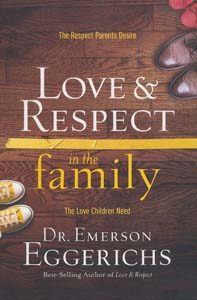
But now he’s written a book calledLove & Respect in the Family. And those same principles that he used uh … apply in a family dynamic.
Body:
Jim: And I’m thrilled to welcome Emerson to the program here atFocus on the Family. Great to have you.
Dr. Emerson Eggerichs: Oh, oh, it’s great being here. I’m honored.
Jim: Let me ask you this question, Emerson, because uh … that was such a profound insight in the early 2000’s when you came out withLove & Respectin the context of marriage. But uh … now you’re applying it to family and the question that really caught my attention, when you talk about authority, that authority really loves respect. And those under authority really need love, no matter who the people are, whether that’s in a marriage or in a family. Is that a fair statement?
Emerson: Well, no, that’s a good statement and uh … I could’ve written this book,Love & Respect in the Familybefore the marriage book. It … it’s just coincidental that the concepts are the same and it truly is coincidental, in that we see in Exodus 20:12 that children are to honor father and mother. We all know that’s one of the Ten Commandments and uh … honor father and mother. And Jesus quoted that in Matthew 15:4, when He said, “God said,” He didn’t say “Moses said.” He said, “God said honor father and mother.”
And Paul picks that up in Ephesians 6:2, “Honor father and mother.” And I saw in the Bible this teaching, that we all see, but I paid close attention, ‘cause then I realized no child is commanded to love a mommy or daddy. And I realized, well, God put it within the heart of a child tolove.But when that child feels unloved, it’s very natural for a … a child to react in ways that feel disrespectful to us.
And then I looked on the other side of the equation and in Titus 2, the older women are to encourage the younger women to love their children. But that’s notagapelove. And so, I realized that God putagapelove within the heart of a parent, but even though that’s there … we would die for our children, literally we would, if we don’t kill ‘em first at times. But there is this unconditional love. But our children don’t alwaysfeelthat love.
So, what happens is, even though we feel this love as parents, and it’s in our hearts, our children don’t always feel that love. And thus was born what I see as another cycle. There’s a correlation that when a child feels unloved, that child tends to react in a way that feels disrespectful.
Jim: Well, and that … and that is so … again, it’s borne out in the marriage relationship so obviously and that’s what you’ve written about in the past. But I had never applied that in the family context, that really in the Scripture uh … what the Lord is telling children to do is to respect and obey their parents.
Emerson: That’s right.
Jim: But you’re right; it doesn’t say “love.” But in the reverse, it is saying to the parents to love your child–
Emerson: That’s right.
Jim: –because that’s what theyneed. Where in the modern day today, uh … do we go wrong as parents? Are we too critical? Is it performance? What is it that makes usnotlove our children the way that God wants us to love our children?
Emerson: Well, I think, as I said, I think we love our children, in that we would die for them, but that uh … because children react in that way that feels disrespectful, they disregard us, you know. We feel disregarded. And uh … when we feel disregarded because they’re not obeying us, it leads to this feeling of being disrespected.
So, how do we deal with those moments? And one of the things we’re trying to help fathers and mothers realize– it’s okay for you to have that feeling. I think sometimes we suppress that, because we think we ought not to feel that way. As I say, parenting is for adults only.
John: Hm.
Jim: (Laughing)
Emerson: And so, there is this sense though, where we pass judgment on ourselves as maybe being more immature. And so, then we fixate on the wrong thing. At … at a moment in time we gotta say, you know what? I’m feeling disrespected. And that’s not necessarily wrong and it doesn’t point to the fact that I’m narcissistic or egotistical. It’s true. I’m feeling disrespected because my child’s reacting (Laughing) in a way right now that feels disrespectful to me. So, how do I deal with that?
Jim: And sometimes I think even with our kids, you know, Trent and Troy, we’ll say it to ‘em. You know, you’re talking in such a way that is expressing disrespect to your mom right now. I just call ‘em out. Is that a … that’s a good thing, I would think.
Emerson: Well, and that’s the point we make. Not only does Scripture address this expositionally, but experientially. I remember as a young boy throwing myself down on the floor in a temper tantrum and that lower protruding lip. And I can remember saying to my mom, “You don’t love me.” I never said, “You don’t respect me.”
Jim: Ah, interesting.
Emerson: And when my parents corrected me, they didn’t say, “Young man, you’re unloving right now. You’re being unloving toward us right now.” They said, “You’re being disrespectful—
John: Uh-hm.
Emerson: –toward us right now.” And it plays itself out experientially just as you gave voice. And it’s really a heavy thing to say to our child, “You’re being unloving right now.” I mean, we can coach them in terms of loving their siblings and so on and so forth. There’s a place to coach them on how to be loving. But we tend to say, “You’re being disrespectful right now.” And children tend to say, “You don’t love me right now.” And isn’t it interesting that Scripture echoes that– Jim: Yeah, right–
Emerson: And our experience echoes Scripture.
Jim: –right to the heart. You … you talk in your book,Love & Respect in the Family, you talk about this uh … family crazy cycle. Give us an idea. I think we’re touching on it here.
Emerson: We are.
Jim; But define the family crazy cycle for us.
Emerson: Right and to that point,when a child feels unloved, that child reacts in a way that feels disrespectful to a parent. And when a parent then feels disrespected, that parent tends to react in a way that feels unloving to the child. So, without love, a child reacts without respect. Without respect, a parent reacts without love. Without love … and you can see how this thing starts to spin.
And so, one of the points we’re challenging parents with is, this is the issue when the issue is no longer the issue. And we see the spirit of our child deflate or even our own spirit deflate or get provoked. We need to get in tune with the root issue, even though the topic is a real issue, it’s no longer the root issue. And the family’s gonna spin out of control real quick over what we think is not getting up on time. And that’s a real issue, but it’s not the root issue at that point.
And so, what we have to do is guard against that, because what happens if we continually react in ways that feel unloving to our child on the heels of some issue like getting up on time or they continue to show us disrespect, then this thing can spin in a way that we end up offending and hurting each other. And what happens is, a child eventually will close off.
Jim: And I think we have that. Now you talk about decoding that crazy cycle.
Emerson: Mm-hm.
Jim: How does a family start to decode where we’re at today? And in … we’re all connecting with you–
Emerson: Right, right.
Jim: –in terms of the love and respect between parent and child, uh … but it’s not healthy right now. I get it. How do I start to decode it?
Emerson: And that’s the first part of the book, we talk about “decoding.” And you’re quoting the word that we use, because there is acode, not always when children react negatively or in ways that feel disrespectful to us, are they feeling unloved. That’s not always the case. And so, we have to decode.
Maybe my child’s reacting the way that feels disrespectful to me uh … and negative and offensive simply because they’re a child. You know, Paul said, “When I was a child, I thought as a child, spoke as a child, reasoned as a child. But when I became an adult, I did away with childless things.” And the point is, child do childish things. You know, when David, my son, was 10, he uh … wanted to be a major league baseball player.
Jim: Uh-hm.
Emerson: And so, unknown to myself, he drew a square on the back of our garage and it was aluminum siding. (Laughter) And he had about 20 baseballs that… we had collected and he wanted to hit the strike zone. And I mean, he peppered the back of our garage with dents, just horribly. And in writing this book, I waited to write this book until my children were adults.And that’s why I said earlier, I could’ve written this book first, but I had my Ph.D. in Family Studies. I did my dissertation on effective fathering, but waited until my kids could speak back into this, the good and the bad and the ugly. And I wanted to quit a couple times, but they’re the ones that gave me the grace to keep going. In fact, they’re endorsing the book, which is mind-boggling to me.
But I revisited some of these stories and on this one, um … you know, David asked me, you know, “Dad, what did you feel, you know, about that when I threw those baseballs and just dented the back of … of the thing?”
I said, “Well, in this particular case, I understood you just weren’t thinking, ‘cause it brought back to my mind when I was little, I smashed every pumpkin in the neighbor’s pumpkin patch. He must have had about 50 and just busted all of them. And then I look back and I’m … I think, “Uh-oh,” and I think to my … I remember that story, because I wasn’t thinking next step.
Jim: Right.
Emerson: I was just childish. I didn’t do it because I was defiant, because I was disrespectful. It was a moment of immaturity and I was having fun. And I said, “When you threw that baseball, I realized you weren’t thinking and it was the same as I had done with those pumpkins. So, that was one time I think I gave you some grace.”
But I said, “On a deeper level, I really was depressed for several weeks. I really was. I have to be honest with you, David, because you didn’t hit the strike zone.” (Laughter)
John: All those dents–
Jim: Right. (Laughter)
John: –and not a shred of hope. (Laughter)
Jim: And never … never … didn’t make it to the major leagues.
Emerson: Oh, man
Jim: But Emerson, let’s go back to that child that you’re trying to get them to do something. Uh … it’s their homework, cleaning the room, whatever it might be. And you develop a pattern where you’ve asked them 10 times. And they’ve always said, “Yeah, okay, yeah, I’ll get to it.” And they don’t get to it. What in this cycle … would help a parent to decode that behavior? And what should that parent do? Let’s get real practical here.
Emerson: Right.
Jim: What should that mom or dad do to arrest that behavior in that child?
Emerson: Right. Well, just as the … theLove & Respectfor marriage, one of the things that I’m bringing to the table is an attitude. You know, people talk to me about their marriage on love and respect. Well, what if this? What if that? What if this? There are a plethora of daily issues that we encounter in marriage. But I talk about love and respect being like food and water, and that you’ve gotta have these two attitudes present in the marriage.
When Sarah and I or any couple deal with issues and we come across in a hostile and contemptuous way, your relationship is gonna be undermined.
Jim: Hm.
Emerson: So, you can be right, but wrong at the top of your voice. And it’s crucial that we deal with these issues in a loving and respectful way. And no one’s gonna do it perfectly, but one of the things we can do is rebound by confessing, “I was unloving here. I was disrespectful,” to try to keep the spirit of our spouse open, as well as our child.
So, in terms of marriage, we say, look, I’ll tell you this. You may have some serious issues on sex, the in-law issues, money issues, but if in this discussion, you come across your wife in a very unloving way, “What’d you do with that $500, woman? You spend, spend, spend, spend.” And her spirit deflates and she walks off and three years later you’re divorced.
You know, you say, if … if we didn’t have those money problems we’d have a great marriage. No, no, no, no. It has nothing to do with money. The money was real, but it wasn’t the root; it was that your unloving–
Jim: It was a symptom.
Emerson: –negative attitude that she’s vulnerable around. God didn’t design a woman to be treated that way. So, too, if you say to your husband, “Is that all you want is sex, you animal, you beast.” And his spirit deflates and he walks off and then three years later, she’s talkin’ to her girlfriend. “You know, if we didn’t have these sex issues, we’d have a great relationship.” No, no, no, no. I mean, sex was a real issue, but it was your contemptuous disdainful uh … attitude, that deflates him. God did not wire a man … no husband feels fond feelings of love and affection in his heart toward a wife he thinks despises who he is as a human being.
So, too, that same idea then we’re bringing to the family, that we as parents, have to guard against an attitude that looks down on that child. You know, one … one of the reasons I wrote this book is my own woundedness. My own dad used to ask me to do things as a little boy and he didn’t instruct me. And then he’d say, “You’re as useless,” and then he had this phrase that he would say. And he would call me “useless” and there would be this um … nervousness in me.
We had a swimming pool as part of our business and he would be under the uh … concrete working on the … the motor. And … and he’d ask me to go get an Allen wrench or a monkey wrench. Well … and I didn’t know what these things were.
Jim: Right. (Chuckling)
Emerson: And then I’d come back just all locked up, ‘cause I remember staring at the bench uh … where the tools were, just looking at it. I can still vividly remember this, thinking, I don’t know. So, then I’d go back slowly and say, I couldn’t find it. And he’d pull himself out from underneath. “If you gotta do anything around this house, you gotta do it yourself.” And so, I closed off to my dad.
Jim: Hm.
Emerson: Andone of the things that I’m encouraging parents is that we all get frustrated with our kids. You’ve told ‘em 15 times. You’ve told ‘em 100 times. We all have this moment and it’s at that moment that we’ve gotta make a decision. Okay, it doesn’t mean that I don’t get mad or angry, but there’s a line over which we must not step. And this is what we’re saying to parents. Is this gonna come across to my child as a hostile, harsh … “You’re not the person that I like.” And we suddenly now are sending a deeper message to them.
On any given day we’re gonna blow it. I blew it with my kids again and again and again. But the pattern here, am I coming across in a way that my child would say, “My dad loves me.” And I would say to my kids, you know, “I love you so much I would … if you were in a burning car, I’d go in after you. I want you to know. But right now I’m so spittin’ mad at what you’ve done …”
John: Uh-hm.
Emerson: See … see what I did there? Then I was able to verbalize my anger. My dad didn’t do that.
Jim: Right.
Emerson: And I never heard my dad say that he loved me until I was 29. My dad was not an evil man. He just didn’t know how to be a daddy, as my mom said, ‘cause he lost his dad when he was 3-months-old.
Jim: Well, and it’s hard, I think, in the heat of the moment. Uh … what I hear you describing, too, Emerson is this difference again, between willful disobedience and um … childish irresponsibility. You know, the fac …and as a dad, not to be able to recognize that … that’s not healthy, that you need to train your child, that here … here’s an Allen wrench. Here’s a monkey wrench.
Um … but getting back to that defiant behavior, where you have again, the child that just doesn’t seem to understand cleaning the room.
Emerson: Uh-hm.
Jim: You may have shown them, this is how you clean a room. You pick your clothes up. You put ‘em in the hamper. And yet, next week we’re at the same battlefront. How do you begin to use the system here, so to speak–
Emerson: Exactly.
Jim: –to apply that to your child? How do you get that child to respond to your loving-kindness–
Emerson: Exactly.
Jim: –but in a way that gets the work done?
Emerson: That’s right. Well, I’m … and I (Coughing) I’ve got a great story that illustrates just … a father was in the front pew at church with his 5-year-old. The mother was singing in choir. And uh … and the boy kept kicking the pew and his dad kept saying to him, “Stop.” You know, “Please stop.” And he’d then kick it again. “Stop.” Kick it again. “Stop.”
Jim: (Laughing)
Emerson: Right, this is that thing where you’re parenting and your child is simply defiantly disregarding you. So, the father in the Sunday morning church service has had it. So, he stands up. He grabs the boy, puts him over his shoulder and starts headin’ down the center aisle. And the … all the congregants are just sitting there, you know, locked up, thinking–
Jim: Great.
Emerson: –whoa! When the little boy yells out, “Y’all pray for me now.” (Laughter)
Jim: Smart kid.
Emerson: Yeah, that’s exactly right.