




Excerpt:
Mark Foreman: What is the purpose of raising kids? And we finally launched on the idea that it wasn’t just safety and protection. It wasn’t just happiness. It was the idea that we were made in the image of God and that we had the almost intoxicating purpose of raising kids to be on the offense. That they can go into culture and make a difference.
End of Excerpt
John Fuller: That perspective comes from Pastor Mark Foreman, and you’re gonna be hearing more from him and his wife, Jan, about raising kids who love God and who positively impact the world.
This is Focus on the Family with your host, Focus president and author, Jim Daly. And I’m John Fuller.
Jim Daly: John, raising kids is one of the most exhilarating—and humbling—
(Chuckling)
Jim: … privileges that God gives us. And here at Focus on the Family, we want to empower you as a parent to equip your children with a lasting faith, and the tools they need to live out that faith in a culture that doesn’t really show appreciation for us.
I love Mark and Jan’s perspective on parenting. They emphasize the importance of forming a relationship with your child, instead of just addressing behavior. And it’s so hard for us as Christian parents to separate those two. And it’s so important for us as Christian parents to realize this.
We recorded this program a few years ago, and I’m so glad we’re able to re-visit it today. This is the kind of content that could change your perspective on parenting, and change your child’s life, for the better.
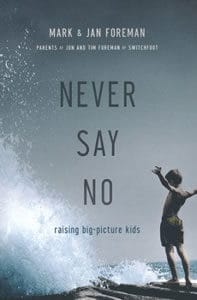
John: Well, Mark and Jan Foreman live in San Diego, California, and they are the parents of John and Tim Foreman of the Grammy-Award winning music group, Switchfoot. And they’ve written a book. It’s called Never Say No: Raising Big Picture Kids. And I’ll encourage you to get a copy of that book at focusonthefamily.com/broadcast.
Jim: And let me add – Switchfoot is what we call a “crossover band.” And for the older folks, that means their music appeals to both secular and Christian audiences. The good news is they do that in order to sing about themes that speak to the hearts of all people. And it is faith-oriented…
John: Yeah.
Jim: … if I could say it that way.
John: They totally come at their topics from a biblical perspective. Here now is the conversation we had with the Foreman’s, as Mark explains what they mean by “Big Picture Kids.”
Mark: I think it’s captured in the word “wonder.” So much of the life is reductionistic, where we’re trying to shrink God down, shrink the world down, shrink art and music down to little bite-sized sound clips and life just isn’t like that. And I’m … you and I aren’t attracted to life like that but raising kids that are living in a world of wonder, God who created this big world, you as a child can go in any direction. You can almost be in the Garden of Eden and start again and find out where this adventure takes you.
Jim: It’s kind of interesting the way life is more simplistic than I think we make it. I mean, when you look at God, He is our Father.
Mark & Jan Foreman: Yeah.
Jim: And you can gain a lot of parenting insight just by seeing how God deals with you—
Mark: Yeah.
Jan: Uh-hm.
Jim: –as an adult and then someone who can understand the principles of parenting. But now there’s gonna be some detractors when you say “never say no.”
Mark: Oh, yeah.
Jim: I mean, some of the hard—
Jan: Right.
Jim: –core—
Jan: Yeah.
Jim: –you know, boundary parenting people, which I appreciate; I’m … I’m in that camp. I try to have a good balance, but “never say no?” That just doesn’t sound right.
Mark: Yeah, if you get stuck in monitoring behavior, you have a problem and the book sounds permissive. But if you transfer from behavior to relationship and there was a motto we have in our home. When there was an opportunity to be with your child, when your … there was an opportunity to do something that maybe you were too lazy to do or want to do, that we would look at each other and say, “Never say no.” And so, that meant, get on your knees and wrestle with them. It meant paddle out into the ocean, even though the water is frigid cold, because your junior higher wants to be with you.
Jim: Yeah.
Mark: And so, we use that to push each other into the relationship. Of course, we’re not promoting permissiveness, but we are promoting a paradigm shift that says, “Come on; let’s fill the love tank first before we concentrate on the “yeses” and the “nos.”
Jim: So, it’s more … to be clear, it’s more of that engagement quality, that—
Mark: Yeah.
Jim: –when your kids and my boys do this and I … you know, boys and girls both, they want to spend time with daddy and spend time with mommy. That’s really the pearl for them, is being—
Jan: It is.
Jim: –together with you. And as a busy parent, you gotta be able to say yes.
John: It’s a great idea and I really like it, but aren’t there seasons where it’s really, really hard to say, oh, I’ll leave all of this project right now—
Jan: Uh-hm.
John: –and play with you or spend time with you?
John: I mean, there … there’s an idealistic sense here that some seasons just—
Jan: There is.
John: –don’t allow for it, it seems.
Jan: There is, but I think the idea is, that if God is one big “yes” for us, we just want to pay that forward to our kids whenever possible. And maybe it’s … and that’s the idea behind Never Say No. Maybe it’s a “not now,” but this is “when.” But still, you want to find that positive momentum, because once you … and that can also mean finding the things you’re interested in are different than the things your kids are interested in and also capitalizing on those things.
I think parents are a lot like archaeologists. They (Laughter) … they start digging in those areas where kids are giving you clues. And don’t young kids give you clues about (Laughter) what they’re interested in?
Jim: It’s so true.
Jan: And it’s often something that you’re not familiar with, comfortable with, would … a place you’d prefer not to go.
Jim: Oh, yeah. In fact, you have a great story in the book about your boys when they were young and things that were buried in the backyard. What was that about?
Jan: Hiding, oh—
Mark: Oh, yeah.
Jan: –the elevator part story.
Jim: Elevator parts?
Jan: We had inherited a church that was three grand in debt and they had heard this, and they thought they could be the solution. And our old 70-year-old home had been owned by an elevator repairman, who buried all his parts in the backyard. (Laughter)
John: Oh, my goodness.
Jan: Can you imagine?
Jim: Literally buried the extra parts in the backyard.
Jan: Really buried them (Laughter) to get rid of them. This was in New England.
Jim: So, were they like gears and chains?
Jan: Oh, right (Laughter), huge things, small parts and just gizmos, you know, that they would uncover.
Jim: What a playground for boys.
Mark: Yeah.
John: Oh yeah, that’s perfect. (Laughter)
Jan: They were just digging. So, we … I said in the book, we literally had a yard sale where they dug them up in … from our backyard and washed them off and put price tags in our driveway.
Mark: And I was the naysayer. I was saying, you know, “I don’t want to hurt your feelings, but you know, there isn’t a high demand (Laughter) for this, you know.” And … and …
Jim: They were doing it for a purpose, right?
Mark: Yeah.
Jan: They wanted to–
Mark: And that was the point. They said—
Jan: –contribute.
Mark: –“Dad, you’ll see.” And so, neighbors and friends started drivin’ up and seeing what was going on and so, they’re paying $5 for an elevator chain that is worthless. But my kids are stackin’ up the money and give the money to the church…
Jim: To help—
Mark: … to get out of debt.
Jim: –pay the debt.
Mark: Yeah.
Jan: Yeah, yeah.
Jim: That is wo … how old were they when you saw this?
Jan: Oh, goodness–
Mark: Three and 5?
Jan: –3 and 5.
Jim: Three and 5? Okay, so you know, right there a lot of parents are saying, okay, these kids are, you know, spiritually gifted. They—
John: They’re perfect, yeah.
Jim: –have some special insight. (Laughter) I mean, what was happening there? You could see it so early that they could put two and two together.
Jan: I think the more you can involve your kids in real life situations, you know, and have conversations; include them in. When big people come over around the dinner table, little ears are always listening. And to take their … their ideas seriously and we just bit our lips when they had this—
Jim: Yeah.
Jan: –lawn sale and I think the lessons learned were more important even than the money. That they … they counted; that their voice counted. Their ideas counted. They could be a part of the solution.
Mark: We get to be change agents.
Jan: Yeah, uh-huh.
Mark: That was the big take home. We’re leaning into culture. We can change things.
Jim: Yeah. Now when you became pregnant, Jan, you weren’t … it sounded like you weren’t that optimistic. You weren’t sure—
Jan: I had never been—
Jim: –about motherhood.
Jan: –around babies–
Jim: So many—
Jan: –ever.
Jim: –yeah, so many young women today are in that spot. They’re hearing a lot of negative messages about parenting and having kids later because, you know, they’re a drag on you. You won’t be able to do your career thing. You won’t … talk about that transition for you, particularly as a Christian young woman when you first, you know, found out you and Mark were pregnant.
Jan: That’s a great question. I … I … actually, my first inspiration came from the story of … of Mary and realizing, you know, she just had to surrender to the Lord what His will was. You know, “Be it done to me according to Your word.”
And thought, well, you know, that whole process was how Christ came into the world and then, so I just surrendered the idea that I wouldn’t necessarily be a failure. I think that was more of an insecurity on my part, that I couldn’t do this and having never been around children or babies much. But then the next day we went for Chinese food and I opened my fortune cookie (Laughter) and it said—
John: And God spoke.
Jan: –“Your horizons will be expanding to vast proportions.” (Laughter)
Jim: Not sure—
Jan: And—
Jim: –if that’s a theological way to get to it, but …
Jan: –I know! (Chuckling) But then I went to the doctor’s, because I hadn’t been feeling well and I was already pregnant.
Jim: Oh, my.
Jan: So, God sort of worked on my heart and then said, “Well, guess what? You know, you’re [expecting].” So, that was one phase, but … but then bringing John home from the hospital, I cried all the way home, you know, just thinking, “I’m gonna break him. I’m gonna mess up this perfect child.” But what I’ve learned is that being a mom is no less a faith experience than any other aspect of life–
Jim: Well, that is really important.
Jan: –you know–
John: That’s good.
Jim: I hope people are hearin’ that clearly.
Jan: –that you trust God for all these other things and then especially here with this life. He’s … it’s His child ultimately. He’s the author and finisher of their faith, too. So, you’re in this together.
Jim: You know, when you look at today’s parenting style, and Jean and I are prone to this, as well, it can be too fear based. That we want to keep our kids safe in every way—physically. You know, I’ll never forget so many times Jean (Laughing) yelling at me in a nice way, as the kids were takin’ off down the long driveway, which is concrete and saying, “How come they don’t have their bicycle helmets on? How many times have I told you, make sure?” And I’m like, “You’re right.” It’s just that I never did it that way and it’s—
Jan: Right.
Jim: –smart to do those things, but sometimes we can get so protective that kids aren’t being kids. They’re not climbin’ trees and jumpin’ and splashin’ and doin’ the things that are a little edgy and they can maybe get a scratch.
Mark: Yeah.
Jim: Are we makin’ a mistake?
Mark: I would agree; I think the … one of the highest goals of parents today is safety.
Jim: And is that a good goal?
Mark: And I think it’s … it’s an adequate early goal. But when we get stuck there and you know, your child’s 23 and it’s still safety, we’ve … we’re on the defense, where you … you cannot drive with the brakes on.
Jim: (Laughing) Yeah, right.
Mark: You gotta have an accelerator and that’s … we have to ask ourselves, “What’s the higher purpose?” And that’s really what we did, at … what is the higher purpose of raising children?
Jim: Wow, that … you know, I like that analogy, rather than driving with the brake on, make sure you’re driving most of the time with the accelerator on when you’re parenting. That’s a great analogy. I love that.
Mark: Well, you take control, rather than reacting.
Jim: Yeah, ‘cause you’re always reacting if you’re on the brake. You in fact, had a story though where you were at the beach.
Mark: Yeah.
Jim: And one of your kids, I mean, you hear some shouts from another couple, I think it was. Talk about that, because I think it’s fair. Your protection in the early years, as you said; you need to be aware and you guys sounded like maybe you weren’t so aware at a point.
Jan: Not … no.
Mark: Yeah, you know, and John almost drowned and so—
John: That’s pretty dramatic.
Mark: Yeah.
Jim: What happened?
Mark: Well, we were taking pictures of Tim. He’s our newborn, a few weeks old, there on the beach, Labor Day. And John was sitting maybe 10 feet from the … the lake’s edge in a little tub type boat. And we said, “We’re gonna play with you in a moment, but we’re gonna just take a couple pictures. And …
Jim: And he’s about 2, just before—
Mark: Yeah.
Jim: –2, right?
Mark: And we hear this lady scream, “Can that little boy swim?” And there’s John, almost 30 feet off shore–
Jim: Oh, my goodness.
Mark: –with his head submerged maybe 12 inches under water, floating vertically with his eyes open. And I exploded into the water, picked him out of the water and I heard him gasp for air as I pulled him. And so, I realized instinctively, he had held his breath. And he was showing no fear. And so, I tried not to and just, “Oh, John.” And he said, “Daddy, I couldn’t find you.”
Jim: Oh, my goodness.
Mark: And that just ripped me apart. So, that night I laid staring at the ceiling of our cabin thinking, “What the heck am I doing? I don’t know what I’m doing. What’s the point of parenting?”
Jim: What was your greatest fear at that point? What were you troubled by?
Mark: Well, it … it connected not only with the thought of losing a child that we all fear, but it connected with the bigger one of, we’re raising children into a culture that evokes fear. And what are we gonna do? And that began us pulling back layers of purposes over the next few months of what is the purpose of raising kids? And we finally launched on the idea that it wasn’t just safety and protection. It wasn’t just happiness, which is probably where the bulk of population ends up. And it wasn’t success, which is where the successful parents end up. That it was the idea that we were made in the image of God and that we have the almost intoxicating purpose of raising kids to be on the offense. That they can go into culture and make a difference with the face of God. Let’s latch onto that one.
John: Our guests on Focus on the Family are Mark and Jan Foreman. And your host is Jim Daly. I’m John Fuller. And we’ll continue the conversation in just a moment.
Get the book and a CD or download of this entire discussion at focusonthefamily.com/broadcast. Or call 1-800, the letter A, and the word FAMILY.
Alright, let’s go ahead and continue this great conversation on Focus on the Family.
Jim: Well, in fact, in the book, Never Say No, you mention this revelation that you could hear your mom and dad’s (Chuckling) voice coming out of your mouth. Now all of us just went, “Yep.” (Laughter) ‘Cause it’s so true, those things that you didn’t like as a child growing up in the home, that … what your mom and dad would say to you, you often pick up those parenting balls and chains as you’re doing it. What was that revelation for you? When did you realize that voice coming out of your mouth—
Jan: I think as soon as we—
Jim: –was not yours?
Jan: –yeah, and I think after the first week, you know. (Laughter) And very … because you are, as a … as a new parent, you’re so insecure and you’re just going with what you know. But then you realize, it’s almost as if you’re handed a deck of parenting cards and you can create three piles. One’s a keeper pile. That’s a great pattern that we had in your family or my family. One’s a discard pile, when you hear those thoughts coming out or saying those things that weren’t good. And then you have a Let’s Rewrite That [pile].
For example, I would say, Mark’s family, to use a musical analogy, was more of a Guns and Roses kind of family. They would—
John: Okay.
Jan: –they would—
John: Harder rock.
Jan: –shoot each other first and then hug and kiss later, a very outspoken—
Jim: The “roses” part.
Jan: –the “roses” part.” My family was more of a Chiffon’s family, where we never really talked about what was bothering us. Everything was superficial. Well, neither one of those were good models for us. So, we had conversations about how to have meaningful relationships with our kids without, you know, using angry words or without hiding. So, those were some of the ways we played off of our … our patterns. Another one was in my family we always ate on TV trays in front of the television.
Jim: (Laughing) That’s what we did.
Jan: Do we really want to do that with our kids?
Jim: No.
Jan: And … or his family ate on paper plates whenever, you know, on the floor. So, that was another marker. We decided let’s have set mealtimes, not every meal necessarily, but set mealtimes where we all sit around the table. The TV is off, with fast-food technology. So, those are the sorts of decisions and choices that we can make and I think that’s really good news for parents, is we don’t have to dance the same dance step that our parents did, that we … we’re unique people and to create a new “us,” not a “you” versus “my family,” but a new “us.”
Jim: Mark, I want to come back to something that you said just before the break there with this idea of engaging and playing offense, teaching our kids that big picture.
Yesterday I was in a conversation and somebody mentioned two metaphors to me about culture and where we’re at in the Christian community and there’s a lot of reasons to be concerned about, you know, our freedoms, our rights as … as Christians and those things. But this person said to me, “We have moat diggers and bridge builders.”
Mark: Oh, yeah.
Jim: And I love that analogy. We can’t … there’s a time around principle to dig a moat. You know, on principle, you don’t want to move. But sometimes I think when it comes to relationship, we’re seeing that as a moat digging opportunity, to get away from the culture, rather than a bridge-building opportunity.
Jan: Uh-hm.
Mark: Yeah.
Jim: If you can elaborate on that. How do you see that when it comes to parenting and preparing your kids to be bridge builders, not moat diggers?
Mark: Yeah. Well, if you change the metaphor from being a castle to a locker room, you know, that they’ll oftentimes, the church or family sees themselves as the castle. You know, pull up the drawbridge.
Jim: (Chuckling) Right.
Mark: And uh… if anything moves, shoot it. We’ll ask questions later. But the flip of that is, what if the family is a locker room, where we actually can discuss plays. We can discuss how we’re doing, but we have this great venture that we get to go out and discover God’s gift and calling on our lives and we get to find the niche of culture that we get to penetrate and influence with the fingerprints of God.
That is almost CIA kind of stuff. That we … we’re on this adventure and I think that … we have found that, that actually is really, really attractive to youth.
When you raise a teenager particularly, with the brakes on and say, “Stay away from that; don’t do that; don’t go there; don’t do anything,” it’s not attractive to a teenager. The teenager wants to know, when do we get to play? When do we get to do this thing that you talked about, going out into the world?
Another analogy is, if you and I went to sky-diving school and we went through all these classes and then we finally say to the instructors, “So, when do we go up?” And he says, “We actually never do. We just learn precautionary safety measures and we study the great people who used to go up and sky dive.”
Jim: Wow, what a great analogy.
Mark: You know, we want to do it!
Jim: Yeah.
Mark: And I think our young people actually want to follow Jesus right into this crazy world, just like He led the disciples into the Roman world.
Jim: How do we, as parents, put on that kind of game—
Mark: We gotta do it.
Jim: –face? I mean, how … how do we do it though? How did you do it? How did you … what kind of activities did you have your boys do to prepare them in this way?
Jan: I think it … I think it starts young when they’re teenies, giving them a … a wide variety of … of samplings from culture.
Jim: Like what?
Jan: We would take our kids to plays, to museums. We’d read great books. We’d have lots of interesting people over for dinner. We always included our kids when we did things within the community as much as possible. We exposed them to great ideas and great people very young.
But the more you can talk about what God’s doing in another part of the world, current events, even when they’re small, it helps them to engage their own cultural sensibilities. I think that’s sort of a foundation. And then as they grow older and get, you know, more their feet underneath them and their own—
Jim: Kind of teen years.
Jan: –yeah, their teen years, their equilibrium, we … we had a phrase. We like to take kids to the edge of themselves. And that is outside their comfort zone, to expose them to ideas that could feel threatening, but you’re with them and you’re there to dialogue about what are you seeing? What are you feeling? What did you think when that man, you know, showed up and … and obviously, he … he was homeless? Or how did you feel when you went to Mexico and … and played with the kids on the street? What did you notice? And have these conversations that stretch all of us at the same time? I think that helps kids have a better sensibility about how to engage in their own culture.
Mark: Kids are looking at our eyes and they want to know, is dad fearful here? Has this really got dad?” And it can be a philosophy. It can be politics. It can be … it can be any number of things that they … you know, they’re looking to see, are you still the brave warrior? (Laughing) I’m thinking, Monty Python. (Laughter) Are you still the brave person that’s gonna go in and … because you have this great God and this great truth, this great news that’s fearless.
So, we would have great discussions from politics–and we still do over coffee–to personal issues, to philosophy, to music. And I actually remember a very specific moment where my sons were starting to get into rock. They were junior high, and I heard Led Zeppelin coming from their bedroom. (Laughter) Now you have to know, I used to play in rock bands and I … I did not do all the good things people … I was not a—
Jim: That was before—
Mark: –really good.
Jim: –you were a Christian, yeah.
Mark: And so, when I heard “A Whole Lot of Love” coming from their room, I just thought, “Oh, my gosh, this is not happening.”
Jim: And you’re a pastor.
Mark: And so, I went aside, and I said, “God, what do I do here, ‘cause I don’t want to squelch them. I don’t want to … you know, they’re just full of wonder, big picture kids.” And so, I walked in after I prayed. I said, “What’s goin’ on, kids?” And they said, “Dad, we’re playin’ Led Zeppelin,” you know, just wide-eyed innocence.
And I said, “So, talk to me about that.” And I was just bein’ really terrified. And they said, “There’s just some great riffs here. We want to learn ’em.” And I realized, there was no ill intent. And so, I … I said, “All right.” And I walked out, spent some more time and I could hear all the religious voices in my mind saying, “You gotta shut it down. This is of the devil. If you play it backwards, it’s really of the devil, you know or something.” And I just said, I gotta find You, God. And I went back in and I didn’t know if I was doin’ the right thing or not. I said, “Okay, we’re gonna do Zeppelin, but we’re gonna do it together.”
Jim: Huh.
Mark: “We’re gonna talk about the lyrics and I’ll teach you “Stairway to Heaven,” but we’re gonna talk about what was going on in that period of our country and what we’re exploring and I’m gonna see you become better people out of this.” And I was off the map.
Jim: Yeah, there was no road map.
Mark: No role model there and it proved to be right and I … I took that philosophy into everything. We … we will talk about everything, but with the idea that Jesus goes into it with us and we’re fearless.
Jim: Well, in fact, what did they do with those lyrics from “Stairway to Heaven?”
Mark: Well, their whole band that eventually came about was a reversal of that and declaring a beautiful way for people to discover the way to heaven.
Jim: The true stairway to heaven–
Mark: Yeah, yeah, the true stairway, yeah, yeah.
Jim: –which is great.
Mark: Yeah, yeah.
Jim: Mark and Jan, this has been so good. I’ve got more questions though. I want to talk about that veneer that we have in our Christian parenting and the fact that Jesus came and said, “I’m here to testify to the truth.” And how do we really know ourselves in our parenting role? It, I think, will be an interesting discussion. Can you stay with us?
Mark: Yes.
Jan: Uh-hm.
Jim: Let’s do that.
Mark: Yeah.
John: We certainly heard some great parenting insights in this first part of our two-part conversation with Mark and Jan Foreman on Focus on the Family.
Jim: Hey, John, the Foreman’s approach to parenting is so inspirational! They’ve found that difficult balance between deeply caring for their children, while surrendering their kids’ to God.
John: Yeah, that’s something that takes a long time to develop and I really appreciate their perspectives.
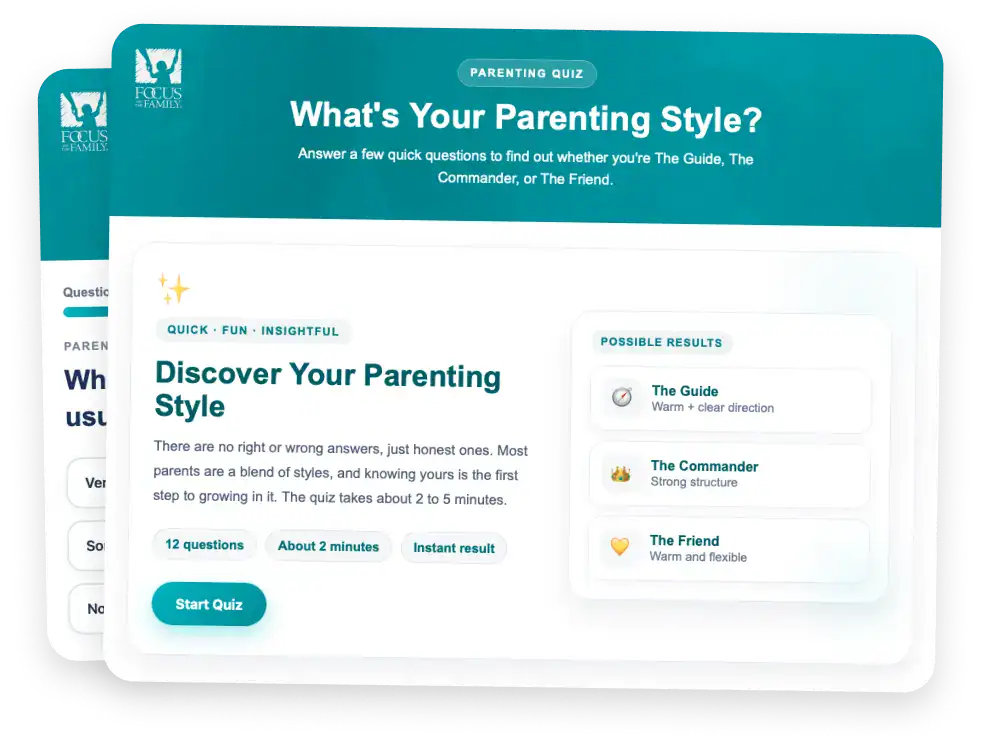
Jim: Well, if you, as a listener, are feeling motivated to take that approach with your own parenting, let me recommend you start with our free online parenting assessment. It only takes a few minutes and the questionnaire looks at both your strengths and your weaknesses as a mom or dad, and helps you address the parts of your parenting that frustrate you the most, so you can learn and grow in your relationship with your children.
John: I’ve taken that assessment. It really is helpful. And you can take it, as well, and get help for your parenting journey. You’ll find it at focusonthefamily.com/broadcast. Or, call 800, the letter A, and the word FAMILY.
Jim: And I also want to say thank you to our donors who make broadcasts like this one possible! In the past year, think of this, 770 thousand moms and dads told us that Focus has helped them build stronger, healthier, and more God-honoring families. So that’s a big high-five.
John: That’s over 2000 a day.
Jim: I know! That’s amazing! And if you’re passionate about a Godly marriage and parenting and want to get on board with our mission here at Focus on the Family to do ministry together, let me ask you to consider joining the team of financial supporters. In a world where the idea of family is greatly misunderstood, your support to Focus is a way of putting a stake in the ground. Not in a mean-spirited way, but in a core, convictional, principled way. Join us as we take a stand for God’s amazing design for family.
And for those of you who are willing to give a financial gift to Focus today, I want to send you a copy of Mark and Jan’s wonderful book, Never Say No: Raising Big Picture Kids, as our way of saying, thank you.
John: Donate as a monthly pledger or a one-time giver and get that book at focusonthefamily.com/broadcast. Or when you call 800, the letter A, and the word FAMILY.
On behalf of Jim Daly and the entire team, thanks for joining us today for Focus on the Family. I’m John Fuller inviting you back next time as we hear more parenting inspiration from Mark and Jan Foreman, and once again help you and your family thrive in Christ.