




Preview:
Joe Dallas: The secret temptation you refuse to bring to light eventually becomes the secret sin you begin to make peace with, which eventually becomes the bondage which derails your life.
End of Preview
John Fuller: Quite an insight from Joe Dallas, and you’ll hear more from him today about how he conquered his particular secret temptation. Welcome to Focus on the Family with Jim Daly. I’m John Fuller.
Jim Daly: Well, what Joe said right there, uh, secret sins do lead to bondage, and that’s the essence of his story. Joe’s an author, podcaster, and conference speaker, and I know you’ll be captivated by what he has to share.
John: And if you have young children nearby, you might wanna use earbuds or listen later through our app. With that, here’s Joe Dallas speaking at Central Assembly in Springfield, Missouri on Focus on the Family with Jim Daly.
Joe: It began in 1971 when I was a 16-year-old junior in high school. And by that time in my life, unfortunately, having been routinely molested by a number of men as a boy, growing up terribly confused, then realizing my sexual confusion was leading me towards interactions with grown men. I had begun seeing adult men for secret sexual liaisons. Of course, at that time, 1971, you could get yourself killed if you declared yourself openly gay. So this was a secret part of my life. On the one hand, I felt such a discomfort with that, that I was on a regular basis dosing myself with LSD and marijuana and cocaine. But on the other hand, I was finding it oddly liberating to say, “This is who I am. I am gay. I embrace this. I am determined not to hate myself for this any longer.”
And in that conflict, part of me saying no, part of me saying yes, I met a lovely classmate who asked me to a backwards dance. That’s one of those dances where the girls asked the guys. And she was one of our homecoming princesses, a beautiful young lady, and I was very flattered and delighted to accept. We went out, had a wonderful time. I dropped her off and I said, “You know, I would love to see you again.” And she said, “That’s great because I’d like to take you to church.”
Audience: (laughs).
Joe: That Sunday, we drove from my hometown, Long Beach, California out to Costa Mesa, California to this little place called Calvary Chapel, a tiny church which was bursting at the seams with scores of newly born again hippies who were on fire and not at all shy about talking about it. To walk into that place was to feel something tangible. As a non-believer who knew nothing about the Father, the Son, or the Holy Spirit, I felt the presence of all three.
I didn’t know what it was, but it was like a wall of something that hit me. And that was the first time I ever heard the Gospel clearly presented and the impact was almost unbearable. I came under conviction that would last for weeks because I knew what it was gonna require. I was just now embracing being a gay man and now here comes this conviction that I’m going to take up my cross and say no to that. And after going back and forth on it, finally, in the middle of the week at school, I snuck off school grounds, went to a little park across the street and knelt under a tree and said, “Yes.”
“Yes, I will receive your grace. I want to be born again. Please forgive me and take me.” And oh, what a time that was.
But there was a problem. And I say this because I know, I know to this day there are many people in the church who are in the same position I was in. I had been born again. I had been filled with the Spirit. I loved the Lord, but I had temptations. And I thought the presence of those temptations meant there was something foundationally wrong with me. And I felt that especially because let’s face it, in 1971, nobody was doing what we’re doing this morning. Nobody was talking about this openly within the church. And while I heard people testifying about overcoming drug abuse, cultic experiences, violent backgrounds, I never heard a story of somebody dealing with this, which only reinforced my idea that I’m still a freak. I’m still an abomination. I still don’t fit in. I’m still on the outside. If these people knew what temptations I have, not behaviors. I had repented and I was living a sanctified life. I in no way gave in to the temptations towards homosexuality, but I thought the presence of those temptations was an indicator that I was fundamentally defective.
And because I kept that a secret, I think you know where this is going, the secret temptation you refuse to bring to light eventually becomes the secret sin you begin to make peace with, which eventually becomes the bondage which derails your life.
And by 1978, the derailing happened when I said very plainly to myself and to God, “I am tired. I wanted all these feelings to go away. I’m mad at you for not making them all go away. I’m mad at the church for not understanding people who have these particular temptations. I’m mad at…” Well, I mean, I was mad at everybody but President Nixon and I wasn’t crazy about him either.
Audience: (laughs).
Joe: So I said something very dangerous to say, “I will.” Because in that moment I said, “I give myself permission. I am tired of trying to resist these feelings. I know that they are wrong. And you know what? I don’t care anymore. I will give myself permission to indulge.” And that was the day I stepped into an adult bookstore to view pornography, which I had not seen since I was a boy. And from there it was all downhill. As one decision, “I will,” led to another “I will,” which led to another “I will,” which finally landed me in a gay bar night after night, drinking excessively, engaging in promiscuity.
I had been a struggler. A struggler in the church is someone who has a secret temptation and does not want to bring that temptation to light. And so as such a person, I embraced a gay identity. I worked hard to tell myself this is all right with me, even if it’s not all right with God, which lasted for about a year. And then the conflict really surfaced when I realized, and yet I miss my fellowship of the church. I miss abiding in Christ. I miss the communion of the Holy Spirit. That’s when someone came along, a gay friend of mine who said, “I know a church where you can be both. Where you can be openly gay and openly Christian and they will teach you how to reread the Bible in a way to show there is no conflict between the two.” And I thought, “I gotta hear this.” And that was when I stepped into the local congregation of the Metropolitan Community Church.
And walking into that church and hearing the pro-gay interpretation of Scripture, on the one hand I thought, “Yes, this is answered prayer.” On the other hand, I thought, “This is kind of sloppy theology and yet even if it’s wrong, is it so terribly wrong?” I mean, if I embrace this and identify myself as a gay Christian, isn’t that a step in the right direction? I’ll stop my promiscuity. I’ll stop my excessive drinking. I’ll clean my act up and I’ll live as a gay Christian man, responsible and moderate in his lifestyle and still proclaiming Jesus Christ. So much so that eventually I joined the staff of the church and I began preaching a pro-gay theological message. I began teaching Bible studies. I was active with the church and I thought, “Finally I have landed at a place of peace. I am no longer denying my sexuality. I am no longer denying my Christianity. It has all come together. Thank you, Lord.” But something interesting was happening in the midst of all that.
I was embracing something that was doctrinally satisfying to me, but also very dangerous. In 2021, it’s becoming increasingly common. And there are many believers, many church leaders even who are saying that perhaps this issue, what the Bible does or does not say about homosexuality is one of those secondary issues we can agree to disagree on but still be in fellowship with each other over.
And there are such issues, aren’t there? I mean, there are some doctrinal matters we can agree to disagree on and it doesn’t break our communion. Good night somebody’s right about the rapture of the church.
Audience: (laughs).
Joe: Wherever you have landed, pre-trib, mid-trib, post-trib, somebody’s wrong, somebody’s right, but I can’t imagine us breaking fellowship over that. Sexuality is another matter. Sexual sin is aggressively condemned in 21 out of all of the New Testament books. The first case of recorded church discipline occurred over a sexual sin within the congregation. And you’ll remember Paul was so put out with the Corinthian church when he said, “There’s sexual sin in your midst and you’re actually proud of it.” This is not a secondary issue. This is a primary issue. In a pluralistic culture, yes, there’s room to agree to disagree. Within the body of Christ, no. There is no room for diversity on something as basic as the definition of marriage and family. On this point, we dare not compromise.
I had embraced a serious error, but the peace I was feeling was soon evolving into something different. I was beginning to feel angry. There’s a good reason for that. I had embraced this. I wanted to believe it was true, but there was a still small voice telling me it wasn’t. My own conscience, my own foundation in the Word of God and the conviction of the Holy Spirit were all conspiring together to tell me, “No, Joe, you’re embracing a lie.”
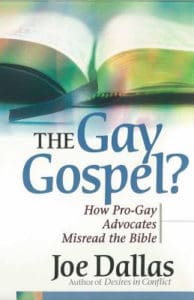
John: You are listening to Joe Dallas on Focus on the Family, and if you’d like to learn more about how to share the love of Christ well with those in the homosexual lifestyle, let me encourage you to get a copy of Joe’s book called The Gay Gospel? How Pro-Gay Advocates Misread the Bible. We can send that out to you when you make a donation of any amount to the work we’re doing here at Focus on the Family. Make that a monthly pledge or one-time gift. We’ll send the book and also include a free audio download of Joe’s entire presentation with some extra content. Uh, donate and request those at focusonthefamily.com/broadcast or call for details, 800, the letter A, and the word FAMILY. 800-232-6459.
Let’s go ahead and return now to more from Joe Dallas.
Joe: Now, when my conscience is telling me something that I don’t wanna hear and I decide, no, I’m not gonna listen to that, then if you come along and tell me something that is in harmony with what my conscience is telling me, I’m gonna be like, la, la, la, la, la, la, la, la, la. I don’t wanna hear it. I don’t wanna hear you. And if you keep saying that, you become my enemy.
The body of Christ became my enemy. Many vocal leaders within the body of Christ were saying, “This is not God’s will.” I didn’t wanna hear that. The more I heard it, the madder I got. And the madder I got, the more I decided I don’t want to just coexist with these people. I wanna shut them up. And that’s when I morphed from being religious to militant. Now, a gay militant is someone with a two-fold agenda, the normalization of homosexuality and the silencing of anyone who objects to that normalization.
I no longer believed just in seeking to normalize homosexuality in the culture. I, like many others, wanted to stamp out the voice of anybody who disagreed with that normalization. And I found a new drug when I made that decision. Now, I had given up drugs when I was a kid. When I was firstborn again, I stopped using dope. And even at my worst, I never relapsed back into using drugs, but I found a whole new one that could be generated within me, rage, getting angry, getting angry over what I saw as an injustice, getting angry over people I believed to be the oppressors. And man, there is nothing like the adrenaline rush you get when you feel you have a holy cause. They are the enemy. We’re the righteous and we go to battle with them. And in that I felt so pumped and so powerful that when I look at the behavior of people throwing public tantrums and burning down buildings and getting in people’s faces, I abhor it, but I get it.
I became addicted to gay militancy. I felt so powerful debating people on college campuses and marching in parades and getting in people’s faces about that and all of the evangelical fervor I had applied to preaching the Gospel when I was a kid, I now applied to converting the culture and the church to a pro-gay position that was my righteous cause. And I loved it, except again, but God. Because there was something still testifying against me even in the midst of that. Occasionally, people who had known me when I was part of the Bible believing church would run into me in the supermarket or they’d call me up and they’d say, “Joe, I hear you’ve gone gay. I hear you’re with a gay church. I hear you are really aggressive about it. What happened to you, man? I knew you when you were such a Christ-centered guy and you knew the Word of God. How were you justifying this?”
And like anyone who was well indoctrinated, I had all my answers ready. And I could rattle them off and look so calm and so convinced and end the conversation and go home and get drunk to kill the anxiety I was feeling because I knew I am being affected by what these people say, but I dare not let them know because that would be a concession. I have to be right because if I’m not right about this, what is my life built on? The whole foundation is gonna crumble. No, no, no. I have to be right. I have to be right. Except as more and more time went by, I began to question how right I really was until early in January of 1984 when the conviction of the Holy Spirit was becoming overwhelming at a time when, by all reasonable causes, it shouldn’t have been.
I mean, my life was going very well, good job, wonderful apartment, good social life. I was in the best physical shape I’d ever been in. I was in so many ways a happy man who seemed to have so much together as my openly gay, proud, religious self would tell you. And yet, I’d wake up in the middle of the night wondering, “Are you kidding yourself?” And at work, sometimes I’d feel like I’m about to cry.
And finally in January of 1984, one night I got home from a workout at the gym, sat down in front of the TV. I saw an old friend of mine on a Christian TV show who was testifying about his own secret struggle with alcoholism. And he said, “I never gave the church a chance. I kept it hidden and that’s why it overtook me.” And I thought, “Okay, Joe, let’s be honest. Did you ever give the church a chance?” “No, I didn’t.” Way back then, I had decided the church will never understand this temptation I have. They’ll think I’m a freak, they’ll reject me. And if I decide that they’ll reject me, that will justify my leaving the church. Because I had never said to any of my Christian friends at the time, “This is a temptation I have. Will you please pray with me because I don’t want to give into it.” Oh, if only I had done that, what a different course my life would have taken. Today, if only so many women and men would do that, what a different course their lives would take.
And that was when I realized, okay, it’s time to get honest. And that’s when I turned out all the lights in my apartment and I knelt down and I said, “Lord, I am ready to admit it. If I have been wrong, I wanna know that I’ve been wrong.” And that was the night I became repentant.
The repentant individual struggling with same sex desires is the person who comes into the church saying, “I do have these desires. I’m not going to keep it a secret. I know it will be a sin if I yield to them. I want to grow in Christ, so what do I do now?” That was the question I posed to the church when I repented, relocated and got into good Bible believing fellowship because I knew I can’t do it the way I did it before. I can’t pretend that these feelings are not a part of what I deal with.
And as I began making friends in the church, a whole new experience for me, by the way, making honest, authentic friendships, the guys in my church took me in and said, “Yeah, we want you. Worship with us. Join our choir. Join our softball team.” And so I could spill it all out with them. This is where I’ve been. I lived as an openly gay man. I wrestle with these feelings. I don’t know what to do about it. There are some struggles we all relate to, right? The struggle to mouth off or punch somebody out or lie or be greedy. And there are some struggles that are more unique that only a minority of us experience like homosexuality, but goodnight it’s all fruit from the same tree, isn’t it? The sin nature.
So these guys said to me, “Look, we don’t expect anything out of you that we don’t expect of ourselves. Get into the Word of God. Develop your prayer life. Abide in Christ. Fellowship with us. Be honest with us about your struggles and we will be honest with you about ours. Seek the will of God and the calling of God in your life and let’s all grow together and become the men of God that we are meant to be.” They knew how you love a brother who is seeking discipleship and accountability.
And this is why I often say, “You don’t have to have a PhD in psychology or sociology to know how to minister to a homosexual person. Do you know the Word of God, and do you have the heart of Christ? You’re in.” And you’re equipped as they were. Interestingly enough, when I prayed my prayer of repentance, I said, “Lord, I have sinned against you, and I know I have the heart of a rebel and I probably always will. You are bigger than my heart. Take a hold of this rebel. Make me obedient.”
I didn’t even think to ask change me as in make me straight, give me a wife, et cetera. But I did find, oddly enough, that as I abided in Christ and stayed in fellowship and grew in grace and sought God’s will, the homosexual temptations reduced and became less and less strong. And I started having a desire for a marriage and a family life, but I didn’t know how on earth that was gonna happen because I really didn’t have the kind of a resume that Christian women were looking for, you know?
Audience: (laughs).
Joe: But if one of them didn’t come along, I met her in the choir I had joined. We started talking. I thought she was lovely at first. Then I thought she’s not just lovely. I really like her. And then finally that evolved into she’s not just lovely. She’s not just somebody I really like. I want her. I want her. And after about, oh, I think 72 years, I worked up the courage to ask her out.
Audience: (laughs).
Joe: On our second date, I told her my whole story. We courted for a year and a half. I proposed. We became engaged for another year and a half. And in August of 1987, she became my wife of 34 years now and mother of our two sons.
There were, of course, things that facilitated change in me, some critical investments that need to be made, critical investments that include intimacy with God. How does somebody walk away from a life dominating sin? They must abide in Christ. As Jesus said, “Without me, you can do nothing. Abide in me and I in you because as the branch cannot bear fruit, unless it abides in the vine, no more can you accept you abide in me.” Intimacy with God was critical. Alliances were critical. Developing accountability and relationship within the church. So the author of Hebrews said, “Exhort one another daily while it’s called “today” lest any of you be hardened in your hearts through the deceitfulness of sin.” And of course, a lifestyle of stewardship.
I love the way Paul puts this, 1 Thessalonians 4:3-4: “This is the will of God, your sanctification that you abstain from fornication and that each of you learn,” I love this phrasing, “to possess your vessel with honor.” Now I think I’m finally starting to get that. I don’t own my body, but I am the manager. Lack of ownership doesn’t mean you can abdicate authority. The owner commissions to the manager the owner’s property and says, “I am entrusting this to you. Answer to me for the way you manage what I have given you, your passions, your thoughts, your gifting and so forth.”
And in that context, I learned something wonderful about my own temptations. They would still come, but I hope I understand now that each temptation is an opportunity for worship, because when I yield my members to God, as Paul told the Romans to, what am I doing if not worshiping? Just like we did this morning, we yielded our hands, our mouths, our bodies. So every time I feel like doing this and I say, “Lord, I love you, I do crave that, but you are what I want.” What is that if not an act of worship? And that takes temptation out of the negative and puts it into the positive as a whole part of the sanctification process. Holiness, for goodness sakes, it’s not an absence of temptation, it is faithfulness in temptation.
John: That is some biblical perspective from Joe Dallas on today’s Focus on the Family with Jim Daly.
Jim: Yeah, it sure is, John. And I really appreciate Joe’s final points on how to overcome a life dominating sin. He said we need to accept accountability, abide in Christ, and steward ourselves. Man, that is powerful. What a great perspective. And as Joe said, each temptation is an opportunity for worship, and we can triumph if we turn to God instead of whatever is tempting us. That’s the power of the Holy Spirit in us we can overcome.
And if you’re struggling with temptation right now, please reach out to us and ask for a callback from one of our caring Christian counselors. This is a free service that we’ve provided for almost 50 years now, and we’ll give you an initial consultation, some ideas on what to do next, and we can help you find a like-minded counselor in your area for an ongoing relationship. It would be an honor to serve you in that way.
And let me just add that we are able to offer these counseling consultations thanks to donors like you. We receive over 2,000 requests for counseling help every month, and we need your help and support. Of course, a one-time gift is great. It helps us today, but a monthly pledge helps us every day throughout the year so that we can be here for every person that God sends our way. And when you make a donation of any amount, we’d like to send you Joe Dallas’s book called The Gay Gospel? How Pro-Gay Advocates Misread the Bible. That’ll be our way of saying thank you for partnering in ministry with us. We also have a free booklet that is a great guide for parents. It’s called “When a Loved One Says, ‘I’m Gay.’” Find it at our website.
By the way, I recently had a chance to sit down with Joe in an extensive interview to talk about how to engage today’s toxic cancel culture with truth and compassion. I hope you’ll check it out on my podcast. It’s called ReFOCUS with Jim Daly. We’ll put a link to that on the webpage as well.
John: Yeah, the podcast is building quite an audience, and the conversations are really in depth and very fascinating.
Now give generously when you visit us online and request your copy of the book by Joe Dallas. Uh, when you order that from us, we’ll include a free audio download of Joe’s entire presentation with extra content. And look for the free booklet, by the way, if you’re having hard conversations with someone in the gay community. And that’ll be at focusonthefamily.com/broadcast. Or call if you’d like a call back from one of our counselors or have additional questions. Our number is 800, the letter A, and the word FAMILY.
Next time, you’ll hear from licensed counselor and mom, Debra Fileta. She’ll have practical biblical insights to help you and your spouse be emotionally healthy.
Preview:
Debra Fileta: You start to really reveal who you actually are in connecting with people emotionally and spiritually. Like this is not…. I’m not who I think you want me to be, this is who I actually am.
Jim: Mm.
Debra: And learning to just become more authentic and vulnerable in a relationship.
End of Preview
John: On behalf of the team, thanks for listening today to Focus on the Family with Jim Daly. I’m John Fuller inviting you back as we once again help you and your family thrive in Christ.