




Preview:
Bill Farrel: Pam and I asked the question several years ago, like, “What has really made our relationship work?” You know, ’cause it’s easy to talk about theory and like-
Jim Daly: Yeah, this is good.
Bill: … but like what really made it work? And what we came up with was we decided early on to be tough on ourselves and tender on each other.
End of Preview
John Fuller: That’s Bill Farrel, and he and his wife, Pam, are with us today on Focus on the Family with Jim Daly, and we’re so glad you’ve joined us. I’m John Fuller.
Jim: John, you and I both know people that have hit the wall, uh, just a few months or years into their marriage. It just becomes a, a place that they’re not as happy as they thought they would be.
John: Mm-hmm.
Jim: Some couples are facing that intense conflict right now, and if that’s where you’re at, we wanna help. Uh, Focus is here for you, so please get in touch with us. We have so many great resources, including a marriage intensive. It’s four days typically, and you spend about 38, 40 hours working on your marriage. It’s one of the best things that we have going here at Focus. It has a post two year, uh, survey of 80% of those couples still married and doing better. So, I’m proud of that and I will continue to talk about it-
John: Mm-hmm.
Jim: … from time to time. Uh, oftentimes husbands and wives, they just feel so disillusioned because their, uh, marital experience has not met their expectations.
John: Hmm.
Jim: And today we’re gonna talk with a wonderful couple about how, how to really do marriage so much better.
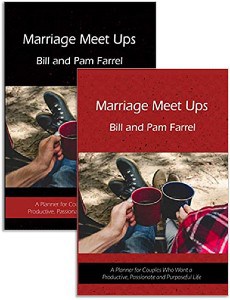
John: Yeah, they’ve been married for over 40 years. Uh, Bill and Pam Farrel have been here a number of times, and they always get a great response from our listeners. Uh, we’ve got a couple of their books that are kinda paired together, a his-and-hers edition of Marriage Meetups: A Planner for Couples Who Want a Productive, Passionate and Purposeful Life. And we’ll post more details about the Farrels and this bundled resource at our website.
Jim: Bill and Pam, welcome back to Focus.
Pam Farrel: Oh, so good to be here.
Jim: (laughs).
Pam: Yay.
Jim: I love your enthusiasm.
Pam: (laughs).
Bill: Isn’t it fun?
Pam: It is fun.
Bill: It is fun.
Jim: Well, let me ask Bill, is that fun?
Pam: We miss y’all like friends.
Jim: (laughs).
Bill: Yeah. And it’s, and it’s genuine. Like gee, uh-
Jim: Oh, absolutely.
Bill: I, I told Pam early in our marriage, you cannot drink coffee because you came into the world pre-caffeinated.
Jim: (laughs).
Pam: (laughs).
Jim: That is very true.
Pam: Yeah, yeah.
Jim: Pam is loaded with energy. Okay, so early this morning, I was getting ready for the show, and I was reading the prep and I, Jean sat down to have a cup of coffee with me.
Pam: That’s nice.
Jim: And she was saying, you know, I kind of explained the concept of marriage meetups and she said, “Oh, I like that.” And I was like, “Really?” (laughs).
Bill: (laughs).
Jim: See, today’s your chore is to win me over.
Pam: Awesome.
Jim: But my wife, she loved the idea. She said we should do this.
Pam: Amen.
Jim: So I think we’re, we’re gonna-
Pam: She’s my new best friend.
Jim: She, we’re gonna be starting to do the marriage meetup weekly.
Bill: You mean we’re Jean’s advocates today? (laughs).
Pam: (laughs).
Jim: (laughs). Yes, absolutely.
John: This is an intervention.
Jim: This is the beat down of Jim Daly. But, you know, frankly, that’s what’s funny. I mean, I think typically opposites marry.
Pam: They do.
Jim: Not always, and I get that. But, um, I think in this area, Jean really connected with the concept of having a weekly marriage meetup and talking things over. And I was like, “I’ve got so many meetings. That’s not a meeting I wanna have.”
Pam: (laughs).
Jim: And that’s probably something you encounter all the time, right?
Pam: Oh, it is. But hey, it’s got some upsides to this meeting that probably your other meetings do not have.
Jim: (laughs).
Pam: Yeah.
Jim: That is well said. Invest wisely.
Pam: That’s right.
Bill: And, you know, John, in your introduction, you mentioned we’ve been married over 40 years, which seems kind of impossible. Like it gets here so fast. But we didn’t write this book early.
Jim: (laughs).
Bill: Even though we’ve been doing this our whole marriage.
Pam: We, we… Right.
Jim: Well, that’s good.
Bill: Because the reaction we get is, “Really? It’s, is it that much work?”
Pam: It’s like homework.
Bill: Like really?
Jim: (laughs). I feel so stupid right now.
Pam: (laughs).
Bill: And we, um, you, you know, we’ve been asking ourselves, okay, how do we do this in a way that people can relate to?
Jim: Mm-hmm.
Bill: Because when you say, “Hey, you should have a business meeting with your, your partner,” like, I do those. I have a lot, I have plenty of those.
Jim: (laughs).
Bill: I don’t wanna, I don’t wanna do that with my spouse.
Jim: Right.
Bill: And when the whole COVID shutdown hit, you know, and everybody was just home, we thought, this is a good time to get this written.
Jim: Yeah.
Pam: Yeah.
Jim: So I mean, you guys have been practicing this for a long time.
Pam: 42 years.
Bill: Yeah.
Jim: Um-
Bill: And, and the reason why I think people resist it is the big disruptor of intimacy is responsibility.
John: Mm-hmm.
Bill: So when you get married and you’re, you know, you’re first at it, your responsibility is off on the side, and you’re just focused on each other. And then every year adds more responsibility.
Jim: Yeah.
Bill: And pretty soon it gets in the way of intimacy.
Jim: You know, I relate to Jean’s enthusiasm. It’s like for her, it’s a solution to something she’s, you know, wanting.
Pam: Exactly.
Jim: You know, let’s clarify some of these things, et cetera. Well, let’s get into it. How did the meetups, the marriage meetups help you two with conflict and disagreements over parenting?
Pam: Right.
Jim: Let’s go right to the jugular.
Pam: Right. Yeah.
Jim: (laughs).
Bill: (laughs).
Pam: I’m glad that we started doing a marriage meetup before we were parents because even some of our discussions, we call it our Monday Morning Marriage Meeting. That’s what we called it.
Jim: And you do it on Monday no less.
Pam: Yeah. Uh, because that-
Jim: Okay, you’re really winning me over here.
Bill: (laughs).
Pam: I know. Bill was a pastor, so Monday was our day off.
Jim: Okay. All right.
Pam: So that’s why it landed there.
Jim: Yeah.
Pam: Um, he was a youth pastor when we first started. So some of our conversations were even about like when do we wanna have kids? You know, how many? So sometimes you tackle some big issues and sometimes it’s the little annoying issues that you-
Jim: Oh, give us one of those.
Bill: Let me give you a specific example.
Jim: Yeah.
Pam: Yeah.
Bill: So, so Pam and Zachary have this like connection to each other because they just get one another.
Jim: Yeah.
Bill: Zachary has a completely different personality for me. So I have to learn about Zach. I don’t instinctively get him.
Jim: Mm-hmm.
Bill: So we, we, he’s in high school and we decide he needs to get a vehicle before he leaves to college. Well, for me, getting a vehicle is a very practical discussion.
Jim: Sure.
Bill: Like we need to find something that’s practical, something that’s reliable, something that will suit his needs, but Pam and Zachary have a emotional connection to this vehicle.
Pam: Right. Zach wants a-
Jim: A particular one.
Pam: … yeah, lifted truck, you know, with big wheels.
Jim: (laughs).
Pam: Totally impractical. Uh, but-
Bill: So I come to the meeting and I-
Pam: … it expresses himself.
Bill: … and I’m thinking we have to have a budget for this-
Jim: Yeah.
Bill: … this purchase, we have to have reasons why it’s a good vehicle, and it needs to be relatively economical. Those are not the reasons that Pam’s bringing to the meeting.
Jim: That sounds like a Honda or a Toyota to me.
Pam: (laughs). Right. Which our third son did drive.
Jim: Yeah, that’s right.
Bill: And the first time Pam said to me, “We need to get him a truck or he’s gonna be mad for years.”
Jim: Oh, now the leverage.
Pam: (laughs).
Bill: And I’m like, “Who cares if he’s mad?” (laughs).
Jim: That may be a good thing.
Pam: And I’m like, “Honey, it’s, it’s his person.”
Bill: We’re tracking here.
Pam: It’s like how he expresses himself and, you know, he wants to make a statement. He lives big.
Jim: Okay.
Pam: He ended up getting a scholarship.
Bill: So I’m sitting in this meeting going, “I trust Pam, and I know Pam understands Zach better than I do, but I don’t like her reasoning.” (laughs).
Pam: (laughs).
Jim: (Laughs). I love this honesty.
Pam: But, you know, so we had that space that was set there and we could take our time over a few weeks to make that decision.
Jim: Yeah.
Pam: And so we decided we did need to bring Zack into this and he did-
Jim: (laughs). That’s good.
Pam: … need to have a budget and et cetera. So if he could find what he wanted under the budget that dad said, “Yay, you could have your lifted truck.”
Jim: That is the benefit of that.
Pam: (laughs) Yeah.
Jim: Let’s talk about the three components of marriage meetings.
Pam: And he still drives a truck (laughs).
Jim: (laughs).
Bill: (laughs).
Jim: A lifted truck, no less.
Pam: He does.
Jim: What are the three components?
Bill: So the first one, which I actually think is the most important one is affirmation.
Jim: Okay, makes sense.
Bill: Because this meeting has to be different than every other meeting you have. Like when you go into a business meeting with business, uh, partners, the, you’re not worried about the emotional climate of your relationship. You’re not worried about, when we’re done with this meeting, are we gonna like each other enough that we would like to make love to one another? Like those don’t come up in, in business hopefully. But in your marriage-
Jim: (laughs). Right. Yeah.
Pam: (laughs).
Bill: In your marriage, those things are vital.
Jim: Yeah, absolutely.
Bill: Like I wanted to, like one of the things I learned early is I have to set a tone with Pam that says, “The only reason I’m having this meeting with you is ’cause I love you enough to connect my whole life to you.” So the affirmation in this meeting starts with a, a prayer with one another-
Pam: Yeah.
Bill: … and a compliment.
Jim: Hmm.
Bill: So either something I love about you that I’ve seen this week or a reminder of why I married you. So it sets the tone that I, I’m glad to be here because of who you are.
Pam: Right.
Jim: That’s a beautiful example. That’s affirmation. What’s another, the other two?
Bill: So the H is habits.
Pam: Yeah.
Bill: ‘Cause if you’re gonna organize your life, you have to develop habits. Like doing your budget, it’s not an inspirational activity in life. Coordinating your calendar for the week is not an inspirational kind of thing. Identifying what projects you have to finish this week as a couple, those are just, that’s the work of marriage. And if you can turn those into habits where it’s not a, it’s not an insult that I asked you about your schedule this week. It’s not an insult that we’re talking about money. It’s not a, “Hey, I hate the way you spend money and I wanna tell you right now.” It’s how do we manage our money in a way that works? And if you develop those habits, it takes some of the emotional steam out of it.
Jim: Right.
Bill: Plus the other thing that I wish I’d known earlier in marriage is the general rule in life is that your emotions always follow your decisions.
Jim: Huh.
Bill: So if you can take the decisions of your marriage and turn them into habits where every week you’re effective at making decisions together, it creates an emotional environment between the two of you that’s satisfying. And if you’re not good at making decisions, it builds resentment and it builds this kind of negative tone. So 20 years into marriage and now you’re like, “I don’t… We don’t like each other. I don’t know why.”
Jim: Yeah.
Bill: It’s probably because you weren’t good at making decisions along the way, and so the emotional atmosphere just eroded.
Jim: Yeah, that’s good.
Pam: And also part of the habits is you pull forward anything that was not finished. So an unfinished decision, um, an unfinished, you know, attitude, or heartache. You, you don’t just like shove it under the rug. You just move it forward a week and say, “Okay, how you feeling? Is this a good time to talk about it?” Um, and for Bill and I, the money thing, sometimes it’s a longer discussion and sometimes it’s like, “Okay, is this a week I can spend money or not?” You know, it’s real simple.
Jim: (laughs).
Pam: Yeah.
Bill: And that’s really helpful because there are some things in life you can’t solve.
Jim: That’s fair.
Bill: If you, if you have a special needs child, you don’t solve that child.
Jim: Right.
Bill: Pam mentioned we’re, we’re in the tail end of caregiving. We couldn’t solve my parents.
Jim: Right.
Bill: They just, their needs have gone higher than they used to be and we have to endure it and not solve it. And if you can bring it forward, you can say, “We just need to keep praying about this ’cause we don’t have a solution.”
Jim: Right. And you know it’s got some time limit, but you don’t know how much time.
Pam: Right.
Bill: Right. But together, like, like one of the, the hardest things to maintain I think in marriage, is the notion we’re really better together.
Jim: Yeah, but it’s a great goal.
Bill: Yeah.
Jim: ‘Cause it’s the right one.
Bill: As you get more responsibility, it tends to make you more independent. So saying, “Hey, we don’t know what to do about this, but we’re in it together.”
Jim: Yeah.
Bill: It’s a good way to remind us.
Pam: And having a template, like the marriage meetup is like the actual template that we have used for 42 years. So these are the components that we’ve seen work for us. So we like to say coffee plus conversation equals connection.
Jim: Yeah.
Pam: That’s really what a marriage meetup-
Jim: For the non-caffeine people, you could have, you know, a nice ice water, some lemonade.
Pam: Yeah. I have green tea now.
Bill: (laughs).
Jim: So that’s affirmation and habits. Affection’s the third.
Pam: Right.
Jim: Describe affection.
Pam: And so one of the best parts is, um, we decide what day we’re gonna have what we call red hot monogamy.
Jim: (laughs).
Pam: Like, you know, there’s the payoff. There’s a business meeting for married couples. We like this.
Jim: Yes.
Pam: And so that’s a part of the marriage meetup. But also, um, it’s bookend, that affection. Uh, early on, you know, you give that prayer, that verse, that compliment. And at the end, we pray over each other, and we thank each other for something we saw during the marriage meetup. And so it’s bookends of love surrounded by a whole lot of productive work.
Jim: Yeah, it’s good. I like it.
Bill: Right. And the affectionate part of marriage early on, it’s easy to do. But the longer you’re married, the more deliberate it needs to be. So if you’re gonna keep dating your spouse, it’s ’cause you decided to.
Jim: Right.
Bill: If you keep, um, expressing affection to one another in either private or public, it’s because you chose to. And if you set a legacy for your kids and grandkids that they see that you’re in love, it’s ’cause you chose to. Because again, over time, you tend to fall into a rut if you don’t fight it. And so keeping affection on the forefront. Like we, we never end a meeting with, “Okay, we’re done.”
Pam: No, no.
Bill: We always end it with, “Thank you for spending this time. Thank you for being this person right here in my life.” And then pray for each other.
Pam: And then usually kiss.
Bill: It sets a tone that, “Okay, we could have another one of these.”
Jim: (laughs) That’s true.
Bill: Because if it ends tense, you’re like, “I don’t know. I don’t know.”
Jim: Yeah, I’m not going back there.
Pam: And we encourage couples to, like, do it in a place that’s romantic too. You, um… We had a, a little bistro under a tree-
Bill: Yeah, of course.
Pam: … with cute little lights and, you know, that made it seem more romantic. Or might be your favorite breakfast place. That’s what ours started out being, just our favorite breakfast place. Or it could be two cozy chairs, you know, in front of a fireplace. But make it some place to look forward to as well.
Jim: Huh, that’s good.
John: Mm-hmm. Some great ideas from our guests today, Bill and Pam Farrel on Focus on the Family with Jim Daly. And you can find more insights in the book they’ve written. It’s called Marriage Meetups: A Planner for Couples Who Want a Productive, Passionate and Purposeful Life. And we’ve got those books, a bundle of them, uh, for him and for her at focusonthefamily.com/broadcast.
Jim: Uh, you mentioned money. So let’s go to that. Um, I’m sure everybody’s probably (laughs) leaning in right now. That’s one of the big issues in marriage, and we hear from so many people on this, uh, topic of finances and how to handle your finances. So what are those common approaches to money?
Bill: So before we share those, just let me quickly say, one of the reasons why money is an issue is because money’s emotional for everybody.
Jim: Huh.
Bill: Jesus even said, “Where your treasure is, there will your heart be.”
Jim: Yeah.
Bill: Like most of us think it should be the opposite way around, you know, where your heart is, there your money is. Jesus said it’s just the opposite. So we’re all emotionally attached to money. And we, we begin to realize, well, that’s why couples argue over money is they’re expressing who they are through the way they like to handle money.
Pam: So like some people, authority is what motivates them. And so these are like the big decision makers. You know, oftentimes they’ll run, you know, companies or be entrepreneurs. They’re used to money’s just a tool, you know, to, to make life work.
Bill: And, and people who love authority, like w- when they make a decision and people follow it, they like it.
Jim: (laughs).
Bill: So they use money that way. They push their agenda and they get their decisions in play.
John: Mm-hmm.
Bill: And if everybody’s on board with it, it works well. But not everybody is motivated that way. And the way I like to say… Like we don’t necessarily marry opposites. I think we marry what we don’t have.
Jim: Yeah.
Bill: So we fill in the gaps in our life.
John: Uh-huh.
Bill: So people who are motivated by authority aren’t gonna marry people who are motivated by authority with money.
Pam: That would be a big clash.
Bill: Right. The second one is some people use money for attention.
Pam: That would be me.
Jim: (laughs).
Pam: I love the look on my daughter-in-law’s when I say, “Hey, um, I’m gonna pay for us all to go to the spa or to get a pedicure.” I love that my money can go to create family vacations, you know? So-
Bill: Well, Jim, you can imagine. Like-
Jim: I’m already imagining (laughs).
Bill: This, this was a big challenge for me.
Jim: Yeah.
Pam: ‘Cause I’m pretty spontaneous too.
Jim: Yeah.
Bill: But she doesn’t have bad ideas.
Jim: Right.
Bill: You know, so when she comes home and says, “Hey, Bill, look what I did for our kids.”
Jim: “You did what?”
Bill: You know, part of me is like, “Man, our kids are, they’re fortunate to have you as their mom, but what were you thinking?”
Jim: (laughs).
Pam: And Bill’s like, “But that-”
Jim: I like that.
Pam: “That wasn’t even in the budget.” Yeah. But I worked really hard for my money and finally, so, um-
Bill: And, and you know, we went to the financial seminars early in-
Pam: Right.
Bill: … our marriage on how to budget your money, how to manage your money, and there was no chapter on what Pam was doing.
Jim: Yeah, okay. (laughs).
Bill: (laughs).
Pam: (laughs).
Jim: She’s creating her own chapter.
Bill: Out of the box.
Pam: There were some rules like anything over a certain amount, I had to ask, you know, we had to ask each other if that was okay, you know? So we kind of gave some honor to each other.
Bill: Right.
Pam: But the more I made my own money, the more I thought, “Oh, that’s like a kind of a dumb rule.”
Jim: Right.
Pam: “I should be able to spend my money.” (laughs).
Jim: So that’s authority. What’s the next one?
Pam: So that was a f- attention.
Jim: Oh, that was authority and attention. And the third one.
Pam: Acceptance.
Jim: Acceptance.
Bill: Right. And this is my primary approach. And I, I like when money is a non-issue. So I want-
Jim: Yeah.
Bill: I want our financial system to create peace, and she was looking for memories.
Jim: Yeah. No, I can see that.
Bill: And if the memories came at the price of the peace, it was hard to enjoy the memory.
Jim: Yeah, that’s a good way to look at it.
Pam: So out of honor to Bill, I knew he would have more fun if there were peace in the relationship.
Jim: Yeah.
Pam: So the marriage meetup is where we forged all that kind of stuff out.
Jim: Let me ask you… Yeah, let me ask you this, because again, it’s probably all of the hot topics in marriage this would apply to.
Pam: Yeah.
Jim: But, you know, just listening to your ability-
Pam: Sex, work, career, money.
Jim: … to understand each other is critical. ‘Cause you could be the person, or your spouse is the person that doesn’t understand.
Pam: Right.
Jim: You know that you’re conveying that I wanted to help Bill, and Bill’s saying the same of you. What about that relationship where they haven’t matured to that level yet? “It’s still about me.”
Pam: Right.
Jim: “And it’s about my fun fund. And I’m negotiating way up.”
Pam: Yeah.
Jim: “And if you don’t like it, we’re gonna have a problem.”
Pam: Right. Then there’s conflict.
Jim: What do you do with that when you’re not looking at each other’s best benefit?
Bill: Well, and Pam and I asked the question several years ago, like, “What has really made our relationship work?” You know, ’cause it’s easy to talk about theory and like-
Jim: Yeah, this is good.
Bill: But like what really made it work? And what we came up with was we decided early on to be tough on ourselves and tender on each other.
Jim: That’s good.
Bill: And what I would say to the person who’s fighting for their agenda-
Jim: That’s really good. Yeah.
Bill: … like, like I know I could say it as like a relationship coach. It’d be hard to say this as a spouse, but as a relationship coach, I would say to that person, “So do you wanna be right or do you wanna be married?”
Jim: Mm.
Bill: Because sometimes it just takes being tough on yourself. And the assertive, you know, individual who thinks, “Well, if everybody lived like me, everybody would be better.”
Jim: Yeah. Now that, that may be the gold nugget. I mean, that just hits me really profoundly. So I appreciate that.
Pam: Tender on yourself, that’s right.
Bill: B- because it’s interesting. I, I, I kinda nuanced that saying of understanding because I concluded somewhere along the way, I’m never really gonna understand Pam, but Romans 15:7 calls us to accept one another just as Christ accepted us.
Jim: Right.
Bill: And I realized I don’t need to understand Pam. I just need to accept how she’s wired and learn how to work with her.
John: Mm-hmm.
Pam: And to be tender on the other, uh, Philippians 1:7 says, “It’s right that I feel this way because I have you in my heart.”
Jim: Yeah.
Pam: And really the marriage meetups just help couples keep each other in their hearts-
Jim: Well, and I so appreciate that.
Pam: … in a tender way. Yeah.
Jim: I think the discipline of it, and even like what we said at the beginning where Jean was just, “Oh, that’d be awesome.” You know, she was all in.
Let me ask you, in that regard, uh, a newly married couple at your church was avoiding serious conversations. That’s probably very typical. You get married again with these high expectations of what it’s gonna be like and now it’s not. And you’re going, “What happened?” How did meetups help that particular couple, which again represents so many.
Pam: Right. So we have this sweet friend, and they’re dear friends of ours. Um, and they both had spouses that had left them for another person.
John: Mm.
Pam: You know, so there’s woundedness on both sides. And so they know that going in, and they know that there’s triggers that they’re gonna be set off, but they also want to have their marriage be a light to others. And so they said, “Pam and Bill, we know that you guys have this Monday marriage meetup, and we wanna try it.” And so they were the first people to buy, uh, the Marriage Meetups when they came out. And I love what happened is they said that it helped them avoid some of the things that happened in their first marriage-
Jim: Oh, interesting.
Pam: … that set off triggers.
Jim: Yeah.
Pam: They were equipped so they could kinda see the landmine coming and be like, “Oh, okay. So this is how we should manage it in a new and different way.” And so now they are marriage mentors teaching and training other, um, couples.
Jim: Yeah.
Pam: Especially couples that have had hurt and pain in the past.
Jim: No, that’s really, really good. Uh, Bill, let me ask you, when you were in your late 20s together, uh, I think Pam had some career options and decisions.
Pam: Mm-hmm.
Bill: Yeah.
Jim: And this, you know, uh, in Christian circles today, a lot of people don’t understand that this is a dilemma because you’re usually two people working.
Bill: Yeah.
Jim: Uh, you know, for all the reasons that we know to make finances work and the household run, often both people need to be working. And we’ve gotta make room for that and talk about how to do that functionally. So what happened in your case with you and Pam?
Bill: Well, we were living in Southern California and I was pastoring. We had three little, well, two little kids and one on the way.
Jim: Yeah.
Bill: And we realized we, we need to increase our income. We’re just in a place we can’t afford what we’re doing on one income, but we feel called to this area. And on top of that, I know Pam is a very talented lady. Not only did I want her to have a career because our finances needed it, but she has a lot to say, she’s very talented, and I knew she was gonna wanna do something productive. And so now we got this tense conversation going on. Does Pam get a job when we have three kids and how do we manage all of that? Or do we chase the dream? ‘Cause I knew Pam wanted to be a writer.
Jim: Yeah.
Bill: Like Pam wrote her first book at eight years old.
Jim: Right.
Bill: Like I knew she was, in her heart, she’s a writer. So I’m thinking, “Okay, how do we do this? You know, how do we make this work?” ‘Cause we looked at what it would take to get her started in a writing career.
Pam: Had to finish my education.
Bill: And it’s a slow rollout.
Jim: Mm.
Bill: Like it’s not like she’s gonna start writing tomorrow or start bringing home a paycheck. It’s gonna be a slow rollout.
Jim: Uh-huh.
Pam: A few years.
Bill: Or she could start working and get an income going.
Jim: Uh-huh.
Bill: And if we didn’t have a structured way to work through that, I think we would’ve, we would’ve had some pretty tense moments.
Pam: Yeah.
Bill: So if, if we had narrowed it down and just said, “You just need to get a job because our family needs you. You just need to get a job.”
Pam: ‘Cause in the midst of all this, we were building a house too.
Jim: (laughs). Oh gee.
Pam: So we like had emptied the coffers.
Bill: Stress of the charts.
Jim: “What other thing could we add to this?”
Pam: Exactly.
Bill: Yeah.
Pam: So Caleb, um, is born. Bill had first said, “Let’s finish your education.” So Caleb is born, I take a year off, but then my passion for writing and speaking and creating a women’s ministry globally just like shifts on. And, um, Bill, he’s like struggling with that passion. But at one of our marriage meetups, he said, “Pam, I believe in you and I believe in the dream that’s on your heart. And I don’t want you to shortcut. I want you to develop that writing gift.” And so you said-
Bill: Can I, can I say just something real quick?
Pam: Mm-hmm. Yep.
Bill: ‘Cause I, I think, especially as Christian couples, there comes a point in your marriage where you have to ask, “Are we gonna walk by faith?”
Pam: Yes.
Bill: “Or are we gonna take control?” Because, you know, we teach all the time that God gives people gifts. And I saw this gift in Pam, and I was like, “If we develop this gift, it’s gonna be a walk of faith.”
Jim: Yeah.
Bill: ‘Cause it’s not clear how the first two or three years are gonna work out.
Jim: Mm-hmm. Mm-hmm.
Bill: And so we’re, we’re looking at this situation where I’m thinking, “Okay, if I think walking by faith is valuable, like, it’s gotta become important now.”
Jim: Yeah.
Pam: And so Bill said, “Okay, we have $25 left in our account. You said this writer’s conference costs $25. We’re gonna take that, and I want you to go to this writer’s conference.” But I-
Bill: And she was still nursing.
Pam: “And, and I know you’re nursing.”
Jim: (laughs). Oh, man.
Pam: “So I, I’m gonna, like, you go down and I’ll bring the baby down for a first break and you can nurse Caleb. And then I’ll take the boys to the beach and then I’ll bring them back at lunch and you can nurse Caleb. And then I’ll take them to the park, and I’ll bring them back at second break in the afternoon and you can nurse Caleb. Then I’ll take them home and I’ll feed them. And by that time, you’ll be back home to-”
Jim: That’s awesome.
Pam: “… nurse Caleb.” That’s what happened at the conference, ’cause I was like praying, “Lord, what do you want me to write about?” And I was chatting at the different tables with different publishers and about what I should write about. And every one of them saw what my husband did and said, “You need to write about love. You need to write about relationships because this is unusual.”
Jim: (laughs). It’s so good. Hey, right at the end here, I’ve got to ask you this for those couples that are really struggling. So how would you encourage husbands or wives who feel disillusioned and maybe even disappointed in their marriage? Is this the magic bullet? Is this the thing that’s really gonna do it?
Pam: We have seen the marriage meetup be a wonderful template to move couples forward in their maturity towards one another and their maturity with God.
Jim: Yeah.
Pam: Really, if you ask Bill and I, what’s the secret sauce-
Jim: Right.
Pam: … to your marriage for 42 years, oftentimes we’ll refer back, “Oh, the marriage meetup is a big part of that secret sauce.” But the verse behind it is what was carved on our wedding presents, and that is, “We love because He first loved us.” And so growing in your relationship with God is gonna help you grow in your relationship with your mate.
Jim: Yeah, no, that’s good. Creates the foundation.
Pam: Right.
Jim: And that’s, that’s important.
John: Mm-hmm.
Jim: And this is such a great concept, marriage meetups. Uh, thank you for the work that you’re doing and developing this tool. And I’m sure a lot of couples are thinking we could do meetups like you’re describing. It’s so practical and a wonderful way to focus on the positives in your relationship.
Let us help you do that. Make a monthly pledge of any amount to Focus on the Family, and we’ll put this pair of books into your hands, one copy for you and one for your spouse so you can work on your meetups together. I think that’s kind of fun. Of course, a monthly pledge helps keep you connected to the work we’re doing here at the ministry. You’re part of it, saving souls and doing so much more. And it also balances out our budget for the entire year so that we’re more equipped to respond to the literally hundreds of thousands of couples who contact us for help.
John: And one example of, uh, how your partnership with Focus works, uh, a wife named Holly sent us this message. “When our marriage went through deep waters two years ago, I knew we needed help. I turned to your website, and I found resources that would change almost everything for us.”
Jim: And that is great news. And thanks to the generosity of friends like you, we’re able to help many other couples like Holly and her husband. So consider joining our marriage building team. Donate today and let’s see what miracles God will do in our families.
John: Yeah, we’d love to hear from you today, either a monthly pledge or a one-time gift when you call 800, the letter A, and the word FAMILY. Or donate and get the Marriage Meetup bundle at focusonthefamily.com/broadcast.
And don’t forget to check out our free online marriage assessment, which is an easy way to get a quick read on your marriage and, uh, show you what’s working well, maybe an area or two of growth. The details are at our website.
Jim: Bill and Pam, again, thanks for being with us. So much fun.
Pam: Oh, God Bless you.
Bill: Thank you.
Pam: Thank you. Love Focus on the Family.
Jim: That’s very kind.
John: And thank you for being with us as well. Now, coming up tomorrow, we’re gonna be offering help and hope for parents who are dealing with an LGBT child.
Preview:
Rob Jackson: But the child who’s coming out today has been carrying this for days, weeks, months, and years, and are typically further down the road than the parent has any clue of.
Jim: Yeah.
Rob: And they do love their parent in most cases and know it’s gonna break their parents’ hearts.
Jim: Yeah.
End of Preview
John: That’s next time on Focus on the Family with Jim Daly. On behalf of the team thanks for joining us today. I’m John Fuller inviting you back next time as we once more help you and your family thrive in Christ.