




Preview:
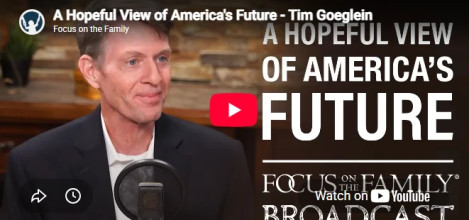
Tim Goeglein: And I think one of the things that I find very often, in fact, I would say almost every campus visit where civics and history comes up, is that young people are actually, uh, angry and they’re disappointed that somehow they were robbed of knowing their own history. And I think that once they rediscover it, uh, it’s both refreshing and it’s nourishing.
End of Preview
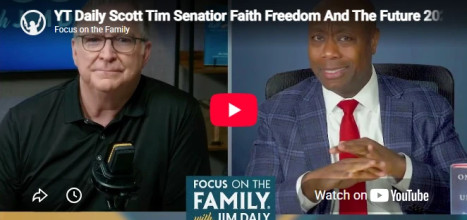
John Fuller: Insight from Tim Goeglein, our guest today, sharing passionately about the importance of American education and his love for this great country. This is Focus on the Family with Jim Daly. And today, as we continue celebrating America’s 250th birthday, we’ll enjoy an inspiring and hope-filled discussion from the National Mall in Washington, D.C. I’m John Fuller.
Jim Daly: John, it was an honor to be invited by the White House Task Force for the 250, as it’s known, for celebrating our 250 years being a nation, and to interview our very own Tim Goeglein on the National Mall. And the emphasis that day was American education. And I thought that’s a good thing to respond to. You know, President Obama asked me to come out and speak to mentoring of young boys, so I went to that meeting, and I thought this would be great to go to President Trump’s, uh, 250 and, uh, to celebrate the country. Many families are asking an important question. What do we want our children to understand about America, about our history?
John: Mm.
Jim: And I couldn’t think of a better person to talk to than Tim Goeglein, our Vice President of External and Government Relations, who lives right there and works in Washington, D.C. We talked about the blessings of liberty, the role of faith in our founding, and the importance of teaching the next generation what is right about America. Every nation has things that are wrong, but we have a lot that is right.
John: Mm-hmm.
Jim: And of course, we also promoted the importance of family, uh, part of the bedrock of this country. And I hope this discussion today will make you more proud as an American and help us to overcome some of the division we see today and build a better future together.
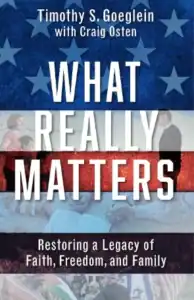
John: Yeah, Tim really is an optimist and he’s fun to listen to. He’s written a book related to this topic called What Really Matters, and of course, we have that here at the ministry. With that, let’s go ahead and jump into the conversation that Jim had with Tim Goeglein in Washington, D.C. on the mall there, on Focus on the Family with Jim Daly.
Jim: Tim, let’s, uh, we’re gonna roll into this program. Uh, your background, you worked with, uh, Senator Dan Coats, you worked in the George W. Bush White House for eight years.
John: Yes.
Jim: You’ve been in this city for a long time.
Tim: Almost 40 years.
Jim: Almost 40 years. You know people.
Tim: Mm.
Jim: (laughs) And you, when you look at the 250 anniversary, the birthday party of America, what thoughts come to your mind about this country?
Tim: The first thought that comes to my mind, uh, is the place that we are sitting. Because from the very vantage point where we are sitting, uh, there is a collective sense of national unity. Uh, behind us, over our, uh, you know, right-hand shoulders, uh, is the citadel of democracy in all of world history, the United States Capitol. It is categorically the most beautiful building in the United States, and that dome represents something eternal, uh, because you cannot understand our constitutional republic without understanding the fundamental nature of the importance of the Judaic Christian tradition, uh, and the importance of the Bible on our founding.
And in front of us is the, uh, Washington Monument, the father of our country. Uh, they stopped building it, uh, during the Civil War. They started again afterward. Beyond that, just, uh, over that street is the World War II Memorial, and beyond that, the Lincoln Memorial. So, Jim, this-
Jim: Uh-huh.
Tim: … is the heart of the United States project on freedom for all mankind.
Jim: You know, Tim, it still feels like we’re in a tug of war on the ideals of this country, and you know, both sides of the political aisle feel they’re fighting a battle for democracy. I mean, you do hear that.
Tim: I y- you do.
Jim: Depending upon what cable news channel you’re listening to.
Tim: You know, Americans have always disagreed about big things, and we’ve always agreed about big things. John Adams, uh, the second President of the United States, famously said in the Revolution that one third of Americans were for the Revolution, one third were for the British, and one third were indifferent. Two thirds either for the enemy or indifferent? That’s polarization.
The Civil War, we spoke about Abraham Lincoln. Uh, 700,000 Americans were killed. Uh, you know, the president was murdered 42 days after his Second Inaugural Address.
Jim: Mm.
Tim: Uh, I mean, it goes on and on. We’ve had polarity and differences before.
Jim: You know, as we celebrate 250 years of this country, it’s important for us to remember, uh, democracy, its roots. Jean and I, we were able to go to Greece this past summer. And I didn’t realize this, and I consider myself a history buff, but, you know, that experiment in democracy only lasted 30 years.
Tim: Yes. And I think it’s a lesson to us. Because when you come to Washington D.C. today, and by the way, Jim, one of the brilliant things has been in the last two weeks leading up to the 250th birthday of our country, I have, having lived here 40 years, I’ve never seen more families come to Washington. And they wanna go to the Lincoln Memorial, they wanna go to the Jefferson Memorial. They wanna take their children to all these important landmarks. You go to Greece, you go to Rome, it seems yesterday’s news. It’s beautiful, it’s important, but it doesn’t seem completely relevant to those societies where you seem that the better days have gone by. That’s not true of the United States. Uh, it’s vital, it’s timely, it’s topical. And we want people to bring their families here of all years in the 250th.
Jim: So, when you look at the way that, uh, the Founding Fathers crafted the Declaration of Independence, the Bill of Rights, all those things, the structure of government, what makes America so unique in the way that they thought through power, the corruptibility of power?
Tim: Yes.
Jim: What did they do differently?
Tim: In all of world history, Jim, until 1776, the Declaration of Independence and the United States Constitution, which came just a few late- uh, years later, in all of world history, there had never been a constitutional republic. And the genius of America is that it’s not imposed from Washington, D.C. It’s not imposed by a king, by a monarchy, by a theocracy, by an aristocracy, however broadly or narrowly defined. It’s power to the people, but with a written constitution, not an unwritten constitution, that we are all equal before the law. This is absolutely genius.
Jim: Yeah.
Tim: And in the history of the world, until the founding of the United States, there had never been freedom like this, then or now.
Jim: You know, you alluded to this issue of the Civil War, slavery, the Lincoln Memorial, et cetera. I was interviewing an African American gentleman, a historian, and he said to me something I’ve never heard. He said, “If you think about it, those Founding Fathers created a document that would take about 80 years to solve a 3,000-year-old problem-”
Tim: Yes.
Jim: “… called slavery.”
Tim: Yes.
Jim: But what a different perspective to think of that. They couldn’t do what some of them wanted to do, which was to end slavery right at that point. Politically, it seemed impossible, they couldn’t keep the country together if-
Tim: Yes.
Jim: … they did that. Uh, yet they created a runway-
Tim: Mm-hmm.
Jim: … is how he said it. They created a runway that it would only take 80 years for Lincoln to arrive, to use the Constitution to abolish slavery. Speak to that positivity of something that was horrific and terrible, and everybody agrees.
Tim: I can’t wait to speak to this. I hope that every single family who comes to Washington, D.C. during the 250 will take some time to go to the Abraham Lincoln Memorial, and on one side, to read the Gettysburg Address out loud with their children, and to read Lincoln’s Second Inaugural with their children. And the reason I say it is that in the Second Inaugural, there is that great line from Lincoln, “A new birth of freedom.” And that is what we’re talking about right now, which is that, yes, the author of the Declaration of Independence was a slaveholder. That is America’s original sin. Undeniably, that is the case. But by the time you get to Abraham Lincoln, the Emancipation Proclamation is on the cusp. Uh, I mean, in all of world history, to go from, uh, slavery to freedom in that short of a period of time is an incredible testament to the United States of America, to our declaration and constitution.
And then, of course, we get to the 19th century, not long after the founding of the country, and we are put on a path toward the modern civil rights movement, the abolition of slavery, um, suffrage. I mean, it all goes together. And by the way, it’s born of a Christian vision that we are all equal in the sight of God. We are made Imago Dei. This is one of the brilliant contributions of Christianity to all of world history.
Jim: Absolutely. Absolutely. The, uh, let me, let me ask you, in terms of that observation of that battle. You said 700,000 people died-
Tim: Yes.
Jim: … in the Civil War. Where can we continue to improve? Where can we go from here? And I, what I like about democracy is that we learn, we grow, we change, we evolve-
Tim: Yes.
Jim: … to become better.
Tim: Yes.
Jim: Which I think is a brilliant point.
Tim: I think it is, uh, fair to say that every major social movement in the United States has been led by the American Church. Uh, we would not have had the, a successful American Revolution without the strong support of the American Church. We would not have had the abolition of the slave trade without the American Church. We would not have had the Civil Rights Movement that began really in the ’40s, ’50s, culminated in the ’60s, without the church. And Jim, I think that the next major civil rights movement, um, is the pro-life movement, again, led by the church. So, I think, and I’m very hopeful, but I’m, I’m particularly hopeful that there will arrive a moment in real American history where every child will be welcomed into the world and protected by the law. And it seems to me that in the American experience, that is achievable.
Jim: Yeah, that’s so, so good. Um, with respect to America today, you, you’re speaking at college campuses around the country, Ivy League schools, you can name them. But you’re seeing a lack of civic understanding, correct?
Tim: It’s huge.
Jim: I mean, that’s some of the interaction you’ve been having. Describe it for us.
Tim: Well, I’ll share one statistic, which is the best and objective measurement of civic literacy, historic understanding among all of American eighth graders is called the NAEP score. And the most recent NAEP score says that less than 15% of American eighth graders are proficient in basic American history. Which means that only 15%, Jim, can say, “This is the basic sequence. The Revolution, the Civil War, uh, the First World War, the Second World War, the Cold War,” or something along that line. So, we have an enormous, a monumental work, I think, of reclamation and revival to do in our country. And I believe firmly that American restoration is possible.
But our founding fathers and mothers, for all their disagreements on big things, they felt that if you wanted liberty and freedom over time, you had to have moral excellence and virtue in the people, in the citizens.
And a basic part of that, of good citizenship, was knowing and understanding, uh, the basic architecture of the country.
Jim: Yeah. And again, brilliance. Let me quote Benjamin Franklin, because he said, “Only a virtuous people are capable of freedom.” And he publicly called for prayer for the, uh, Constitutional Convention.
Tim: He did indeed.
Jim: That’s interesting. I guess separation of church and state didn’t agree in that context. But he went on to say, “The longer I live the more convincing proofs I see of this truth, that God governs in the affairs of men. And if a sparrow cannot fall to the ground without His notice, is it probable that an empire can rise without His aid?” Speak to that quote.
Tim: I think it’s one of the most powerful things ever written by any American ever. And I think that as Americans living in the 21st century, we can look backward to Franklin’s observations, and we can look forward and say that Franklin’s vision has never been more timely or topical than right now. And to ring the bell backwards, here’s what Franklin is saying. If you wanna have liberty and you wanna have freedom over time, you better foster moral excellence in the rising generation of young Americans.
Jim: Right.
Tim: Uh, you better foster moral excellence at every opportunity you get. And in the free society, we have no established religion, we have no religious test for office. Those are important achievements. That’s not to say that there’s not a very important role for the church. And I believe that the role of the church has never been important, more important than it is right now.
Jim: Couldn’t agree more. You know, when we look at the battles in public places, uh, public schools, why would there be resistance teaching our children about the history of the country?
Tim: Yeah. May I say, here we are in the center of the public square. I mean, it, for anybody who’s ever been in a debate, done a speech, written a book, whatever, about faith in the public square, here we are on the National Mall in the middle of a constitutional republic. You cannot have a public square more public than this. Okay? It is a testament to our founding fathers and mothers that they had a vision, that if people disagree, it’s really okay. Uh, but that the strength of a democracy is that if you disagree, you can do it agreeably. You can do it magnanimously. You can do it civilly, unapologetically, but you have the right to come into the public square and to say what you want to say and to believe and to think what you want to believe and think. That, to me, is the greatness left, right, and center. That’s the greatness of the United States of America.
Jim: I agree.
John: This is Focus on the Family with Jim Daly, and you’re listening to a conversation Jim had with Tim Goeglein in Washington, D.C. As we reflect on the 250th anniversary of this great country, we hope you’re inspired by the many ways God has blessed our nation. Learn more, uh, by picking up a copy of Tim’s book, called What Really Matters: Restoring a Legacy of Faith, Freedom, and Family. Look for it at focusonthefamily.com/broadcast.
Jim: You know, looking through the, the lens of family, which is what we do at Focus on the Family-
Tim: Yes.
Jim: … uh, you often speak with great insight on the breakdown of the family.
Tim: Mm-hmm.
Jim: What are some of those statistics that we’re seeing change over the last several decades that really does have an impact on the health and wellbeing of our nation?
Tim: Jim, if you and I were having this conversation in 1970, which, you know, by, that’s a snap of the finger by American history, right? If you and I were having this conversation only in 1970, okay, 77% of all American homes were comprised of mothers and fathers, and at least, uh, one child, uh, 18 years of age and under. That number today is less than 25%. The breakdown of marriage and family is very expensive. Uh, and it seems to me that it is one of the great parts of restoration in our constitutional democracy to once again focus like a laser beam on the importance to a free society of strong marriages, families, and parents. We need to go tell a new generation, right? That marriage is good. Babies and children are good. Uh, and faith and freedom go together. They’re not opposed.
Jim: Well, again, this isn’t rocket science. It’s just sad to see there’s so many forces that work against that outcome. And you’re right, all the data shows conclusively-
Tim: Yes.
Jim: … that a child does best in a two-parent home, mom and dad.
Tim: You know, I’m very hopeful, because I believe that a central part of the American restoration that we’re talking about, I believe that Americans overwhelmingly will fall in love again with the idea of the centrality of focusing on the family. And I think by and large, part of the recovery of the country will come by the recovery of family.
Jim: Well, we totally agree with that. You know, Focus on the Family, we’re doing Hope Restored. It’s for marriages that are in trouble.
Tim: Yes.
Jim: It’s got an 81% success rate two years later; we go back to every couple. And 30% or so have divorce papers in hand. And I think it’s one of the greatest things we can do is to recover a failing marriage and a failing family. Because again, when you look at all the data, that does more to help the culture, help the community, et cetera, than anything else we could do. So, I’m very proud of that 81%-
Tim: Yes.
Jim: … save rate-
Tim: Yes.
Jim: … when it comes to marriages that are in trouble. I think it’s one of the great contributions that Focus is making.
You know, one thing we do, uh, Tim, for parents to help parents, it is a difficult time to parent. There’s so many things, I think, at Focus on the Family. We have more questions from parents about how do we control our children’s screen time-
Tim: Yes.
Jim: … and what they have access to? And there’s been no real good answers, other than you gotta monitor it like crazy. This new ruling by the Supreme Court will help, in that, you know, children under 18 won’t be able to sign up for certain apps, et cetera. That’s a step in the right direction.
Tim: It’s a huge step in the right direction. And Jim, I think there is a book to be written. Uh, not George Orwell’s, uh, 1984, but the new book would be called 2010 because that was the year the smartphone was introduced. And 2010 began to disincentivize human relationships. And the implication has been enormous.
Jim: Mm.
Tim: The implications on physical and mental health to incentivize not relationship, not friendship, uh, not in-person, uh, relationships. I mean, this has been very tough for the country. And I think that in our 250th year, this is the year, in my view, to get out into your neighborhood, go back to church, uh, learn about the school board. In your own community, learn more and connect with people at a very human level. I think it’s a great part of our national spirit, and I think that our founding fathers and mothers, they’re the ones who pattern this for us.
Jim: You know, and it’s so good, as parents, we can be really busy, and-
Tim: Mm.
Jim: … be distracted from the core role of being a good parent, a good dad, a good mother.
Tim: Yes.
Jim: And I think we need to do all we can as a culture to help support those families that are raising young children. Focus on the Family have something called Age and Stage.
Tim: Mm-hmm.
Jim: People could, it’s absolutely free, people can sign up. You get a weekly email, zero to 18, what you can expect with raising that child in that, you know, the terrible twos.
Tim: Mm.
Jim: What are some things I could do as a parent to help calm the terrible twos? That kind of straightforward, helpful, practical advice.
Tim: Yes.
Jim: So, one of the many things that we’re doing to try to help parents do the best job that they can do. Um, speaking of that, again, I wanna come back to the colleges that you speak at.
Tim: Mm.
Jim: Harvard, Yale, Princeton.
Tim: Yes.
Jim: Why is there such an embrace of socialism when it comes to college campuses?
Tim: I think the single answer to that has been the form of education, uh, that young people have gotten from the earliest years. I mean, very often, Jim, pre-kindergarten, kindergarten, very often K through 12, it’s remarkably unreliable. Uh, in fact, I have argued, and I know we have discussed strongly, that the best alternative that I’m aware of, to K through 12, uh, civics and history, is actually from our friends at Hillsdale College. Very commodious with Focus on the Family.
Because what the 1776 curriculum does, and one of the things that I think is an antidote, uh, and a help, uh, to the kind of indoctrination that has happened from the youngest of ages in American education broadly, there are great exceptions, but broadly I think, is to go tell a new generation the story of the American experience. And I think one of the things that I find very often, in fact, I would say almost every campus visit where civics and history comes up, is that young people are actually, uh, angry and they’re disappointed that somehow they were robbed of knowing their own history. And I think that once they rediscover it, uh, it’s both refreshing and it’s nourishing.
Jim: You know, I agree, that’s a good way to look at it. So often when we’re watching the news, it’s all about what’s wrong.
Tim: Mm.
Jim: You know, the problems, the hassles, uh, you know, the exploits of humanity-
Tim: Yes.
Jim: … against humanity. What is right about America?
Tim: Uh, I can’t wait to answer that, and especially sitting here on the National Mall-
Jim: (laughs).
Tim: … uh, looking at some of the more than 20 museums which comprise the Smithsonian, all right? Uh, just one block from us, and we can see it from here, it’s called the Castle. It is the original Smithsonian. And what I love about this, Jim, is that this exhibition, of all the exhibitions in Washington this year, you walk into that exhibition hall at the Castle, and you see the desk that Thomas Jefferson used at the age of 33, to draft the Declaration of Independence. You see Thomas Edison’s original light bulb. Uh, you see, which I absolutely love, Harriet Tubman’s hymnal, which was very important to her.
Jim: Mm.
Tim: And what you realize, Jim, over and over again, is that any conversation about American exceptionalism, any, and I, I challenge all of us to go into any of the Smithsonians and to find an exception, is that if you look directly, if you really absorb it, you will find that the Judaic Christian tradition, faith, religion, things of the Spirit, it’s baked into the DNA of the United States of America.
I would offer that without religious liberty and conscience rights there would be no United States of America. There’s a reason when you walk one block from where we’re sitting and you visit the National Archives, you look at the Declaration, you look at the Constitution, but right there to the right of the Constitution, the Bill of Rights, the First 10 Amendments to the Constitution. And what’s number one? Religious freedom. Uh, religious conscience. I mean, it’s unmissable.
Jim: Yeah. You know, those cornerstones of our culture seem to be rocked right now.
Tim: Yes, they are.
Jim: Why are we finding it so difficult to rally for what the Constitution is talking about, those freedoms?
Tim: Yes.
Jim: And why do we feel like those freedoms are at risk today?
Tim: I mentioned George Orwell earlier, Jim. George Orwell famously wrote that language shapes politics. I’ll say it another way. Language, words, et cetera. They’ve got to be true because they ultimately shape public policy for good or for ill. Our late friend, Jack Kemp, said that the only way to defeat a bad idea is with a good idea. And so, this is what we are debating in our time. The public square is filled with bad ideas. But the really great news is that the public square is also filled with very good news. Uh, homeschooling. Uh, charter schools. I could go on and on. There’s all kinds of good ideas there. Parental rights, we’ve been debating these things. It’s very important that in the contest of ideas, that we win the debate before we win the vote. And it seems to me, in order to do that, we have to go tell a new generation why the things that we believe are so foundational are worth defending in the first place.
And Ronald Reagan famously said that somebody who’s with you, Jim, 80% of the time is your friend.
Jim: (laughs).
Tim: So, I think it’s important in public policy to do everything we can, when possible, to find someone who we can agree with, uh, you know, 70 or 80% of the time, and to be comfortable with it maybe later on, we’ll come back for the rest of the 20 or 30%, debate that, hope to persuade. But we’re Americans. Let’s find the commonality. Let’s find the area where we can agree and then let’s go make our country even better in the next 250 years.
Jim: I think that’s a great place to end, Tim. Thank you so much for being with us on the mall here in Washington, D.C.
Tim: It was a blessing and honor, more than I can say.
Jim: God bless you.
Tim: God bless.
John: Well, Jim, what an energetic and really great conversation that you and Tim had there in D.C. It’s pretty inspiring stuff.
Jim: It was fun. Uh, Tim gave us some great reminders that the future of America depends not only on policies or elections, but on the strength of faith and family. And I couldn’t agree more. Um, as we continue celebrating America’s 250th birthday, this is an important moment for moms and dads to be intentional, talk with your children about our nation’s history, to help them see both our blessings and the challenges that we’ve had, and to raise them with gratitude to God and hope for the future.
If you’re raising children right now, we want to come alongside you in that important calling. Focus on the Family has a free resource called Age and Stage. It’s designed to give you practical, biblically grounded encouragement for every season of parenting. And when you sign up, you’ll receive helpful guidance tailored to your child’s specific age, with insights on what they’re experiencing developmentally and how you can connect with them, and how to guide their heart with wisdom and grace.
John: Yeah, Age and Stage is a great resource.
Uh, sign up today, and, uh, when you’re online, also consider a contribution of any amount today to the ministry of Focus on the Family. And we’ll send Tim Goeglein’s book, What Really Matters: Restoring a Legacy of Faith, Freedom, and Family, which will help you and your family better understand this wonderful nation’s history. You’ll find other educational resources as well. It’s all at focusonthefamily.com/broadcast, or call 1-800, the letter A, and the word FAMILY.
Thanks for listening to Focus on the Family with Jim Daly. I’m John Fuller, inviting you back next time as we once again help you and your family thrive in Christ.