




Matt Bell: It took me four and a half years to get out of debt. That’s, you know, took time. It wasn’t just gonna happen instantly and it may take time for couples to get into a better place financially. Be patient, put honoring the Lord first, put loving each other well second, put making a difference in the world third, and start to orient your finances that way. It may not change radically overnight, but eventually you’ll be on a very, very good path.
John Fuller: Well, that’s Matt Bell and he joins us today on Focus on the Family with Jim Daly. We’re gonna be exploring some healthy habits for your marriage with regard to finances. Thanks for joining us. I’m John Fuller.
Jim Daly: You know, John, money can be a really touchy subject (laughs) within marriage and-
John: It can be.
Jim: … within families.
John: Mm-hmm.
Jim: It’s probably, you know, it ranks right up there, number one, two, or three in the areas of marriage that couples really struggle with. So it’s a very important topic. We come to this, probably every couple of months we try to do a program to help people with their finances. Let me, uh, rattle off some stats. Did you know about 40% of couples don’t know their spouse’s salary?
John: Oh.
Jim: Now, I probably know just about every NFL salary.
John: (laughs)
Jim: You know, what, what is Bo Nix of the Broncos making? But, you know, that’d be an interesting question.
John: Mm.
Jim: Do you know more about the salary of sports figures and not your spouse, right?
John: Yeah.
Jim: Um, another one, 28% of couples admit to hiding significant purchases or debt-
John: Mm.
Jim: … from their spouse. And I remember a story where a couple got married in their 20s. The woman had accumulated $250,000 of school debt-
John: Oof.
Jim: … for a French literature degree.
John: Oof.
Jim: And, uh, wow. I mean, that, and had not disclosed it to her fiancé and then husband. And, uh, that would be a rude awakening.
John: Mm.
Jim: There are practical, biblical approaches to money and I think the main point is simply good to be reminded of how we should manage that money.
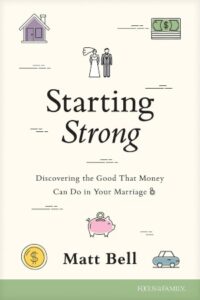
John: Mm-hmm. Yeah, and it’s great to have Matt Bell back with us. Uh, he’s been here before. Uh, our listeners really resonate with his insights. He’s a personal finance writer and speaker and he’s the managing editor at Sound Mind Investing and he and his wife, Jude, have three young adult children. Today, we’re gonna be talking about a brand-new book that he’s written called Starting Strong: Discovering the Good that Money Can Do Through Your Marriage.
Jim: Matt, welcome back to Focus on the Family. Good to have you.
Matt: Thanks so much, Jim and John. It’s a pleasure to be here.
Jim: You know, one of the most interesting things with financial folks, you know, planners, helpers, writers on the topic, most of them come from a place of pain.
Matt: (laughs)
Jim: You’re not born necessarily. Maybe you have an aptitude to accounting, I don’t know. But most of the people that I’ve interviewed come from a period of time where they were in the hole-
John: Mm-hmm.
Jim: … and they had to figure it out. I really appreciate that. I think Dave Ramsey has that testimony. What’s your prodigal story?
Matt: (laughs) Well, it very much is just that, the prodigal son.
Jim: (laughs)
Matt: Um, I inherited $60,000 from an uncle when I was in my mid-20s. Had no idea he planned to leave me any money, an incredible gift, incredible surprise and I, and I really did have good intentions with that money when I received it. I thought this is a once in a lifetime opportunity to do something amazing career-wise. And I love to play golf, I love to travel. I thought, “How can I turn all that into a career?” So I created a newsletter for people to take golf vacations.
Jim: (laughs)
Matt: And, and while it lasted, it was amazing. I got to play Pebble Beach. I got to play these great golf courses in Southern Spain. It was everything I dreamed it could be, except profitable.
Jim: (laughs) Yeah. Oh, wow. It sounds like you’re ahead of the tech, uh, curve on that. You could have had a following, an app.
Matt: (laughs)
Jim: People would have paid you money to go play golf.
Matt: Well, keywords were “could have.”
Jim: (laughs) Could have.
Matt: It-
Jim: You were really-
Matt: … didn’t really work out all that well.
Jim: … 20 years ahead of that one, right?
Matt: Yeah.
Jim: Yeah. Let me ask you this, Matt. If you would have invested that 60,000-
Matt: (laughs)
John: (laughs)
Jim: … in your 20s-
Matt: Oh, that’s painful.
Jim: … you would have had $2 million by the time you were 65. Did you realize that?
Matt: Well, very painful to think about that, but you’re exactly right.
Jim: Compounding interest-
Matt: (laughs)
Jim: … is quite amazing, isn’t it?
Matt: You sound like some of my friends-
John: (laughs)
Jim: No, I mean I’ve-
Matt: … that would talk about that.
Jim: I’ve, I have talked to people that have given, you know, put $5,000 for their kids-
Matt: Yeah.
Jim: … who were just born and they’ve shown me the models at average rates-
Matt: Yeah.
Jim: … of growth from the stock market-
Matt: Yeah.
Jim: … you would expect about a million dollars when that one-year-old turns-
Matt: That’s right.
Jim: … 65.
Matt: It’s amazing what it can turn into.
Jim: Without-
Matt: (laughs)
Jim: … putting any more into it.
Matt: But in my case, I took the 60,000 and transformed it into 20,000 of credit card debt.
Jim: Wow.
John: No.
Jim: Okay. Now let’s speak about that.
Matt: Yeah.
Jim: The 20,000 of debt.
Matt: So you’ve got to do a lot of things wrong to do that. And, and I was doing a lot of things wrong. Um, but it was a huge wake-up call. It was very humbling to see that dream die, to see, you know, the, the guilt of, of squandering my uncle’s hard-earned money and that sort of thing. So I moved home with my parents for six months and I was really down for the first couple of months that I was out there, but, but God used it for great good. I mean, a friend of mine from college reached out and shared his faith with me. He had become a Christian a year after I, I graduated from college and that was life changing unto itself because it got me exploring matters of faith, and ultimately I placed my faith in Christ, which would have been plenty to come out of that experience, but I also really got interested in learning about money.
Jim: Yeah.
Matt: And I was amazed at how much the Bible says on this topic. And so I’ve been writing about it, speaking about it, learning about it evermore, um, ever since then.
Jim: You know, Matt, it’s a great insight. So this was your valley. You were 25-
Matt: Yeah.
Jim: … 24?
Matt: Mid 20s.
Jim: I mean, so you hit this valley-
Matt: Yeah.
Jim: … of being in debt $20,000.
Matt: Yeah.
Jim: This friend of yours from college calls.
Matt: Yeah.
Jim: He’s just accepted Christ the year before. He starts sharing the Lord with you, I’m assuming.
Matt: Right, yep.
Jim: You, you’re not repelled by that. You’re intrigued, partly because I’m sure you’re in a valley.
Matt: Yeah, absolutely. I was humbled. I was, I was so humbled-
Jim: Mm.
Matt: … by that experience and so, um, just kind of distraught and trying to figure out what is my life gonna be about. I thought I knew, but clearly I didn’t know. And so he was saying encouraging things like, uh, “God has a plan for your life.” And that was very intriguing to me. So I began reading the Bible, I began going to church, I began learning and I was just a, a sponge for all things, uh, related to matters of faith. And then I couldn’t believe how much the Bible says about money. So the first church I went to has a stewardship ministry, I got involved in that and just loved that. So I loved seeing how God was using my pain, my values, as you said, my story to start to help others, because I’m not a guy that’s always gotten the money thing right. I can relate to a person who’s, who’s had trouble with money.
Jim: You know, I so appreciate that though, but, uh, you know, speaking to those who are listening or watching, I mean, that, that’s a starting place-
Matt: Mm.
Jim: … when you’re in that valley. So often that’s where the Lord begins to turn your heart-
Matt: Yeah.
Jim: … right? And open your ears and eyes to what is true.
Matt: Absolutely.
Jim: The spiritual things that are most important, you usually win those battles down in the gutter-
Matt: Yeah.
Jim: … and not on the mountaintop. I mean, that comes later. Let me ask you this, uh, in terms of scripture, Matthew 6:24 says you cannot serve both God and Mammon.
Matt: Mm-hmm.
Jim: …that’s a very famous area of scripture. How can we cultivate an attitude toward money that honors God? And let me add this too, in a culture that, you know, for the most part, needs are taken care of-
Matt: Yeah.
Jim: … in Western civilization? Not all of it, here in America, Canada-
Matt: Yeah.
Jim: … parts of Europe. So how do we even get our hands around what the Lord would want for us and what we think is being poor, being rich?
Matt: Mm. Yeah. Well, the Bible never says that money is a bad thing unto itself. You know, the Bible doesn’t say that money is the root of all evil. Some people think it does. It says the love of money is a root of all kinds of evil. And I think that’s a, a really important distinction. So I think as we start to see that God’s intentions for us are good, that he wants good things for us and as we start to experience some of the worldly approaches to money and see that that’s either not working or could be hollow if you do achieve some financial success and you start to see, “Oh, the Bible says so many things about money, so many practical things about money, but, but God just wants us to put him first.” You know, that’s the thing. You can’t serve both God and money, God needs to come first and then money is used according to his principles for his purposes. That’s the approach that tends to work really, really well.
Jim: So you and Jude, your wife, you’re engaged, you’re looking at the registry, everybody’s done that.
Matt: (laughs)
Jim: Our registry may have been Target.
Matt: (laughs)
Jim: I don’t remember this.
Matt: (laughs)
John: (laughs)
Jim: That’s a fair, probably a true story, actually. But the, uh, you know, you’re looking at china, right? That was nice.
Matt: Right.
Jim: (laughs)
Matt: That was the source of our first disagreement.
John: Oh.
Jim: And let me know-
Matt: (laughs)
Jim: Yeah, tell me what happened with that and how it pointed to a little, you know, rub between the two of you.
Matt: Yeah. It, it’s funny because we dated for six months and then we got engaged and things were going along really, really well, but then we started to register for gifts that we wanted other people to buy for us. It wasn’t even our money we were spending. (laughs) It was other people’s money. But it was in that department store walking these aisles of, of plates and cups and saucers that we realized, “Oh wow, we have very different views of, of what these things should look like.”
And, you know, it sounds so trivial, right? But, but yet it started to make me concerned. I mean, I’m, I’m very kind of minimalist. I like, my parents were that way and so I think I’ve adopted their views of, of design and, and art and what, what looks good. That’s what I was drawn to, very simple, you know, maybe plain white, you know, sturdy would be good. It, it’s gonna last a long time. But, but she grew up, she’d grew up in a home where there was a, a, a set of dishes on display, very formal gold rim dishes and, and their everyday plates had a floral design. Floral really works against my instincts.
John: Taking up way too much space.
Matt: (laughs) Yes.
John: (laughs)
Matt: And so I started to think, “Oh wow, we’re so different in this area. I never noticed.” And so I started to think, “Oh, what other things in my life are gonna have floral designs on them?” And it started to be a little bit fearful, but, you know, it’s a funny anecdote, but, but really it pointed to the need to have lots of conversations and try to come together. And I think over the years I’ve become, I’ve kind of moved toward her and she’s moved toward me on design issues so we’ve come together, but that was the first example of, “Wow, we’re really on different pages on something.”
Jim: That’s great, Matt. What was your second argument?
Matt: (laughs)
Jim: No, I’m kidding. I’m kidding. I, you don’t need to answer that question. Um, let me, uh, mention this though, talking about arguments. According to one study from Fidelity, the, the resource management firm, rather large.
Matt: Yeah.
Jim: Uh, they say as many as 25%, that’s one in four couples, call money their most significant relationship-
Matt: Mm.
Jim: … challenge.
Matt: Yeah.
Jim: So that’s a big number.
Matt: Yeah.
Jim: Um, and probably if you look across the arc of decades of marriage, it doesn’t go down typically.
Matt: Yeah.
Jim: It still rests in bubbles one, two or three.
Matt: Mm.
Jim: What’s happening with those couples?
Matt: Yeah, I think initially when couples come together in marriage, what’s happening there is that, you know, people don’t enter marriage with a blank slate. We, we all bring something into our marriage. We bring stuff into our marriage. We bring how we saw our parents deal with money into our marriage that we may not even realize the degree to which it still works on us, but we bring that. That’s a big factor. We bring our hopes and dreams around money that might be very different from our, our spouse. We bring certain early experiences we’ve had with money. In my case, I had a lot of debt and that was a very traumatic experience. And we bring very different temperaments into marriage. And these things don’t naturally just fit together and so that’s a source of a lot of friction and a lot of having to work things out early in marriage, but then as time goes on, I think people, it’s, it’s a failure to communicate.
Jim: Mm-hmm.
Matt: I mean, as you mentioned, people don’t even know what their spouse earns for a living. We’re just, that’s just a failure to communicate. So just more communication around money and most things would probably help.
Jim: Yeah, for sure.
John: Yeah. Along those lines, Matt, Jim mentioned this, a couple that got engaged and married and, and she had no, uh, disclosure about s- sort of where she was at-
Matt: Yeah.
John: … with her debt. You advocate full disclosure about all of that-
Matt: That’s right.
John: … for couples that are getting married or have recently married.
Matt: Yeah.
John: What’s the importance of that?
Matt: Yeah. I advocate full financial disclosure before marriage and, and complete ongoing financial transparency after marriage. You don’t wanna be surprised, uh, when you get married at, at what you’ve actually married into with all this debt, because I really believe, you know, the vision for marriage in the Bible is oneness, it’s unity. And so if one spouse was really wealthy before marriage, now once you’re married, you’re both very wealthy. If one spouse had a lot of debt before marriage, when you come together in marriage, now you both have a lot of debt. There’s a, um, a great story that, that I have from my past where a couple that I know, Scott and Karen, she brought $50,000 of, of non-mortgage debt into their marriage. He called it a reverse dowry.
John: (laughs)
Jim: (laughs)
Matt: And, and he had-
Jim: That is so true.
Matt: He had a great attitude about the whole thing though because she would always say early in their marriage, “Oh, my debt, my debt, my debt is keeping us from doing this or that. My debt, I feel so bad about my debt.” And he would always correct her and say, “It’s not your debt, it’s our debt.” And I think that’s a really bold act of leadership, act of love to take that perspective. So I just want there to be no surprises. I want there to be full disclosure, maybe not on your first date, but as you, as things start to get serious in a relationship, it seems to be headed toward marriage, now let’s understand how much are we each earning? How much do we have in savings? Are there any traumatic stories in our background around money? And then ongoingly, everybody, both parties should have access to all the finances.
John: Yeah, yeah. And a surprising number of people never have the conversations.
Matt: Yeah.
John: Well, we’re trying to encourage you to have the conversations today on Focus on the Family with Jim Daly. Our guest is Matt Bell and we’re talking about a newly published book called Starting Strong: Discovering the Good that Money Can Do In Your Marriage. Uh, get a copy from us here at the ministry when you stop by focusonthefamily.com/broadcast.
Jim: And Matt, what are some ways that couples, uh, can create that financial unity? What, what are some practical tools they can use?
Matt: Yeah. One of the things is, is simply having conversations about the past. You know, how were you raised around money? Um, that’s really big. There was one couple that I tell the story of in the book, where, they were on some fun outing to Wrigley Field in Chicago, what can’t be fun about that?
Jim: Mm-hmm.
Matt: You’re just at this great ballpark. But some of them, a topic of money came up and it closed the conversation down because he found out that she was carrying a balance on a credit card and that to him was an absolute no-no. And so it was a, it was a troubling, difficult conversation. But it also opened up the door to more conversations where they gained a much greater sense of empathy and understanding of each other’s background. He grew up in a very stable household. There was always money for vacations and groceries. She grew up single parent household where money was always tight. She had gotten acclimated to using credit cards, but, but in realizing he really didn’t like that, she quickly paid off her balance and he, by the same token, gained some empathy for the difficulty with which she was raised as-
John: Mm-hmm. Yeah.
Matt: … as a, with, with a single parent household.
Jim: That, that field level ticket at Wrigley might be 128-
Matt: (laughs)
Jim: … bucks.
Matt: (laughs) It is today.
Jim: I wouldn’t start there, but (laughs) anyway. No, I mean, that’s part of it is that communication. You know, let me go back for a moment to that opening comment I gave of a situation, was a true situation, where th- this, uh, young man and woman were getting married.
Matt: Mm.
Jim: She had not disclosed her school loans of, uh, $250,000-
Matt: Yeah. Wow.
Jim: … for a four-year degree.
Matt: Wow.
Jim: And, you know, then they’re married and that came forward and how… How would you go about as the spouse that’s not, has no debt and that’s never come up, and this is an off-the-wall question for you, but what do you say at that point? You’re already married now she’s disclosing this and you say, “Okay, there’s only one option. We’ve got to create a financial plan-
Matt: Yeah.
Jim: … that pays that down.”
Matt: Yeah.
Jim: Uh, uh-
Matt: Yeah.
Jim: … but wow.
Matt: Yeah. And, and hopefully that’s it. That, that, they’re both on that same page that, “Hey, we’re in this together now so let’s tackle this together.” It may take time, it may mean dying to certain dreams or at least the timing of certain dreams, but we’re in this together so let’s get really committed to getting out from under. And the story I mentioned of the couple where she had $50,000 of non-mortgage debt, they saw the blessing of not buying a house when all their friends were buying a house. They saw the benefit of waiting, even though they sometimes… And, and by the way, they were giving generously throughout that time.
Jim: Huh.
Matt: And she told the story very candidly about how sometimes she felt like, “Boy, if we didn’t give so much, we’d be able to get out of debt so much faster.” But they saw God’s blessing in it because ultimately when they did get out of debt, they realized that they would have bought a house at a very difficult time or, or at the market high.
Jim: Right.
Matt: And today, given what, what happened eventually at that point, the market had, had declined quite a bit, they probably would have been underwater on a house that they bought-
Jim: Yeah.
Matt: … then.
Jim: Anybody else have that gift? Buying at the high-
Matt: (laughs)
Jim: … point and selling at the low point?
John: You did that.
Jim: I’m, I’m good at that.
Matt: (laughs)
Jim: So, hey, uh, Matt, what about the common question about combined accounts and, “If we have combined accounts, how do I get him a birthday present?”
Matt: (laughs)
Jim: “He, he’s gonna know about it.”
Matt: Right.
Jim: Or, you know, something like that, keeping separate accounts, maybe the both of them work and they just decide, “Let’s keep separate checking accounts rather than a joint checking account.”
Matt: Yeah. I would strongly encourage joint accounts, uh, because that fosters transparency and teamwork and unity. But in terms of buying a gift, you could do something as simple as withdraw some cash from an ATM so now there’s no record that’s readily apparent of where a gift was purchased so there can be a surprise doing something as simple as that.
Jim: Yeah, that’s good. I mean, one of the, one of the problems is when people hear the word “budget,” uh, you go, “Ugh.”
Matt: For sure.
Jim: And you, especially the budget meeting.
Matt: (laughs)
Jim: Let’s set one up.
Matt: (laughs)
Jim: Yeah. And, you know, it’s gonna take a little bit of work, a little bit of pain.
Matt: Yeah.
Jim: Uh, but how do you, how do you reverse that attitude-
Matt: Yeah.
Jim: … that couples might have at the early stage of dating or marriage for sure?
Matt: Right. I think a budget is the single most powerful tool anybody can use to manage money well. And we’re stewards of God’s resources, the Bible teaches us. So doesn’t it just make sense, you know, if we’re running a business or running an or- organization, we’re gonna watch over the finances, we’re gonna have a plan, we’re gonna have a budget. Uh, a family, a household, is a small business and so we’re managing God’s resources. We need a tool to manage that effectively.
You know, a lot of people think they, they talk about a budget as something you go on like a diet or they think about it as being about less, it’s about being obsessively spending as little as possible, but a budget is really, I like to tell people about more. It’s about having more knowledge of what’s happening with your finances so that you can be more intentional in your use of money so that you ultimately have more for the things that really matter. So people hearing that might have to take it on faith, but if they will just try a budget for about 30 days and start to get used to that habit, I think they will see so much good, so many blessings-
Jim: Yeah.
Matt: … that come from it.
Jim: You know, your book Starting Strong has many gold nuggets in it. The one that caught me as a maybe the mother lode-
Matt: (laughs)
Jim: … is this idea that normally we start with expenses, savings and then giving.
Matt: Yeah.
Jim: And you say flip that, start with giving.
Matt: That’s right.
Jim: That’s an amazing thought. I’d never thought of that.
Matt: Hmm.
Jim: I mean, I did it the traditional way.
Matt: Yeah. It’s very countercultural. You know, I tell people in, in a variety of workshops, if you take nothing out of this (laughs) workshop t- today, take this. The order with which you use money will make all the difference. And with a married couple, it’ll make all the difference in their finances, it’ll make all the difference in their, uh, marriage. And so think about it, there’s only a few things you can do with money. You can spend it, you can use it for debt payments, you can save it, you can invest it, you can give it away, and that’s the order that our culture teaches us in countless ways, both overt and subtle. We’re taught to spend first. We’re making, you know, $80,000 a year. We, that means you can live here, you can drive that, you can wear this brand of clothing. When, when spending comes first, debt is just a given I’ve found. And if any money’s left over, some might be saved, invested and given away, but typically there isn’t much left over.
So if we flip that, you know, the Bible says, “Honor the Lord with your wealth, with the first fruits, the first portion of all of thy increase,” one version of the Bible says. So if, if we flip that equation on its head and we say, “We’re gonna honor the Lord with the first portion by giving to is work in this world. We’re gonna give first, then we’re gonna save a portion,” because the Bible says in the house of the wise are, are stores of choice food and oil, but a foolish person devours all that they have. Then we’re gonna invest a portion for the future and then we’re gonna decide, we’re gonna see how much we can afford to spend on housing and clothing and vacations and all the rest and along the way we’re cautious to not become enslaved to creditors as the Bible warns. That, if, if people will do that, it sounds so simple, it’s so practical, it’s so effective, it’s so biblical and yet it’s so rarely practiced, but if people will do that, it will serve them so well.
John: Yeah. So is, is it 10%? Is it 5%? How, how do I determine that I’m gonna start by giving first?
Matt: Yeah. And, and that’s a fair question because I think people need guardrails. They need some guidance about that. And so the, the Old Testament teaches very clearly, a tithe or a 10th part, 10% of, of income, that’s a starting point. In the New Testament, Matthew 23:23, Jesus seems to affirm the tithe and yet every example in the New Testament goes beyond it. You got Zakias giving half, you’ve got the widow giving all. And, and that’s what Jesus did with the, the laws is He, He made them, He changed them from letter of the law adherence to spirit of the law, and I just think it makes sense to use that as an helpful biblical starting point.
Jim: You know, so many people I talk to, couples that recount their early years and they’ll say often, “Those were great years, but we didn’t have a bed.”
Matt: (laughs)
Jim: “We didn’t have a couch. We didn’t have a table.” That was Jean and I, too.
Matt: You didn’t have a table, right?
Jim: No, we didn’t.
Matt: (laughs)
Jim: We had no furniture because I had just gotten back from Japan a couple of years before. I said, “We can make a futon, you know, we’ll just throw blankets down until they’re soft.” (laughs).
Matt: (laughs)
Jim: So buy three or four blankets, that becomes your mattress and then here we go. So, you know, that, part of that struggle is actually part of building your memory together.
Matt: Yeah.
Jim: Your, you know, the sweetness of all that when it-
Matt: That’s right.
Jim: … was tough.
Matt: Yeah, absolutely. When you’re starting out… That’s why it’s so important with all these things we’re talking about to get these things right from the beginning, because life is only going to get busier and maybe God’s going to bless you more financially. And so if we establish these priorities early in our marriage, we’re going to serve the Lord. As for us in our household, we will serve you, Lord. We’re going to base our decisions, our marriage and our finances on, on the solid rock of God’s word. We’re going to, you know, use money in a way to love each other well, to strengthen our marriage and to glorify God and to make the difference in the world that God intended when he brought us together in marriage. Make these decisions early. And, you know, you’re mentioning kind of the early, many people experience-
Jim: Yeah.
Matt: … that sort of early difficulties in financially in, in, in their starting out years. John Rockefeller, you know, one of the wealthiest people ever lived, he said, “I never could have tithed on my first million dollars if I hadn’t tithed on my first salary, which was a $1.50 a week.”
Jim: Wow.
Matt: And I think there’s an important-
John: Mm.
Matt: … point there. There’s an important point for kids there, teaching kids-
Jim: Mm.
Matt: … about generosity, and an important point for our marriage is, “Let’s start there and let’s see how, how God blesses that over time.” And I think, I feel very confident that He will.
Jim: You know, the most common thing, Matt, right here at the end, and we’ll continue if you can stick with us, we’ll keep going. But the most common thing, I think, is if you only knew the mountain I faced-
Matt: Mm-hmm.
Jim: … you know, I, I could barely scrap by. How often is it that you look at somebody’s finances in, in that consulting role-
Matt: Mm.
Jim: … and it’s really perspective over everything. It, it just means you can’t do certain things. Can you pay your rent or your mortgage?
Matt: Yeah.
Jim: Can you buy groceries? Can you take care of transportation?
Matt: Right.
Jim: And then beyond that, it kind of ends up being wants, right?
Matt: Yeah.
Jim: I mean, there are probably other things. You might have medical issues.
Matt: Yeah.
Jim: I get all that and everything’s unique. But what’s that rhythm that you normally see with young couples where, you know, the advertising world has done a number on us-
John: Yeah.
Matt: Yeah.
Jim: … and we think we need those shoes, we need that coffee, we need whatever.
Matt: Right.
Jim: And in fact, you don’t.
Matt: Yeah. I just encourage couples to live counter cultural lives and to take their cues from the Bible. It will be a counter cultural life. It’ll be a life that isn’t what your friends are necessarily doing or what you see on, on social media, but it will be a good life. So, so base your decisions on what the Bible teaches us about, about money. You know, get those decisions right early on, make those convictions, something that’s really clear from the beginning of your, of your marriage. Some couples do really, really have significant financial struggles and, and God’s going to meet them there. There’s compassion for that. We’re not about legalism and, and legally, you know, legalistic adherence to certain teaching in the Bible. But I think if people will orient their use of money around what the Bible teaches and be convicted by and motivated by what it teaches and to make those distinctions between needs and wants, because a lot of times wants can morph into needs very easily, but if we orient things financially and otherwise around a biblical approach, over time it will work well. It took me four and a half years to get out of debt. That’s, you know, it took time. It wasn’t just going to happen instantly and it may take time for couples to get into a better place financially. Be patient, put honoring the Lord first, put loving each other well second, put making a difference in the world third, and start to orient your finances that way. It may not change radically overnight, but eventually you’ll be on a very, very good path.
Jim: Oh, that’s a good word, Matt. And, uh, like I said, let’s keep going and come back next time and continue the discussion. I think that’d be a great thing to do. It’d be a lot of help for, again, young couples particularly, but good advice for everybody. So we’ll continue to talk about practical budgeting ideas next time and maybe go a little deeper in the practical side. And, uh, let me turn to the listener. I encourage you to get a copy of Matt’s great book, Starting Strong: Discovering the Good that Money Can Do Through Your Marriage. And we’d love to get that into your hands, uh, for a gift of any amount. If you can send just anything, we’ll send it to you as our way of saying thank you for being part of the ministry. I, it’s one of those programs. If you can’t afford it because you’re that strapped, this is something we need to give to you.
John: Mm-hmm.
Jim: So call us, we’ll trust others. We’ll give a little more to offset that, but give us a call. Don’t be embarrassed. We’ll get it out to you to help you in your, uh, struggles with managing money.
John: Mm-hmm. Yeah, we’re here to help and another great resource is our free online marriage assessment. Uh, it’ll take you 10 or 15 minutes to fill this out. It’s gonna give you insights into your marriage journey, uh, asking about key things including money and, uh, that free online marriage assessment is available through our website. Uh, so donate, uh, take that assessment, get a copy of Matt’s terrific book, Starting Strong, uh, all at our website and that’s focusonthefamily.com/broadcast, or give us a call, 800, the letter A, and the word FAMILY. 800-232-6459.
Well, thanks for joining us today for Focus on the Family with Jim Daly. I’m John Fuller inviting you back next time as we continue the conversation with Matt Bell and once again, help you and your family thrive in Christ.