




Preview:
Dr. Steve Farrar: We get diverted as men from the leadership that God wants us to exercise in the home because we are told and we are put upon that the most important work that we do is what we do when we leave the house. That’s contrary to what God says in His Word.
End of Preview
John Fuller: In a world where men tend to be defined by what we do, we have encouragement for you to be counter-cultural and really focus on your family. This is Focus on the Family with Jim Daly, and I’m John Fuller.
Jim Daly: John, this message is counter-cultural, but it’s also fun, uplifting, and rather moving. So let me say right now, this is a message men need to hear, period. It’s very, very important. So, for the women who are wishing their husbands could hear this, let me remind you, he can. Contact us here for the CD or audio download, or even better, get the app.
John: Yeah, we’ve got a great app. It has so much content, and you can get details about it at focusonthefamily.com/broadcast.
Jim: Our guest, the late Steve Farrar, was a prolific author and speaker who specialized in encouraging men to be godly husbands and fathers. In fact, he was one of the premier speakers in the Promise Keepers Movement in the early ’90s. Sadly, Steve died of a cardiac event in February 2022 at the age of 72. And boy, I’m so glad we can still hear his wisdom today through these recordings.
John: Yeah, this is timeless content. Uh, Steve is missed, but here he is now speaking at a men’s conference in 2005 on today’s episode of Focus on the Family with Jim Daly.
Dr. Farrar: Story is told of a real estate developer who was out in the country. He’s looking for some property. He’s driving down a two-lane road going about 55 miles an hour and out of the left side his peripheral vision, he, uh, he senses a car going around to pass him. And as he looks over at the car, he realizes it’s not a car, it’s a chicken. There’s a chicken that’s running absolutely dead even with him going 55 miles an hour. He can’t believe this. He looks and, uh, the chicken looks back at him. Uh, he steps on the accelerator, he gets it up to about 65 or 70. Chicken stays right with him. He, he’s looking at this chicken, and it appears to him that this chicken has three legs, but he’s not sure because the thing’s moving so fast. Finally, the chicken looks at him again and just accelerates and takes off and leaves this guy in his dust.
Well, he sees the chicken go up a hill and then make a left down a dirt road. He follows this chicken. He’s going down the dirt road. He can see the dust. Comes over a little rise and he sees a farm down there. Pulls up in front of the farm. The farmer’s out in front and he goes, “Sir, excuse me. Uh, did you see a chicken go by here?” He says, “I sure did. He just went by a minute ago.” He said, “That’s one of my chickens.” He said, “That’s one of your chickens?” He said, “It is. ” He said, “It appeared to me that chicken had three legs.” He said, “That’s right.” He says, “I breed three-legged chickens.” Real estate guy says, “Now, why in the world would you breed three-legged chickens?” He says, “Very simple.” He said, “After church on Sunday, our family, we love to have fried chicken, and it’s me and my wife and my son. And we always have a problem because all three of us love chicken legs. So, we were always a leg short, so I decided to breed three-legged chickens.”
Real estate guy says, “That is unbelievable.” He goes, “Well, yeah, I got a bunch of them around here.” He says, “How do they taste?” Guy says, “You know, I don’t rightly know. I’ve never been able to catch one.”
Audience: (laughs)
Dr. Farrar: Now, you know, guys, that sort of describes our lives. We’re running at a very, very fast pace. We start early in the morning, uh, we go late at night, we’re running, we’re… I don’t know about you, but our house, we don’t even have an alarm clock anymore. We got a starter’s pistol. Boom.
Audience: (laughs)
Dr. Farrar: We come out of the blocks, we’re running, we’re gunning, we’re emailing, we’re faxing, we’re paging, we’re doing all the… We live very, very rapid lives. We’re going very, very fast. And as a result, it’s easy for us to get off course as men from our most important work.
We’ve got a bunch of leaders in here this morning. We’re different kinds of leaders. Uh, some of you don’t even perceive yourself as leaders, but you’re a leader because someone is watching your life. You are influencing someone. If you’re a husband, you’re a leader. If you’re a father, you’re a leader. How many of you guys are fathers? Let me see your hands. Yeah, good. How many of you guys are sons?
Audience: (laughs)
Dr. Farrar: Okay, good. We didn’t wanna leave anybody out here. We didn’t want any hurt feelings, you see? You’re a leader. Now, you say, “Well, I’m not an upfront guy.” You don’t have to be an upfront guy to be a leader. Most leaders are not upfront. They just quietly go about the business and the work that God has called them to do. That’s how the world functions. That’s how the church functions. Uh, you’re a leader. You’re a leader because you’re a man. You’re a leader because you’re a husband, you’re a father. We’re gonna talk about fathering today because even you single guys, one day you’ll probably be a father. All these guys who are married, you see all their hands? They used to be single.
It’s amazing how life changes and how we assume different roles as we go through life.
But what happens as men is that as we get married and then we have kids and we’re going through life and we got responsibilities and we got mortgages and we got all this stuff, we get very, very, very, very busy. And we are told that our careers and our work is the most important thing that we do.
1 Timothy 3 says If a man is going to be a leader in the church, he must first prove his leadership in the home. Probably the most violated principle in the scripture. If a man’s got money, if a man’s got, uh, people skills, if a man is good in the community, we’ll put him in leadership. God says, “I want him to prove his leadership first at home.” Our first work is men. Our first work is husbands. Our first work as fathers is at home.
You recall in Matthew 16 that Jesus said, “If anyone wants to come after me, he must deny himself.” We live in a culture that’s intoxicated with self. We’re into self-fulfillment. We’re into self-realization. We’re into self-actualization. We tell people to look deep into themselves to find the answers to life. And by the way, you don’t want to do that because there’s not much there.
Audience: (laughs)
Dr. Farrar: Looking deep inside yourself to find answers is like going scuba diving in a septic tank.
Audience: (laughs)
Dr. Farrar: There’s just not much there and you’re gonna be sorely disappointed. If you’re looking for answers in life, you don’t look in, you look up to the one who made you. That’s where you look, to the one who gave you life and created life. Our first work as husbands and our first work as fathers is at home, but we are so busy and we are pulled so many different directions that we get diverted. We get distracted. Last year, I taught a study on the Old Testament Kings. 43 Kings in the Old Testament. Uh, some of them we’re familiar with, Saul and of course David. Then he had a son named Solomon. After that, it tends to get a little murky, but there were 43 of these guys. If you take your Bible and turn to 1 Samuel 8, and then if you’ll put your finger there and then go to the end of the Old Testament.
Go to Malachi 4. If you can’t find Malachi, go to Matthew. It’s just a page over. Let me show you what I’m doing here. I’m taking that chunk of scripture in between my two fingers from 1 Samuel to Malachi 4. You see that chunk of scripture right there? That chunk of scripture is called history. Uh, 1 Corinthians 10 says that these things, what things? The history of Israel. These things were written for our instruction. There’s a reason that history is in there. History is His story. The philosopher Hegel said that history teaches us that men never learn from history. We’re supposed to learn from history. That section of scripture that I’m holding there between 1 Samuel 8 and Malachi 4, every book that I’m holding in those borders from 1 Samuel to Malachi is about the kings in some way, shape or form. Uh, except for Job, and quite frankly, Job was a king figure.
The scripture either gives us the history of the kings, or you say, “What about the prophets?” The prophets were speaking to the kings and to the nations which they were ruling. Uh, you say, “What about Psalms?” Half the Psalms are written by a king. “What about Song of Solomon?” Written by a king. What I’m saying, guys, is that in some way, shape or form, the kings are related to almost two thirds of your Old Testament. So why is it that we don’t know much about these guys? They’re fairly important. You read a biography, every time I read a biography, I learn something from somebody’s life. There are 43 biographies in here. As I studied these guys last year, and by the way, out of, out of the 43 kings, biblical scholars only call eight of them good. The rest of them were losers.
The rest of them wasted their lives and ruined their lives. As I surveyed those 43 kings last year, you know the thing that struck me? Quite frankly, these guys all blew it when it came to their primary responsibility. Uh, other than David was Solomon, and only after blowing it with at least three of his boys did David get focused on mentoring his son Solomon. But other than David, out of those 43 kings, let me tell you the big mistake these guys made. They built their kingdoms, but they didn’t build their sons. And as a result, when they passed off the scene, their sons were not equipped to follow them. Their sons were not equipped to take the spiritual leadership of the family.
Uh, can I tell you something? You don’t think of yourself this way, but in a real sense, you’re a king. Uh, your wife’s a queen. Uh, you’ve got a son, he’s a prince, you got a daughter, she’s a princess. Now, we don’t tend to use those terms. You say, “Yeah, hey, hey, I don’t have a castle.” Well, you got an apartment? You got a house in the suburbs? Where do you live? You see, that’s your castle. That’s your… “Well, you know, I don’t rule over a land.” No, but you got a family that you’re responsible for. That’s a stewardship. It may not be a nation, but it’s a family. Every family is a small civilization, and God has called us to leadership.
Can I give you a couple of principles, guys? Here’s the first one. God has not called women to lead the family. Now, there are some wonderful women who are leading families. Perhaps your, your mom was in that position because your father took off. He was irresponsible. So, we… Women that are doing that, we honor them because they’re doing the work of two people, and we thank God for them. But that is not God’s original intention. We thank God for godly women who work hard.
But you see, God has called men to lead in their families lovingly before Christ. In the church, God has not called women to lead the church. God has called men to lead the church. It’s not that women don’t have gifts and women aren’t important. I’m married to a gal who’s a tremendous leader, a gifted leader. But as gifted as Mary is, the leadership responsibility for my family is not on the shoulders of my wife, it’s on my shoulders before Almighty God. And it’s on your shoulders.
We get diverted as men from the leadership that God wants us to exercise in the home because we are told and we are put upon that the most important work that we do is what we do when we leave the house. That’s contrary to what God says in His Word.
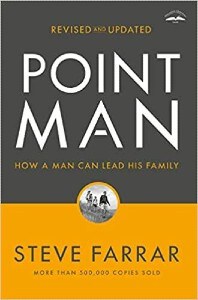
John: That’s a pretty passionate statement from Steve Farrar on Focus on the Family with Jim Daly. And I’m sure you’re gonna want to get a copy of his book, Point Man. That comes with a free audio download of the entire presentation from Steve when you make a donation of any amount to the ministry of Focus on the Family today. You can also get a CD of this broadcast to more easily pass this along to the men in your life.
Find those options and more at our website, focusonthefamily.com/broadcast, or when you call 800, the letter A, and the word FAMILY. Let’s return now to more from the late Steve Farrar.
Dr. Farrar: In Deuteronomy 6, there is a job description given to men. I’d like you to turn there if you have your Bibles. Deuteronomy 6, God gives us two specific things, and these things apply to the kings, and these instructions apply to you, and these instructions apply to me. Deuteronomy 6 was written to the men of Israel, may I point out. If you look at verses one and two, Moses says, “Now, this is the commandment and the statutes and the judgments, which the Lord your God commanded me to teach you so that you might do them in the land which you are going over to possess,” now catch this, “So that you and your son and your grandson might fear the Lord.” Interesting concept. He’s speaking to the men because he says, “So that you and your son and your grandson,” might what? “Might fear the Lord.”
14 times in the book of Proverbs, we see the phrase, “The fear of the Lord.” Uh, the fear of the Lord, Proverbs tells us is the beginning of knowledge. The fear of the Lord is the beginning of wisdom. Do you ever get concerned about our country and what’s happening in our country? Sure you do. Uh, you know what’s wrong with our country? Very simply put, our country has lost the fear of the Lord. And when we lose the fear of the Lord, we lose our wisdom. You know what’s wrong with our universities? Tell you what’s wrong with our universities. Our universities have lost the fear of the Lord. And when you lose the fear of the Lord, you lose knowledge.
Copernicus, great astronomer, had a friend who was an atheist and they would have lunch, and they would dialogue from time to time. They would get together and discuss their different viewpoints. For about two to three years, Copernicus was doing something no one else had ever done. He was building in his atrium a model of the solar system. Now you’ve seen those, and I’ve seen them. No one had seen them before then. And he fashioned planets and he would hang them from different parts, and he had it all laid out. Didn’t tell anybody.
One day when he finished, he was dialoguing with his friend. They were having some coffee and he said, “Let’s walk down to my house. I want to show you something.” And as he was talking to his atheist friend, they’re talking about different things. They finally walk into the house. They open the doors of the atrium. His atheist friend walks in, looks up and sees, he immediately realizes this is a model of the solar system. He’s just aghast at what he sees. He is amazed. He is speechless.
He just looks, he takes it all in and he looks at Copernicus and he said, “Who made this?” And Copernicus said, “No one made it. It just happened.”
Audience: (laughs)
Dr. Farrar: What a ludicrous thing to say. What a foolish thing to say. But the fool has said in his heart, “There is no God.” There is a God. You study DNA, there’s a God. There has to be a God.
I saw on the news last night these new three-dimensional, four-dimensional pictures, images of babies in the womb. You can see their face. This doctor was being interviewed on Fox News, and she was being asked about the implications of this and she was trying to be very subtle, but she said, “You can actually see the face. Oh, here’s twins. You can see the twins touching each other and kicking each other. What are the implications of this? Well, the implications are that parents are going to, uh, have some more information about the nature of the child within them.” Uh, she’s trying to… That’s a baby. It’s not a fetus. That’s the information. And you can’t take that baby’s life because that is a little baby made in the image of God. She wouldn’t come out and say it, but it was right before her eyes. That’s a child in there.
Where’s the fear of the Lord? The fear of the Lord’s the beginning to knowledge. See, if you don’t have the fear of the Lord, you can’t be a real scientist. If you don’t have the fear of the Lord, you can’t be a good teacher. See, and can I say this? If you don’t have the fear of the Lord, you can’t be a good father. Because in order to do the work that God has called us to do, there must be a fear of the Lord which we then instill in our sons and in our grandsons.
If you look at verse five specifically, there are two things that are said to men as their job description, and they’re very simple. Uh, I’d summarize them this way. Number one is, men, we are to love God deeply from our gut.
Notice what it says there in verse five of Deuteronomy 6. He says, “And you shall love the Lord your God with 40% of your heart, with 30% of your soul.” That’s not what it says. Not even in the Hebrew does it say that.
Audience: (laughs)
Dr. Farrar: You shall love the Lord your God with what?
Audience: All your heart.
Dr. Farrar: “All your heart, all your soul, all your might.” I did a word study in that word “all” one morning. I spent about three hours going over this in the original and working through different lexicons. Let me tell you that word “all” means in the original. It means “all.”
Audience: (laughs)
Dr. Farrar: That’s what it means. You should love the Lord your God with all. See, that means from your gut. Everything within you, you love Him. You follow Him. You pursue Him. He’s number one in your life.
And then on that basis, we go to the second thing and really when you love the Lord your God, you’re gonna love His Word. That’s why you go back to verse one, “These are the commandments, the statutes, the judgments, which the Lord your God has commanded me to teach you.”
So, when you love God, you love His Word. “Thy word I’ve hidden my heart that I may not sin against thee. Open my eyes and I may behold wonderful things from their law, thy law. How can a young man keep his way pure?” This is Psalm 119. “By keeping it according to thy word,” you see. So, if you love God, you love His Word. Jesus said, “If you are truly disciples of mine, you will abide my word.” And what will the Word do? You see? What does the Word do? The Word is truth. “If you are truly disciples of mine,” He said, “You will abide my word. And you shall know the truth.” And the truth shall what?
Audience: Set you free.
Dr. Farrar: It’ll set you free. See, that’s why if you love God, you love His Word, and when you love God, you have truth and you live in reality. That is mentioned in verse six. “These words which I am commanding you today shall be in your heart.” And then here’s the second responsibility, “You shall teach them diligently to your sons and shall talk of them when you sit in your house and when you walk by the way and when you lie down and when you rise up.” So, what are the two jobs? They’re the job description. They’re pretty simple. Number one, you love God deeply with all your heart, you love Him from your gut.
Secondly, you teach your sons diligently. You say, “Steve, I’ve got daughters.” Great. What a gift from God. I’ve got a daughter too and I’ve got two boys. “So, aren’t you gonna talk about daughters?” I’m talking about sons this morning. Now, does that mean I don’t care about my daughter? I love her to death. You love your daughter. And if God’s given you daughters, then you know what your job is, it’s to love them and show them what it means to be a godly man because one day they’re gonna look for a godly man to come into their life and you show them what that’s like.
You say, “Well, how do I treat my daughters? Are there any passages in scripture that tell me how to treat my daughters?” I think the passages in scripture that tell you how to treat your wife, you apply those passages to your daughter. Because one day your daughter will be a wife. Does that make sense?
Audience: Yeah.
Dr. Farrar: “You husbands likewise live with your wives in an understanding way.” Could we say you husbands likewise live with your daughters in an understanding way? Yeah. ‘Cause one day, some young man is gonna come into her life and he’s going to want to enter into her life. How is she gonna know whether or not this guy meets the criteria? Well, she’ll take the template. Unconsciously, she’ll take the template of your example, and she’ll look at how you treated her mother and she’ll look at how you loved her mother and how you honored her mother. And she will take that template as a young man comes into her life. If he meets that criteria of your example, he has the potential of passing through and be accepted. But if he is harsh with her, if he is critical of her, he will bounce off of the example of your life that you followed the Word of God. She’ll know what to look for.
So, daughters are important. We love our daughters. But we’re talking about sons here. And you guys that are raising daughters, you raise them with the glory of God because those of us who are raising sons, those boys are gonna need some girls. In fact, I think this morning we ought to do some arranged marriages right here, don’t you?
Audience: (laughs)
Dr. Farrar: ‘Cause what we got going on in America, we got a lot of deranged marriages going on because we’re not following the principles of the Word of God. He says, “You’re to love God deeply.” And secondly, he says “You’re to teach your sons diligently.” Does that mean you get up at 4:30 every morning and open up the Greek text and teach your sons the book of Romans? That’s what it means.
Audience: (laughs)
Dr. Farrar: I don’t think that’s what it means. At least that’s not what the text says. What does the…how am I supposed… Okay, great. I’m supposed to teach him. How do I teach him? God is very real. He’s very practical. He’s very down to earth. You got a job, man. You got all kinds of responsibility. You can’t run a classroom in your house. I mean, you got all kinds of stuff going on in your life. So then how am I to teach them? What does the text say? “You shall teach them diligently to your sons and shall,” catch this, “Talk of them when you sit in your house.” How many of you guys ever sit in your house? You just look like you’re good at that.
Audience: (laughs)
Dr. Farrar: Yeah, we sit in our house. Nothing wrong with that. “When you walk by the way,” you ever walk? You ever take a walk? Yeah. Sure you do. See, that’s just life. What he’s saying is, is that as you go through life, you teach your kids. See, that’s why it’s really important that you be with, W-I-T-H, you be with your sons.
John: Well, we’re only halfway through a really encouraging message for husbands and fathers from the late Steve Farrar on today’s episode of Focus on the Family with Jim Daly. You’re gonna hear lots of ways to apply this message next time.
Jim: You know, John, we have aired several messages from Steve Farrar over the years and what I really appreciated about him was that he always inspired me to do better with my boys as they were growing up, and most importantly, Steve made it sound doable. So often as men, we get overwhelmed by too many instructions and then we just stop and pull back and don’t do it at all. Simple is usually better, at least for me, and that’s why I love the idea of looking for those opportunities to talk with your children or grandchildren throughout the day. For us, the best time was when I was driving the boys to school. That’s right, carpool.
John: (laughs).
Jim: But that’s when we had the most interesting conversations about the Lord. Uh, here in Colorado, we can just look at Pike’s Peak and start a discussion about God’s Creation. It’s right there in front of us. There’s no need to overcomplicate it. Be natural about it, and that was Steve’s great point.
John: Mm. Yeah, I appreciated when we had the kids, uh, they were younger and we’d, we’d be camping.
Jim: (laughs).
John: We’re sitting around looking at the stars, realizing, “Oh, there’s some perspective here.”
Jim: Yeah, for sure. His Creation is awesome. And let me remind you, here at Focus on the Family, our ultimate goal is to strengthen your relationship with Jesus Christ. Marriage and parenting advice is helpful, but if you don’t know the Lord, you’re missing the bigger picture.
Here’s a great example from Casey who called to ask for prayer. He said this. “If Focus on the Family didn’t exist, I probably wouldn’t be a Christian husband and father today. Our family was agnostic, but my mom became a believer by listening to your broadcast. She relied on Focus’s godly advice to raise me and my siblings. After high school, I went to seminary and now I listen to the broadcast to help raise my kids in the Lord. I thank God for Focus on the Family.”
John: Oh, that is wonderful. I love hearing how God has used this ministry, almost 50 years old now, to, uh, touch generations.
Jim: Yeah, and we thank God for our donors who make it all possible. By donating to Focus on the Family, you have an opportunity to participate in ministry to others. We’ve built the machine, so to speak, and we just need the fuel your donations provide to keep it running. Now, a one-time gift is great, it helps us today, but a monthly gift essentially helps us every day to provide resources for every family that God sends our way throughout the year. In July, we’re looking for 1,200 monthly donors to join us. It only takes 90 seconds to set it up, and you can adjust the amount or cancel at any time.
And when you make a monthly pledge of any amount, we’ll send you a copy of Steve Farrar’s bestselling book, which was just revised in 2022, called Point Man: How A Man Can Lead His Family, that’ll be our way of saying thank you.
And if you can’t make a monthly commitment right now, we understand. We can send Point Man to you for a one-time donation of any amount. We just want to have this terrific resource in your home library. So, join us as we help families around the world to thrive in Christ.
John: Yeah, donate online at focusonthefamily.com/broadcast, or call 1-800, the letter A, and the word FAMILY.
When you’re online with us, look for a great article on fathering that includes a downloadable Report Card for you to have your kids fill out, and we have our free parenting assessment which will help you see your strengths in an area or two perhaps that needs growth. Those are both free and available through our website.
Next time, more encouragement for fathers from Steve Farrar.
Preview:
Dr. Farrar: You know what Almighty God does? He wants to heal your family. That would delight Him. He’s looking for us to respond and be obedient, and if necessary, deny ourselves. Let’s be those men, guys.