





Estimated reading time: 17 minutes
When a husband won’t talk, it usually isn’t because he doesn’t care. Most couples in this situation feel caught in a pursue-withdraw pattern: she reaches for connection. He feels overwhelmed or like he’s failing, and he goes silent. When he does, she reaches out even more. Focus on the Family calls this the Reactive Cycle. Either spouse can break it: she can soften her approach; he can take a break and come back. If he uses silence to punish or control, or comes with signs of depression, get outside help.
Key Takeaways
- The wife pursues; husband withdraws pattern is the most common conflict pattern in marriage.
- A husband who shuts down is usually flooded or afraid of failing, not indifferent.
- The Reactive Cycle, not your spouse, is the enemy – and it only takes one person to break it.
- A healthy time-out includes a return time. Silence with no return is withdrawal; silence used to punish is something more serious.
My Husband Refuses to Engage
Meg* spent years thinking about what she and her husband would do once they were empty nesters – the travel, the romance, and the chance to spend time together. (*Name changed for privacy.)
Now, after 30-plus years of marriage, the kids were on their own. And her dreams? The fact that she’s sitting in a counseling office should tell you things aren’t going well.
“Every dinner feels like sitting in a cold, lonely prison cell,” she told her counselor. “I tried getting my husband to respond. To say anything. But he refuses to engage. I’m so tired of trying.”
Know the feeling? You’re not alone. Your situation may feel hopeless if this is an ongoing pattern in your marriage. But I have learned something important from all the times my wife Erin and I have talked to couples at events and in counseling sessions: the problem isn’t that a husband doesn’t care. It’s that the two of them – husband and wife – feel trapped in a painful cycle. She reaches out but he feels overwhelmed and retreats. And this cycle – not the spouse – is the enemy of a healthy marriage.
Why Won’t My Husband Talk to Me? You’re Not Alone.
“My husband won’t talk to me,” is one of the most common complaints in marriage. Researchers even have a name for it: the demand-withdraw pattern. One spouse pursues conversation or change, and the other retreats. The more one pursues, the more the other withdraws. It’s usually a cycle both of you are stuck in, not proof that he doesn’t love you.
In 2014, a group of researchers reviewed seventy-four studies (with 14,000 participants) and found the demand-withdraw pattern is the most common struggle couples deal with. It looks like this: She thinks, if he just talks to me, I wouldn’t have to push. He thinks, if she just backs off, I wouldn’t have to shut down.
Either spouse can play either role, but the wife-pursues, husband-withdraws pattern shows up most often. One of the studies in the report I just mentioned found the split grows stronger over time. Couples caught in the pattern report lower satisfaction with their relationship, less intimacy, and poorer communication. Pursue/withdraw does the most damage in marriages that are already struggling.
Our own research tells the same story. In Focus on the Family’s Marriage Health in America study, more than 3,800 spouses rated thirty-two areas of their marriage.
Respondents named listening to each other as one of the top five drivers of a healthy marriage, alongside love, respect, and sexual intimacy. Ironically, when asked to rate their own marriage, couples admitted they’re less likely to take time to listen to each other (Marriage Health in America, p. 14).
Am I asking too much?
No. Wanting to be known by your husband is how God designed you. “It is not good that the man should be alone” (Genesis 2:18, NIV). The first couple was “naked and were not ashamed” (Genesis 2:25, ESV). In other words,both felt fully seen and fully accepted. Research backs this up: married people feel more committed to a spouse who sees them as they are: flaws and all, than to the one who sees only the best. We don’t just want to be admired. We want to be known and loved regardless of our flaws.
What Does “He Won’t Talk” Really Mean?
When a wife says her husband won’t talk, she rarely means he refuses to speak at all. She usually means one of four things:
- Daily sharing: He doesn’t tell her about his day, thoughts, or plans. Questions usually receive answers like, “fine” or “I don’t know.”
- Emotional openness: He refuses to share his fears, hurts, or hopes. She knows his schedule but not his heart.
- Conflict: When an issue comes up, he goes quiet, changes the subject, or leaves the room.
- Responsiveness: When she shares, he doesn’t look up, ask a follow-up question, or remember what she said.
An outside observer might quip he’s the strong, silent type, but the wife living and sleeping next to him sees the situation much differently. She feels ignored, unseen, and lonely.
Why does my husband’s silence hurt so much?
Because underneath “Why won’t you talk to me?” is a deeper question: Do I matter to you? Silence answers that question in the most painful way possible. It pushes what we call “emotional buttons” – the feelings of being alone, unimportant, shut out, or rejected.
When your husband is silent, you may feel like he’s pushing one of your emotional buttons:
- Alone: I’m married but lonely.
- Unimportant: Work, sports, and his phone get his attention. I get what’s left, if anything.
- Shut out: I don’t know who he is anymore.
- Abandoned: When I most need him, he disappears.
- Helpless: Nothing I do gets through.
You’re not oversensitive. In our national study, couples in unhealthy marriages cited a lack of emotional intimacy, loneliness, and communication. (Marriage Health in America, p.19)
But it’s not just a big issue that breaks a marriage. Small moments matter too. Marriage researcher Dr. John Gottman found that spouses constantly make small “bids for connection”- a comment, a touch, or a “look at that.” Dr. Gottman spent years studying newlyweds and learned that successful couples (those still married six years later) turned toward each other’s bids 86% of the time, who those who had divorced had turned toward each other’s bids only a third of the time.
A husband who “won’t talk” may be missing hundreds of these moments, and each miss feels like a rejection. That’s because silence leaves gaps in the relationship. When there are no words to explain what he’s thinking or feeling, you naturally fill the gap with a story: He doesn’t care. He’s unhappy with me. He’s hiding something.
Why Does My Husband Shut Down?
Most husbands who shut down are overwhelmed, not indifferent. During conflict, a man’s body often floods – racing heart, stress hormones, fight-or-flight – and silence is his attempt to keep from making things worse. Underneath the silence there’s usually a fear of failing his wife.
He feels flooded
About 85% of the “stonewallers” in Dr. Gottman’s research were men. When a husband shuts down, his body is often in fight-or-flight mode. Clear thinking and listening are difficult. His silence is often an attempt to calm things down – the opposite of caring. Men also tend to replay distressing thoughts after conflict, which keeps them stirred up longer.
Stress pulls you in opposite directions
One study followed couples’ workdays and how they treated each other that evening. After a stressful day, wives tended to get more upset and engaged, while husbands got quieter and more withdrawn. On ordinary days, men showed little difference. In another study, researchers studied air traffic controllers to see how stressful work affected their home life.
When the wives of air traffic controllers gave their husbands the time and space to “decompress” after a hard day, the marriage benefitted. The research suggests that a short retreat can be healthy. The problem comes when the husband retreats to his man cave and never comes out to interact with his wife.
He may not know there’s a problem
In our national study, husbands rated their marriage healthier than wives did in more than half of the thirty-two areas. He may think things are fine while she suffers from loneliness. (p. 32, “Limitations”)
His buttons get pushed too
When you start the conversation with, “We need to talk,” he may hear a verdict:
- Failure: “I can never get it right.”
- Inadequate: “I’m not enough for her.”
- Criticized or disrespected: “Here comes the list of what I did wrong.”
- Controlled: “She’s telling me what to do and how to feel.”
Other things feed his silence. Some men were raised without words for sadness, fear, or hurt, so “How do you feel”? may feel like a test he’s afraid he’ll fail. If, in the past, talking has led to criticism or his words being used against him, silence feels safer. Also, the spouse who wants less change in the marriage tends to withdraw. And some men simply process before they speak and get run over by a faster-talking spouse.
The First Withdrawal
After humanity’s Fall, Adam said, “I heard the sound of you in the garden, and I was afraid, because I was naked, and I hid myself” (Genesis 3:10, ESV). Since that moment, fear and shame have resulted in hiding.
The Reactive Cycle: Why the harder you reach, the further he pulls away
His silence pushes her emotional buttons, so she pursues harder. Her pursuit pushes his buttons, so he withdraws further. At Focus on the Family, we call this the Reactive Cycle. Each spouse sees other as the cause, but the cycle is the enemy, and each of you can step out of it.
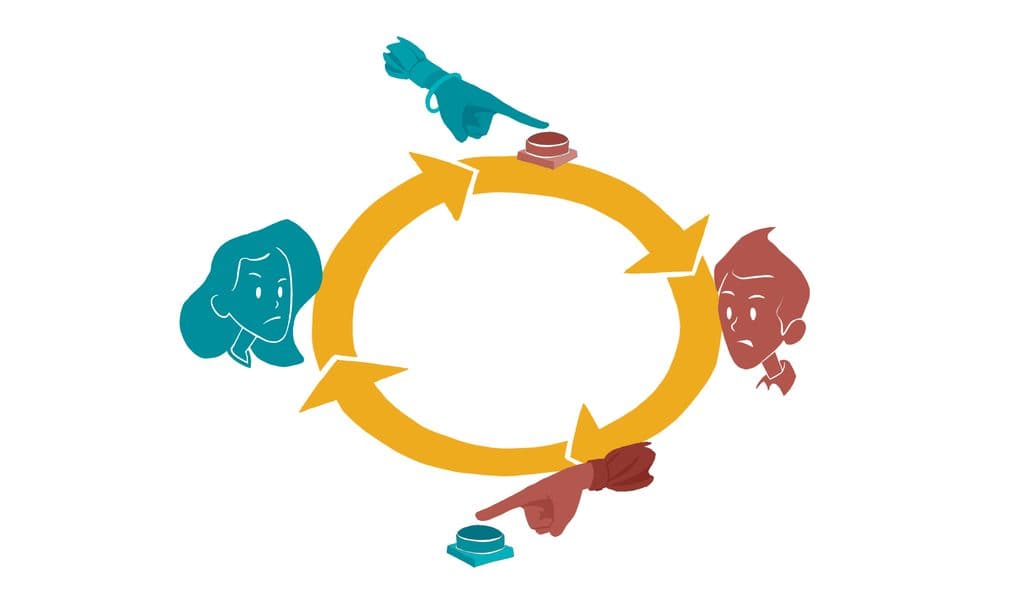
Here’s what happens in the Reactive Cycle:
- His silence pushes her buttons. She feels alone, unimportant, and rejected.
- She reacts by pursuing him harder. Sometimes by criticizing or escalating.
- Her reaction pushes his buttons. He feels failed, inadequate, and controlled.
- He reacts by shutting down, which pushes her buttons again.
- The cycle repeats and escalates.
In Reactive Cycle terms, she has become a “fighter” by engaging him or following him from room to room to make her case. He becomes a “flighter” by going silent, agreeing to end the conversation, or staying in the room but disconnecting from his wife. If he’s fully overwhelmed, he “freezes” and disengages.
When emotional buttons get pushed, hearts close. Erin and I compare it to a roly-poly bug: touch it and it curls into a tight ball. You can’t pry it open without causing serious hurt. That’s why pushing harder doesn’t work. You can’t force a closed heart open.
The book of Proverbs in the Bible uses an interesting word picture to describe this very thing: contention drives a man to “a corner of a housetop” (Proverbs 21:9). While this explains the cycle, it doesn’t excuse it. Contention fuels withdrawal, and withdrawal fuels contention. Every spin of the Reactive Cycle damages the very things that make a marriage healthy. Listening breaks down. She feels unloved. He feels disrespected.
But there’s hope. It only takes one person to stop the Reactive Cycle. It’s like a tug-of-war. If one of you drops the rope, the game is over. Want to learn how you react under pressure? Take our free Reactive Cycle Assessment.
Is the silent treatment abuse? When silence is a warning sign.
Not all silence is the same. Earlier, we mentioned a “time-out.” It’s a helpful tool for couples to use to lower the tension, but with a promise: you must come back together after the time out. And you have to say how long the time-out will last. We recommend twenty minutes. A time-out is a tool, not a strategy. The goal is to clear your head, let go of the tension, and then reengage with your spouse.
The time-out should never turn into stonewalling or the “silent treatment.” Stonewalling is shutting down because you’re overwhelmed. The “silent treatment” often turns into punishment or control. Silence can become emotional abuse when it is part of a pattern of control, intimidation, or fear. If this is a pattern in your marriage, seek outside help.
- Overwhelm vs Control. Silence from “flooding” or feeling overwhelmed is different from silence used to punish. If his silence comes with threats, intimidation, or a pattern of control, or if you feel afraid, contact a counselor and get to safety. You can call the Hotline for help with intimate partner violence. Or, if the problem is ongoing but not unsafe, contact the Focus on the Family counseling team at 1-800-A-Family.
- Depression. In men, depression often looks like withdrawal, irritability, and fatigue rather than visible sadness. Sudden or new silence deserves this question. Our study found that having an emotionally healthy spouse is itself a strong driver of marriage health. (p. 12)
- Heavy stress. Work pressure, finances, or a job loss can drive a man inward.
- Something hidden. Pornography, debt, or another secret can produce silence. Hiding sometimes leads to quiet.
What Can I Do When My Husband Won’t Talk to Me?
Change how you reach, not how much you care. Start softly, lead with the vulnerable feeling instead of the complaint, talk side by side, and give him a few minutes to decompress. You can’t open his heart for him, but you can make it safer for him to open it.
- Start softly. “I’ve missed you this week. Could we take a walk after dinner?” works far better than, “You never talk to me.” Remember: “A soft answer turns away wrath, but a harsh word stirs up anger (Proverbs 15:1, ESV).
- Lead with a softer feeling. Instead of, “Why won’t you ever…” try this: “I get scared that I don’t matter to you.” The vulnerable emotion invites him in; the protest pushes him away.
- Skip, “We need to talk.” It floods or overwhelms him before you start.
- Go side by side. Many men talk more easily in the car, on a walk, or while working on something together.
- Ask questions he can win. “What was the hardest part of the day?” is easier than “How do you feel?”
- Give him a brief time to decompress. After a hard day, offer a few minutes before the questions start. “Want some time to unwind? Let’s talk after dinner.” You’re not accepting his absence; you’re giving him room to come back.
- Guard what he shares. If his openness gets corrected or brought up in a later fight, the door closes.
- Take a breath. When you feel the urge to press, pause and care for your own heart first. Put Jesus’ words in Matthew 7:3-5 into action and “clear the speck from your own eye” if needed.
“The purpose in a man’s heart is like deep water, but a man of understanding will draw it out” (Proverbs 20:5, ESV). Patience draws it out; pressure doesn’t. For more, see Erin’s article, How to Communicate Better with Your Husband.
What Can a Husband Do Instead of Shutting Down?
When you feel overwhelmed, name the feeling, and then take a time-out that comes back. Say, “I’m getting overwhelmed and don’t want to say something I regret. Give me 20 minutes, and I’ll come to find you. Use the break to calm down, open your heart, and then go back and turn toward her.
- Listen to your body. When your heart races, your face gets hot, or you want to run, pay attention. You’re feeling overwhelmed.
- Call a time-out, not a retreat. A time-out tells her you’re not walking away from her. Withdrawal leaves her guessing.
- Use the break well. Take time to walk, breathe, or pray instead of researching the argument. Our Care Cycle walks you through it. Become aware of when you’ve been triggered, accept responsibility for your heart, allow God to help, attend to what you’re feeling, and act to reopen your heart.
- Follow Jesus’ pattern. “He would withdraw to desolate places and pray” (Luke 5:16, ESV). After he withdrew, he returned to the people. A break that returns is healthy; one that doesn’t is withdrawal.
- Transition from work. Use the drive home to hand the day to God and ask, “How can I love my wife well tonight?”
- Turn toward her bids. Look up from the phone, answer, and ask one follow-up question.
- Share one layer deeper. Move from “Work was busy,” to “Work was busy, and I’m worried about the reorganization.”
- Let her influence you. The Hebrew word for listen, shama, means to hear and respond. You haven’t really heard until it changes something.
James 1:19 calls us to be “quick to hear, slow to speak” (ESV). The Greek word for “quick” is tachys. You might recognize that word from thee modern medical term, “tachycardia.” It means a racing heart and uses the Greek word tachys as its root. In our context, your heart races when you’re stuck in a difficult conversation and want to escape.
But the Apostle James doesn’t leave us with racing hearts. He tells us to do just the opposite and slow things down before you speak. The word James uses for “slow” is bradys. From it, we get the medical term bradycardia that describes a slow, resting heartbeat.
Put these words together and we learn that James tells us to race to listen to our wife’s words but to take appropriate time responding to them.
How Do We Break the Cycle?
Name the cycle together. Build small daily rituals of connection, and practice slow, structured conversations when you’re both calm. If you’ve felt stuck for years, get help. Counseling works, and intensive programs can help couples who feel hopeless.
- Name the struggle together. Say something like this: “When your button gets pushed, you pursue. When mine gets pushed, I withdraw. We’re both trying to protect something.”
- Have a daily stress-reducing conversation. Spend about 20 minutes on stress outside the marriage, where the listener’s only job is to be on the other’s side.
- Create connection rituals. Morning coffee, a nightly walk, a weekly date.
- Revisit hard moments once you’re calm. Ask, “What happened for you? What happened for me?”
- Practice “Draw It Out” conversations once a week. One spouse asks a deep question, such as “Where do you feel most unseen by me right now?” The other spends 90 seconds responding. The listener then reflects the facts and the felling underneath them before sharing. Once completed, swap roles.
- Get help when the cycle is entrenched. Couples typically wait about six years after problems begin before seeking help. In our study, only 21% of married couples had sought help in the past year (p. 20). Emotionally Focused Therapy begins by helping the quiet spouse re-engage. Couples who’ve felt stuck for years should seek out a Hope Restored marriage intensive program.
Coming Out of Hiding
God is a God who speaks and reveals Himself (Hebrew 1:1-2). Jesus calls us friends because He has made know to us all He heard from the Father (John 15:15). And God moved toward us while we were the ones hiding: “God shows his love for us in that while we were sinners, Christ died for us” (Romans 5:8, ESV).
“There is no fear in love, but perfect love casts out fear (1 John 4:18, ESV). Love answers both her fear of being alone and his fear of failing. When a husband takes a step out of hiding and a wife softens her reach, the cycle reverses; the closeness you both long for becomes possible again.
Frequently Asked Questions
Because you’re the one person whose disappointment can push his failure button Coworkers and friends don’t carry that weight. When he’s quiet with you, it often means your opinion matters more, not less. Softer start-ups and lower-pressure settings usually help.
It’s common. Many men were raised without words for sadness or fear, and stress tends to push husbands toward silence. But “common” doesn’t mean healthy. A feelings-word list, side-by-side conversations, and sharing “one layer deeper” help him build the skill.
It can be. Silence used repeatedly to punish, control, or make you afraid is emotional abuse. Shutting down because he’s overwhelmed is stonewalling, which is harmful but not the same thing. A healthy time-out promises a return time.
A healthy break is usually 20 minutes to a few hours and ends with the spouse who left coming back. Silence lasting days, with no plan to return, has moved from a time-out to a withdrawal and needs to be addressed – with a counselor if necessary.
Treat is as missed bids for connection, not a verdict on your worth. Name the pattern calmly at a neutral time (“I miss you in the evenings”), suggest a phone-free ritual like dinner or a walk, and notice when he does put his phone down.
Anger and silence are both reactions to pushed buttons. If he hears your concern as criticism or control, he may fight instead of fleeing. Start softly, raise one issue at a time, and take a time-out if either of you feel overwhelmed. If his anger frightens you, get help.
No. Stop pressing, not reaching. Shift from pursuing harder to inviting differently: softer words, better timing, side-by-side settings. Wanting to be known by your husband is part of God’s design for marriage.
Start small. Turn toward his bids, create one daily ritual of connection, and use a structured conversation like “Draw It Out” weekly. Name the Reactive Cycle together so you’re fighting the pattern instead of each other.
Scripture calls husbands to understand their wives (1 Peter 3:7), to cherish them (Ephesians 5:29), and to be quick to listen and slow to speak (James 1:19). It also calls on both spouses to speak the truth in love and not let arguments fester and create bitterness (Ephesians 4:25-26).