




If your child’s brain has lived in survival mode, summer can feel like free fall. School’s structure disappears, and suddenly we are juggling boredom, big feelings, and a never-ending snack parade. The goal is predictable rhythms that help nervous systems settle so your relationships can breathe.
I dreaded summer vacations every single year. Long days of unstructured time that other families craved were our downfall. Our son needed very high structure to make it through. We could feel summer coming at the end of every school year. Too many parties. Too much sugar. Field day, always on the hottest day. Our son’s escalating behaviors announced the season long before the calendar did. I dreaded the early wakeups and the nightly bedtime battles. By 10:00 a.m. I was exhausted and counting down the minutes until lights out. To survive, we built our own routine. These are the strategies that helped us most.
Key Takeaways:
- Predictability calms the nervous system. Structure and sameness help kids who’ve lived in survival mode feel safe.
- Stack VBS weeks. Sign up for 4–6 weeks across nearby churches for consistent, low-cost structure and childcare.
- Room Time isn’t punishment. Daily sensory breaks (30–60 min) help kids reset and recharge.
- Budget one outing per day. Avoid over- or under-scheduling to prevent dysregulation.
- Keep snacks predictable. A repeatable snack station cuts down on daily power struggles.
- Water play soothes big feelings. A pool, creek, hose, or bathtub can defuse most meltdowns.
- Anchor the day with small rituals. Morning cuddles, midday Room Time, and nighttime reading create stability.
- Small and same > big and exciting. For these kids, low-key routines bring more joy than novelty.
7 Summer Vacation Survival Strategies to Regulate Nervous Systems
Strategy 1: Stack VBS Weeks Like a Pro
Many churches run Vacation Bible School with the same theme, songs, schedule, crafts, and small-group flow. That is nervous-system gold. Familiarity lowers threat. By the third VBS of the summer, my kids felt like rockstars. They knew every song, had already practiced each craft, and could answer all the story questions. Even if it was a different church each week, there was enough sameness to feel safe.
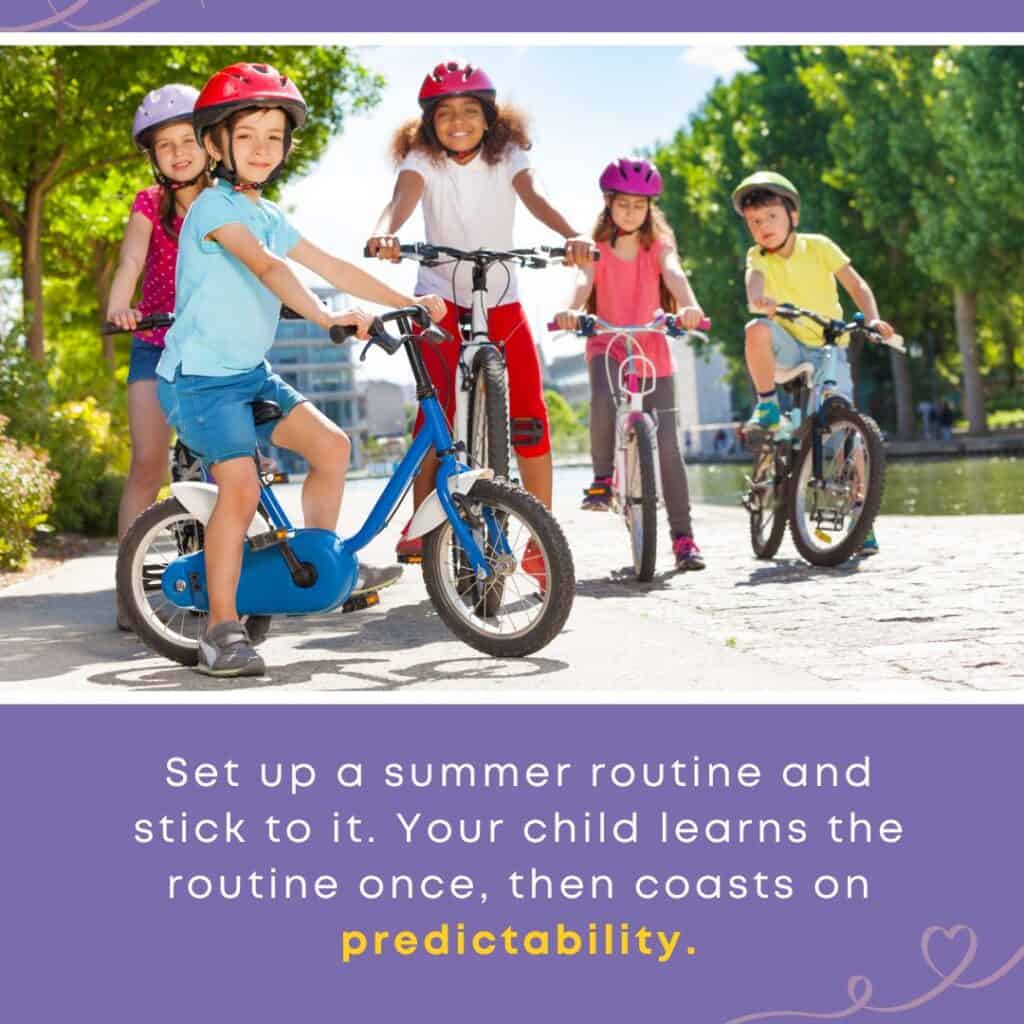
Sign up for four to six VBS weeks across nearby churches. Your child learns the routine once, then coasts on predictability.
There are also evening VBS options if your kids do well later in the day. Mine did not. They turned into little monsters at 6:00 p.m., but evening sessions can be great respite for some families.
Tips:
- Ask to meet the leader on day one.
- Share a one-page “About My Kid” with regulation tools and a meltdown plan.
- Start looking for sign-ups in May. Registrations close and spots fill quickly.
- Map churches close enough that the three hours of childcare are worth the drive.
- Keep your calendar open and register, even if your beach trip is not finalized. If you do not get ahead of this, you will miss out.
Strategy 2: The Picnic-Park Block
After VBS, go straight to a simple picnic, then a park. It extends the predictable block. Run the same sequence daily: car snack, picnic blanket, one hour of play, water, then head home.
Keep a trunk bin ready with a blanket, wipes, sunscreen, an extra shirt, and a few fidgets. This reduces your decision fatigue.
Strategy 3: Room Time
Room Time is not a punishment. It is part of the routine. All children go to their rooms for 30 to 60 minutes, depending on age. This is time for the sensory system to settle, for little brains to rest from the morning’s effort, and for a correction-free zone.
The rules are simple. Bathroom breaks without asking are fine. Otherwise, stay in your room until the timer rings. Do not let kids play together during this time. They need a break from each other and from you. Let them have a complete sensory rest. On days without VBS, you can run Room Time twice.
Post the plan on a simple visual schedule. Point to it often. The paper is the boss, not the mood.

Strategy 4: Budget Your Energy Like Money
Pick one out-of-the-house block per day. That is it. Over-scheduling invites chaos. Under-scheduling invites bored dysregulation. Aim for the middle.
A little TV time every day is okay. Here are the guardrails. You pick the show. You hold the remote. Choose something regulating for your child. Make it part of your energy budget. My favorite windows were while I prepped dinner or right after dinner before bedtime, when my reserves were gone.
Strategy 5: Snack Scripts Save Afternoons
Predictable food reduces power battles. Create a snack station with three choices. Rotate daily to avoid decision fatigue. When the script is the same every day, kids spend less energy arguing and more time eating.

Strategy 6: Water Play
Water is profoundly calming and regulating. If you have a cranky kid, add water. If siblings are not playing well, add water. It is my basic solution for summer meltdowns.
We had a creek a mile away, so we walked there or headed to the rec center pool. My kids are in their twenties now, and some of their best memories are summer water days. No creek or pool nearby? No problem. Turn on the hose. Fill the bathtub and let them splash in swimsuits. Kids are not picky about water. They are just happy to get wet.
Strategy 7: Summer Vacation Micro-Rituals That Anchor the Day
Morning anchor: Cuddles. There is nothing sweeter than a sleepy face tucked into your shoulder, still breathing those deep, sleepy breaths. When we rushed and skipped it, we felt the loss all day.
Midday anchor: Room Time. A forced sensory break after a full morning is stabilizing.
Nighttime anchor: Bedtime. It is often stressful, so protect connection rituals. For us, that was reading. We worked through The Chronicles of Narnia, Percy Jackson, and other series together. The stories gave our evenings a gentle pathway.
A final word: Ignore the Facebook posts about how exciting everyone else’s summer looks. Exciting does not work for many of our kids or families. You are not failing if you keep summer small and manageable. For our kids, small and same is where joy lives. Novel and new is where their nervous systems get triggered. Give your summer a little sunscreen for the nervous system and watch your family breathe again.
Summary
Summer break can undo a child’s sense of safety when their nervous system depends on structure. These seven practical strategies for keeping summer predictable and manageable:
-
- stacking VBS weeks for consistency,
-
- extending routines with simple picnic-park outings,
-
- building in daily Room Time for sensory rest,
-
- budgeting energy with one outing per day,
-
- using repeatable snack scripts,
-
- leaning on water play to soothe big feelings,
- and anchoring each day with small morning, midday, and nighttime rituals.
The takeaway is simple: for kids whose brains have lived in survival mode, small and same brings more peace than big and exciting.