


Given our nation’s long history on abortion, it is clear this is not the “settled issue” proponents claim it is. The debate on the ethics of abortion rages white-hot as ever. It is a deeply consequential issue. So, asking serious questions about the ethics of abortion is something every citizen must examine, because the nature of what is growing in the womb is a fundamental human question.
The ethics of abortion really come down to four fundamental questions:
- What is abortion?
- Does it end an innocent human life?
- Is it good for women?
- Is it ever justified?
Let’s examine each.
What is Abortion?
Abortion is the act of ending life growing in a woman’s womb either by chemical or surgical intervention.
Does Abortion End a Life?
Abortion itself answers this question. If what is in the womb is not a growing life, why is there a need to end it? The procedure always starts with two lives and “success” dictates only one remains. That is the direct objective of abortion. Therefore, abortion is an active medical procedure with the intention to end a life. Abortion should not be called health care. Health care preserves life. Abortion ends it.
On the question of innocence, what is more innocent than a baby growing in the womb?
Are They Human?
If that life is not human, what is it? Two human beings can only create human life.
The renowned human embryologist C. Ward Kischer explains in a foundational medical essay, “Virtually every human embryologist and every major textbook of human embryology states that fertilization marks the beginning of the life of the new individual human being.”
Princeton University explains that “human life comes into existence with the formation of the one-celled zygote.” You are the human your parents created at conception. The same is true for every preborn child.
Opinions on Abortion
Considering the scope of abortion’s impact on both men and women, it’s safe to assume that abortion is more prominently a civil rights issue. Abortion impacts more than those making the abortion decision.
Since the infamous ruling of Roe v. Wade in 1973, over 67 million lives have been lost. (Unfortunately, the loss of life has not stopped since the famous overturning in June 2022). Lives lost were those of men and women of various ethnicities. Some were conceived at less than ideal times, while others were aborted for being created differently, having special needs or disabilities.
Knowing this, limiting abortion to being a “women’s issue” drastically misrepresents the problem. Moreover, it oppresses the voice of a weaker and silent minority: preborn children.
Those participating in the abortion debate take one of two sides: pro-life or pro-choice. Some members will argue that only the abortion-minded woman should have the right to speak to the abortion issue. At first glance, it seems like a valid point. After all, isn’t it a decision that impacts her and her body the most?
Who can talk about abortion?
Lyric Gillett, a pro-lifer who advocates for the voice of abortion survivors, describes the faulty thinking behind the idea that only post-abortive or abortion-minded women can speak authoritatively about abortion. Gillett points out that if we argue that only those impacted most by abortion have a say in the issue, then the strongest voice should actually fall to abortion survivors.
Knowing the scope of abortion’s impact on men, women, children, the religious and non-religious alike, we can take courage. We all have the right to discuss if abortion should be legal, no matter who we are.
An alarming admission
In a BBC interview, reporter Hilary Andersson and Dr. LeRoy Carhart, a Maryland abortionist practicing for over 30 years, discuss the nature of his work.
Sitting together in his procedure room, Dr. Carhart tells Andersson, “The baby has no input in this as far as I’m concerned.”
Visibly surprised, the BBC reporter responds, “It’s interesting that you use the word ‘baby’ because a lot of abortionists won’t use that, they use the word ‘fetus’ because they don’t want to acknowledge that there’s a life.” Dr. Carhart answers directly, “I use them synonymously. I think that it is a baby and I use it with our patients.”
Andersson asks Dr. Carhart bluntly, “And you don’t have a problem with killing a baby?” He actually interrupts her, answering, “Absolutely not.” He continues, “I have no problem if it is in the mother’s uterus.”
Dr. Carhart is certainly not alone in this view.
A major 2022 commentary in The Nation admits in its banner headline, “Abortion Involves Killing – and That’s OK!” The author freely admits hers is “an argument in favor of abortion-as-killing.” She also proudly states:
“The distinction between making fetuses killable, and making it easy and stigma-free for people to take the decision to kill a fetus, is significant.”
Sophie Lewis, Abortion Advocate
Abortion advocates no longer think of abortion as something that should be regrettable and rare. Now, there are bold calls to proudly celebrate it by organizations like Shout Your Abortion, which exists to “aid and abet abortion.”
Is it "illegal" to call it "choice"?
The prominent stance on why abortion should be legal revolves around bodily autonomy and the right to privacy. For U.S. citizens, the independence of an individual is considered something sacred.
Take, for example, the famous introduction of one of our nation’s most precious documents:
"We hold these truths to be self-evident, that all men are created equal, that they are endowed by their Creator with certain unalienable Rights, that among these are Life, Liberty and the pursuit of Happiness."
The Declaration of Independance
Liberties we consider “unalienable” are reflected in the U.S. Constitution as a right. And you’ve probably heard the claim that “abortion is a woman’s constitutional right.”
It’s a convenient claim, and it sounds good when repeated on your local news network. But let’s unpack it.
Defining Constitutional Rights
Cornell University defines constitutional rights as:
"the protections and liberties guaranteed to the people by the U.S. Constitution. Many of these rights are outlined in the Bill of Rights, such as the right to free speech and the right to a speedy and public trial. Even though these rights are expressly stated, their proper interpretation and scope has been the subject of many Supreme Court decisions. Additionally, not all rights protected by the U.S. Constitution are explicitly stated. Some are implied or unenumerated, like the right to privacy."
Abortion: A Constitutional Right?
When a person claims that abortion should be legal because it is a constitutional right, they usually mean that restricting a woman’s “choice” violates her right to privacy, infringing on her right to make decisions about her own well-being.
Yet, this thinking, according to Supreme Court Justice Alito is faulty. In the majority opinion, Justice Alito expressly states that “procuring an abortion is not a fundamental constitutional right” and explains why: the Constitution does not expressly mention abortion, and the Court held that a right to abortion is not “deeply rooted in the Nation’s history and traditions” nor implicit in the Constitution’s text. Based on that reasoning, the Court concluded such a right was not protected under substantive due process and that states could regulate abortion under a more deferential standard of review.
Restrictions on Medical Procedures
Another common argument for keeping abortion legal is that health-related decisions should be between a patient and their doctor (again, the right to privacy).
However, placing restrictions on medical procedures for the wellbeing of patients involved isn’t a new practice. And any qualified OB-GYN will tell you that mother and preborn child are treated as two patients (not just one).
A few court cases in which the government regulated interactions between patients and doctors include:
- Whalen v. Roe (1977) – Required doctors to write and submit patient information forms for prescriptions of potentially harmful medication.
- Planned Parenthood v. Casey (1992) – Affirmed Roe v. Wade but allowed the Pennsylvania legislature to amend their abortion law. They added several provisions. These provisions included a 24-hour waiting before the abortion procedure. Additionally, minors need the consent of one parent (or judicial bypass) before receiving an abortion.
So, is there ground for placing protective measures on the abortion procedure? Absolutely!
Reasons for restricting abortion access come from understanding the potential harm abortion can cause. For instance, consider the testimonies of former abortion workers. Many of these professionals attest to the abortion industry’s harmful marketing of abortions. Furthermore, OB-GYNs who provide life-saving services like abortion pill reversal (APR) are discriminated against by abortion providers and mainstream media. Those favoring abortion falsely claim that services like APR are a hoax or “experimental science,” despite the procedure’s success rate.
Is Abortion Good For Women?
When it comes to the wonder of a woman’s beautiful gift of fertility – that which only she can do – it is natural for her to give birth. Literally.
Everything in the profound intricacy of the feminine body begins toward this miraculous conclusion. Abortion is a sudden and drastic interruption of nature’s process. Consequently, this has a measurable impact on the mental health of women.
Dr. Christina Francis, a practicing, board-certified OB-GYN and CEO of the American Academy of Pro-Life Obstetricians and Gynecologists, in a 2022 testimony before Congress states, “Pregnancy is not a disease and elective abortion is not healthcare.” As such “elective abortion carries no maternal benefit.”
Additionally, data shows it carries significant harm.
“As demonstrated by hundreds of studies over nearly five decades, abortive procedures carry several deleterious effects for women, including risk of preterm birth and mental health problems.”
Dr. Christina Francis to Congress
Abortion Ethics Study #1
A meta-analysis in the British Journal of Psychiatry examined twenty-two separate studies examining post-abortive women and their mental health outcomes. This involved more than 877,000 women, 164,000 of whom had undergone an abortion. This article concluded:
Based on data extracted from 22 studies, the results of this meta-analytic review of the abortion and mental health literature indicate quite consistently that abortion is associated with moderate to highly increased risks of psychological problems subsequent to the procedure.
Every well-being outcome measured moved in a decidedly negative direction following the abortion.
- Anxiety disorders increased by 34 percent.
- Depression increased by 37 percent.
- Alcohol abuse increased by more than 100 percent.
- Suicidal behaviors increased by more than 100 percent.
- Marijuana use increased more than 200 percent.
Abortion Ethics Study #2
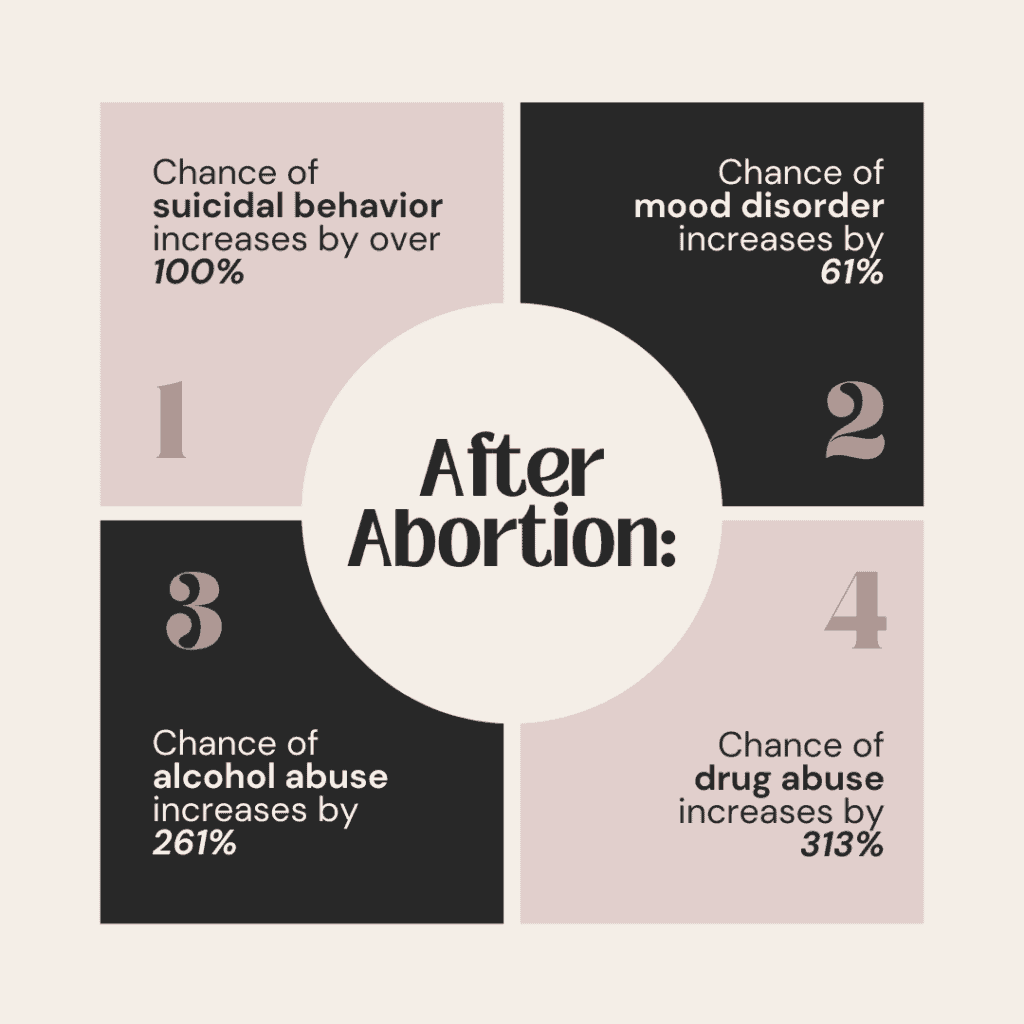
These increases remained even after controlling for prior psychiatric problems. A 2010 study in The Canadian Journal of Psychiatry was singled out for its significance in this British meta-analysis because the “results are startlingly similar.” It is explained, “Statistically significant associations were observed between abortion history and a wide range of mental health problems after controlling for the experience of interpersonal violence and demographic variables.” Compared with peers who had never undergone an abortion, women who did suffered:
- 61% increase in mood disorders;
- 61% increase in social phobia;
- 59% increase in suicidal ideation;
- 261% increase in alcohol abuse;
- 142% increase in alcohol dependence;
- 313% increase in drug abuse;
- 287% increase in drug dependence
- 280% increase in “any substance use disorder.”
Rather than solving a problem and relieving difficulty, abortion tends to create new ones.
An additional study by abortion-friendly medical researchers questioned such findings and sought to refute them. Their own meta-analysis surprised them, compelling them to admit, “Abortion was associated with small to moderate increases in risks of anxiety, alcohol misuse, illicit drug use/misuse, and suicidal behavior.”
These scholars further warn “it is our view that the growing evidence that abortion does not have therapeutic benefits cannot be ignored indefinitely, and it is unacceptable for clinicians to authorize large numbers of abortions on grounds for which there is, currently, no scientific evidence.”
When the Mother's Life is at Stake?
Is the treatment of life-threatening conditions, like ectopic pregnancy, the same as abortion? Actually, they are not. Treatment for an ectopic pregnancy is not an abortion. Dr. Francis is featured in a video reenactment that talks about this very topic.
Due to remarkable medical advances, abortions truly necessary to save the life of the mother are essentially non-existent. Doctors who care for women on both sides of the abortion debate have affirmed this fact over many decades.
On the pro-abortion side, Alan F. Guttmacher, a foundational leader for Planned Parenthood, wrote in his 1967 book, “Today it is possible for almost any patient to be brought through pregnancy alive, unless she suffers from a fatal illness such as cancer or leukemia, and, if so, abortion would be unlikely to prolong, much less save, life.”
One the pro-life side, former U.S. Surgeon General C. Everett Koop, M.D. explained in 1980, “Protection of the life of the mother as an excuse for an abortion is a smoke screen. In my 36 years in pediatric surgery, I have never known of one instance where the child had to be aborted to save the mother’s life.”
And just consider one simple fact about OB/GYNs as medical professionals. Each strives to provide the best, overall life-saving care for their patients. However, research from the Guttmacher Institute, the largest abortion advocacy research group in the world, finds that nearly all (93%) U.S. OB/GYNs do not perform abortions. How can most OB/GYNs be serving their patients well by refusing to perform something abortion advocates declare is “essential health care?”
Simple.
These doctors who have committed their lives to care for women and their well-being know abortion is not health care and it is not medically necessary.
Do Women "Need" Abortions?
Although there are reasons to restrict abortion access, questions still stand.
“Yes, abortions are harmful,” you may say, “but that doesn’t mean we should completely abolish it, right? Besides, what if a woman needs an abortion?”
These are great questions. And it wouldn’t make sense to seek the abolition of abortion without answering them. First, let’s look at the reasons why women may seek out an abortion.
Reasons for Abortion
As summarized by BMC Women’s Health, most women get abortions for these reasons:
- Financial Reasons (40%)
- Timing (36%)
- Partner-related reasons (31%)
- A need for focus on the children they already have (29%)
Does abortion provide a solution to these problems?
Many believe reducing the headcount of a family will naturally reduce any financial strain they may be experiencing. However, research has found that the cost of a family is not necessarily correlated with the headcount of the family. Moreover, studies show that most women pay for their abortions out of pocket. Abortions cost anywhere between $600 to $1600. Knowing this, it’s painfully clear that abortion is not a feasible answer for most women who consider them.
To make matters worse, many women report physical, mental and emotional costs for having have an abortion. For example, celebrities like Sharon Osbourne and Alyssa Milano have made comments on the impact of abortion in their lives. As revealed by their stories, any benefits they claim to have received from abortion are accompanied by painful or traumatic experiences.
Resources for Post-Abortion Hurt and Healing
Summary
Abortion is ethically wrong because it is the deliberate ending of an innocent human life. It is not medically necessary and it harms women. As Dr. Christina Francis explained to the U.S. Congress in 2022, “abortion exists to solve a social problem, not a medical one.”
Christianity has understood these facts from its earliest days. Christian orthodoxy had a very direct and irrefutable rationale for its strong pro-life views.
- If abortion is needed to bring the death of a child, it must be living.
- If living, the child had to have received that gift of life from God, the giver of all life, and God is actively sustaining that new life in His goodness, even in the secret of the womb as Psalm 139 teaches:
“For you formed my inward parts; you knitted me together in my mother’s womb.”
- Therefore, abortion is to be condemned because it rejects the goodness and sovereignty of God.
And nothing that has developed in medical science serves to refute this wisdom. In fact, it only serves to support Christianity’s life-preserving insight.