


“My Body, My Choice” is a term coined by the pro-choice movement to represent bodily autonomy, freedom of choice and women’s rights. Consequently, the term is used most often by those who identify as pro-choice.
But it shouldn’t be.
In fact, every facet of the term “My Body, My Choice” can break down to support life.
Key Takeaways
The article explains that every component of the phrase “My Body, My Choice” can be reframed as a pro‑life argument. Choice, autonomy, and bodily integrity can be interpreted to support protecting the life of the preborn, not ending it.
While pro‑choice advocates apply bodily autonomy to the woman, the article argues that the same principle also protects the preborn child, whose body and rights should not be overridden.
The article emphasizes that if bodily integrity and human rights, including the right to life, are universal, they must also extend to the preborn, who are described as distinct individuals with their own DNA and humanity.
"My Body, My Choice" Meaning
The Argument for Abortion
The term “pro-choice” refers to the idea of freedom of choice. According to Britannica Dictionary, it describes an individual’s opportunity to perform an action they select from at least two available options, unconstrained by external parties.
Why It's Actually Pro-Life
There are many choices besides abortion that will give women freedom of choice while still recognizing and protecting an individual’s right to life. There is a decision to have or not have sex, a decision to parent, a decision to make an adoption plan and within adoption, a choice for open or closed adoption.
To explain this another way, if I want someone out of my life, I have the choice to confront them, ignore them, press charges, even file a restraining order. However, I obviously do not (and should not) have the choice to take their life. I only have rights over my body and what I do in relation to others. I shouldn’t have the right to determine what someone else’s body does. If that were considered acceptable, so would horrendous acts like slavery, sexual assault and human trafficking: all of which allow someone else to control your body and what rights you have.
"Bodily Autonomy" Meaning
The Argument for Abortion
Bodily autonomy refers to one’s right to make independent decisions involving their body without outside interference. In short, it’s the right to self-governance. The core of this idea was first articulated in the 70’s by philosopher Judith Jarvis Thompson. Judith is also the originator of the violinist argument, which follows the idea that even if a fetus is in fact alive, abortion is still morally permissible because it relies on someone else to survive.
Additionally, the Fourth Amendment to the United States Constitution states “the right of the people to be secure in their persons… shall not be violated.” The Supreme Court has also upheld the right to privacy, which often protects rights to bodily autonomy. Pro-choice advocates believe this also includes abortion, though there is no guaranteed right to abortion in the Constitution.
While the 14th amendment preserves the right to “life, liberty, and property,” it is argued that the preborn, those not yet “born or naturalized in the United States,” have no claim to these rights. Additionally, many claim that the intrusion of government into a woman’s womb is a violation of privacy. These types of actions were ruled illegal through such cases as Griswold v Connecticut and Roe v Wade.
This argument, the right to bodily autonomy, isn’t about who deserves rights. Rather, it’s about where we draw the lines with those rights. When can my rights infringe upon someone else’s?
Why It's Actually Pro-Life
As a reminder, bodily autonomy is the self-determination of one’s own body without outside interference. And since she acknowledges the preborn are people, Judith’s argument debunks itself. Yes, women shouldn’t have someone else tell them what to do with their bodies. But neither should their child have someone else govern theirs. One’s rights cannot and should not be elevated above another’s.
The problem with using bodily autonomy as a pro-choice argument is that it just as accurately defends the person within the womb as it does the person with the womb. While a woman could argue a pregnancy is an invasion of their bodily rights, a preborn child could argue the same with abortion.
In fact, most medical professionals acknowledge the individuality of mother and preborn child. Dr. William Lile, for example, has decades of experience in treating both pregnant and preborn patients. He often discusses how the medical field treats mothers and preborn children as two different patients.
Bodily autonomy arguments in favor of abortion – like the violinist argument – have further flaws.
For one, in the violinist argument of detaching oneself as life support for another, the best case-scenario is both living dependently. But in an abortion, if both the mother and baby survive, it’s considered a failure. Abortion is the intentional ending of a life – something no other ethical or legal scenarios would allow. Additionally, her argument involves a forced commitment to someone else’s life.
However, with abortion (except in cases of rape/incest), two people voluntarily have sex – the only act that would bring new life into existence, and part of the intended purpose of sex. The child is not an unwelcome parasite; it’s exactly where it’s supposed to be. And, once that life is created, parents have an obligation and privilege to care for their child at a minimum of nine months. After that, they may choose parenthood or to make an adoption plan.
“Missing from bodily autonomy arguments for abortion is any recognition that a moral relationship between a mother and child already exists by the time a woman is contemplating an abortion.”
– Alexandra Desanctis and Ryan Anderson
“Bodily Integrity” Meaning
The Argument for Abortion
Bodily integrity is the third tenant of “My Body, My Choice.” It’s defined as the inviolability of the physical body, emphasizing personal self-ownership. Essentially, human beings should determine what happens with their bodies because it is their property. It’s a fair and agreeable concept. Bodily rights are a societal pillar. But the overarching pro-abortion argument of bodily integrity insinuates not all humans have the same privilege. Like a parasite to a host, they define a preborn child as merely an uninvited resident impeding on a woman’s body. So, it would naturally be her choice whether to keep it around or not. A woman is simply using another method of contraception and healthcare by choosing abortion – at least in the eyes of those who are pro-choice.
Why It's Actually Pro-Life
This self-ownership shouldn’t overstep into another’s self-ownership. If we’re following a concept of bodily integrity, it must be for everyone instead of just certain groups.
The Universal Declaration of Human Rights (UDHR), Article 3 is undeniably clear:
“Everyone has a right to life.”
Everyone. Regardless of dependency, age, race, gender or any other discrimination. In Articles 1 and 7 of the UDHR, it declares all deserve a right to live based on the equal dignity of human beings. There is humanity in the preborn, and even pro-choice arguments acknowledge that there are two sets of DNA. Two sets of heartbeats. Two distinct humans. And they are both fully deserving of their individual rights. It’s a baby’s body and a baby’s choice, just as it is her body and her choice.
The owner of an 1800’s plantation could have easily claimed that his purchasing an imported slave made that slave his property. He could have further argued, as many surely did, that the government’s involvement in what took place on his plantation was an invasion of privacy. The tipping point of this argument is that human life is not property to anyone but the sole owner of that life. That is the heart behind the Declaration of Independence‘s statement that “all men are created equal.” No one living being, despite his position of physical or political power, had the right to dominate another. By this founding principal, slavery was abolished and women’s suffrage was achieved.
Historically, when this foundational right to one’s own life is crossed, tragedy occurs. Reducing human life to property never results in equality and freedom. Rather, it’s often used to justify the mass taking of lives.
Consider if this is the case for the preborn. According to stats from Guttmacher Institute, the number of abortions in the U.S. have reached over 1 million. To put it into perspective, that’s more lives than the entire population of the country Fiji.
In Conclusion
Of course, as Christians, we can always help this process through prayer and by steadfastly defending the truth. And let’s not forget the power of unconditional, Christ-like love. We can always demonstrate the transformational love of Jesus, as He did, through taking action. For pro-lifers, that means providing hope and support to every person impacted by the abortion decision.
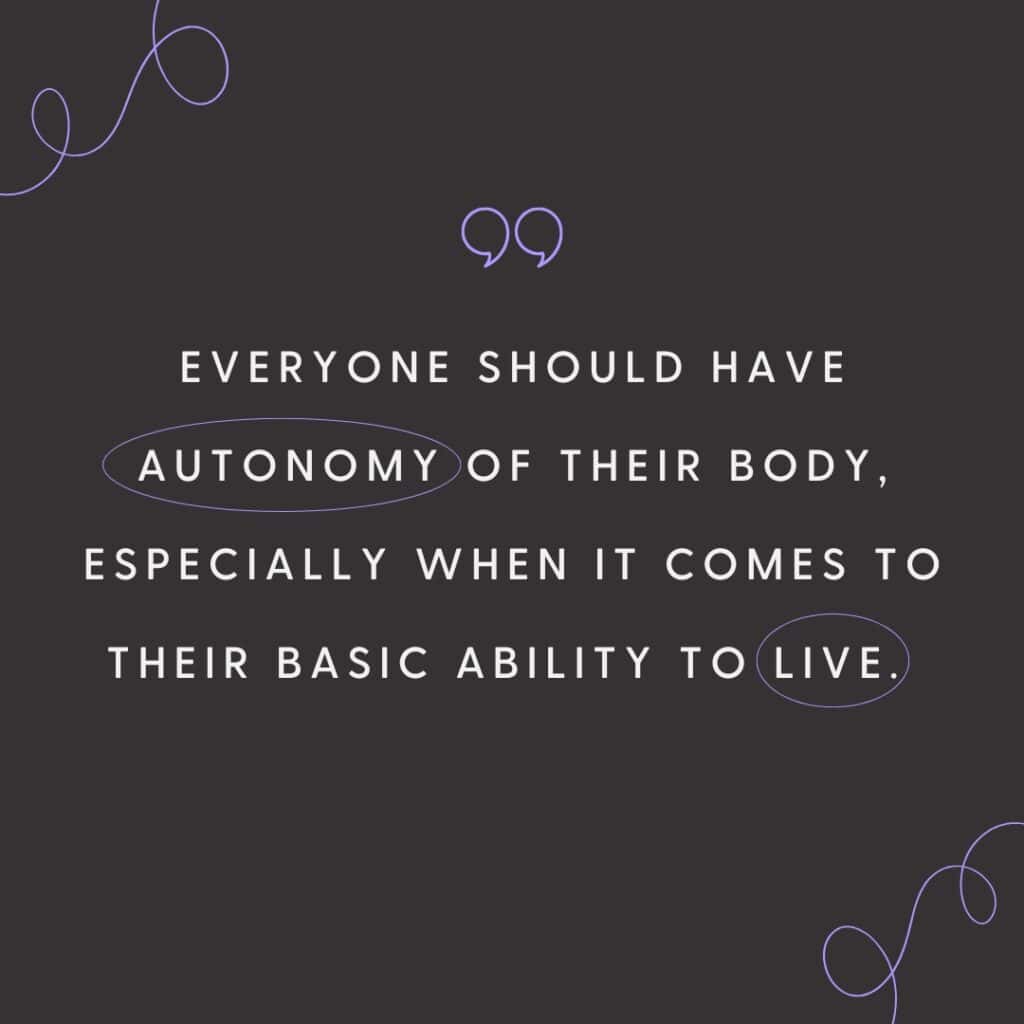
The pro-life movement isn’t trying to take away a woman’s authority of her body; we want women to succeed, and have thousands of pregnancy medical centers dedicated to supporting them and their families. We do draw a line when anyone’s rights infringe on someone else’s. Everyone should have autonomy of their body, especially when it comes to their basic ability to live. Rights should never stretch so far that someone has another’s rights in their hands. Humans weren’t meant to own or be owned.